
The fundamentals of the Cap Soncas method
What is the cap method in sales?
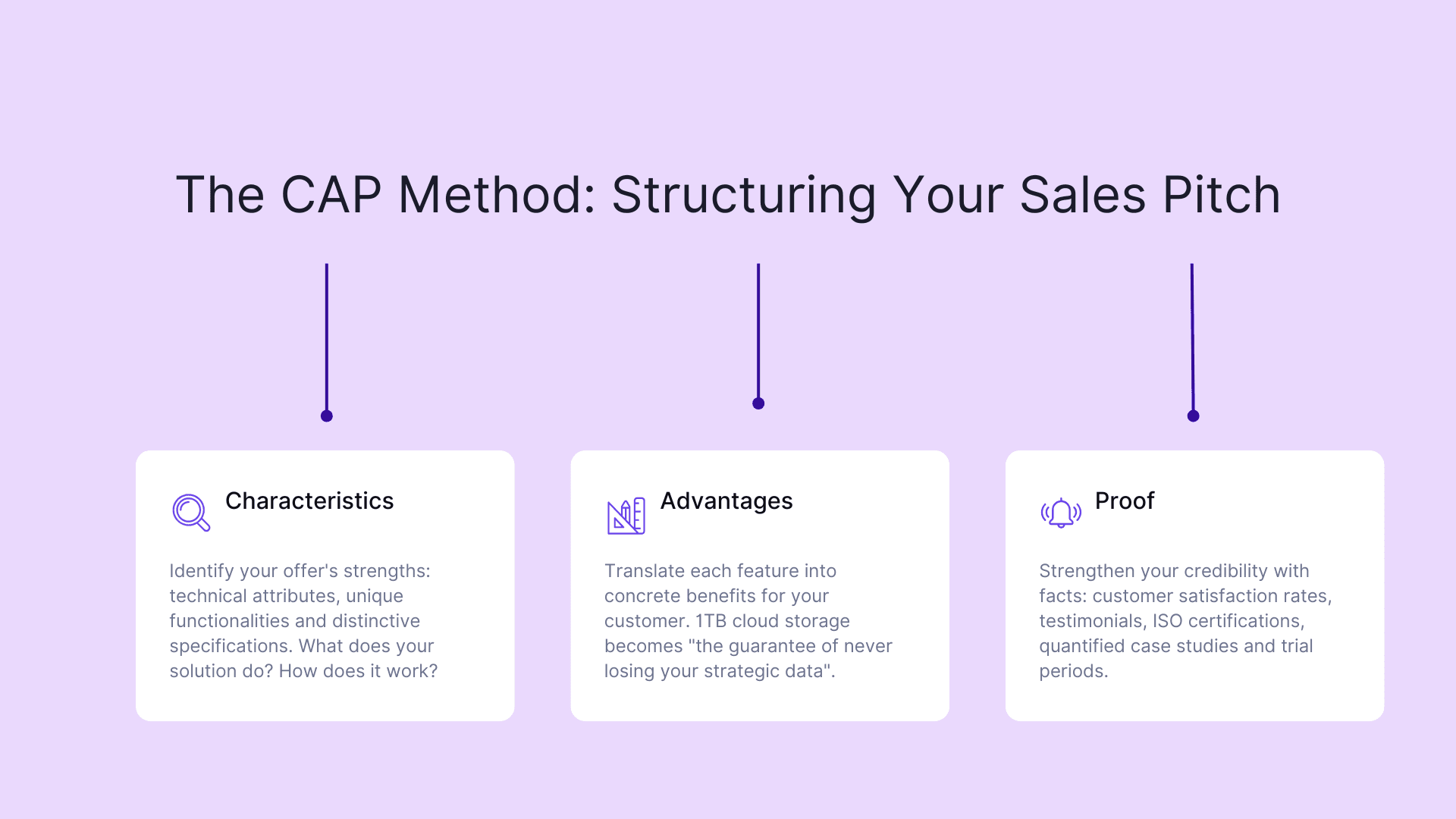
The cap method, which stands for characteristics-advantages-proof, provides a structured approach to building compelling sales arguments. This technique allows salespeople to organize their pitch around three complementary pillars.
Its cousin, the CAB method, swaps Proof for Benefits; the two combine well, since the benefit gives the argument its meaning and the proof gives it credibility.
A concrete example with a smartphone: its 256GB storage capacity is the characteristic; being able to keep years of photos without ever having to sort them is the advantage; an in-store demo or an independent comparison test is the proof. This structure ensures a clear and logical product presentation.
Cap transforms every technical feature into tangible benefits for your prospect, strengthening your commercial message's impact. This method adapts to all industries, from B2B to B2C.
CAP describes the offer from the seller's point of view. To check that every advantage you picked answers a real need, run it against the 4C framework (customer value, total cost, convenience, communication), which takes the buyer's point of view instead.
The 6 psychological profiles of Soncas
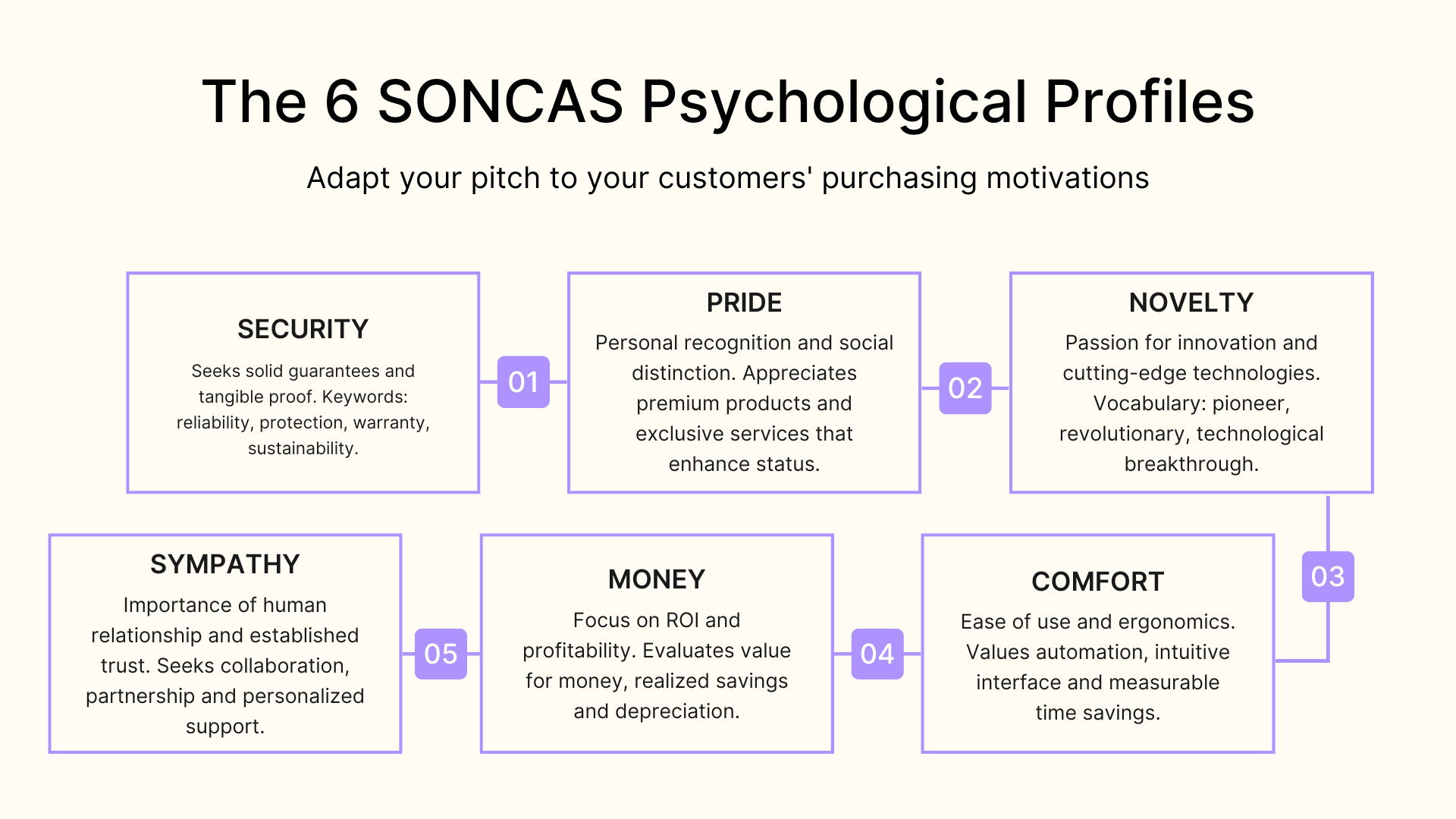
The soncas psychological profiles reflect the deep motivations that guide purchasing decisions. The security profile seeks solid guarantees and tangible proof. The pride profile values prestige and exclusivity of premium products.
Novelty enthusiasts get excited about innovations and the latest trends. The comfort profile prioritizes ease of use and turnkey solutions.
Money-focused buyers carefully evaluate value for money and actively negotiate. The sympathy profile bases choices on human relationships and trust established with the salesperson.
A single client can combine several of these traits, with one dominant characteristic that guides their final decisions.
A newer variant, the SONCASE method, adds a seventh lever, Ecology, which shows up more and more in B2B RFPs; the CAP grid applies to it in exactly the same way.
The strategic alliance of cap and Soncas
The fusion of cap and soncas methods creates formidable sales dynamics. A salesperson who masters this alliance adapts their technical pitch to their prospect's deep motivations.
Take the case of a software solution: facing a security-sensitive decision-maker, the seller will highlight data encryption features. For a money-focused buyer, the same software will be presented from the angle of return on investment and savings achieved.
This personalized approach transforms each characteristic into targeted advantages, supported by proof that resonates with the prospect's psychological profile. The result: a custom sales pitch that maximizes closing chances.
Building an effective sales pitch
Characteristics: identifying strengths
Identifying characteristics requires a methodical analysis of your offer. Start by listing technical attributes, unique features, and distinctive specifications of your product or service.
Adopt a structured approach by answering these essential questions: what does your solution do? How does it work? What are its components? For example, with an electric vehicle, note the range in miles, motor power, and charging time.
Focus on differentiating elements. A comparison chart with competitors will help you spot your distinctive strengths. Keep in mind that each characteristic should bring real value to your client.
Advantages: transforming features into benefits
Converting characteristics into benefits requires perfect knowledge of your prospect's priorities. A top-performing salesperson translates each technical feature into concrete added value for their contact. That translation only works once the account has been qualified: a BANT grid (budget, authority, need, timing) tells you which advantages are worth developing and which ones won't carry weight in the decision.
Take the example of management software: its 1TB cloud storage capacity becomes "the guarantee you'll never lose your strategic data." Automatic synchronization transforms into "saving 2 hours daily on your administrative tasks."
This pragmatic approach helps create trust with your prospect. Rather than listing specifications, show the real impact on their professional daily life. A good exercise involves systematically answering the question "what does this concretely bring to my client?"
Proof: convincing through facts
Factual demonstration reinforces your pitch's credibility. Quantified data provides a first level of proof: customer satisfaction rates, usage statistics, percentage of savings achieved.
Customer testimonials bring a human dimension to your arguments. A CFO explaining how your solution reduced their management costs by 30% carries more weight than a simple sales claim.
Certifications, labels, and professional awards validate your offer's quality. An ISO 9001 certification or a sector innovation award strengthens your credibility.
A real-world product test remains the ultimate proof. Offer a trial period or personalized demonstration to let your prospect directly experience the announced benefits.
Soncas buying motivations in detail
Security and trust
The search for security represents a fundamental psychological need in the buying process. A security-dominant buyer fears change and seeks solid guarantees before any decision.
To convince this profile, focus on deep active listening to their concerns. Your arguments should be based on verifiable facts: contract duration, cancellation terms, data protection.
Keywords that resonate with this profile include "reliability," "protection," "guarantee," and "sustainability." A skilled salesperson knows how to create a reassuring environment by sharing relevant experience feedback, case studies and detailing each implementation process step.
Pride and recognition
The pride-driven buyer seeks personal validation and social distinction. This profile particularly appreciates premium products and exclusive services that reinforce their status.
To seduce this type of client, adopt vocabulary centered on excellence and rarity. High-end brands, limited editions, or VIP access constitute compelling arguments. A marketing director will be sensitive to an innovative solution that positions them as a pioneer in their sector.
Value their expertise by seeking their opinion on strategic points. Public recognition, like highlighting their success at professional events or on social media, significantly reinforces this buyer profile's engagement.
Novelty and innovation
Tech-forward enthusiasts constantly seek the latest market advances. To convince these pioneers, prioritize the innovative aspects that differentiate your solution from competitors. This profile is also the most receptive to a Challenger Sales approach: a fresh take on their market holds their attention far better than a list of features.
Discovery-focused vocabulary stimulates their interest: pioneer, revolutionary, technological breakthrough. For example, an R&D manager will be captivated by an AI platform that automates predictive data analysis.
Demonstrate your mastery of current trends by sharing case studies of companies that have adopted similar solutions. Productivity gains and business process improvement figures reinforce your proposal's credibility.
Comfort and practicality
Comfort-sensitive buyers value ease of use and solution ergonomics above all. A savvy salesperson will highlight features that facilitate daily work: task automation, intuitive interface, measurable time savings.
Vocabulary should reflect this search for ease: ergonomic, intuitive, accessible, time-saving. For example, a logistics manager will appreciate a solution that reduces order processing time by 40% through its customizable dashboard.
Concrete demonstrations reinforce your argument: show quick adoption, offer clear tutorials, share customer feedback on ease of adoption. A prospect convinced by comfort often becomes a natural ambassador for your solution.
Money and profitability
Return on investment constitutes a major decision lever in any buying process. Rigorous financial analysis identifies concrete gains: operational cost reduction, resource optimization, productivity improvement.
Mastering financial vocabulary reinforces your argument's credibility: profitability, amortization, economies of scale. A purchasing manager will be particularly receptive to precise figures: "This solution reduces maintenance costs by 25% from the first year."
ROI calculations rely on verifiable data: comparison charts, sector studies, quantified experience feedback. Presenting an adapted financing plan, including staged payment options or long-term lease, maximizes your closing chances.
Sympathy and client relationship
The relational dimension represents a determining sales asset in the selling process. A sympathy-sensitive buyer primarily seeks an authentic connection with their contact. Attentive listening, personalized follow-up, and being there at the moments that matter: that's the heart of the Account Manager role, and this buyer profile is especially receptive to it. A sales director will particularly appreciate a seller who takes time to understand their business challenges rather than delivering a standardized pitch.
Vocabulary should reflect this personalized approach: collaboration, partnership, support. Creating a lasting relationship also builds through concrete actions: invitations to exclusive events, strategic information sharing, availability at key moments.
Applying the cap soncas method daily
Client profile analysis
Effective client profile analysis relies on structured observation during initial exchanges. Active listening helps spot revealing signals: vocabulary used, non-verbal language, and reactions to different proposals.
Adopt a methodical approach by asking strategic questions about past experiences, choice criteria, and expectations. For example, a client who frequently mentions deadlines and speed reveals comfort sensitivity.
First meetings are the ideal moment to identify dominant motivations. Note the spontaneous reactions to the arguments you present: a prospect who dwells on client references shows a marked need for security. These signals show up within the first minutes: the 4×20 rule reminds you that the first twenty seconds, twenty words, and twenty gestures set the tone for the rest of the meeting, and therefore what the prospect is willing to reveal to you. On the phone, body language disappears and the read relies on tone and word choice, which is exactly what makes a well-prepared cold call so valuable, since the opening questions are already there to spot the dominant lever.
Sales pitch adaptation
Personalizing your sales message begins with strategic transformation of your standard arguments. Align each presentation element with dominant motivations identified in your prospect.
A security-sensitive buyer will receive quantified data and client references. Facing a novelty-oriented profile, highlight innovative and disruptive aspects of your solution.
Chosen vocabulary must resonate with your contact's concerns. Replace generic terms with lexicon adapted to the detected soncas profile. A profitability-focused decision-maker will be more receptive to words like "return on investment" and "cost optimization."
Stay flexible in your approach. Your adaptation's success depends on your ability to adjust your message according to your prospect's reactions.
That adaptation shouldn't stop at the spoken pitch: the proposal you send afterward needs to carry the same levers, in its structure and its presentation, or the prospect reads a generic document that contradicts what they just heard.
Adapted closing techniques
Mastering personalized closing techniques multiplies your cap soncas pitch's impact. Offer two equivalent options to facilitate decision-making: "Do you prefer in-person or remote training?"
Use the anticipated closing technique by naturally presenting next steps. For example: "Once the contract is signed Monday, we can start implementation Tuesday."
Benefit summary closing recalls key points validated during the meeting: "We've seen that this solution reduces your costs by 30% and increases your productivity by 25%."
Facing a security profile, offer a free trial. For a money profile, put a number on the cost of inaction and propose a payment schedule or a phased ramp-up instead of a discount. Closing success relies on alignment between chosen technique and prospect's deep motivations.
To structure the entire meeting rather than just its conclusion, the SIMAC method (Situation, Idea, Mechanism, Advantages, Conclusion) offers a throughline into which the CAP argument slots at the Mechanism and Advantages steps.
Concrete examples of cap soncas usage
Cap Soncas in consulting and professional services
In consulting, the offer is intangible: the prospect is buying a method, a team, and a result they won't see until after they've signed. That's exactly where the CAP SONCAS matrix earns its keep. Facing a pride-dominant executive, a consulting firm highlights its track record in the prospect's own sector and the seniority of the consultants who will actually run the engagement, not the partners who sign the proposal.
A security profile expects something else: a methodology laid out step by step, named deliverables with delivery dates, a steering committee, and a reversibility clause. The proof takes the form of an anonymized sample deliverable and a detailed engagement plan.
The money profile, meanwhile, weighs a fixed fee against time and materials. A fixed fee reassures them on the total spend, time and materials on paying for actual use. The argument that tips the decision is putting a number on what each month of the status quo costs, then proposing a phased plan where each phase delivers a verifiable result before the next one gets funded.
Application for B2B services
In the B2B services universe, the cap soncas method takes on strategic dimension. A software publisher will demonstrate their solution's reliability through ISO certifications and measured availability rates to reassure decision-makers.
Digital transformation requires fine understanding of business challenges. Savvy consultants present their sector references and document ROI through quantified case studies. An innovation-sensitive prospect will particularly appreciate demonstrations of cutting-edge features.
Sales message personalization shows in each interaction. Facing a CIO concerned about data security, the salesperson will value protection protocols and sovereign hosting. For a CFO, emphasis will focus on operational cost optimization.
One last historical note: the SONCAS method was formalized in 1993 by Jean-Denis Larradet, an executive at the GNFA (France's national automotive training body), for dealership salespeople. The grid was first used to sell cars to individual buyers; it works just as well for a B2B deal where several decision-makers, each with their own dominant lever, weigh in on the outcome.
Cap soncas pitch chart
Typical cap soncas chart structure
Building a cap soncas chart organizes buying motivations in rows and the cap method in columns. This matrix allows quick visualization of arguments adapted to each client profile.
Once filled in, the matrix becomes the source for your proposals: a sales proposal generation tool can pull straight from the row matching the detected profile, instead of starting over from a single template every time.
Place the six soncas levers (security, pride, novelty, comfort, money, sympathy) in the first column. Then distribute your arguments in the following three columns: product characteristics, client advantages, and concrete proof.
A practical tip: start by filling the characteristics column for each motivation, then naturally develop corresponding advantages. Finish with proof that validates each argument. This progressive method guarantees coherent and exhaustive matrix completion.
A CAP SONCAS matrix example for management software
Example for a publisher selling management software to SMBs, each line following the order characteristic, advantage, proof.
- Security. Characteristic: ISO 27001-certified hosting in France. Advantage: data stays under French jurisdiction, so audits from your own clients pass with no extra cost. Proof: an audit report and uptime measured over twelve months.
- Pride. Characteristic: a customizable executive dashboard. Advantage: the CEO presents figures to the board with a tool that reflects the company's own image. Proof: recognized references in their sector.
- Novelty. Characteristic: AI-assisted bank reconciliation. Advantage: the finance team moves from manual entry to exception review. Proof: a live demo on a real extract of their own transactions.
- Comfort. Characteristic: native connectors with the bank, payroll, and invoicing. Advantage: no re-entry and no exports to reconcile at month-end. Proof: a rollout plan with timelines observed at comparable clients.
- Money. Characteristic: per-user subscription, no upfront license and no exit fees. Advantage: spend tracks activity from month one. Proof: a quantified case study from a comparable client, before and after.
- Sympathy. Characteristic: a dedicated contact during and after rollout. Advantage: a name and a number, not a ticket. Proof: a client testimonial on the support experience, attached to the proposal.
Every proof comes from outside the offer: an audit, a client, a demo. A characteristic repeated with confidence never becomes one.
Ready-to-use models by sector
The consulting sector particularly values arguments related to expertise and methodology. A consultant will adapt their grid by emphasizing prestigious references for the pride profile, or measurable ROI for the money profile.
In technology solutions, model personalization involves highlighting security certifications and data protection protocols. Demonstrating quantified productivity gains reinforces arguments for rational profiles.
In industrial equipment, the pitch is built around production continuity. The security profile expects a maintenance contract with a guaranteed response time and parts in stock; the money profile thinks in total cost of ownership over the machine's lifetime; the comfort profile wants a turnkey installation, operator training included. The most convincing proof is a visit to a site already running the equipment, where the prospect can question the operator directly.
Frequently asked questions
What is the Cap Soncas method?
It's a sales technique that combines the CAP pitch structure (Characteristics, Advantages, Proof) with the SONCAS analysis of buying motivations (Security, Pride, Novelty, Comfort, Money, Sympathy).
How does soncas complement the Cap method?
SONCAS uncovers the buyer's deeper motivations, so you can select and present the Characteristics, Advantages, and especially the Proof points (CAP) that will carry the most weight with them.
What is Cap Soncas' main objective?
The goal is to build a highly personalized, and therefore more persuasive, sales pitch by aligning the offer's strengths with the prospect's specific psychological drivers.