
The Truth No One Wants to Hear: No, It's Not the Same
The Quote: When You're Selling a Commodity
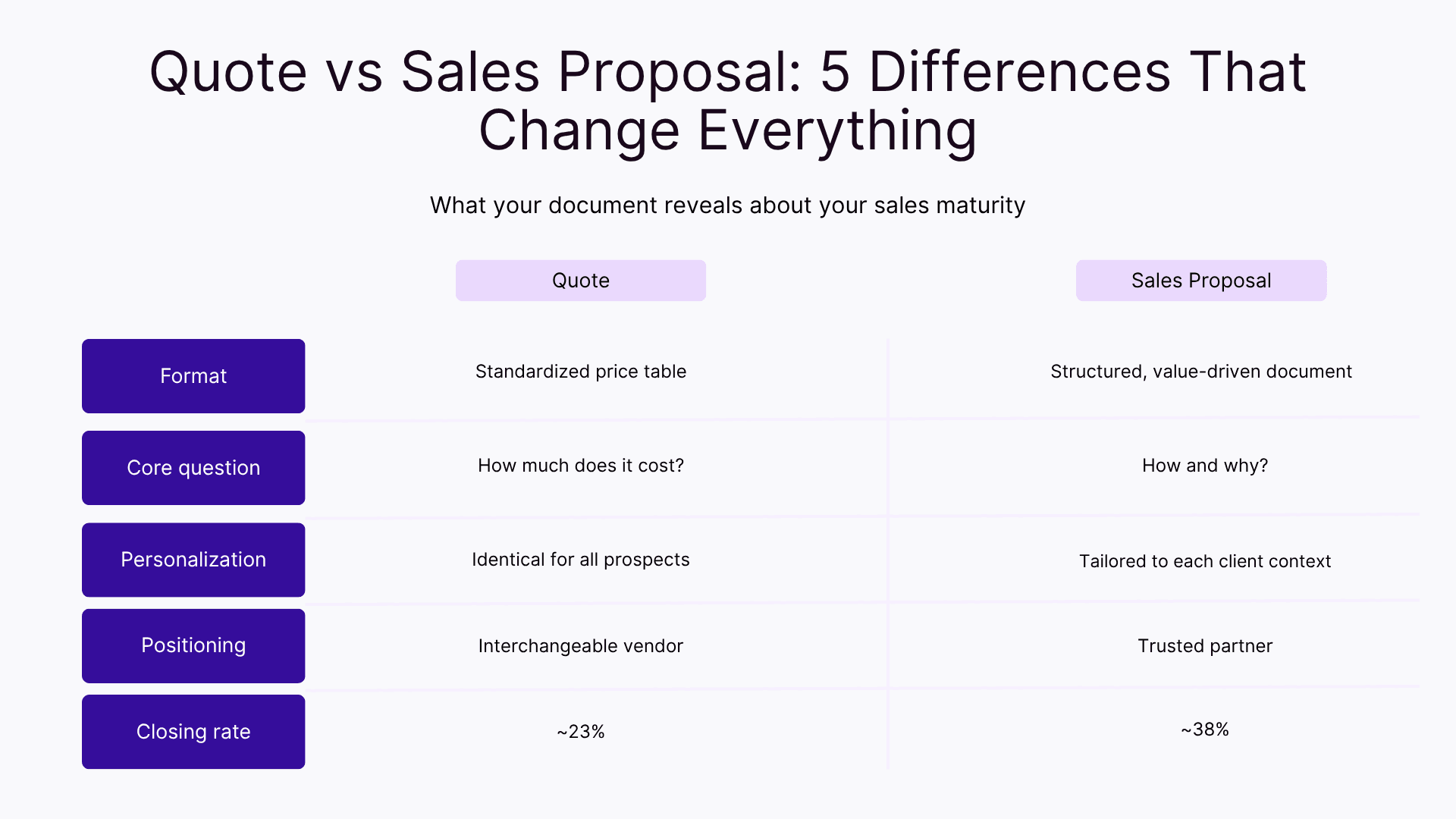
A quote is a transactional document, period. Its spreadsheet-like structure lists products or services with quantities, unit costs, and a total. It answers only one question: "How much does it cost?". This approach automatically positions your offer as a comparable commodity. You're handing your prospect all the tools they need to pit you against competitors based solely on price. The psychological impact is immediate: your company becomes an interchangeable supplier.
A quote has its place, but it's very limited: for when the client has already made their decision and just needs a formal price confirmation, or for standardized sales where the value is self-evident. In all other cases, you are missing a monumental opportunity.
Real-world example: A Paris-based web agency tested two approaches for the same website redesign service. A standard Excel quote: 23% closing rate. A structured proposal with context and reasoning: 38% closing rate. Same provider, same client profile, same service, same budget. The difference? A quote turns your offer into a line item on a budget. A proposal transforms it into a solution for a specific problem.
The Sales Proposal: The Tool of a Trusted Partner
A sales proposal fundamentally changes the nature of the conversation. It no longer just answers "how much," but also "how" and, most importantly, "why". It is client-centric, value-oriented, and built to persuade, proving that you have conducted a thorough discovery phase. It shifts the discussion from cost to results, from features to benefits.
The analogy is simple: a doctor who makes a diagnosis and prescribes a personalized treatment versus a pharmacist who sells drugs off a list. In the first case, you build a relationship of trust based on expertise. In the second, you're just managing a transaction. This difference in positioning changes everything. Your prospect is no longer comparing prices; they're evaluating approaches. They're no longer choosing a supplier; they're selecting a partner.
The reality on the ground: Companies that systematically use structured proposals see an average increase of 8 to 12 points in their closing rate. More importantly, they justify prices that are 15% to 25% higher than their "quote-sending" competitors.
The Litmus Test: Your Current Practice Says Everything About Your Results
3-Minute Diagnostic: Quote or Proposal?
Your default document instantly reveals your level of sales maturity. Here is a self-diagnostic in 5 simple questions:
- Format and Presentation
- Does your document look like a spreadsheet with line items and prices? (= Quote)
- Does your document start with the client's context and challenges? (= Proposal)
- Content and Argumentation
- Do you just list your services with prices? (= Quote)
- Do you explain how your solution solves the client's specific problems? (= Proposal)
- Upstream Process
- Do you send the same document to all your prospects? (= Quote)
- Is each document personalized based on the discovery call? (= Proposal)
- Intent and Thought
- Do you adapt a standard template by just changing the name and price? (= Quote)
- Do you specifically reflect on this client's challenges to customize your approach? (= Proposal)
- Nature of Post-Send Communication
- Is the feedback mainly about price and competitor comparisons? (= Quote)
- Do questions revolve around your methodology and implementation details? (= Proposal)
Scoring: 3 or more "quote" answers reveal a transactional approach that is costing you money every month.
Why a Demanding Proposal Elevates Your Entire Process
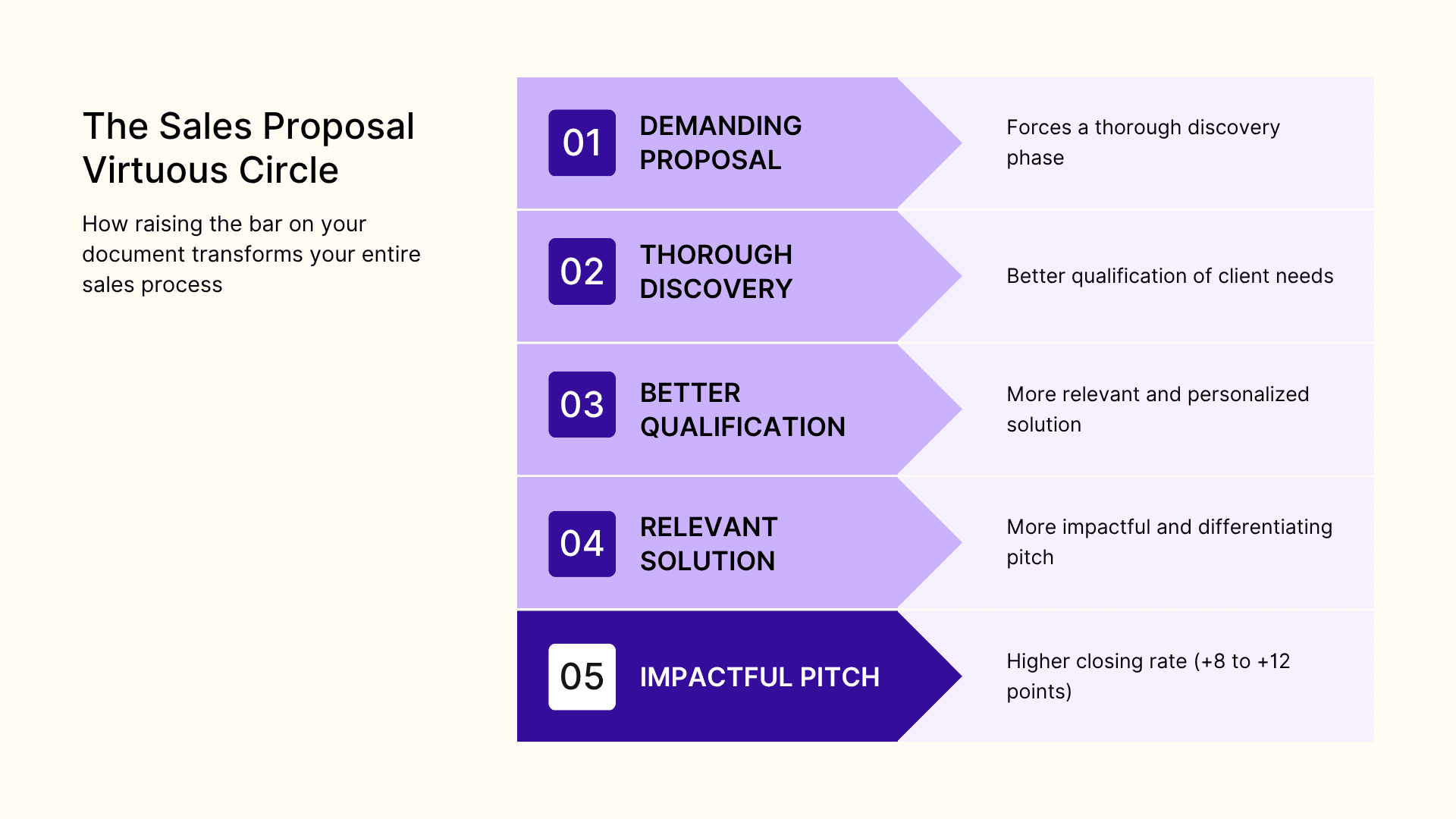
Here's the secret few understand: it's impossible to write an excellent proposal with a flawed discovery process. The high standards required for the final document mechanically force an improvement in everything that comes before it. A virtuous cycle is automatically set in motion:
- A demanding proposal → Mandatory in-depth discovery
- In-depth discovery → Better qualification and understanding of needs
- Better qualification → A more relevant solution and a more impactful pitch
- A relevant solution → A higher closing rate
This correlation isn't theoretical. A Paris-based marketing agency experienced it firsthand: by simply making a structured proposal mandatory (without any sales training), they went from a 22% to a 37% closing rate in 6 months.
Why it works: When your salesperson knows they will have to fill out a "Client Context and Challenges" section, they automatically conduct a more rigorous discovery call. When they have to justify their solution, they qualify needs better beforehand. The quality of your proposals thus becomes an unforgiving diagnostic of the maturity of your overall sales process.
The Business Impact: What Your "Quote" Approach Is Really Costing You
The Painful Calculation: How Much You're Losing Each Month
Let's take a real-world case: a sales team of 5 people, each with an annual target of €150k. Current closing rate with quotes: 20%. After switching to structured proposals: 28%.
Direct Impact:
- +8 points in closing rate = +40% in sales performance
- A €750k team target becomes €1.05M in realized revenue
- Annual gain: +€300k in additional revenue
Indirect Impact:
- Shorter sales cycles (less back-and-forth for clarification)
- Justification for higher prices (demonstrated value vs. a communicated price)
- Sales time reclaimed (fewer lost proposals to redo)
Monthly opportunity cost: Every month this team delays this transformation costs them €25k in lost revenue. Over a year, the difference is six times the cost of an additional salesperson. Companies that justify their value with a structured argument sell for 18% more on average than those who just provide a price in a table.
3 Immediate Levers (Without a Budget or a Consultant)
- Lever #1: Ban Simple Quotes — Except in very specific cases, every sales document must contain at a minimum client context and a value-based argument.
- Lever #2: Require a Minimum of Client Context — Before sending anything, the salesperson must answer: "What is this client's specific problem?" and "How does our solution precisely solve it?".
- Lever #3: Measure and Correlate the Results — Track the closing rate per salesperson and cross-reference it with the type of document sent.
Observed result: A management consulting SME imposed these 3 rules with no other changes. Result: a 12-point increase in their closing rate in 4 months, €0 spent on training, €0 on new tools. Initial situation 32%, final situation 54%.
The Transformation Starts Now
The distinction between a quote and a proposal reveals much more than a question of format. It exposes the maturity level of your sales approach and your ability to create value for your clients. The numbers are unforgiving: the "quote" approach is costing you between 25% and 40% of your sales performance. The "proposal" approach positions you as a trusted partner capable of justifying your prices and shortening your sales cycles.
The real question isn't "quote or proposal?". It's "how much longer will you accept leaving money on the table?".