
The Fundamentals of Commercial Prospecting on LinkedIn
What is B2B Prospecting on LinkedIn?
B2B prospecting on LinkedIn involves identifying and approaching business decision-makers to create qualified sales opportunities. This method relies on a personalized professional approach, tailored to the specific challenges of each industry sector.
A sales rep contacting a CFO to present a management solution, or a consultant approaching an HR director to offer services—these are two concrete examples of B2B prospecting on the platform.
Success in this approach rests on three fundamental pillars: an optimized LinkedIn profile that inspires trust, a relevant outreach message that demonstrates your understanding of needs, and a content strategy that showcases your expertise.
LinkedIn's Potential for Finding Prospects
LinkedIn's power for B2B prospecting translates into concrete results: 277% more effective than Facebook and Twitter for generating qualified leads. With over 30 million users in France, the platform concentrates a unique professional database.
Advanced search features enable ultra-precise targeting by industry, company size, or geographic area. Sales Navigator enhances this precision with additional filters to identify the right contacts.
The platform also facilitates prospect analysis through detailed information about their background, interests, and network. A major asset for personalizing each contact and maximizing response rates.
The 5 Pillars of Effective Prospecting
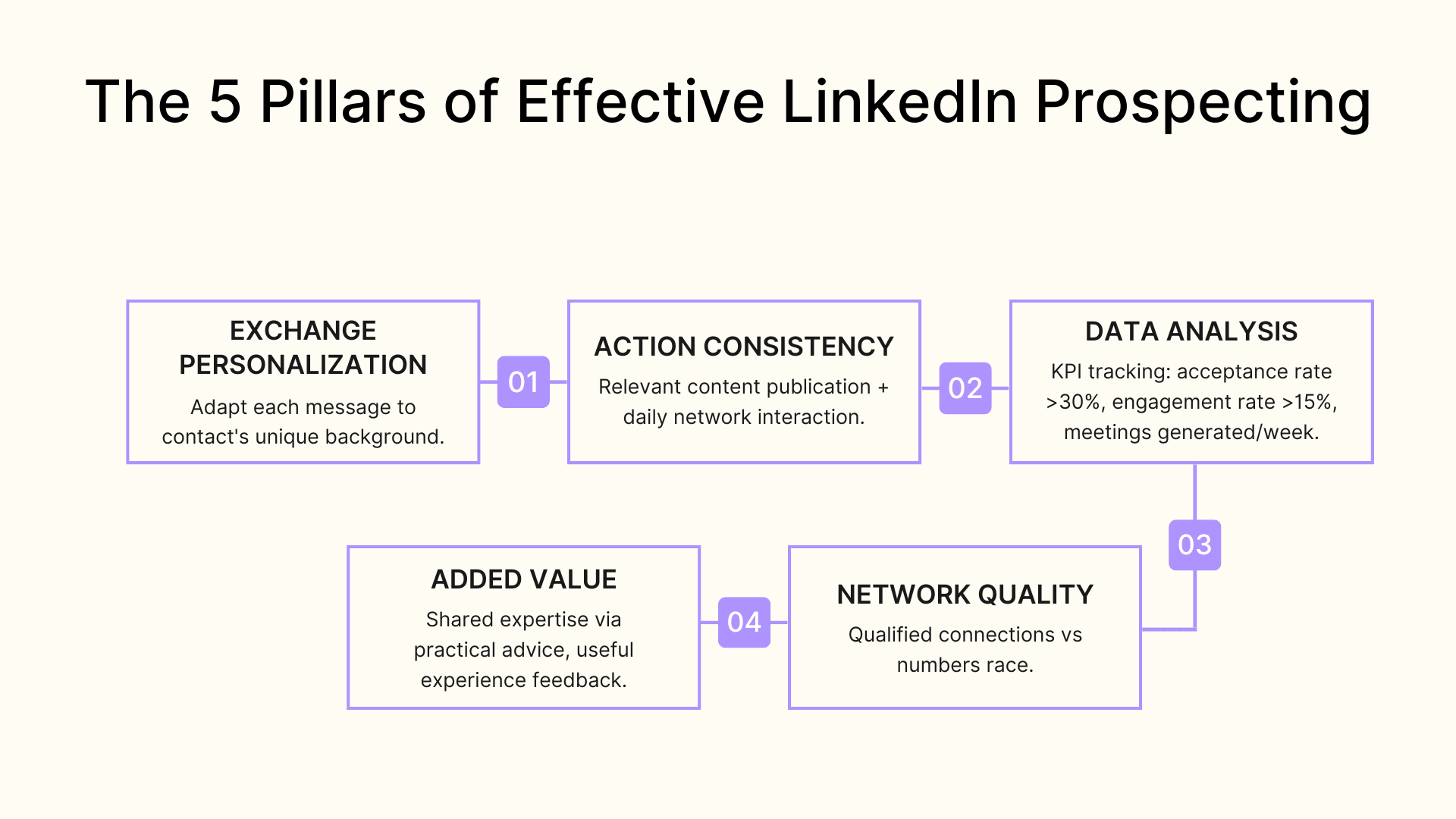
Successful LinkedIn prospecting rests on five fundamental pillars. Exchange personalization forms the cornerstone: adapt each message to your contact's unique background.
The second pillar focuses on action consistency: publish relevant content and interact daily with your network. The third key element: data analysis to refine your targeting and measure results.
Your network quality represents the fourth pillar. Prioritize qualified connections over a numbers race. Take the example of a consultant focusing on 50 targeted HR directors rather than 500 random contacts.
The final pillar lies in the added value brought to each interaction. Share your expertise through practical advice or useful experience feedback.
Building a High-Performance LinkedIn Prospecting Strategy
Defining Your Sales Objectives
A successful LinkedIn strategy begins with defining quantifiable and realistic objectives. A high-performing B2B sales professional sets precise targets: 20 new qualified connections per week, 5 monthly meetings with decision-makers, a 25% response rate to prospecting messages.
These metrics must align with your sales cycle. A software publisher might target 50 product demonstrations per quarter, while a consulting firm would prioritize 10 monthly strategic meetings with general managers.
The key lies in establishing a personalized dashboard. Track your weekly indicators: number of prospects contacted, connection request acceptance rate, conversion of exchanges into sales opportunities.
Identifying and Qualifying Your Ideal Prospect
Qualifying a prospect on LinkedIn relies on precise and measurable criteria. A qualified prospect matches your ideal persona: their industry sector, decision-making capacity, and maturity level in the buying process.
Take the example of an HR software company seeking HR directors in companies with over 200 employees who have expressed a need for digitalization. Engagement signals like comments on posts related to HR digital transformation reveal their interest.
The BANT method optimizes your qualification: Budget (financial capacity), Authority (decision-making power), Need (identified problem), Timing (project schedule). This structured approach guarantees optimal conversion rates for your LinkedIn prospecting actions.
Establishing a Measurable Action Plan
Transforming your objectives into concrete actions requires structured planning. Start by creating a detailed weekly calendar outlining your prospecting activities: time slots dedicated to prospect research, personalized message sending sessions, and moments reserved for network interactions.
Adopt a progressive approach with evolution milestones. For example, dedicate the first week to profile optimization and creating your prospect database. In the second week, launch your first message sequences while monitoring performance indicators like open rates and responses obtained.
Document each action in a tracking spreadsheet to quickly identify the most effective approaches. This method allows real-time strategy adjustment and optimizes your return on investment.
Optimizing Your Profile for Commercial Prospecting
Key Elements of an Impactful Sales Profile
A high-performing sales profile begins with a high-quality professional photo that conveys trust and authenticity. Your LinkedIn headline represents your showcase: integrate strategic keywords and your unique value proposition.
The custom banner reinforces your professional identity. Use visuals that illustrate your industry sector or highlight notable achievements. A digital transformation consultant could, for example, display a dynamic image representing innovation.
Your summary should tell a captivating story emphasizing concrete results obtained for clients. Each professional experience deserves enrichment with quantified data: "45% revenue increase," "Portfolio of 200 loyal clients."
Creating a Strong Personal Brand
Building a powerful personal brand on LinkedIn requires distinctive expert positioning. Choose a specific theme where you excel and regularly share high-value content on this subject.
Focus on varied formats like detailed case studies or white papers that demonstrate your expertise. A tech sales director could, for example, publish an in-depth analysis of SaaS market trends, enriched with field feedback.
Engage in relevant conversations by commenting on thought leaders' publications in your sector. This approach reinforces your credibility and naturally increases your visibility among targeted decision-makers.
Optimizing Your Visibility with Prospects
The engagement strategy represents a powerful lever for increasing your LinkedIn reach. Comment meaningfully on your targeted prospects' publications by bringing a unique perspective based on your field experience.
Maximize your interventions' impact by participating in conversations during high-activity hours, generally between 9 AM and 11 AM. Analysis of 10,000 LinkedIn posts shows that morning interactions generate 40% more visibility.
Adopt a multichannel approach by relaying your LinkedIn contributions to other professional platforms. For example, share your sector analyses on your company blog while creating bridges to your LinkedIn profile. This synergy naturally amplifies your reach among sought-after decision-makers.
LinkedIn Prospecting: Advanced Techniques
Mastering Advanced Search Filters
LinkedIn search filters' power lies in their ability to refine your targeting with precision. Start with the "current position" filter to identify relevant decision-makers in your sector.
Combine the "company size" filter with "geographic location" to create ultra-targeted segments. A B2B sales professional could, for example, target marketing directors in companies with 50-200 employees in the Paris region.
"Industry" and "seniority" filters allow further refinement of your searches. A winning approach involves saving your search criteria in dedicated lists for regular monitoring of new profiles matching your criteria.
Use the "connections" filter to prioritize 2nd-level prospects, accessible through a recommendation from your existing network.
Leveraging Professional Groups
LinkedIn groups represent a relational goldmine for your B2B prospecting. Select 3-4 active groups in your sector where your prospects regularly exchange views on their business challenges.
Position yourself as an expert by sharing high-value content. An HR consultant could, for example, analyze the latest digital recruiting trends or share concrete feedback on remote onboarding.
Create authentic connections by answering members' questions with personalized advice. This approach naturally generates qualified sales opportunities.
Participate in discussions during high-activity slots, between 12 PM and 2 PM. LinkedIn statistics show that engagement during these hours increases your contributions' visibility by 35%.
Using Prospect Alerts Intelligently
Strategic configuration of LinkedIn alerts transforms your monitoring into a proactive prospecting tool. Set up notifications for position changes in your target companies to seize opportunities during professional transitions.
Create personalized alerts on strategic keywords in your sector. An HR software publisher would, for example, monitor terms like "recruiting," "HRIS," or "talent management" to spot relevant discussions.
Maximize your alerts' impact by organizing them by segments: key decision-makers, priority companies, industry sectors. This structure allows quick adaptation of your approach according to context.
Synchronize your alerts with your CRM for centralized interaction tracking. This method ensures optimal responsiveness to your prospects' buying signals.
Sales Navigator: LinkedIn's Premium Prospecting Tool
Essential Features to Master
Sales Navigator's power lies in its ability to refine your prospecting with advanced targeting features. The personalized recommendation system analyzes your activity to suggest relevant prospects, while the TeamLink function reveals common connections within your company.
The "Smart Links" content sharing tool allows sending professional presentations to your prospects and tracking their engagement. A valuable feature for adapting your sales approach based on observed interactions.
Personal notes and the tagging system facilitate your sales pipeline organization. For example, categorize your prospects by interest level or industry sector for structured and efficient follow-up.
Advanced Targeting Techniques
Boolean search represents a strategic asset for refining your results. Combine "AND," "OR," and "NOT" operators with your keywords to create ultra-precise queries. A practical example: "director (marketing OR communication) NOT consultant" targets only decision-makers in position.
LinkedIn's relevance score evaluates each prospect's engagement probability. Focus your actions on profiles rated "highly relevant" to maximize your response rate. This method reduces time invested in poorly qualified prospects.
Exploit the "View similar" function after identifying an ideal prospect. This technique reveals analogous profiles, creating a snowball effect in your prospecting. For example, after finding a receptive CFO, automatically discover their counterparts in similar companies.
Measuring Your ROI with Sales Navigator
Precise return on investment measurement requires tracking key metrics. Configure your dashboard to follow connection request acceptance rates, positive InMail responses, and conversion to qualified meetings.
Adopt a structured approach by assigning specific tags to each prospect based on their engagement level. This method allows evaluating your leads' progression in the sales funnel and adjusting your approach strategy.
ROI calculation relies on a simple formula: subtract your monthly subscription cost from revenue generated by new clients acquired through the platform. A high-performing sales professional generally achieves a 1-to-5 ratio between investment and generated revenue.
The Art of Outreach Messages for LinkedIn Prospecting
Structuring Your Prospecting Messages
A successful prospecting message relies on a three-part architecture. Begin with a personalized hook showing your profile knowledge: a comment on a recent achievement or shared article creates an authentic connection.
The message body should provide concrete added value. Share specific advice or relevant observation about your prospect's industry sector. For example: "I noticed that in retail, companies adopting AI increase sales by 25%."
End with a simple action proposal. Avoid direct meeting requests. Favor an open question that invites exchange: "What's your view on this trend?"
Best Approach Formulas
The art of LinkedIn approach formulas relies on mastering relational copywriting. A winning opening sentence references a recent accomplishment: "Congratulations on your presentation at E-commerce Paris."
Favor expressions that create natural dialogue: "Your perspective on innovation intrigues me" or "What do you think about recent advances in our sector?" These formulations open conversation without sales pressure.
Focus on hooks that value your contact's expertise: "Your digital marketing approach breaks new ground." This professional recognition establishes a solid foundation for constructive exchange.
Always keep in mind that your primary objective remains establishing an authentic connection, not selling from first contact.
Examples of Converting Messages
A winning LinkedIn message relies on relevant industry observation: "The McKinsey 2025 report shows 40% growth in HR automation. Your recent publications on the subject particularly interested me."
Contextualization creates natural connection: "Following our participation in Digital Week, I'd like to exchange views on digital transformation challenges in retail."
Opinion requests generate more engagement: "New GDPR regulations are disrupting our marketing practices. What impact do you observe in your sector?"
Value proposition should remain subtle: "Our B2B market evolution study reveals interesting trends for companies like yours. I can share it if the subject interests you."
Automating Your LinkedIn Prospecting with the Right Tools
Solution Comparison: Waalaxy and Alternatives
The LinkedIn automation tools market offers several solutions adapted to different needs. Waalaxy stands out through its intuitive interface and multichannel features, combining LinkedIn and email.
Alternatives like Lemlist or LaGrowthMachine excel in advanced campaign personalization. Apollo.io brings a data-driven dimension with its enriched database, while ZoomInfo focuses on B2B information precision.
The choice depends on your priorities: budget, prospecting volume, personalization needs. A beginning sales professional will appreciate Waalaxy's simplicity. An experienced team might prefer Apollo.io's analytical power.
Setting Up Automated Campaigns
A successful automated campaign relies on meticulous sequence parameter setup. Start by defining a natural sending rhythm: 3-4 daily actions maximum, spaced at least 2 hours apart.
Message personalization constitutes a key success factor. Exploit dynamic variables to automatically adapt content according to prospect profile: name, company, position held. Create multiple message versions to test their performance.
Structure your sequence in three phases: personalized first connection, follow-up message providing value, then concrete exchange proposal. Program realistic delays between each step: 2-3 days minimum to preserve exchange authenticity.
Respecting Safe Prospecting Limits
Your LinkedIn account security relies on respecting strict daily thresholds. For connection requests, stay under 100 invitations per week. Space your actions at least 2 hours apart to maintain natural rhythm.
Follow-up messages deserve particular attention. Wait 48 hours minimum after connection acceptance before sending your first communication. Profile consultation should remain under 150 daily views.
Reasonable use of premium features like Sales Navigator allows optimizing these limits. Prioritize exchange quality over quantity: better 10 personalized conversations than 100 automated messages without response.
LinkedIn Prospecting: Transforming Connections into Opportunities
Effective Relationship Follow-up
Building lasting relationships with potential clients requires a structured approach. Plan regular contact points through relevant content sharing for their industry sector.
Create a personalized dashboard listing key interactions: recent exchanges, interests, specific challenges. This overview allows anticipating needs and bringing real added value to each conversation.
Transform each interaction into a learning opportunity. Note subjects that fascinate your prospect, their professional objectives, daily challenges. This valuable information will guide future discussions toward more meaningful exchanges.
Non-invasive Follow-up Techniques
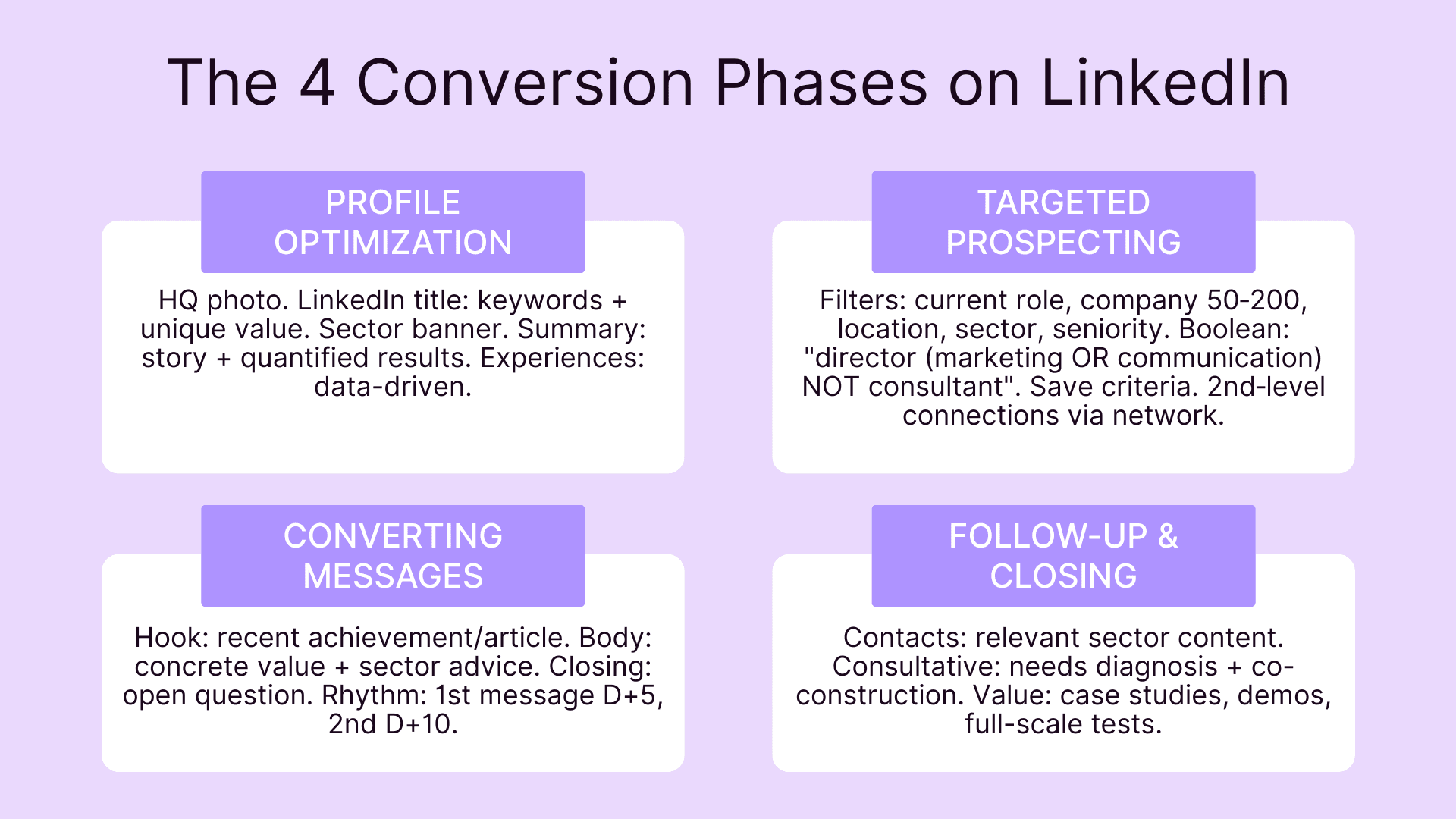
Optimal LinkedIn follow-up cadence follows natural rhythm: first message 5 days after connection, then second 10 days later. This approach respects prospect reflection time.
A winning follow-up message systematically brings new perspective. For example: sharing a relevant case study, suggesting specialized article, or proposing exclusive webinar in their expertise domain.
Engagement signals guide follow-up timing: profile consultation or post like represent opportune moments to reconnect. This proactive method increases your response rates by 25% on average.
From Prospect to Client: Closing Strategies
Transforming a prospect into client relies on your ability to create a decisive moment adapted to each situation. Favor consultative approach by proposing personalized needs diagnosis rather than standardized service presentation.
Modern closing art passes through solution co-construction. Invite your prospect to actively participate in commercial proposal elaboration. This method reinforces their commitment and naturally facilitates decision-making.
Focus on concrete value demonstration: share relevant case studies, organize targeted demonstrations, or propose full-scale testing. These tangible proofs reassure your prospect and accelerate conversion.
Measuring and Optimizing Your LinkedIn Prospecting Actions
Essential KPIs to Track
A prospecting strategy's success relies on tracking quantifiable metrics. An invitation acceptance rate above 30% reveals relevant audience targeting.
Measuring engagement rate per message allows evaluating your approaches' relevance: aim for minimum 15% responses on first contacts. Number of meetings generated per week constitutes a key performance indicator.
For finer analysis, monitor:
- Average prospect response time
- Ratio between connections and active conversations
- Average prospecting cycle duration until first call
A weekly dashboard grouping this data facilitates rapid commercial approach adjustment.
Adapting Your Strategy Based on Results
Facing mediocre performance, dynamic modification of your approach becomes paramount. Start by testing new message formats: replace classic texts with voice notes or personalized videos to create more authentic connection.
Adapt your sending schedules based on activity peaks observed among your prospects. A message sent at the right time significantly increases response chances.
Revise your content strategy according to generated interactions. Publications having generated most engagement reveal subjects that fascinate your audience. Prioritize these themes in your next approaches.
Exploit A/B testing to refine your hook messages. Test different versions with similar prospect samples to identify most impactful formulations.
Continuously Improving Your Conversion Rate
Permanent conversion process optimization relies on thorough prospect journey analysis. Implementing a dynamic scoring system allows evaluating each contact's commercial maturity and adapting your approach accordingly.
Advanced value proposition personalization radically transforms results. Analysis of the 500 best LinkedIn sales professionals shows that a customized proposition, based on industry sector specificities, triples conversion probability.
A progressive qualification system reinforces your exchange effectiveness. Rather than frontal approach, establish micro-conversions: exclusive resource consultation, online workshop participation, or personalized audit request. This method naturally builds trust and facilitates final decision.
Frequently asked questions
How can you quickly optimize your LinkedIn profile for commercial prospecting?
Ensure you have a professional photo, clear headline including your value proposition, and summary highlighting your client results.
Is LinkedIn prospecting automation recommended?
Automation can help save time on repetitive tasks, but message personalization and authenticity remain paramount for success and avoiding account damage.
What are the most important KPIs for tracking LinkedIn prospecting?
Connection request acceptance rate, message response rate, and especially the number of qualified meetings or sales opportunities generated.