
The Fundamentals of the Sales Development Representative Role
Definition and Significance of the SDR Role
The Sales Development Representative represents a major evolution in the organization of modern sales teams. Their primary mission is to turn marketing contacts into genuine business opportunities.
An SDR acts as an expert in prospect qualification, using sophisticated prospecting tools to analyze each lead against specific criteria: budget, need, decision-making authority, and purchase timeline.
In a typical B2B company, the SDR works in close collaboration with Account Managers to optimize the conversion rate. For example, a qualified SDR can handle up to 50 leads per day through various channels: phone calls, personalized emails, or professional social networks.
Essential Day-to-Day Missions
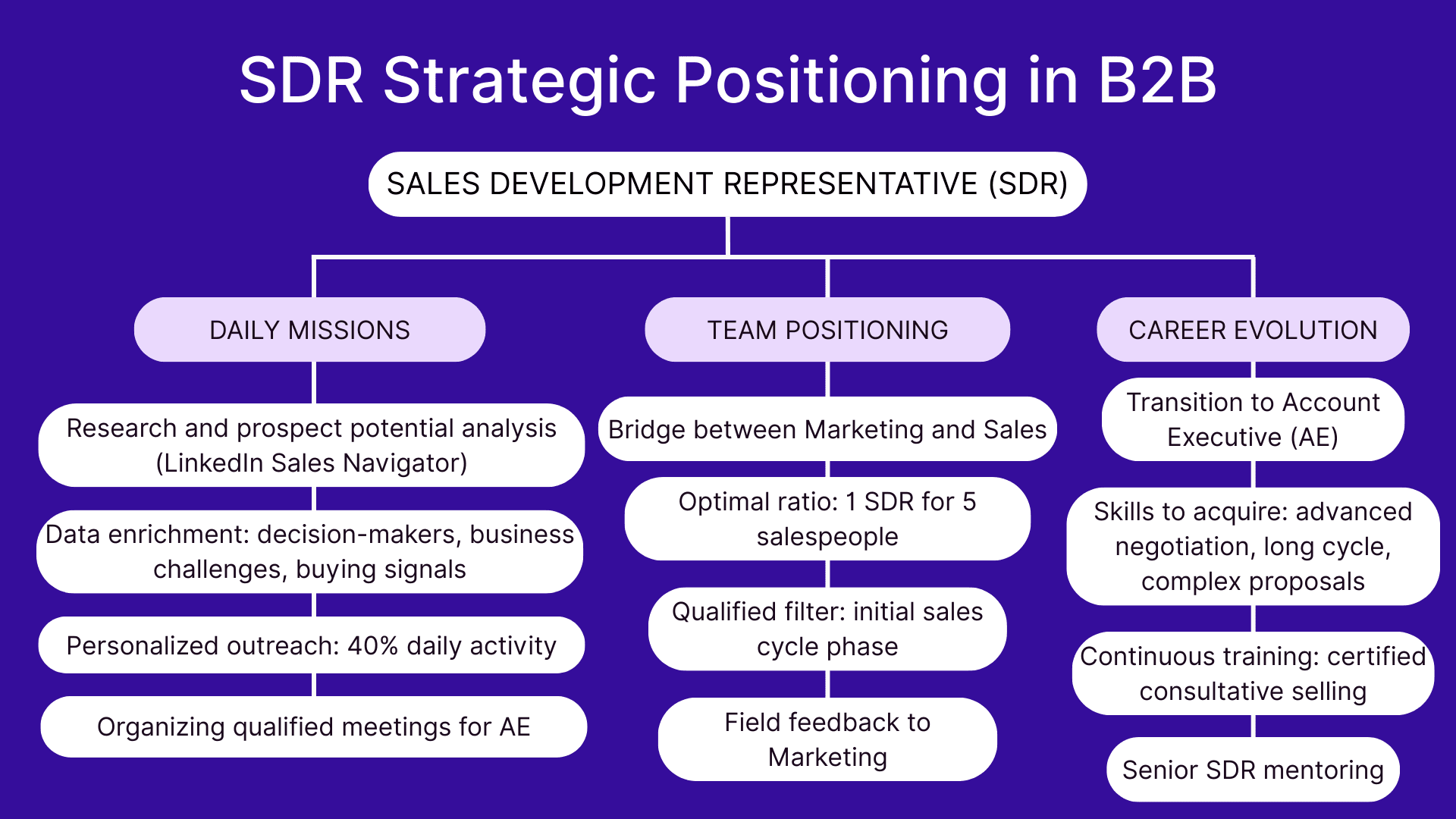
An SDR's typical day revolves around precise strategic activities. Researching and analyzing potential customers forms the foundation of their work, particularly through specialized tools like LinkedIn Sales Navigator.
An SDR spends a significant portion of their time enriching prospect data: identifying decision-makers, understanding business challenges, and analyzing buying signals. Personalized outreach accounts for 40% of their daily activity.
Organizing and following up on qualified meetings requires close coordination with Account Executives (AEs). For example, an experienced SDR schedules an average of 8 to 12 weekly meetings for their sales team.
Strategic Positioning within the Sales Team
The SDR's strategic position is based on their ability to create a bridge between marketing and sales. In a modern B2B organization, the optimal ratio is 1 SDR for every 5 salespeople, ensuring an effective distribution of business opportunities.
The added value of the SDR lies in their role as a qualified filter. By handling the initial sales cycle, they allow Account Executives to focus their expertise on the negotiation and closing phases.
This specialization of roles transforms the team's dynamics. The SDR holds a central position, feeding the sales pipeline with qualified leads while providing valuable field feedback to marketing teams on the relevance of their campaigns. Such an organization multiplies overall productivity, as each member can focus on their own expertise.
The Essential Skills to Succeed as an SDR
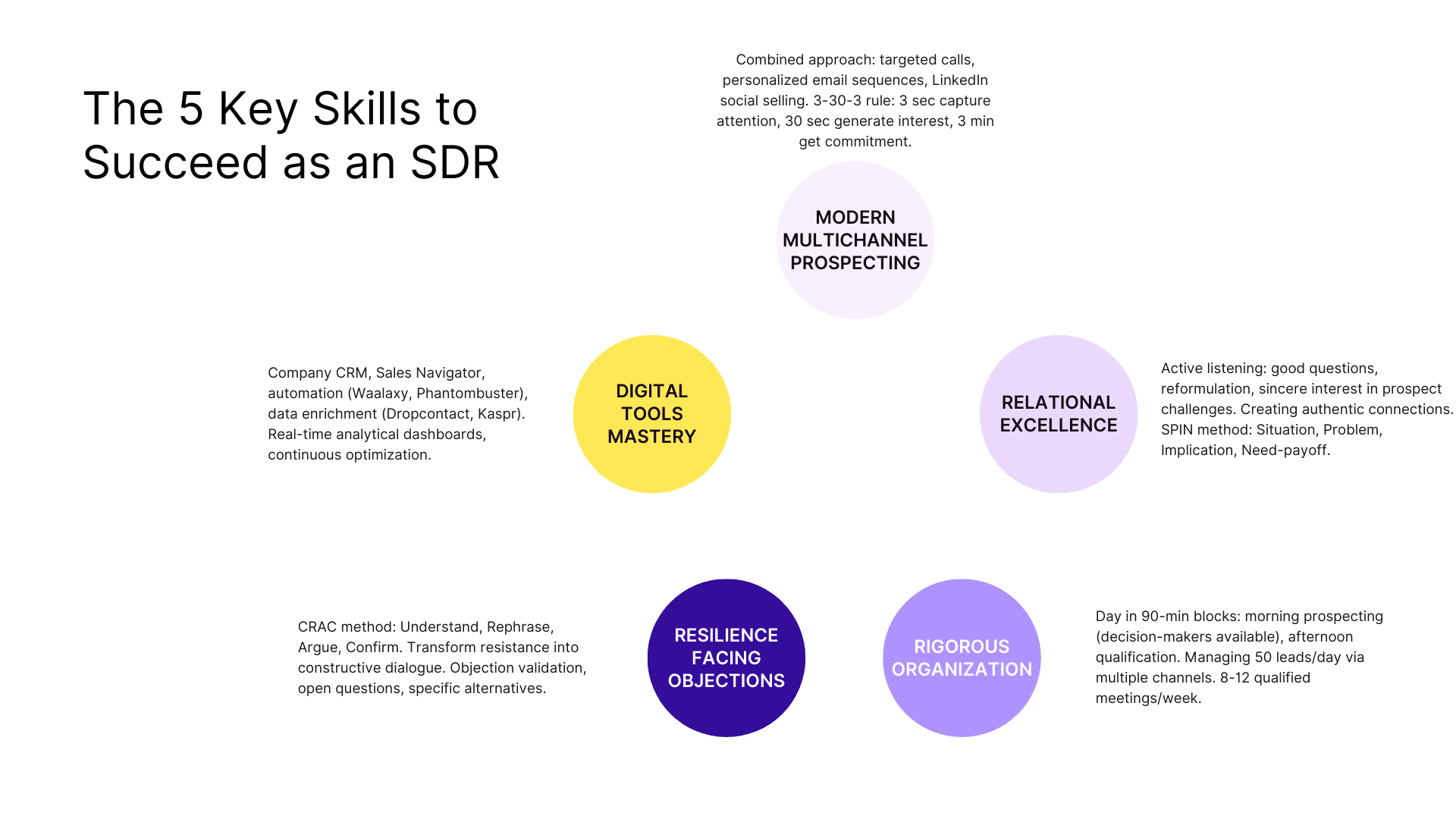
- Mastery of Modern Prospecting Techniques: The success of an SDR depends on their ability to master advanced prospecting techniques. A multichannel approach is fundamental: combining targeted calls, personalized email sequences, and social selling on LinkedIn optimizes the response rate.
- Relational Excellence and Communication: The success of an SDR is based on their ability to create authentic connections. Active listening is the cornerstone of any successful business relationship: asking the right questions, rephrasing to confirm understanding, and showing sincere interest in the prospect's challenges.
- Organization and Time Management: An SDR's productivity relies on the strategic planning of their daily activities. A proven method is to divide the day into 90-minute blocks: prospecting in the morning when decision-makers are available, and lead qualification in the afternoon.
- Resilience and Objection Handling: Mastering objections transforms resistance into a constructive dialogue. The CRAC method (Understand, Rephrase, Argue, Confirm) naturally guides the conversation. The SDR listens attentively, rephrases to show understanding, responds with a targeted argument, and then verifies the prospect's agreement.
- Expertise in Digital Tools (CRM, Automation): A modern SDR's success depends on mastering smart automation platforms like Sales Navigator, Waalaxy, or Phantombuster, as well as data enrichment tools and, most importantly, the company's CRM.
How to Be a Good SDR: Best Practices
Effective Outreach Techniques
The art of the sales approach lies in timing and relevance. A high-performing SDR analyzes buying signals before each contact: funding rounds, strategic hires, or technology deployments are opportune moments to establish contact.
The 3-30-3 rule optimizes every first interaction: 3 seconds to capture attention, 30 seconds to generate interest, and a maximum of 3 minutes to get a commitment. For example, starting with an observation about a prospect's recent LinkedIn article creates an immediate connection.
The SPIN method (Situation, Problem, Implication, Need-payoff) naturally structures the exchange. An experienced SDR starts by understanding the business context before identifying specific challenges.
Optimal Prospect Qualification
Rigorous qualification is based on the BANT method (Budget, Authority, Need, Timeline), enhanced with criteria specific to 2026. A perfectly qualified prospect must match a precise evaluation grid: validated budget capacity, confirmed decision-making power, and an active project with a defined timeline.
The discovery phase requires mastery of strategic questioning. For example, rather than asking directly about the budget, a high-performing SDR explores previous investments in similar solutions or the savings they are looking to achieve.
Managing Common Objections
Mastering objections transforms each point of resistance into an opportunity for constructive dialogue. A structured response system helps maintain composure in the face of rejection. First step: validate the objection with an open-ended question to understand its true nature. When a decision-maker mentions the budget, explore their current investment priorities. If they say "call me back later," offer a specific alternative: "Would Tuesday at 2 PM or Thursday at 11 AM work better for you?"
The High-Performing SDR's Toolkit
- Essential CRM Software: A CRM adapted to the needs of SDRs is the cornerstone of effective prospecting. It centralizes prospect data, syncs emails and calls, and provides an intuitive pipeline view.
- Prospecting and Automation Tools: Modern SDRs rely on smart automation platforms. Sales Navigator is a powerful tool for targeting on LinkedIn. Solutions like Waalaxy or Phantombuster automate multichannel sequences, while data enrichment tools like Dropcontact or Kaspr provide valuable insights.
- Tracking and Reporting Solutions: Precise measurement of prospecting activities requires analytical dashboards. Real-time tracking visualizes response rates by channel and conversions at each pipeline stage, allowing for data-driven management and continuous optimization.
Career Path and Outlook for an SDR
From SDR to Account Executive
The transition to an Account Executive (AE) role requires methodical preparation. A high-performing SDR first masters prospect qualification and initial closing before considering this move. Acquiring new skills is crucial: advanced negotiation, long sales cycle management, and building complex sales proposals.
Continuous Skills Development
An SDR's growth comes from a dynamic learning strategy. Certified training in consultative selling is a major asset. Mentoring by a senior SDR provides an expert perspective on your practices and accelerates your progress.
Opportunities in the B2B Sector
The B2B market is undergoing a massive digital transformation in 2026, creating fertile ground for SDRs. The tech and cybersecurity sectors are showing growth rates above 30%. Demand for qualified SDRs is particularly intense in SMBs, with attractive compensation packages ranging from $35,000 to $45,000 annually, including bonuses.
Frequently asked questions
What is the main mission of a Sales Development Representative (SDR)?
To identify and qualify leads (often those generated by marketing), initiate first contact, and pass qualified opportunities to account executives for closing.
What is the fundamental difference between an SDR and a BDR (Business Development Representative)?
A BDR/SDR focuses on outbound prospecting and lead qualification, while an Account Executive manages the full sales cycle from qualified opportunity to closing.
What are the most important skills for an SDR who wants to succeed and advance?
Key metrics include number of qualified meetings booked, outreach volume and response rates, pipeline generated, and conversion rate from lead to qualified opportunity.