The marketing funnel: cornerstone of modern sales
Definition and principles of the sales funnel
A sales funnel represents the strategic path that each visitor takes, from their first interaction with your brand to the final purchase. Its structure resembles a marketing funnel where the number of prospects naturally decreases at each stage.
The power of a sales funnel lies in its ability to methodically guide your prospects toward the purchase decision. Take the example of a professional training company: the journey starts with a free blog article, leads to a webinar, then offers a personalized consultation before the final sale.
The fundamental principles rely on logical progression: attract attention, generate interest, create desire, and trigger action. This approach allows you to naturally accompany each prospect according to their level of engagement.
The difference between funnel and conversion tunnel
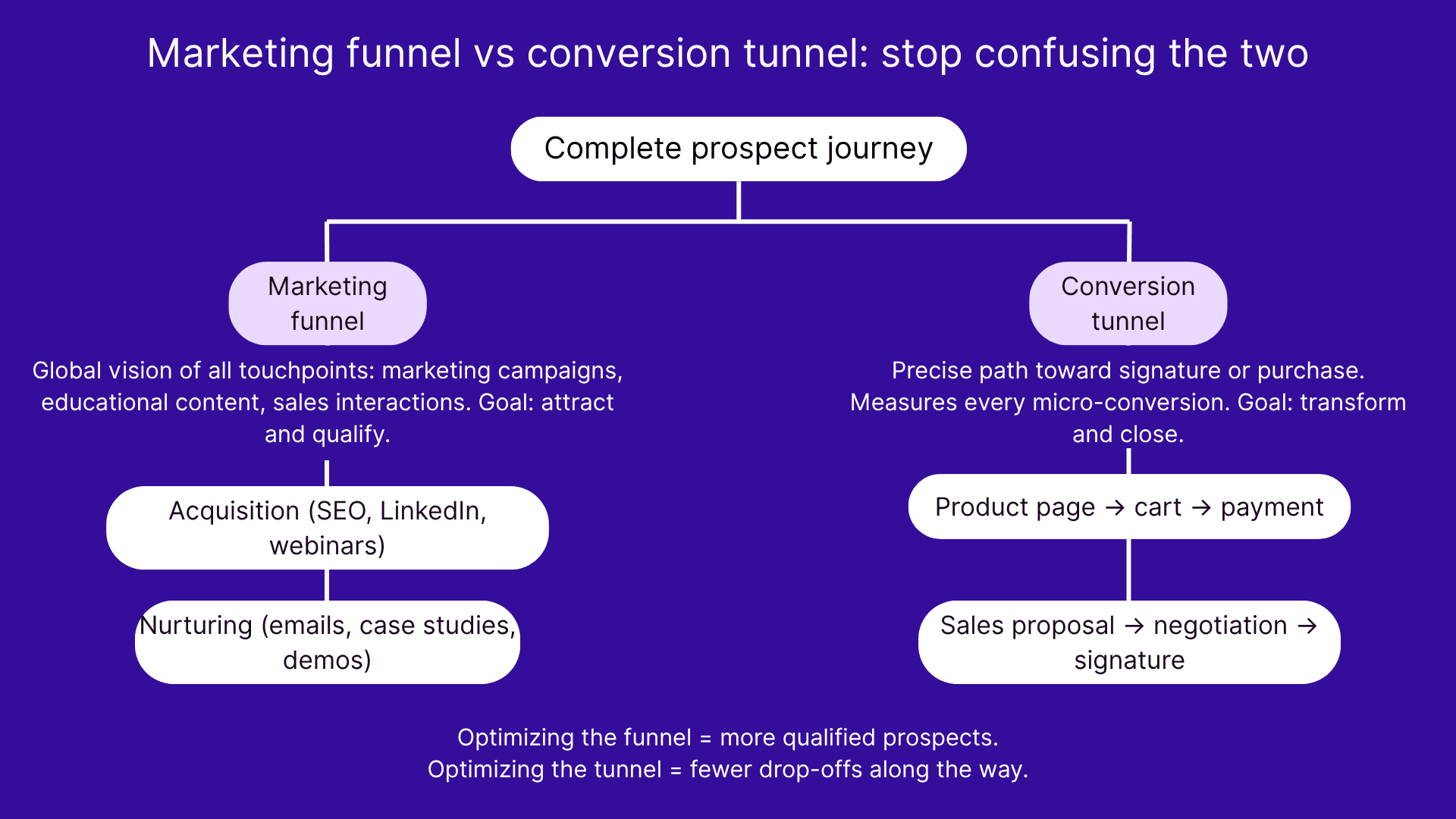
The marketing funnel encompasses all actions to attract and convert your prospects, while the conversion tunnel focuses on the specific purchase process. Take the example of a B2B company: its funnel includes marketing campaigns, educational content, and sales interactions. The tunnel, however, traces only the precise path toward contract signing.
The funnel's power lies in its global vision of touchpoints, while the conversion tunnel measures each micro-conversion up to purchase. This distinction allows you to separately optimize your acquisition strategies and sales processes.
The impact on your conversion rate
A well-structured sales funnel can triple your conversion rate. 2025 data shows that methodical optimization of each stage increases sales results by 20% to 35% on average.
Implementing a smooth purchasing journey drastically reduces abandonment. An e-commerce company saw a 45% decrease in cart abandonment after simplifying its ordering process.
Precise tracking of micro-conversions allows you to quickly identify friction points. For example, an optimized contact form can increase appointment bookings by 25%. Sales teams then save valuable time by focusing on qualified prospects.
Personalized user experience strengthens engagement at every stage of the funnel. A website that adapts its content based on visitor profile sees an average conversion increase of 15%.
Key stages of a high-performing sales funnel
Acquisition and prospect qualification
The first stage of a high-performing funnel relies on a targeted acquisition strategy. Prioritize channels that naturally attract your audience: LinkedIn for B2B, Instagram for visual products, or organic search for specific queries.
To qualify your prospects, establish an evaluation grid based on these essential criteria:
- Available budget and investment capacity
- Decision-making power within the company
- Urgency of the need to solve
- Compatibility with your solution
A scoring system allows you to assign a score to each prospect based on these criteria. For example, a sales director with an approved budget and urgent need will get a high score, requiring priority follow-up.
Conversion and closing phase
Closing success relies on a structured and methodical approach. The decisive moment arrives when the prospect shows buying signals: questions about terms, requests for guarantees, or price negotiation.
Adopt a progressive three-step method: first present the unique added value of your solution. Follow with concrete proof like case studies or customer testimonials. Finalize by addressing final objections with personalized arguments.
An experienced salesperson knows how to recognize the perfect timing to close. A clear business proposal, accompanied by a time-limited offer, naturally accelerates the prospect's decision-making. Signing then becomes a logical continuation of the journey.
Post-purchase retention
Transforming a customer into a brand ambassador begins right after signing. A successful retention strategy relies on personalized follow-up and regular interactions. A well-built onboarding program accelerates product adoption and reduces abandonment risk by 40%.
Usage behavior analysis allows you to anticipate future needs. For example, a company that notices decreased usage of certain features can proactively offer targeted training. This preventive approach strengthens customer satisfaction and increases perceived service value.
Implementing a structured relationship calendar, alternating follow-up meetings, exclusive webinars, and user meetups, creates an engaged community around your brand. Satisfied customers naturally become your best advocates.
How to create an effective sales funnel
Essential tools for web funnels
The success of a sales funnel relies on judicious selection of tools adapted to each stage. A high-performing CRM constitutes the cornerstone for centralizing your prospect data and tracking their progression in the conversion funnel.
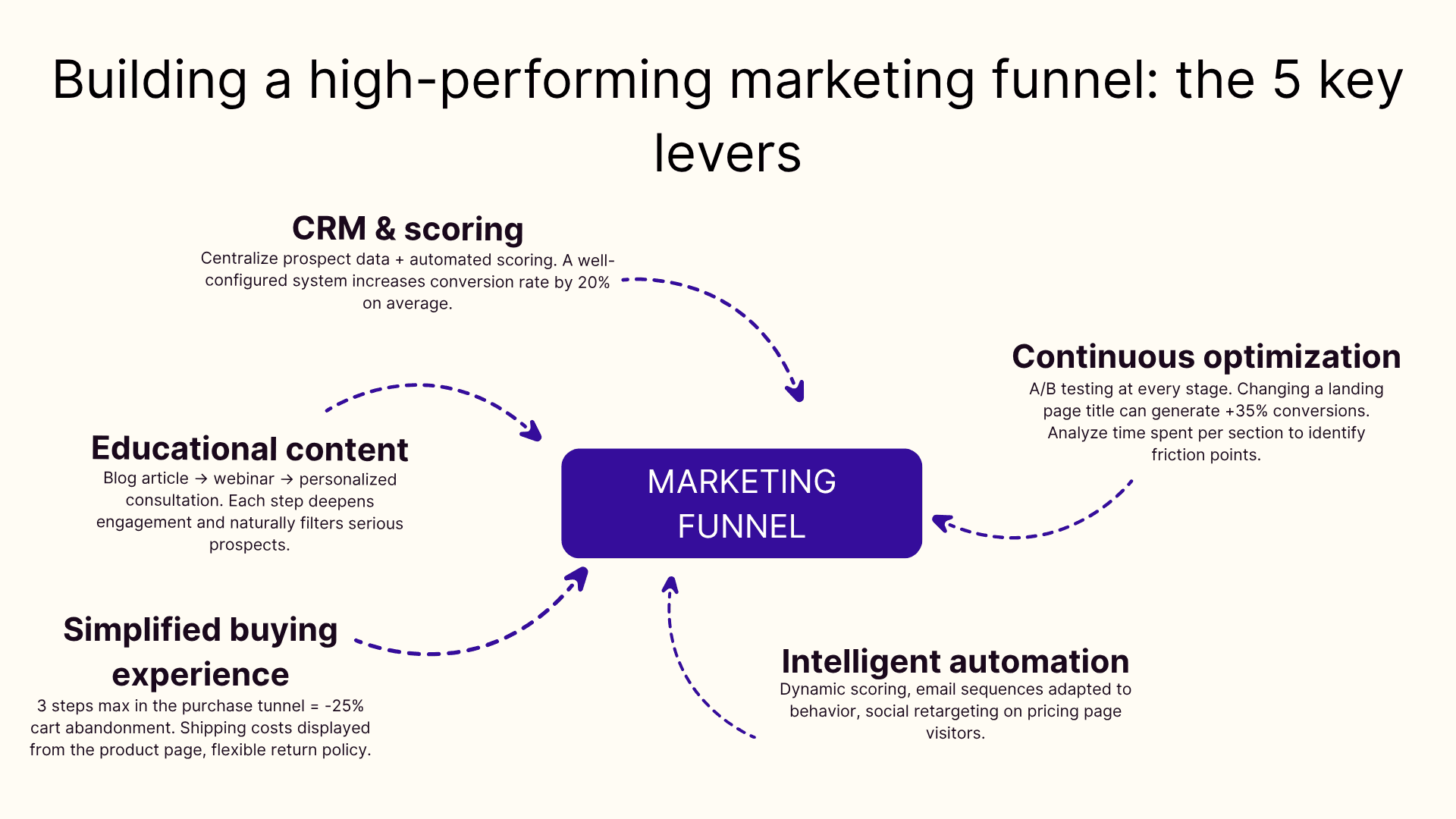
For the acquisition phase, marketing automation platforms simplify lead qualification through automated scoring. The conversion rate increases by 20% on average with a well-configured scoring system.
Business proposal creation gains efficiency with specialized tools integrating customizable templates and real-time interaction tracking. A unified dashboard gathering your key metrics helps you make data-driven decisions.
Best practices in e-commerce
The success of an online store relies on well-identified strategic elements. A simplified payment process, limited to 3 steps maximum, reduces cart abandonment by 25%.
Implementing a clear progress bar reassures buyers about their advancement in the purchase process. High-quality product photos, accompanied by verified customer reviews, strengthen visitor confidence.
Transparent display of shipping costs from the product page and a flexible return policy constitute powerful levers to transform a visitor into a customer. For example, offering free shipping on orders over $50 increases average cart value by 30%.
Adapting to service offerings
Service sales require extensive personalization of the conversion funnel. A free diagnosis or preliminary audit serves as effective first contact points to demonstrate your expertise.
Creating targeted educational content, like sector case studies or thematic webinars, establishes your professional credibility. A digital strategy consulting firm could offer a free mini-audit of online presence, followed by a personalized results presentation.
The decisive stages of the funnel revolve around key moments:
- Concrete demonstration of your methods
- Transparent presentation of your rates
- Access to detailed testimonials from satisfied clients
A consultative approach, based on listening and analyzing specific needs, naturally transforms your prospects into loyal customers.
Intelligent automation of your funnel
Available software solutions on the market
The market now offers all-in-one platforms that simplify sales funnel creation and management. These solutions typically combine a page builder, email automation system, and advanced analytics tools.
Modern SaaS solutions now integrate artificial intelligence to optimize each funnel stage. For example, automated prospect scoring allows dynamic message adaptation based on their engagement.
Particular attention should be paid to the scalability of the chosen solution. A software adapted to SMEs typically offers flexible pricing based on usage volume, enabling serene growth without tool changes. Essential features include interaction tracking, content personalization, and clear analytical dashboards.
Social media integration
Synchronizing social media with your sales funnel multiplies its effectiveness. A social authentication system simplifies prospect entry into your funnel while collecting valuable data about their preferences.
Setting up conversion pixels on your pages allows automatic retargeting of non-converted visitors with personalized content based on their engagement level. For example, a prospect who consulted your pricing page will receive targeted customer testimonials on LinkedIn.
Social widgets strategically placed in your funnel strengthen prospect confidence. Dynamic display of recent customer reviews or interactions transforms each visit into an enriched social experience.
Continuous performance optimization
The success of a sales funnel relies on constant improvement. Regular analysis of key metrics reveals optimization opportunities: a high abandonment rate on a page signals a need to adjust the message or user journey.
A/B testing constitutes a powerful lever to refine each stage. Changing a landing page title can increase conversions by 35%. A color change on an action button sometimes generates 20% more clicks.
Measuring time spent by section allows you to identify content that truly captures attention. Behavioral data guides adjustments: shortening a form that's too long or simplifying a complex step naturally improves user experience and results.