
Sales pipeline fundamentals
What is a sales pipeline and why it matters
A sales pipeline visualizes your complete sales journey, from prospect qualification to deal closure. This method allows sales teams to get a comprehensive view of their active opportunities and potential revenue.
The pipeline's strength lies in its ability to transform data into concrete actions. Salespeople quickly identify priority leads, adapt their follow-up based on advancement level, and anticipate future results.
For example, a salesperson managing 50 prospects can easily spot the 10 most promising ones in final negotiation phase and focus their efforts on these high-potential deals. This methodical organization naturally increases conversion rates and accelerates sales cycles.
Differences between pipeline, tunnel, and funnel
The distinction between these three sales tools lies in their fundamental approach. The pipeline emphasizes seller actions at each stage, while the funnel focuses on the potential customer's buying journey. The tunnel represents a more structured path with predefined steps.
A concrete example illustrates these nuances: a B2B company uses its funnel to track website visitors' evolution toward contact. Its pipeline traces seller interventions from first call to signature. The tunnel methodically guides each qualified lead toward final decision.
Combined use of these three approaches maximizes sales team effectiveness. Managers analyze contact flow in the funnel, optimize actions in the pipeline, and structure the journey via the tunnel.
Essential components of an effective pipeline
A high-performing pipeline relies on three fundamental components: precise qualification of incoming leads, a dynamic scoring system, and structured documentation of interactions. Implementing a scoring mechanism allows quick evaluation of each opportunity's potential based on objective criteria like available budget or need urgency level.
Documentation of sales exchanges constitutes the cornerstone of effective follow-up. A salesperson who methodically archives communications, quotes, and key decision points saves precious time during follow-ups.
Take the example of an IT services company: its pipeline relies on a technical needs evaluation grid, detailed exchange history, and a prioritization system based on project maturity. This methodical organization naturally accelerates decision-making.
Anatomy of a high-performing sales pipeline
Key stages of the sales cycle
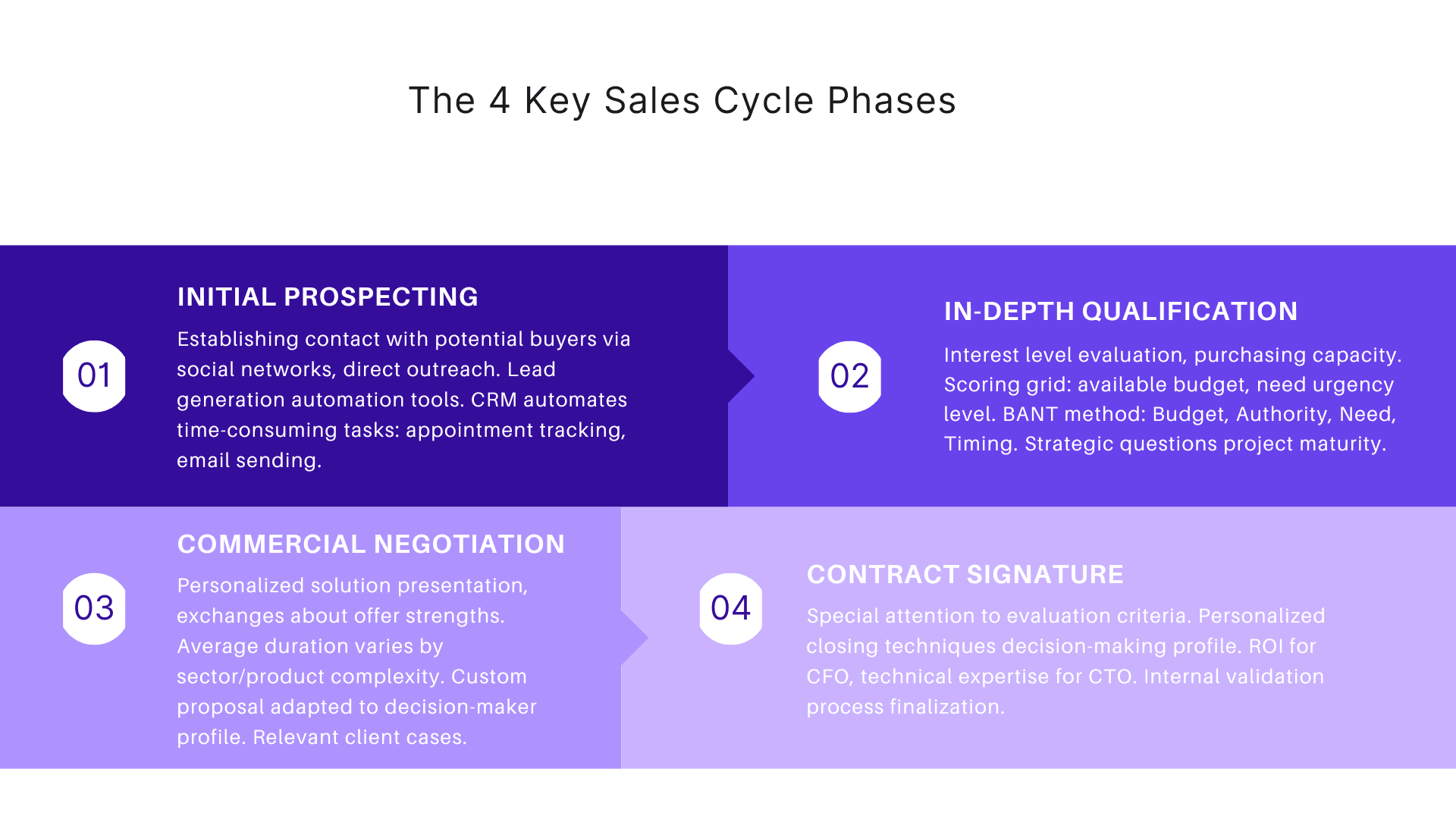
A structured sales cycle revolves around four strategic phases. Initial prospecting establishes contact with potential buyers via social networks or direct outreach. In-depth qualification then evaluates their interest level and purchasing capacity.
The negotiation phase begins with a personalized presentation of your solution, followed by exchanges about your offer's strengths. Average time for this stage varies by industry sector and product complexity.
The final stage, contract signature, requires particular attention to evaluation criteria set by the sales director. Modern CRM software automates time-consuming tasks like appointment tracking and email sending, offering better visibility on case advancement.
Indicators to track at each stage
Precise sales performance measurement requires tracking targeted metrics. Conversion rate between each level determines your business health. For example, a 30% transition from qualified prospects to negotiation phase reveals an excellent score.
Total value of active opportunities allows revenue anticipation. A salesperson managing a $500,000 portfolio with a 25% average closing rate can project $125,000 in revenue.
Also monitor average cycle duration: 45 days represents a B2B reference baseline. An Excel spreadsheet lets you visualize these essential data points at a glance:
- Number of new qualified contacts per week
- Average transaction amount for ongoing deals
- Response rate to sent proposals
- Time between first meeting and signature
How to evaluate opportunity quality
In-depth opportunity evaluation relies on measurable objective criteria. Client project maturity level, validated budget, and decision-making process constitute the foundation of this analysis.
A dynamic scoring grid allows precise rating based on the prospect's ability to provide detailed information about their needs and constraints. Answers to strategic questions quickly reveal project solidity.
An experienced salesperson also examines concrete prospect engagement: their responsiveness to exchanges, transparency about internal challenges, and willingness to share a precise timeline. Considering these behavioral signals refines evaluation and helps anticipate actual signature chances.
Setting up your sales pipeline
Defining phases adapted to your business
Building a high-performing sales pipeline starts with thorough analysis of your sales cycle. Create a precise picture of your process by observing how your best salespeople convert prospects into customers.
Gather necessary information from your field team. An experienced salesperson in B2B SaaS sales naturally details their key stages: qualified contact, technical demonstration, customized proposal, and final negotiation.
Ask yourself these questions to refine each phase: what's the average transition time between stages? What actions trigger prospect advancement? When do your technical experts intervene? This structured reflection helps develop a pipeline perfectly adapted to your sales reality.
Choosing the right CRM pipeline tools
Selecting a CRM adapted to your pipeline relies on essential criteria. Prioritize a clear visual interface allowing you to move opportunities between different sales phases with simple drag-and-drop.
Administrative task automation constitutes a major asset: automatic reminders, email synchronization, and personalized report generation. A manufacturing SME reduced its management time by 40% thanks to these features.
Collaborative features deserve your attention: information sharing between teams, interaction history, and shared notes. Opt for a solution offering high-performing mobile application, guaranteeing access to sales data even while traveling.
Establishing precise qualification rules
Implementing qualification standards radically transforms your sales team's efficiency. Each lead must meet specific requirements before progressing in the sales process.
A structured evaluation grid allows systematic scoring of available budget, contact decision-making level, and need urgency. An experienced salesperson verifies, for example, if the prospect has a validated budget envelope for the next 6 months.
Strategic questions to ask during first contact quickly reveal project maturity:
- What problem are you trying to solve?
- What's your implementation timeline?
- Who are the decision-makers involved in the project?
Clear documentation of these criteria in your database ensures homogeneous qualification among all your salespeople.
The 5 pillars of successful pipeline management
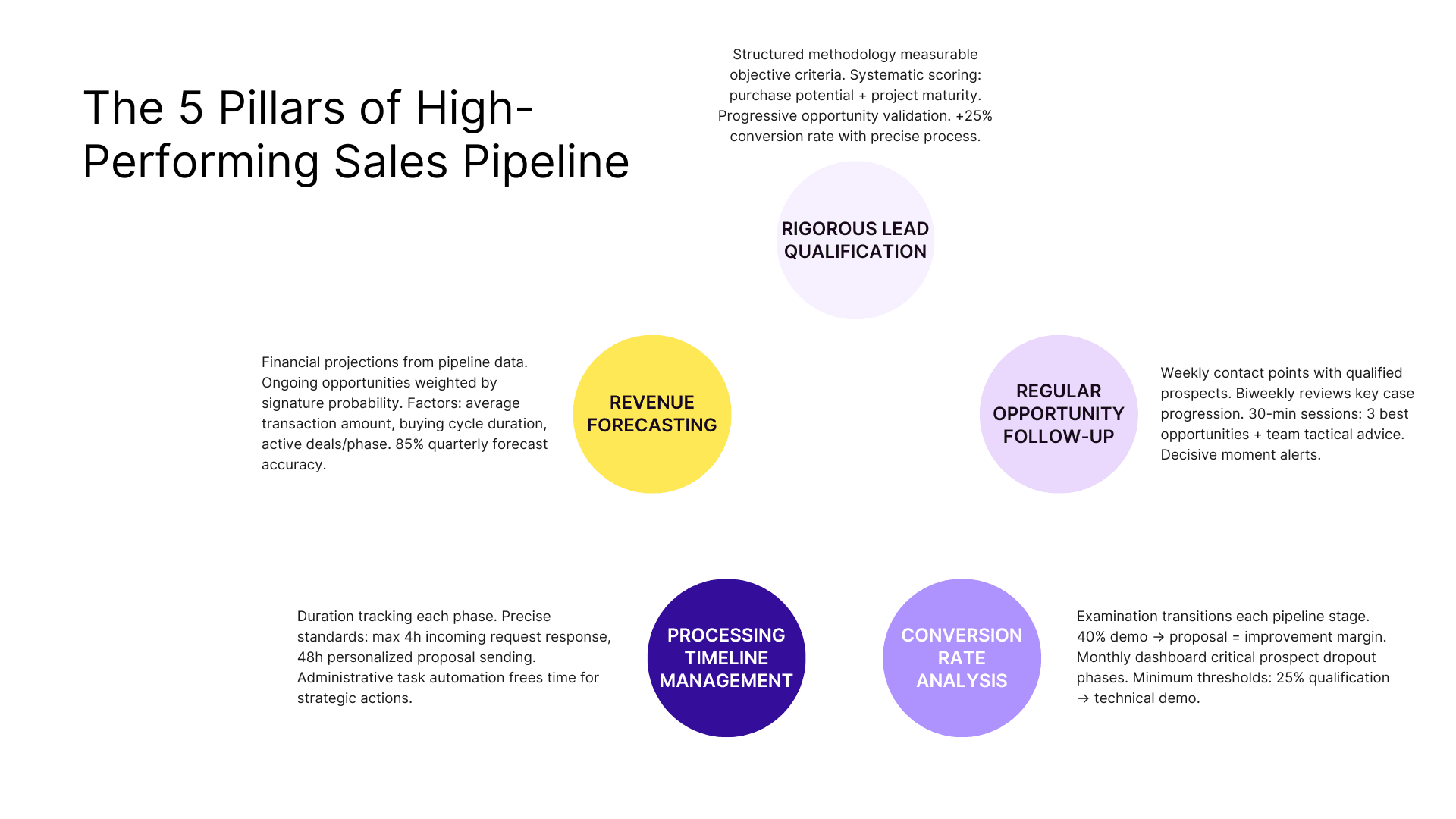
Rigorous lead qualification
Implementing a structured qualification methodology radically transforms sales performance. Companies that excel in this area adopt a systematic approach based on measurable and objective criteria.
A sales manager at a tech SME increased his conversion rate by 25% by establishing a precise scoring process. His method combines purchase potential analysis with project maturity evaluation.
Progressive opportunity validation optimizes invested time. Salespeople focus their efforts on high-potential prospects, while less qualified leads benefit from targeted marketing actions. This approach ensures a healthy and dynamic sales pipeline.
Regular opportunity follow-up
Sales pipeline success relies on dynamic opportunity monitoring. A high-performing salesperson establishes weekly touchpoints with qualified prospects to maintain engagement and detect buying signals.
Organizing biweekly opportunity reviews allows evaluation of key case progression. A tech company sales director implemented 30-minute sessions where each seller presents their three best opportunities and receives tactical advice from the team.
Strategic action prioritization proves essential. Experienced salespeople create personalized alerts for decisive moments: post-proposal follow-up, pending signature tracking, or reminders of commitments made during previous meetings.
Conversion rate analysis
Mastering conversion rates requires granular analysis at each pipeline level. A wise sales manager examines transitions between each stage: from first contact to signature. For example, a 40% transition rate between demonstration and proposal signals significant improvement margin.
Comparative analysis of historical data reveals seasonal trends and performance variations. A monthly dashboard quickly identifies critical phases where prospects drop off. This visibility guides corrective actions, such as strengthening sales arguments or adjusting qualification processes.
High-performing companies set minimum thresholds for each pipeline stage. A 25% conversion objective between initial qualification and technical demonstration serves as reference for evaluating sales action effectiveness.
Processing timeline management
Mastering processing times radically transforms sales team performance. Methodical tracking of durations at each stage reveals improvement areas: response time to incoming requests, proposal preparation time, period between two follow-ups.
High-performing companies establish precise standards: maximum 4 hours to respond to incoming requests, 48 hours to send personalized proposals. A dedicated dashboard visualizes these temporal metrics and quickly identifies cases requiring urgent action.
Administrative task automation frees precious time for high-value actions. Sales teams focus their energy on exchange personalization and strategic prospect support.
Revenue forecasting
Mastering financial projections relies on intelligent exploitation of pipeline data. In-depth analysis of ongoing opportunities, weighted by their signature probability, enables reliable 3, 6, and 12-month estimates.
An experienced sales director combines several key factors: average transaction amount, standard buying cycle duration, and number of active deals per phase. This method allowed him to achieve 85% accuracy in quarterly forecasts.
High-performing managers adjust their forecasts based on seasonality and market trends. For example, a B2B company anticipates a 30% signature increase in the last quarter, traditionally favorable period for investment decisions.
Continuous sales pipeline optimization
Identifying bottlenecks
Rapid detection of blockages in your sales pipeline requires constant vigilance. A dedicated dashboard highlights phases where opportunities stagnate abnormally. For example, excessive delay between commercial proposal and final negotiation often reveals lack of resources in the presales team.
Opportunity flow analysis unveils recurring friction zones. In-depth diagnosis points to specific causes: inadequate sales documentation, overly complex validation process, or lack of technical expertise at key moments.
Precise mapping of these tension points guides corrective actions. A B2B company reduced its processing times by 40% by reorganizing its commercial offer validation process.
Accelerating opportunity velocity
Improving sales velocity relies on concrete actions. Rather than waiting passively, high-performing teams implement automatic alerts as soon as an opportunity stagnates more than 5 days in a stage.
A technology company reduced its sales cycle by 45% by establishing precise intervention thresholds: systematic follow-up after 48h without response, escalation to technical expert at first technical objection.
Here are the levers that maximize velocity:
- Standardization of commercial documents by stage
- Implementation of dynamic opportunity scoring
- Follow-up automation based on engagement level
- Need anticipation with predictive models
Improving conversion rates
Mastering closing techniques radically transforms sales results. A personalized sales pitch based on the prospect's decision-making profile considerably increases signature chances. For example, when facing a CFO, emphasize ROI and achieved savings.
Using relevant client cases reinforces your proposals' credibility. A technology company doubled its conversion rate by systematically integrating video testimonials adapted to each prospect's industry sector.
Sales and marketing synchronization brings additional strategic dimension. Targeted content, sent at the right moment in the decision cycle, maintains prospect engagement until signature.
Measuring your pipeline performance
Essential KPIs to monitor
Precise measurement of your sales performance relies on strategic indicators. The ratio between qualified opportunities and concluded signatures reveals your approach's real effectiveness. An experienced sales director also monitors average sales cycle duration by market segment.
Average transaction amount, combined with number of active deals, allows evaluation of overall pipeline health. Total opportunity value at each cycle stage offers clear vision of potential revenue.
A dynamic dashboard displays prospect attrition rate by phase, quickly signaling areas requiring optimization. Measuring elapsed time between each stage identifies phases where sales support must be reinforced.
Comparative results analysis
Successful comparative analysis relies on structured methodology. A digital services company revealed 35% performance gaps between its teams by comparing their sales cycles over 12 months.
Market segmentation unveils high-potential areas. A sales manager identified 50% growth opportunity in the industrial sector through cross-evaluation of results by business sector.
Benchmark between sales regions highlights best practices. For example, the Paris team converts 40% faster than national average thanks to reinforced consultative approach. This methodology allows adaptation of winning strategies to each territory.
Sales strategy adjustment
Reactivity in adjusting your sales strategy radically transforms your results. A dynamic action plan is essential facing market variations: adapt your messages based on client feedback, strengthen team training on detected weak points.
Your sales approach deserves regular adjustments based on concrete data. For example, a digital services company revised its pricing grid after analyzing refusal reasons, increasing new contract signatures.
High-performing teams prioritize targeted strategic adjustments:
- Redefinition of qualification criteria by segment
- Prospecting script adaptation based on recurring objections
- Resource reinforcement on critical cycle phases
Best practices for 2025
Repetitive task automation
Automation technology frees precious time for your salespeople. A B2B company observed a gain of 140,000 hours per month through automation of follow-up calls and email reminders.
Automation redefines sales productivity in 2026. AI assistants handle prospect file updates, appointment scheduling, and activity report generation. This delegation of administrative tasks allows sellers to maximize their field time.
A wise sales manager starts by mapping their team's time-consuming actions. For example, automatic sending of post-meeting documents or calendar synchronization represent quick wins. This methodical approach ensures optimal ROI from automation tools.
Marketing data integration
Synchronization between marketing and sales data radically transforms sales team performance. A unified database allows salespeople instant access to prospect's previous interactions with your marketing content.
Teams leverage marketing engagement signals to identify propitious moments for sales action. For example, a prospect regularly consulting your case studies reveals marked interest in your solution.
Behavioral scoring enriches opportunity qualification. Website visits, white paper downloads, or webinar participation feed a dynamic score. This data-driven approach guides salespeople toward prospects most mature in their buying cycle.
Client follow-up personalization
A personalized sales follow-up approach relies on deep understanding of each prospect's specific needs. An experienced salesperson adapts their communication based on industry sector, company size, and decision-maker's particular challenges.
Personalization goes beyond simple courtesy formulas. For example, a technology company increased its signature rate by 45% by creating follow-up scenarios adapted to different decision-maker profiles: technical director, CFO, or CEO.
High-performing sales teams build customized interaction models. Each exchange enriches prospect knowledge, allowing recommendation refinement and solution relevance reinforcement.
Frequently asked questions
What's the main difference between a sales pipeline and a sales funnel?
The sales pipeline tracks actions and stages managed by the sales team, while the sales funnel represents the buyer's journey from awareness to purchase decision.
What are the key performance indicators (KPIs) for tracking sales pipeline performance?
It provides visibility into deal flow, helps forecast revenue, identifies bottlenecks, and enables better resource allocation and sales team management.
How can CRM software help better manage a sales pipeline?
Pipeline stages should be reviewed quarterly at minimum, but optimally on an ongoing basis using CRM data to ensure they reflect actual buying behaviors.