What is a Closed-Ended Question and How to Recognize It?
A closed-ended question is characterized by predefined response options. The most classic expects a "yes" or "no," but it can also offer several specific choices. For example, "Would you like a demonstration of our solution?" or "What budget have you planned: under $5,000, between $5,000 and $10,000, or over $10,000?"
These questions are recognized by their formulation, which often begins with "Do you," "Have you," "Would you like," or "Do you prefer." Their structure naturally guides toward a short and precise answer, leaving no room for interpretation.
In the sales context, they enable quickly obtaining factual information about the prospect's budget, timeline, or decision process.
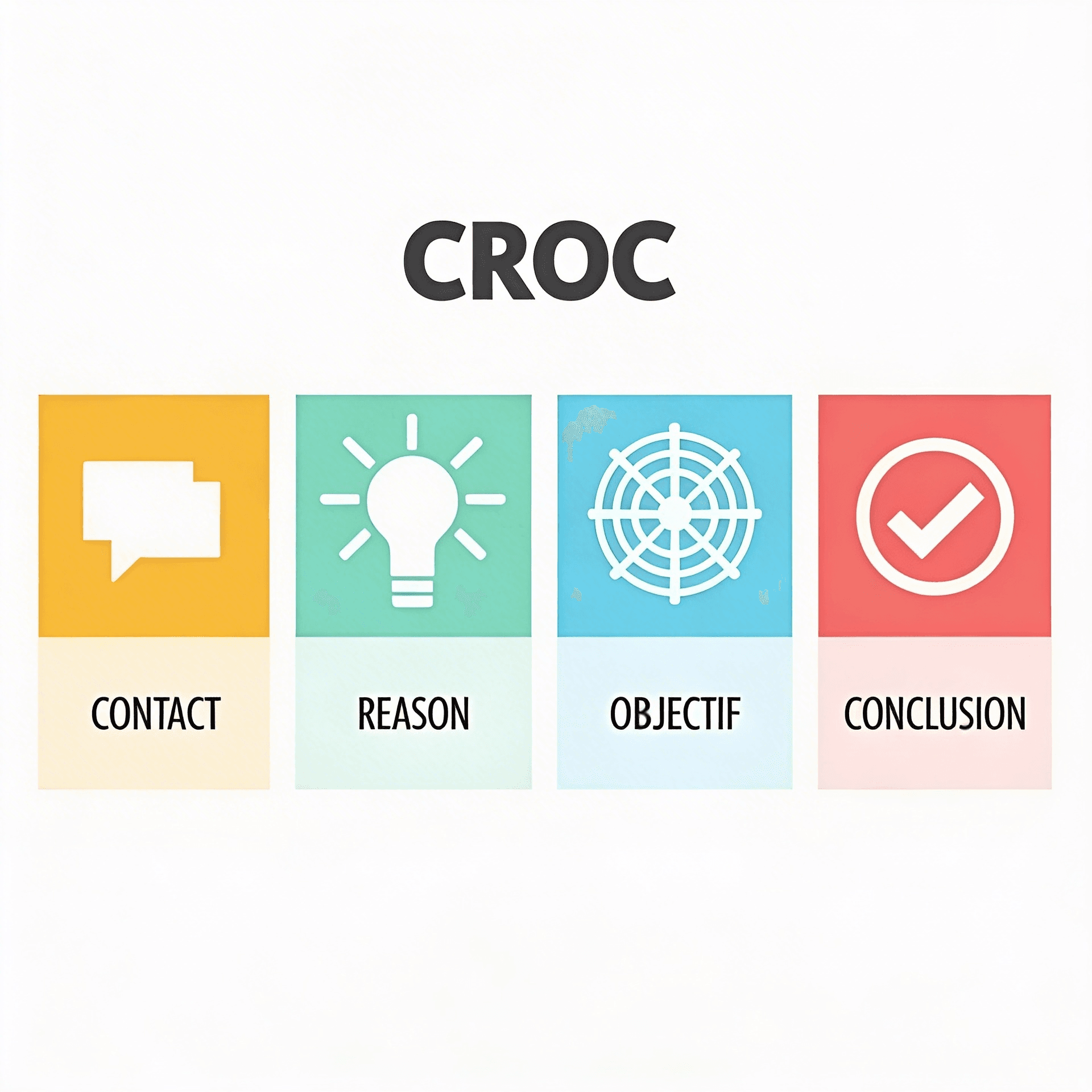
On the phone, the CROC method (Contact, Reason, Objective, Conclusion) reserves the Objective phase for exactly this: three or four closed-ended questions to qualify the contact before closing with a meeting request.
Different Types of Closed-Ended Questions in Practice
Single-Choice Questions: Yes/No and Alternatives
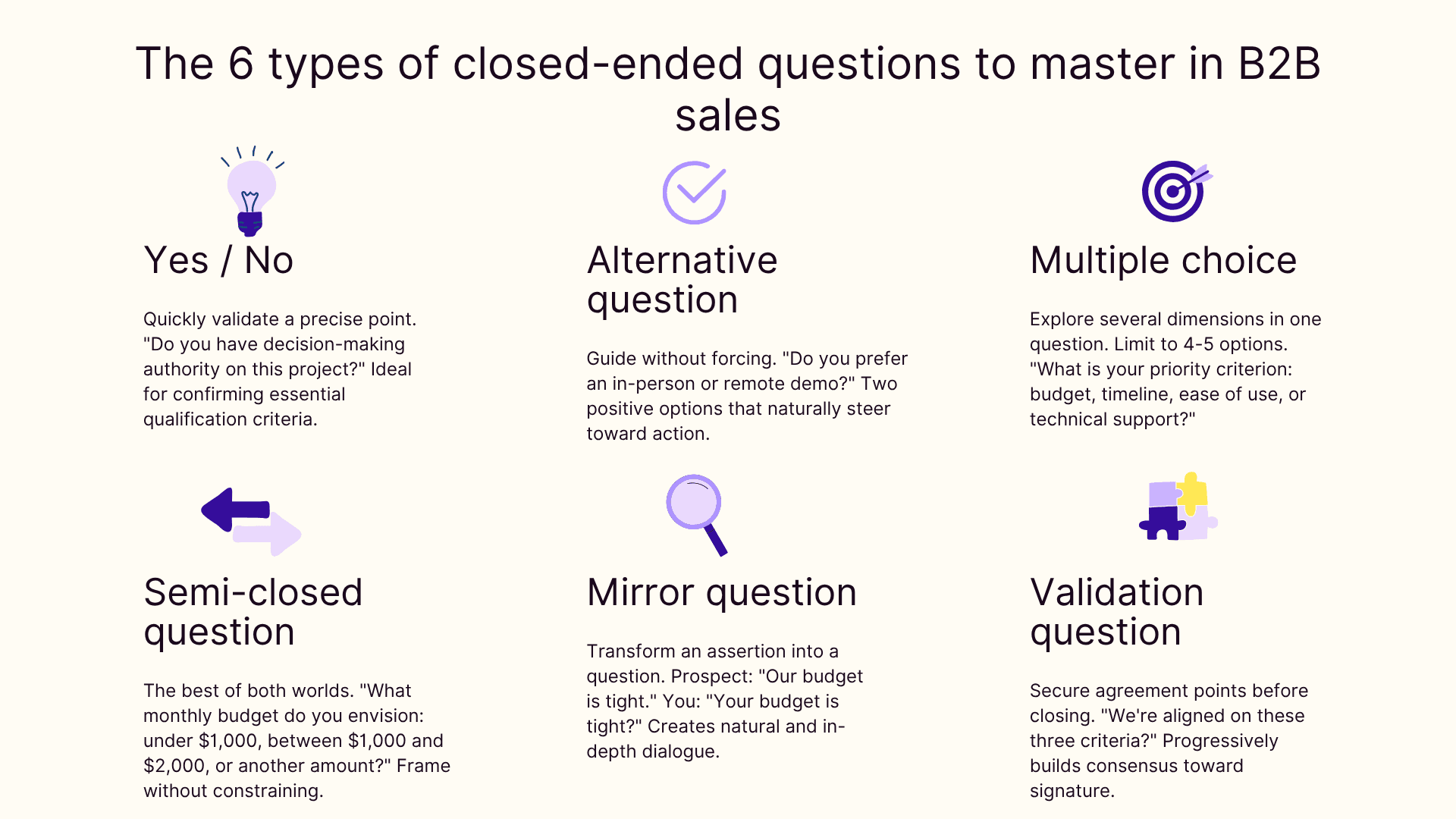
Single-choice questions represent a strategic tool for framing your sales exchanges. A "yes" or "no" answer proves particularly useful for validating precise points: "Do you have decision-making authority on this project?"
To enrich your approach, use alternative questions that offer two distinct options: "Do you prefer in-person or remote training?" This technique naturally guides your contact toward a defined choice.
Best practices recommend alternating these formats based on your objectives:
- Yes/no questions to quickly confirm information
- Alternative questions to steer discussion toward concrete solutions
- Validation questions to secure agreement points
Multiple-Choice Questions: Options and Selections
Multiple-choice questions considerably enrich your sales arsenal. A well-constructed multiple choice question enables exploring several aspects simultaneously: "Among these criteria, which influence your decision: budget, implementation timeline, ease of use, technical support?"
This technique reveals your prospects' priorities while maintaining a structured framework. The key lies in judicious selection of proposed options, each providing strategic information about client needs.
Maximize your multiple choice questions' impact by limiting choices to 4 or 5 relevant options. For example: "What are your priority objectives: cost reduction, revenue growth, productivity improvement, customer satisfaction?" This approach guarantees actionable responses without overwhelming your contact.
Semi-Closed Questions: The Best of Both Worlds
Semi-closed questions represent a hybrid approach particularly suited to complex sales conversations. They combine the precision of a predefined answer with the prospect's freedom of expression.
An experienced salesperson will use, for example: "What monthly budget do you envision: under $1,000, between $1,000 and $2,000, or another amount to specify?" This formulation enables framing the discussion while leaving room for the client.
The strength of semi-closed questions lies in their adaptability. During price negotiation, they enable probing the prospect's real expectations without constraining them into overly restrictive options. The salesperson thus maintains control of the exchange while respecting each situation's uniqueness.
Validation and Mirror Questions: Two Formats Worth Knowing
Two more formats round out this typology. A validation question locks in a point of agreement before you move on: "Are we aligned on these three criteria?" Asked at every stage, it builds consensus step by step and keeps you from discovering a disagreement at signature time. It's especially valuable after a presentation or a negotiation, when everyone assumes they understood the same thing.
A mirror question turns a prospect's statement into a question: "Our budget is tight this year" becomes "Your budget is tight this year?" On the surface, it's a closed-ended question, the prospect can answer yes or no, but in practice it almost always invites them to say more. You'll find a closer look at how to use it further down, in the advanced techniques section.
These six formats (yes/no, alternative, multiple-choice, semi-closed, validation, mirror) cover most situations you'll face in a B2B conversation. The goal isn't to memorize them, it's to pick the right one at the right moment, with a prospect who's probably comparing several offers.
Strategic Advantages of Closed-Ended Questions
Efficiency in Gathering Precise Information
Closed-ended questions guarantee quantifiable data collection in your B2B sales conversations. A sales director who asks "Is your budget between $50,000 and $100,000?" gets an answer they can act on immediately, whereas an open-ended question about budget often comes back as an answer that still needs qualifying.
The precision of gathered information makes qualification more reliable. An experienced salesperson uses these questions to build a complete prospect file during the very first conversation, with no follow-up call needed to fill in the gaps.
The power of closed-ended questions lies in their ability to create a reliable database. For example, knowing that 80% of prospects validate a specific need instantly directs your sales strategy toward the most adapted solutions.
Ease of Response Analysis and Processing
Standardization of closed-ended question responses enables systematic analysis of sales conversations. A salesperson can quickly identify trends thanks to standardized and comparable data.
This structured approach facilitates creating relevant dashboards. Sales teams instantly visualize key points: available budgets, desired timelines, or prospects' priority decision criteria.
These answers have another benefit: they carry straight into the sales proposal (budget framed, timeline confirmed, decision-maker identified). A proposal generation tool built on this data produces a document that's already aligned with the client's constraints, instead of forcing you to rewrite a generic template from scratch.
Response exploitation transforms into a true strategic lever. Sales managers can adjust their market approach, refine their pitches, and optimize prospect targeting through fine understanding of expressed needs.
Time Savings in Sales Conversations
Closed-ended questions speed up the rhythm of B2B conversations. A meeting structured around targeted questions noticeably shortens the qualification phase, without sacrificing the quality of information gathered.
This optimized approach frees valuable time to deepen strategic points. For example, a closed questionnaire about technical needs enables quickly identifying the adapted solution, leaving more space to discuss return on investment.
Standardization of closed-ended questions also simplifies conversation preparation. Salespeople gain confidence through a proven framework, while keeping necessary flexibility to personalize their exchanges based on prospect profile.
Closed-Ended vs Open-Ended Questions: What's the Difference?
Impact on Quality of Responses Obtained
Closed-ended questions generate more precise and reliable answers in the sales context. A prospect confronted with predefined choices naturally provides more actionable information than with a poorly framed open-ended question.
The binary or multiple-choice nature of these questions considerably reduces ambiguities in responses. For example, rather than vaguely asking opinion about a product, a satisfaction scale from 1 to 5 enables obtaining measurable and comparable feedback.
Closed-ended question responses are easier to compare because they limit interpretation. A salesperson who offers clear options like "Monthly or annual?" for the billing terms gets a clear read on client preferences. The trade-off: they box the prospect into your options. If none of them match their reality, they'll pick the least wrong one without telling you. That's why it helps to include an "other" option, or to double-check with an open-ended question.
Situations Suited to Each Question Type
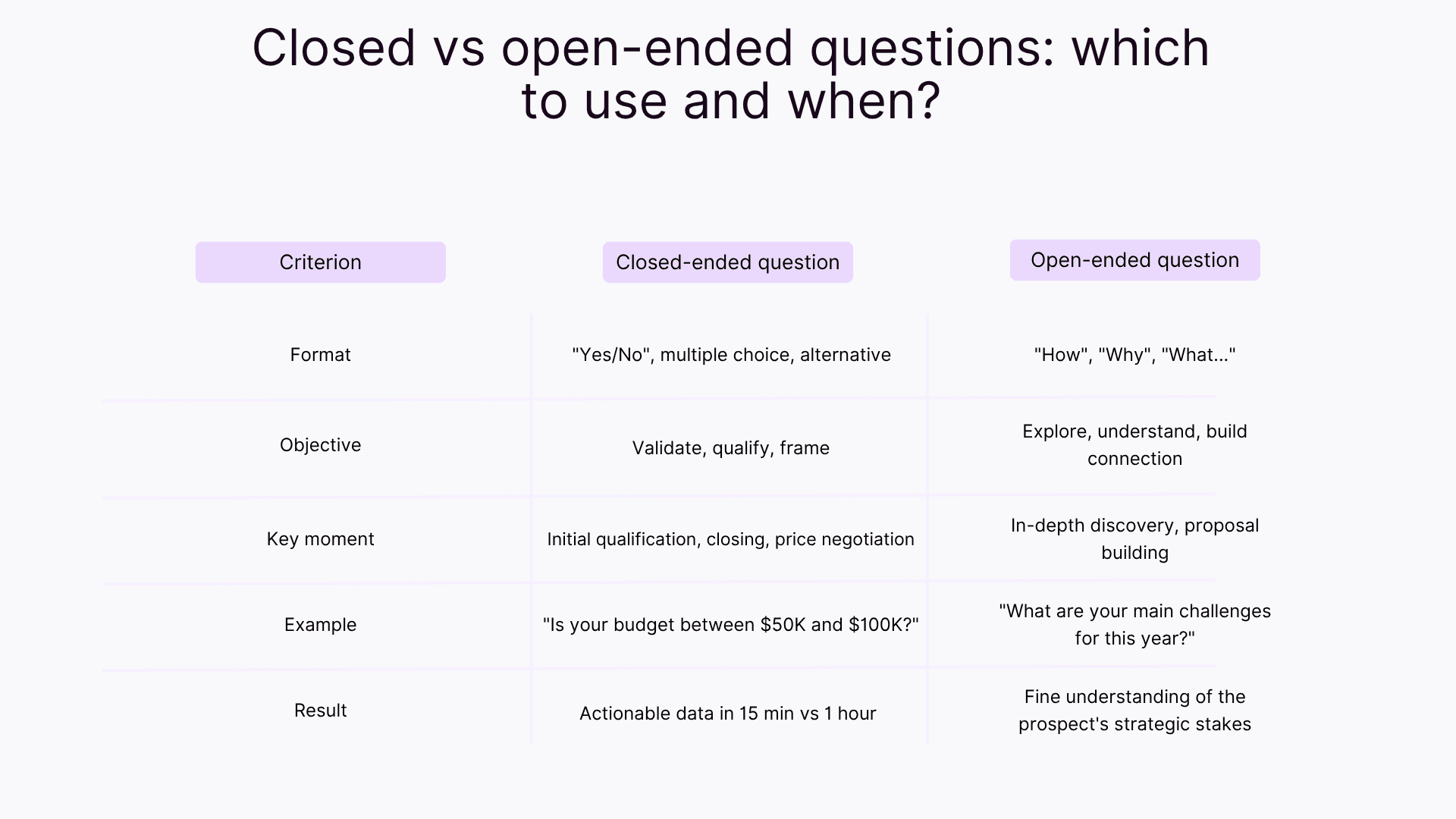
Initial qualification phases require closed-ended questions to quickly validate essential criteria: available budget, project timeline, decision process. This structured approach enables identifying priority opportunities in minutes.
Price negotiation moments call for a skillful mix of both formats. An experienced salesperson starts with an open-ended question about budget expectations, then uses closed-ended questions to frame discussion around realistic options.
During in-depth discovery meetings, open-ended questions take over. The salesperson lets their contact detail their vision, strategic challenges, and business objectives. This active listening nourishes fine understanding of needs to build a custom proposal.
That's the logic of solution selling: the proposal follows the diagnosis built with the client, not the catalog, and closed-ended questions then lock down each element of that diagnosis before you start drafting.
Advanced Techniques for Formulating Your Questions
Mirror and Bounce-Back Questions
Mirror questions transform a prospect's assertion into a question, creating natural and in-depth dialogue. A buyer mentions "Our budget is tight this year"? Simply repeat: "Your budget is tight this year?"
The bounce-back technique relies on the last response to explore a new direction. When a decision-maker mentions their growth objectives, bounce back with a closed-ended question that locks down the information ("Is this growth coming from new customers or from your existing accounts?") before reopening with an open-ended question ("What's holding you back from that today?"). The bounce-back works both ways; it's the back-and-forth that moves the conversation forward.
These methods energize your B2B meetings by keeping the prospect at the center of the exchange. A purchasing manager talks about their automation need? A mirror question followed by a bounce-back enables identifying their selection criteria while validating understanding.
Alternative Questions to Guide the Conversation
Formulating alternative questions considerably enriches your sales exchanges. "Do you prefer delivery at the beginning or end of the month?" advantageously replaces "When would you like to be delivered?" This strategy naturally steers discussion toward constructive choices.
The art of alternatives particularly applies to price negotiation phases. "Would monthly or annual payment suit you best?" frames the discussion while leaving room for your prospect.
An experienced salesperson uses these alternatives to explore deep motivations: "Does cost reduction or productivity improvement represent your priority?" This formulation reveals true stakes without putting the prospect on the defensive.
Concrete Usage Examples in Sales
Mastering closed-ended questions radically transforms key sales cycle phases. During initial qualification, "Is your budget between $50,000 and $100,000?" enables quickly identifying an opportunity's potential.
It's also the core tool of setting: a setter who has to qualify a contact in five minutes before booking a meeting relies almost exclusively on this type of question.
In discovery phase, a series of targeted closed-ended questions like "Do you currently use a project management solution?" followed by "Does your team have more than 50 employees?" helps build an adapted proposal.
At closing time, closed-ended questions become a powerful lever: "Would you like to start the project next month?" naturally steers toward decision. Asked right after the prospect has re-read the proposal, this question rarely falls flat; a proposal tracking tool tells you exactly when that moment is. Salespeople who master this back-and-forth between open and closed-ended questions reach the closing stage with fewer unknowns, and fewer last-minute objections.
Frequently asked questions
When should you use a closed-ended question instead of an open-ended one?
Reach for a closed-ended question when you need a precise piece of information, want to confirm a point, or need to steer the conversation toward a decision or a choice.
What's the biggest mistake to avoid with closed-ended questions in a sales meeting?
Overusing them. Stringing together too many closed-ended questions turns the conversation into an interrogation and stops the prospect from freely explaining what they actually need.
How can a closed-ended question help you close a deal?
By asking a question that invites a simple, low-friction decision, for example "Would you like to start the project next month?", you give the prospect an easy way to commit.