
The Fundamentals of Competitive Intelligence
Proactive competitive intelligence transforms every market data point into a competitive advantage. A compelling example: a B2B software company monitors competitor customer feedback on social media, identifies their weaknesses, and adapts its offering accordingly.
Systematic analysis of your competitors' pricing, product innovations, and marketing strategies reveals untapped opportunities. Monitoring RFPs and market movements helps anticipate emerging needs.
To maximize effectiveness, structure your approach around three pillars:
- Market surveillance: trends, new entrants, mergers and acquisitions
- Competitive analysis: positioning, pricing, innovations
- Customer listening: expressed needs, satisfaction, usage evolution
Why Intelligence is Crucial for Your Market
A company that masters its commercial environment triples its chances of success in negotiations. Field reality demonstrates this: sales teams that quickly detect market signals convert more opportunities.
Take the example of a sales director who adapts pricing based on collected data: their closing rate increases by 25% on average. Informed decision-makers transform every piece of information into an action lever.
Mastering market data also allows anticipating emerging needs. A sales manager who understands sector changes can redirect strategy before competitors. This strategic agility becomes a major asset in an economic context where responsiveness makes the difference.
The 5 Types of Intelligence for Your Business
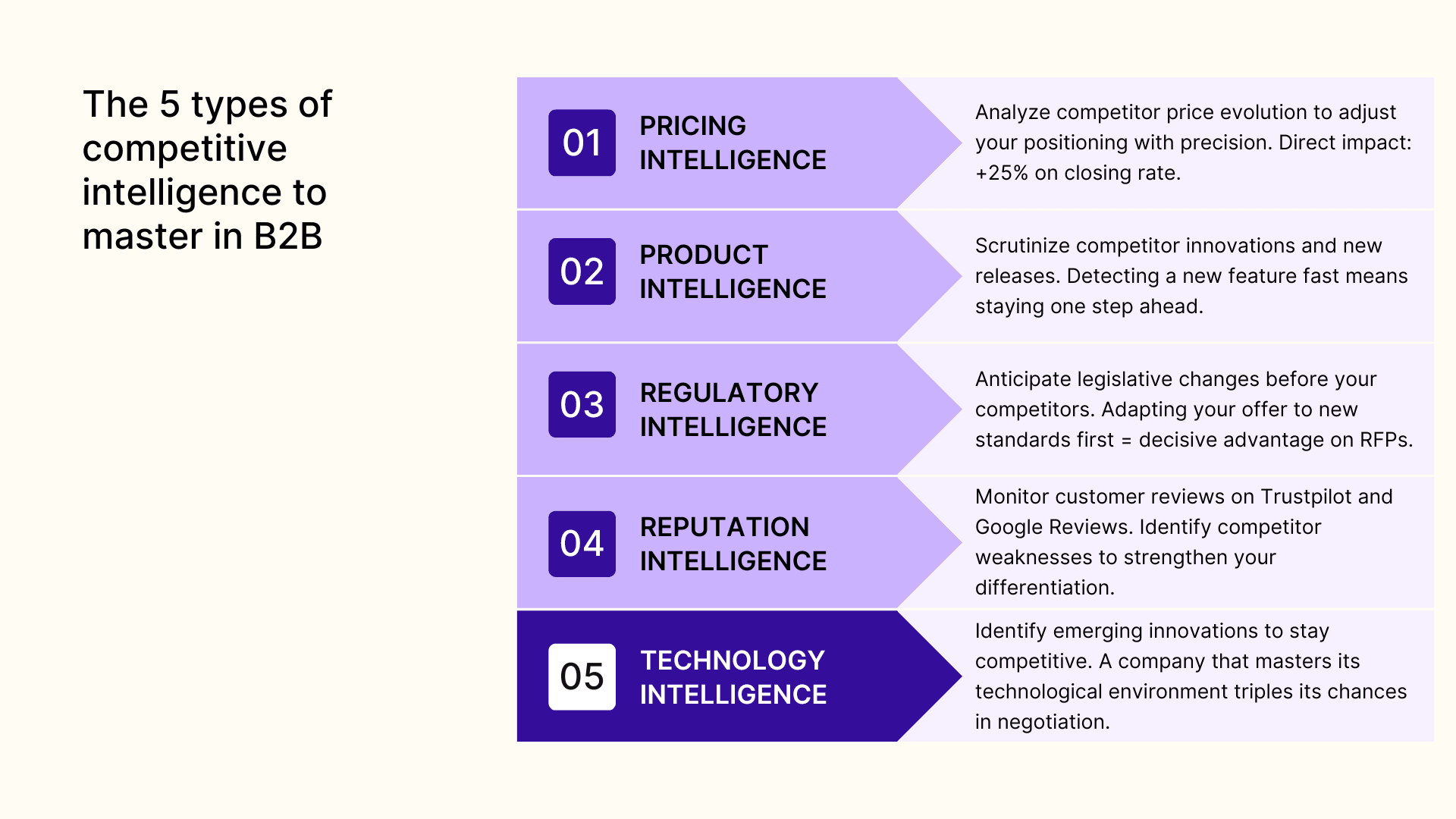
Pricing intelligence analyzes market price evolution to optimize your commercial positioning. A software solutions manufacturer that monitors competitor pricing adjusts offers with precision.
Product intelligence scrutinizes innovations and new releases. A cloud services company that quickly detects new features offered by competitors stays ahead.
Regulatory intelligence anticipates legislative changes. Companies that master this aspect adapt their offers to new standards before competitors.
Reputation intelligence monitors brand image on social media and press. Technology intelligence identifies emerging innovations to remain competitive.
Methodology: Key Process Steps
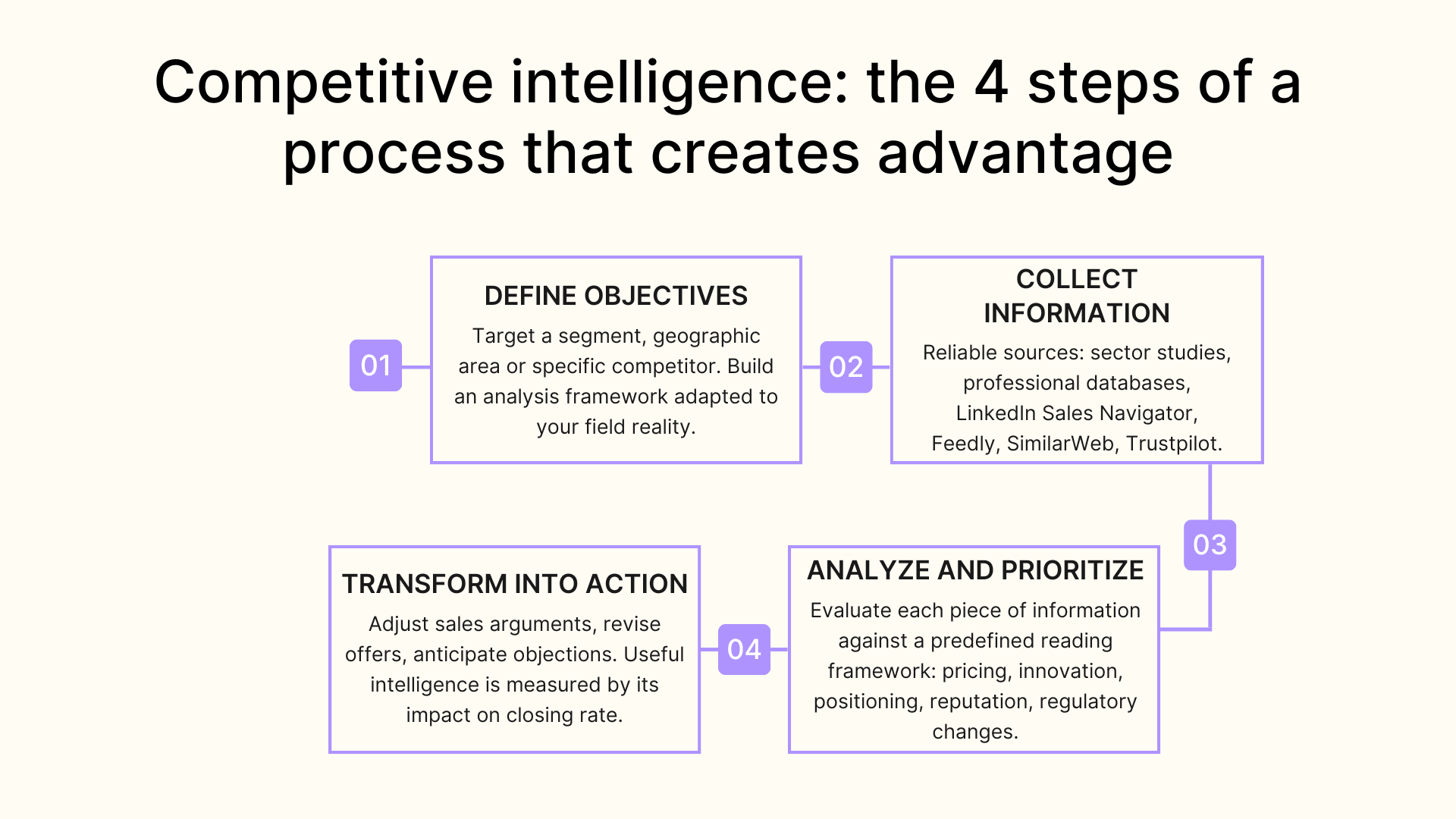
Start by precisely defining your priority strategic objectives. A sales manager seeking to conquer a new segment will establish a specific analysis framework for that market.
Next, structure your information collection around reliable sources: sector studies, professional databases, specialized social networks. Data quality determines the relevance of your decisions.
Analyze every piece of collected information according to a predefined reading framework. A B2B salesperson will evaluate competitor new products based on their price positioning and differentiating features.
Transform your analyses into concrete action plans. Collected data must translate into precise adjustments to your sales strategy, such as revising your sales arguments or adapting your offers.
How to Effectively Analyze Competition
A detailed mapping of your competitors forms the basis of effective analysis. Start by identifying their distribution channels, price positioning, and unique value proposition.
Monitoring professional social networks often reveals valuable information about their hiring and strategic directions. A new digital director position may signal a shift toward e-commerce.
Leverage customer feedback on specialized platforms to spot differentiation points to develop. For example, recurring comments about competitor delivery times can guide you toward a service improvement opportunity.
Essential Tools for Your Intelligence
The Feedly platform stands out as essential for centralizing your information sources. Configure personalized alerts to track your priority markets in real-time.
Optimize your pricing surveillance with Pricing Hub. This solution automatically analyzes competitor price evolution and generates detailed reports.
B2B sales teams rely on LinkedIn Sales Navigator to spot buying signals and understand sector dynamics. Complete your setup with SimilarWeb, which reveals your competitors' digital strategies.
For effective customer satisfaction intelligence, combine Trustpilot and Google Reviews. These platforms reveal the real expectations of your target market.
Optimizing Your Marketing Strategy with Intelligence
Transforming intelligence data into concrete marketing actions requires a methodical approach. A high-performing marketing manager leverages customer feedback to refine messages and communication channels.
Take the example of a professional furniture brand that detected growing demand for hybrid work through its intelligence. This observation led them to redirect communication toward flexible layout solutions, increasing conversions by 25%.
Success also requires synchronization between marketing and sales teams. Collected data allows adjusting your pitches to real market needs. An industrial equipment manufacturer thus strengthened its positioning by highlighting predictive maintenance, after identifying this major concern among prospects.
Professional Intelligence: 2026 Best Practices
Intelligence data centralization emerges as the flagship practice in 2026. A single dashboard now brings together market signals, customer feedback, and competitive analysis.
Personalized alert automation revolutionizes team responsiveness. Professionals configure ultra-targeted notifications on their priority markets, enabling quick and informed decision-making.
Predictive analytics takes center stage in modern intelligence. For example, an industrial sector company anticipates its B2B clients' equipment needs through maintenance cycle analysis and sector trends.
Personal data protection becomes an essential pillar. Companies adopt strict protocols to guarantee ethical intelligence compliant with 2025 regulations.
Concrete Solutions by Industry Sector
In the industrial sector, intelligence focuses on optimizing purchasing processes. Sales teams monitor raw material fluctuations to adjust their proposals in real-time.
The digital services domain relies on a personalized approach. Tech companies leverage user feedback to adapt their offers to each market segment's specificities.
For the luxury sector, social trend monitoring becomes paramount. Premium brands analyze social media conversations to anticipate their high-end clientele's expectations.
The medical sector prioritizes in-depth regulatory intelligence. Medical equipment manufacturers adapt their sales pitches to new health standards.
Dashboards: Tracking Key Indicators
An effective dashboard synthesizes essential intelligence data into actionable metrics. Visualizing conversion rate by channel, average closing time, and average order value quickly reveals priority improvement areas.
To maximize your reports' impact, structure your KPIs in three levels:
- Overall performance: revenue, margin, market share
- Commercial dynamics: prospecting, conversion rate, retention
- Customer satisfaction: NPS, response times, processed complaints
A B2B sales manager recently increased results by 30% by adjusting strategy through precise sales cycle tracking by customer segment.
From Degree to Professional: Adapting Your Intelligence
The transition from academic studies to the professional world requires strategic adaptation of your intelligence methods. A junior salesperson benefits from structuring intelligence around real client cases rather than theoretical case studies.
Field data analysis becomes your major asset. For example, a former business student developed a personalized customer feedback tracking system via a simple evaluation matrix, allowing them to anticipate 80% of objections during negotiations.
Mastering digital tools also marks this evolution. Beyond academic methods, favor professional automated intelligence platforms to gain responsiveness to market changes.
Strategic Stakes Not to Neglect
Digital transformation redefines commercial game rules in 2026. High-performing teams now combine predictive analysis of customer needs with a personalized market approach.
The accelerated pace of innovation demands flawless responsiveness in decision-making. A tech sector sales director recently doubled results by adopting an approach based on prospect behavioral data.
The rise of B2B marketplaces revolutionizes traditional distribution channels. This commercial landscape transformation pushes companies to rethink their positioning strategies and customer acquisition methods.
Frequently asked questions
What are the main types of commercial intelligence to implement?
Competitive intelligence (prices, products, strategies), market intelligence (trends, new entrants), and listening to customer needs and satisfaction.
How can I start commercial intelligence with limited resources?
By defining very precise intelligence objectives, using free tools (Google Alerts, Feedly), and focusing on a few key information sources.
How often is it recommended to update commercial intelligence?
Continuous monitoring of important signals is ideal. More in-depth analysis of collected data can be done monthly or quarterly