
The fundamentals of Gap Selling by Keenan
Key methodology principles
The Gap Selling methodology is built on a thorough analysis of the client's current state. The salesperson adopts an investigative stance to understand daily challenges, operational roadblocks, and concrete business impacts.
Precise identification of future objectives forms the second cornerstone. This practice allows for a clear visualization of the desired destination and expected benefits. For example, a company seeking to reduce order processing time from 5 days to 24 hours.
Quantifying the gap between these two states guides purchasing decisions. The salesperson guides the prospect in measuring hidden costs, missed opportunities, and potential ROI. This pragmatic approach transforms a simple transaction into a genuine strategic partnership.
The Problem Identification Chart, Keenan's central tool
Keenan sums up his method in one formula: no problem, no sale. To put it into practice, he proposes a tool the salesperson prepares before the first meeting, the Problem Identification Chart (PIC). It's a table that lists, for your offer, the technical problems it solves, the business problems those create, their measurable impacts, and the root causes you encounter most often among your clients.
In the meeting itself, this chart changes the salesperson's posture. They're no longer trying to present, they're checking boxes and putting numbers on things: which problems from the list exist for this prospect, how big are they, and what's the underlying reason? For every technical problem spotted (an order management tool that doesn't talk to billing, for example), they trace it up to the business problem (invoices sent late), then to the impact (tight cash flow), then to the root cause (a process that was never formalized).
Keenan adds a layer that classic discovery frameworks tend to skip: the emotional dimension. How does your contact actually experience this problem? What frustrates them, worries them, or puts them in a difficult spot with their own leadership weighs as much in the decision as the number does. That's why, in Gap Selling, discovery isn't just one step among others: it is the sale itself.
Client problem-centered approach
The Gap Selling methodology places solving the prospect's real challenges at the heart of the sales process. This strategy transforms the salesperson into a true strategic partner who thoroughly explores their contact's business issues.
Take a company facing high abandonment rates in its digital customer journey. The sales professional doesn't rush to a technical solution. They first examine the concrete consequences: revenue loss, customer dissatisfaction, support overload.
The salesperson then guides their prospect toward an optimal future state where these obstacles are overcome. This projection enables a precise quantification of the proposed solutions' added value and naturally facilitates decision-making.
The crucial role of strategic questions
Strategic questions form the keystone of Gap Selling. A high-performing salesperson masters the art of questioning their prospect about priority objectives, operational roadblocks, and performance indicators.
The power lies in the sequence of questions asked. Start by exploring the overall situation before drilling down into pain points. A progressive approach naturally reveals major dysfunctions and their business repercussions.
The precise formulation of your questions determines the quality of the responses obtained. Favor open-ended questions that push your contact to develop their thinking. For example, replace "Are you satisfied with your current process?" with "How does your current process impact your productivity?"
A well-placed quantifying question sharpens the picture even further: something like "What would a 30% improvement in your productivity mean for your team?" turns a vague pain point into a number the prospect can defend internally. Stay alert to non-verbal signals throughout the conversation, too. A hesitation or a shift in tone often flags a sensitive spot worth exploring further, so adjust your questioning based on what you're hearing to keep the dialogue constructive and revealing.
Understanding the "gap" concept in B2B sales
Who uses Gap Selling and why?
Gap Selling particularly appeals to B2B sales teams managing complex sales cycles. This methodology finds maximum relevance in technology sectors, professional services, and consulting, where financial stakes are high.
Sales directors adopt it to structure their approach and train their teams in value-based selling. Key account managers find it an effective framework for building lasting strategic partnerships.
This method also appeals to B2B startups in their growth phase. It helps them better qualify opportunities and optimize their sales process. A valuable asset when every resource counts.
Keenan positions his method as the natural evolution of Solution Selling: where the latter starts from a stated need and matches it to an offer, Gap Selling refuses to talk about solutions until the cost of the current situation has been measured and acknowledged by the client.
How to calculate the sales gap
The precise calculation of the sales gap relies on a simple formula: desired state - current state = gap value. For example, a company generating $100,000 in monthly revenue and targeting $150,000 presents a $50,000 gap.
Gap quantification extends beyond raw numbers. A manufacturer observing an 8% product return rate against a 2% target identifies a 6-point gap, representing substantial hidden costs in after-sales service and brand image.
To maximize calculation precision, systematically measure three dimensions: financial indicators, operational metrics, and customer satisfaction data. This approach guarantees a comprehensive vision of improvement opportunities.
Different types of gaps to identify
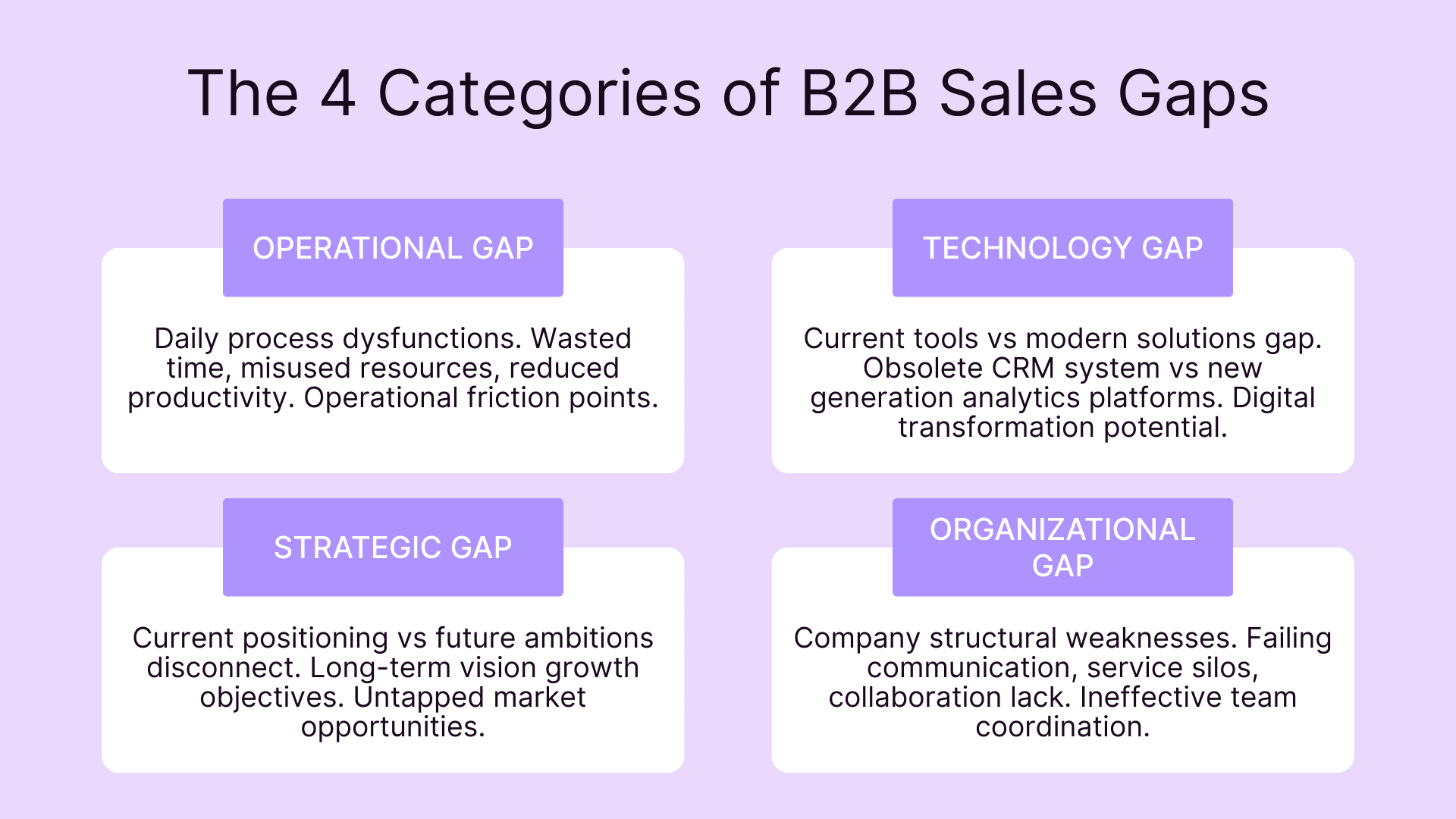
You can group the gaps you encounter in the field into four families, useful for structuring your diagnosis: operational, technological, strategic, and organizational. The operational gap reveals dysfunctions in daily processes: wasted time, misused resources, reduced productivity.
The technology gap highlights the disconnect between current tools and available modern solutions. An obsolete customer management system versus new-generation analytics platforms represents a telling example.
The strategic gap exposes the disconnect between current market positioning and future ambitions. The organizational gap highlights structural weaknesses: poor communication, service silos, lack of collaboration.
Each type requires a specific analysis approach and leads to solutions adapted to the identified challenges.
Gap Selling, Solution Selling, Value Selling: what's the difference?
These three methods belong to the same family, consultative selling, and get mixed up all the time in training programs. But they don't start from the same place.
Solution Selling starts from the need the client states and looks for the offer that answers it best. The salesperson listens, reflects it back, then matches features to expectations. The risk: treating a symptom the client has already misdiagnosed.
Value Selling focuses downstream. It puts a number on the value the solution will deliver (productivity gains, savings, added revenue) to justify the price. The logic holds up, but it assumes the client has already acknowledged the scale of their problem.
Gap Selling reverses the order: first the cost of the current situation, measured and validated with the client, only then the solution, and only if the gap justifies it. It's a diagnostic stance, not a presentation. Keenan is explicit about this and criticizes approaches that sell an offer or a value before the problem has been established.
As for SPIN Selling, it supplies the questioning mechanics (situation, problem, implication, need-payoff) that Gap Selling borrows heavily. The difference lies in the demand for quantification: SPIN surfaces the implications, Gap Selling systematically converts them into dollars, hours, or lost customers, then gets the client to acknowledge them.
In a competitive sale, that difference matters a lot. The vendor who has quantified the gap with the client sets the frame every other offer will be judged against.
The power of client diagnosis in Gap Selling
Current situation analysis
Successful client diagnosis relies on a structured three-phase methodology. The first is conducting in-depth interviews with different stakeholders, following, for example, a structured discovery framework like BEBEDC, to collect qualitative and quantitative data about their daily reality.
A field observation phase then proves indispensable. Spend a day with your contacts to understand their operational challenges. For example, a logistics manager can concretely show you the bottlenecks in their warehouse.
The final stage mobilizes numerical data: activity reports, dashboards, and statistics. This mixed approach enables a comprehensive situation overview and the identification of priority improvement areas.
Projecting the ideal future state
Visualizing an optimal future state requires a structured methodology. Start by establishing measurable objectives: revenue increase, operational cost reduction, or customer satisfaction improvement.
Use projection techniques like "backcasting": start from your ideal vision and work backward to the present, identifying key milestones. For example, a company targeting 30% annual growth would detail the necessary quarterly milestones.
Mobilize your prospects in this projection exercise. Ask stimulating questions: "What would your customer service look like with a 95% immediate resolution rate?" This collaborative approach reinforces their engagement in the transformation process.
Business impact quantification
The precise measurement of business impacts transforms intuitions into actionable data. To succeed in this step, adopt a multi-criteria evaluation matrix combining financial, operational, and human aspects.
A production manager can demonstrate that a 15% reduction in machine downtime would generate $75,000 in annual savings. In the service sector, every point of client retention rate gained weighs directly on margin: a retained client costs nothing in prospecting or onboarding, and according to Salesforce, 42% of sales leaders say recurring sales are their main source of revenue.
Here are essential criteria to quantify:
- Direct costs: revenue losses, additional expenses
- Productivity: wasted time, delivery delays
- Performance: reduced quality, missed opportunities
- Satisfaction: attrition rates, NPS score
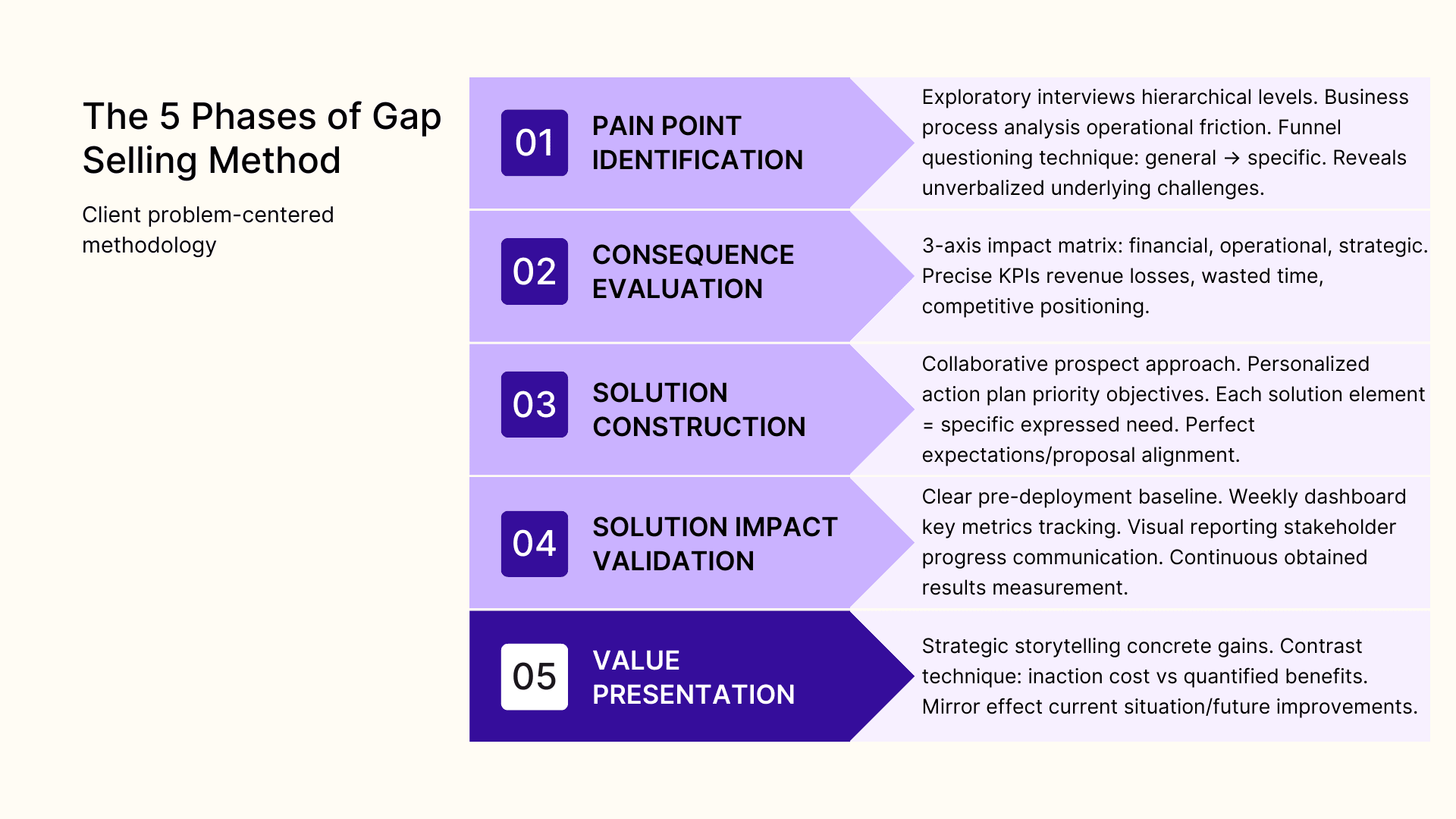
The 5 steps of the Gap Selling process
1. Identifying pain points
The precise identification of client pain points requires a methodical and structured approach. The first phase involves conducting exploratory interviews with different hierarchical levels to map organizational dysfunctions. Thorough analysis of business processes then helps spot operational friction points. For example, a sales manager might discover that a prospect loses 4 hours per week in unproductive meetings due to poor coordination between departments. The funnel questioning technique proves particularly effective. Start with open questions about the general context, then progressively refine to identify specific problems. This method often reveals underlying challenges the prospect hadn't initially verbalized.
To make sure the funnel hasn't left any blind spots, run every identified problem through the seven CQQCOQP questions: who's affected, how much it costs, since when, and why nothing has been done about it yet.
2. Evaluating consequences
In-depth impact analysis requires a structured quantification method. An evaluation matrix allows measuring repercussions across three axes: financial, operational, and strategic. For example, recurring 48-hour delays in order processing generate $12,000 in monthly losses, not counting customer dissatisfaction translating to a 15% decrease in repeat purchase rates. Consequence measurement relies on precise KPIs: direct financial impacts (revenue losses, additional costs), operational repercussions (wasted time, errors, delays), and strategic consequences (market share, competitive positioning). This methodical approach transforms abstract problems into quantifiable issues, facilitating decision-making.
3. Solution construction
Designing a winning solution relies on a collaborative approach with the prospect. Start by synthesizing the identified challenges and establish a personalized action plan that precisely addresses priority objectives. Take a sales director facing insufficient conversion rates. The analysis reveals a lack of proposal personalization. The solution then combines a new client qualification process with document templates adapted by sector. Each solution element must align with a specific expressed need. A marketing manager could transform manual reporting time waste through targeted automation of recurring tasks. This pragmatic approach guarantees a perfect alignment between client expectations and your proposal.
4. Validating the gap with the prospect
Before presenting anything, get the prospect to validate the size of the gap you measured together. This step determines everything that follows: a gap the client hasn't acknowledged as their own justifies no investment, no matter how good your solution is. In practice, revisit with them the figures collected during the diagnosis (the monthly cost of the problem, the hours lost, the missed opportunities) and ask them to confirm or correct them. A logistics manager who admits that late deliveries are costing them customers every month will defend that finding in front of their own leadership far better than you ever could. Put this validation in writing, in a summary the prospect reviews and amends. This document becomes the foundation of your proposal: it sets out the current state, the desired future state, and the gap between the two, in the client's own words. If the prospect refuses to put a number on the gap, or downplays it, you don't have a sale to close yet. You have a diagnosis to dig deeper into.
5. Value presentation
A compelling value presentation relies on strategic storytelling that highlights concrete gains for the client. Rather than a long feature list, structure your message around tangible results. Your proposal should follow the same logic: open with the client's quantified gap, in their own words and numbers, and only then present the solution. A document that opens with your company's history has already closed the gap it took you three meetings to open. A sales manager transformed their demonstration by calculating the 90-day ROI. This numerical projection convinced their prospect by demonstrating a potential $45,000 in savings. The contrast technique reinforces your proposal's impact. First present the cost of inaction, then follow with your solution's quantified benefits. This method creates a striking mirror effect between the current situation and future improvements.
The cost of inaction is in fact one of the closing conversations formalized by Q2C Selling, which makes it a required step before any discussion about price.
Gap Selling and effective investigative techniques
The art of active listening
Active listening comes down to a handful of precise behavioral techniques. Learn to read body language: an open posture, sustained eye contact, and the occasional nod all signal you're fully engaged in the conversation.
Build your ability to reflect back accurately. A simple "If I'm understanding you correctly..." followed by a clear summary confirms you've understood, and shows the prospect that what they're saying matters.
Strategic silence is a powerful tool. Leave a pause of three to five seconds after your contact answers. This naturally pushes them to go deeper and surface information they might otherwise keep to themselves.
An experienced salesperson also masters mirroring. Faced with a statement like "Our lead times are too long," simply echo it back: "Too long?" That invites the prospect to spell out the problem in more detail.
Documenting identified gaps
Structured gap documentation is a decisive step in the sales process. Take a methodical approach: build an analysis matrix that captures the key dimensions of each gap you uncover, its nature, its measurable impact, and the improvement opportunity it points to.
Use a standardized format for every gap you document. One sales director transformed his results simply by structuring every finding around three axes: the quantified current situation, the identified hidden costs, and the quantified transformation potential.
Build a shared knowledge base that brings together:
- Current metrics with baseline data
- Validated financial and operational impacts
- Proposed solutions and their estimated ROI
Putting Gap Selling into practice
Essential tools to get started
Running Gap Selling well takes the right digital toolkit. A solid CRM is the backbone of the whole setup: it lets you track every stage of the process and measure the gaps you've identified along the way.
Data visualization software turns your analysis into presentations with real impact. Dynamic charts make abstract gaps feel concrete and immediate for prospects.
A collaborative platform centralizes documentation and makes it easy for reps to share what's working. An automated scoring tool then evaluates how well each opportunity fits the Gap Selling criteria.
A structured sales proposal generator speeds up the creation of personalized documents that showcase the gaps you've identified and the solution you're proposing. The time you save on formatting gets reinvested where it counts: in the diagnosis, the one part of the process the prospect is actually paying for.
Common mistakes to avoid
The first, and most costly, mistake is rushing through the exploration of client problems. A salesperson in a hurry to present their solution routinely misses the biggest opportunities to create value.
A second mistake is poor quantification of impact. Without hard numbers behind it, your prospect will struggle to justify the investment to their own decision-makers.
Salespeople also tend to underestimate the hidden costs of the current situation. One sales manager recently lost a strong opportunity simply by forgetting to factor productivity losses into his ROI calculation.
Watch out, too, for jumping to conclusions too fast. Take the time to explore every angle of the gap you've identified before you propose a solution.
Performance indicators to track
Measuring success in Gap Selling comes down to a few precise, strategic metrics. Your opportunity qualification rate reveals how well you're actually diagnosing: an opportunity only counts as qualified once the gap has been quantified and acknowledged by the prospect, not just because the salesperson feels good about it.
Average sales cycle length and average deal size are your two other core gauges. Sharper problem identification widens what the client is willing to buy and shortens internal back and forth, since the cost of inaction has already been established. Also track the number of documented gaps per opportunity: the more they connect to one another, the more leverage you have to justify the investment.
Skip the generic benchmarks for close rate. Instead, compare, over a quarter, the close rate and cycle length of opportunities where the gap was quantified and validated by the client against those where it wasn't. That's the only benchmark that matters for your team. According to the 2025 Sales Odyssey survey, 39% of companies don't measure their close rate, or don't even know whether they do: keeping track already puts you ahead of a good share of your competitors.
Optimizing your results with Gap Selling
Current best practices
Applying Gap Selling today means going deeper on personalization in every client diagnosis. High-performing teams combine in-person meetings with remote analysis to get the most accurate read possible.
One notable shift is using behavioral data to anticipate needs the prospect hasn't voiced yet. This lets you spot gaps before the prospect has even consciously registered them. Analyzing buying journeys, for instance, often surfaces friction points nobody was tracking.
Co-building the solution with the prospect is becoming the norm. The strongest performers bring their prospects into the process from the exploration phase onward, turning every interaction into a working session. That approach naturally cuts down on objections and speeds up the decision.
Integrating into your existing process
Successfully rolling out Gap Selling takes a methodical fit with your current sales practices. Start by mapping the touchpoints where the method will naturally strengthen your existing sales process.
A precise map of your key stages helps you spot the moments best suited to gap analysis. During early qualification calls, for example, systematically build in questions about the prospect's current state.
Rolling out training in phases keeps adoption smooth. Start with a pilot group that masters the method before a wider deployment. That staged approach builds buy-in and makes it easier to adjust as you go.
Measuring ROI
Measuring ROI in Gap Selling comes down to a simple but powerful formula. Take a concrete example: for a $10,000 investment in training and tools, a team that generates $50,000 in additional margin over six months gets a 400% ROI. Think in margin, not in revenue.
The calculation needs to capture the tangible gains: bigger average deal size, shorter sales cycle, better conversion rate. Compare these indicators before and after rolling out the method, on the same type of deals, so you isolate its real effect.
Key metrics to watch:
- Close rate before and after Gap Selling
- Average deal size
- Number of deals closed per quarter
- Average sales cycle length
Frequently asked questions
What is the "gap" in the Gap Selling methodology?
The "gap" represents the measurable distance between a client's current situation (with its problems and shortcomings) and their desired future state (goals and ambitions).
Why is Gap Selling particularly suited to complex B2B sales?
Because it helps to deeply discover the prospect's business problems and quantify the financial impact of not solving them, thus justifying the investment in a solution.
What are the most common mistakes to avoid when applying Gap Selling?
Neglecting the thorough client diagnostic phase, poorly quantifying the impacts of the identified "gap," or proposing a solution before fully understanding the prospect's problem.