
What is social selling?
Today's definition of social selling
Social selling radically transforms sales prospecting through an approach centered on creating value via social media. This method relies on establishing qualified connections and sharing relevant content to naturally attract prospects.
According to Uptoo, 72% of sales professionals already use social media to research the decision-makers and companies they target. The reason? A strategic presence on LinkedIn helps you identify key decision-makers at the right moment in their buying journey.
Sellers build their credibility by sharing their expertise through blog articles, case studies, or customer testimonials. This approach doesn't replace traditional techniques like cold calling; it sets them up: a call preceded by a LinkedIn interaction gets a far warmer reception than a cold call.
The evolution of B2B and B2C sales practices
Digital transformation has profoundly changed the relationship between buyers and sellers. Approach methods now differ by market: in B2B, LinkedIn accounts for most of the professional interactions useful to a salesperson, while other networks mainly serve as a monitoring tool. In B2C, Instagram and TikTok capture consumer attention through brand and impulse-buying dynamics that fall outside the scope of this guide.
The B2B buying journey keeps getting longer: several stakeholders weigh in on the decision, and according to Gartner, buyers consult an average of 7 information sources per purchase. Spotting each decision-maker on LinkedIn and showing up among those sources becomes a real edge over your competitors. B2C transactions, by contrast, are shorter and heavily shaped by community recommendations.
Personalization is becoming the norm. According to HubSpot, 96% of prospects do their own research before talking to a salesperson, and your LinkedIn profile is often the first page they read: treat it as the first page of your proposal.
Differences from social media marketing
Social media marketing aims to increase overall brand awareness among the general public. Its primary mission: create an engaged community around company values through regular posts and promotional campaigns.
Conversely, social selling adopts a targeted and relationship-focused approach. Sales professionals develop individual connections with qualified prospects, share content adapted to their specific needs, and build trust before selling.
Social selling is the individual counterpart to inbound sales: where inbound draws leads toward the company's content, the salesperson goes out to find the conversation wherever the prospect is already talking.
A concrete example: when an IT equipment brand publishes content on its networks for its entire community, its salespeople simultaneously identify IT managers commenting on the post to engage in personalized dialogue about their equipment projects.
Strategic advantages of social selling
Impact on customer relationships
Digital transformation redefines the fundamentals of commercial relationships. Authentic interactions on social platforms allow sellers to support their contacts throughout the buying journey, creating unprecedented proximity.
According to Salesforce, 86% of B2B buyers are more likely to buy from a company that understands their goals. They particularly value responsiveness and transparency in exchanges: a salesperson who first offers useful insight gets a reply, where a cold message goes unanswered.
Value creation now happens through targeted expertise sharing. Sales professionals become true trusted advisors, proposing relevant solutions based on deep understanding of each stakeholder's challenges.
This posture sets the stage for value selling: a prospect who has already received useful insight ends up discussing the value of the offer, rarely its price.
This method also strengthens loyalty: a client who keeps seeing their supplier's expertise between two milestones renews more easily and flags a new need sooner. According to Salesforce, 73% of buyers see personalization as essential to keeping them loyal.
Reducing the sales cycle
Companies that master social selling see a notable decrease in their sales cycle on complex B2B deals, because the first meeting starts with a prospect who already knows the salesperson and their expertise. This acceleration also comes from more precise identification of buying signals on social media.
An industrial SME sales director significantly shortened his negotiation duration by spotting his prospects' LinkedIn posts discussing their investment projects. His strategic monitoring allows him to intervene at the right moment with adapted solutions.
A post announcing a project describes the state the prospect is aiming for; the first exchange then serves to qualify their current situation and the gap between the two, the starting point of Gap Selling.
Digital behavior analysis also facilitates lead qualification. Sales teams focus their efforts on prospects demonstrating real interest through their interactions with shared content, thus optimizing their time and efficiency.
The same signal-tracking logic applies after the meeting: a sales proposal sent as a browsable page rather than a PDF shows who opened it, which sections held their attention, and when to follow up. According to the 2025 Sales Odyssey survey, 68% of companies use no tool at all to track prospect engagement after sending a proposal: a blind spot that the discipline of social selling teaches you to close.
Improving conversion rates
Companies that excel at social selling see their conversion rates climb. According to Uptoo, sales professionals who use social media increase their success rate by 51%. That number gives you an order of magnitude, not a guarantee: it rewards consistency and targeting quality, not mere presence on the platform.
Message personalization combined with regular social media presence radically transforms the buying experience. Targeted engagement allows precise identification of prospect needs and timely intervention in their decision-making journey.
Salespeople who share high-value content get noticeably higher response rates than cold messages, because the prospect has a reason to reply. An IT consulting firm, for example, saw its conversions rise meaningfully within a few months by publishing case studies and sector analyses on LinkedIn.
A pleasant side effect: visible, credible salespeople on LinkedIn make the company attractive to candidates, with no extra effort.
Essential platforms
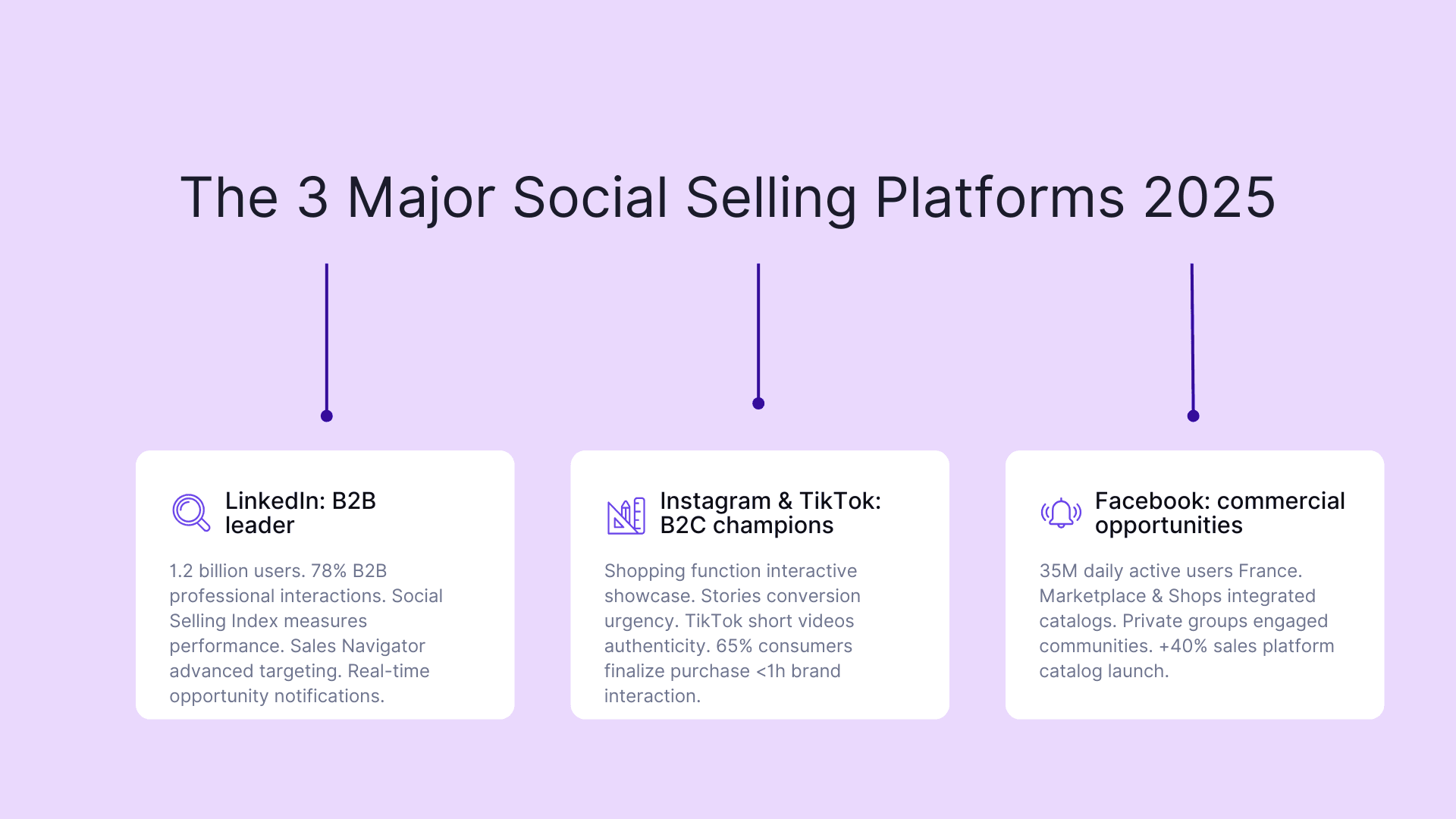
LinkedIn: the leading social selling network
As the world's leading professional network, LinkedIn dominates the professional social selling landscape. Its strength lies in its unique database of decision-makers and its ability to facilitate qualified connections.
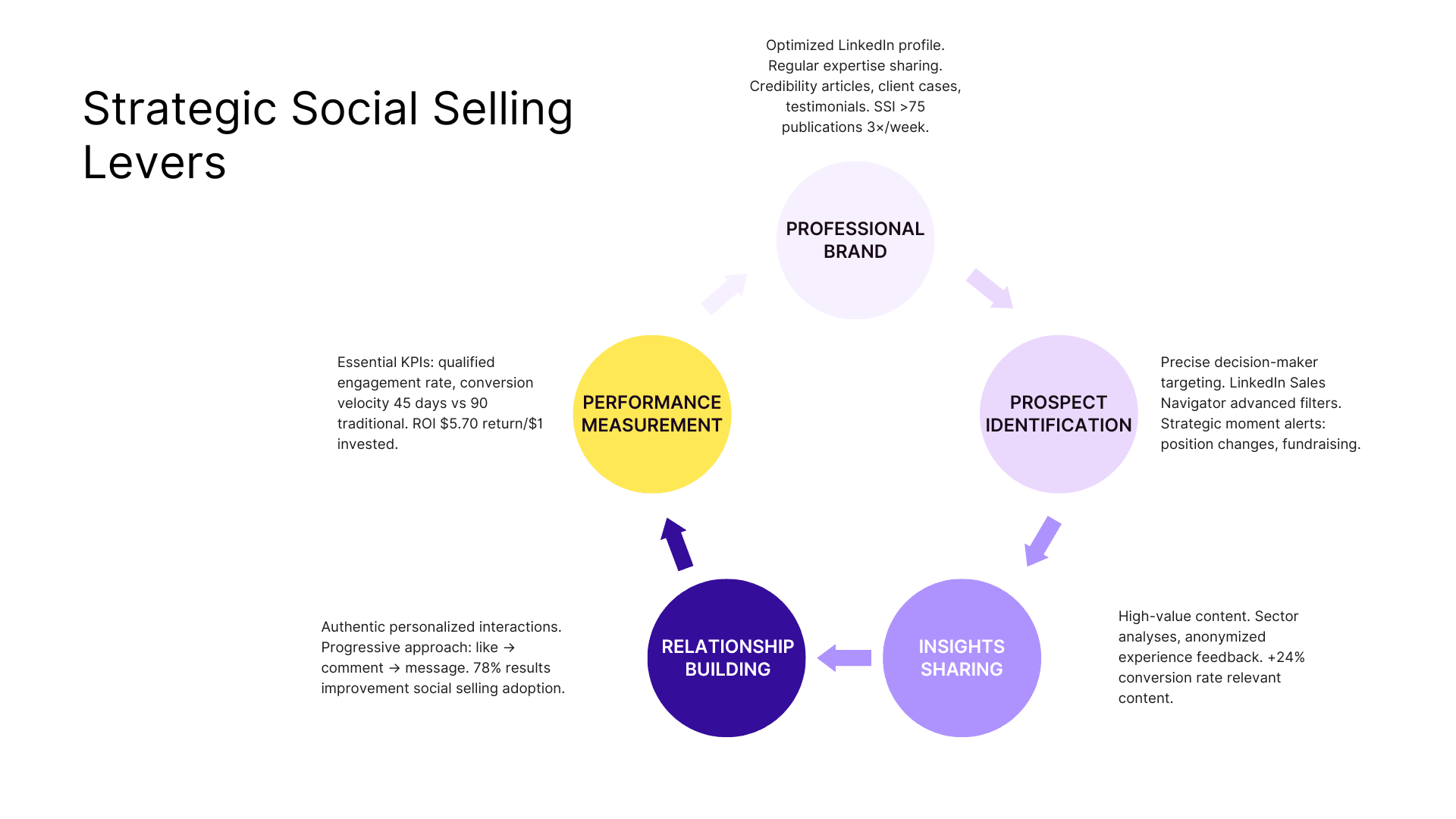
The network stands out through exclusive features like the social selling index, measuring seller performance according to four criteria: personal brand, prospect identification, insight sharing, and relationship building.
The platform offers advanced targeting and prospecting tools, allowing precise reach of relevant decision-makers. Real-time activity notifications signal opportune moments to engage conversation, while the recommendation system facilitates organic professional network expansion.
Beyond LinkedIn
X (formerly Twitter) stays useful for monitoring: tech and media executives comment there on their own news and their competitors', which surfaces buying signals before they show up on LinkedIn. YouTube and podcasts let you build the kind of deep expertise a single post can't convey. Private communities (Slack, Discord, or WhatsApp groups for a function or an industry) gather decision-makers who talk openly about their problems there: contributing without selling is the purest form of social selling.
Facebook, Instagram, and TikTok belong to B2C social selling: brand dynamics, impulse buying, live shopping. They fall outside the scope of this guide, which focuses on LinkedIn and B2B sales, where long cycles and multi-stakeholder decisions play out.
Mastering LinkedIn for social selling
Optimizing your SSI (social selling index)
Mastering the social selling index requires a methodical and regular approach. An optimal score requires daily activation of four key levers: establish your professional brand, enrich your qualified network, share relevant content, and cultivate your relationships.
The key lies in action regularity. Dedicate 30 minutes each morning to commenting on your sector's publications and sharing your expertise. High-performing sales professionals maintain a score above 75 by publishing at least three weekly contents and systematically responding to received comments.
Prioritize interaction quality over quantity. An in-depth analysis on a current topic in your industry will generate more impact than a dozen shares without added value. For example, an HR consultant saw his SSI jump 15 points in a month by documenting his client experience feedback.
Using LinkedIn sales navigator effectively
Sales Navigator's power comes from its filters (industry, company size, job title) and its follow-up lists: you target the right decision-makers and keep every account under watch. Alerts flag the right moments to reach out (a job change, a funding round, a newly announced project), and CRM sync keeps your contact records enriched with up-to-date information.
The prospecting mechanics themselves (advanced filters, sequences, message templates) are covered in our guide to LinkedIn prospecting. What matters here is the posture: a credible profile, a regular presence, and interactions that give something before asking for anything.
Best engagement practices
LinkedIn success relies on your ability to create authentic interactions with your network. Prioritize personalized exchanges by constructively responding to your strategic contacts' publications.
Adopt a progressive approach in your contact attempts. A simple "like" can evolve into a relevant comment, then naturally into a private message to deepen the discussion.
That private message isn't meant to sell but to land a qualified meeting: that is exactly the work of setting, with its three framing questions on the prospect's context, stakes, and timeline.
Opportune moments deserve particular attention: position changes, certification obtainment, or event participation represent ideal occasions to naturally restart dialogue.
Regularly share your expertise through anonymized client cases or concrete experience feedback. A cybersecurity consultant strengthened his credibility by publishing weekly analyses of the latest detected threats.
Essential tools for success
CRMs adapted to social selling
Syncing your CRM with your social networks changes the nature of your sales follow-up. Modern solutions centralize data from LinkedIn and, for monitoring purposes, X, in a single unified interface.
A personalized dashboard visualizes each prospect's complete journey: social network interactions, email exchanges, past appointments. This 360° view guides sales professionals toward the most relevant actions.
Next-generation CRM platforms integrate artificial intelligence features that analyze social media behaviors. This technology predicts the best time to contact a prospect and suggests the most appropriate communication channel, doubling engagement rates.
Monitoring and data analysis tools
For a B2B salesperson, useful monitoring comes in three layers: Sales Navigator alerts on tracked accounts and contacts, intent signals (funding rounds, hiring, job changes, new locations) captured by enrichment tools, and semi-automated LinkedIn sequences (tools like Waalaxy, lemlist, or La Growth Machine) that keep you in control of the message.
Social listening tools like Brandwatch or Talkwalker remain marketing tools: they measure a brand, they don't qualify a prospect. And automating your monitoring has only one real justification: freeing up time to actually read what a decision-maker publishes before you write to them.
Content management solutions
Collaborative platforms transform content creation and distribution on social networks. A centralized editorial calendar synchronizes the entire sales team's publications, ensuring consistent presence on each channel.
The shared resource library simplifies access to validated materials: case studies, white papers, or testimonial videos. Sales professionals draw from this catalog to enrich their exchanges with prospects.
That same content base feeds the sales proposal: the case studies and testimonials that got a reaction from a prospect on LinkedIn belong in the proposal they'll receive, provided you weave them into their context instead of stacking them in an appendix.
A marketing manager tripled his team's engagement by structuring a thematic content base, adapted to different sales cycle stages. This organized approach strengthens message impact while reducing time spent searching for relevant content.
Advanced social selling strategies by sector
B2B approach: examples and case studies
A digital services company's experience demonstrates B2B social selling power. By adopting a targeted influence strategy, this company transformed its digital presence into a source of commercial opportunities. Regular publication of technical analyses on LinkedIn attracted attention from large corporation IT directors.
An industrial equipment manufacturer revolutionized its commercial approach through qualified conversations on professional networks. Its sales engineers now share their technical expertise through detailed case studies. This approach generates a dozen qualified prospect requests monthly.
Success lies in combining sector expertise with authentic exchanges. An HR software publisher documents sector innovations through client testimonials, naturally creating dialogue opportunities with decision-makers.
B2C social selling (Instagram, TikTok, live shopping) follows different rules, centered on brand and impulse buying, and falls outside the scope of this guide. In B2B, the game plays out on LinkedIn: long cycles, multiple decision-makers, and a relationship built well before the proposal.
Social selling in the financial sector
The financial sector adopts a unique social selling approach in 2026. Bank advisors build their expertise by sharing in-depth market analyses and economic news interpretations.
A major French banking group revolutionized its relationship approach: its experts now publish weekly LinkedIn podcasts, analyzing responsible investment trends. This editorial approach naturally attracts premium clientele sensitive to ESG issues.
Strategic use of behavioral data considerably enriches interactions. Predictive algorithms anticipate client investment needs, allowing advisors to intervene at the right moment with personalized recommendations. This proactive approach redefines the traditional client-banker relationship.
Training and skill development in social selling
Available educational resources
A complete range of learning materials accompanies professionals in their skill development. E-learning platforms offer interactive modules adapted to each level, from beginner to social selling expert.
Weekly webinars led by experienced practitioners allow exploring real cases and exchanging best practices. An automotive salesperson doubled his portfolio after following a mixed program combining theory and practical exercises.
The specialized digital library provides:
- Sector-specific methodological guides
- Contact message templates
- Quantified performance studies
- Commented demonstration videos
Are certifications worth it?
There's no reference-grade certification in social selling, and that's good news: the skill proves itself by publishing. The most useful paths are free, starting with the Sales Navigator training offered by LinkedIn and the HubSpot Academy certifications on inbound and social media. Be wary of grand-sounding titles sold by private organizations: an active profile, a qualified network, and meetings booked count for more than a badge.
Choosing a specialized agency
Selecting a social selling agency deserves particular attention. Look for a structure demonstrating tangible results through its client portfolio and documented case studies.
Personalized support constitutes a major asset: your agency must understand your commercial objectives and adapt its strategy to your industry sector. For example, an industrial SME tripled its qualified leads through a custom approach combining technical content creation and targeted prospecting.
Transparency on performance indicators represents a decisive criterion. The best agencies share detailed monthly dashboards and organize regular meetings to adjust their strategy according to your feedback.
Measuring your social selling strategy performance
Essential KPIs to track
Qualified engagement rate constitutes the cornerstone of a successful social selling strategy. This metric combines the number of relevant interactions with their quality, allowing precise evaluation of your commercial actions' impact on social media.
**Conversion velocity** measures the time elapsed between first social contact and signature. Compare it against your other channels (cold calling, trade shows, inbound) rather than against a market figure that knows nothing about your average deal size or decision cycle.
Active recommendation score reveals your ability to turn clients into ambassadors. According to Spyral Conseil, 91% of clients are willing to make a referral, but only 11% of salespeople actually ask: track the share of clients who've actually introduced you to a peer, and ask for it systematically at the end of every project.
Social selling ROI analysis
Social selling profitability is measured the same way as any other channel: total cost (sales time, Sales Navigator licenses, content) set against revenue signed on opportunities whose first contact came from social media. Without first-contact attribution in your CRM, ROI stays an opinion.
Commercial performance data allows establishing a direct link between social media activity and revenue growth. For example, an IT services company saw a 32% increase in revenue after 6 months of investment in its digital strategy.
Return on investment measurement relies on advanced analysis tools that track the complete prospect journey, from first social contact to signature. This global approach allows identifying the most profitable actions and optimizing resource allocation.
Commercial effectiveness barometer
Teams that are improving no longer measure the volume of messages sent but the share of conversations that turn into a meeting, and that share depends first on targeting quality and the context you bring to the first message. Artificial intelligence helps prepare that context (summarizing a profile, spotting a signal, drafting a first version), but it doesn't replace actually reading what a decision-maker publishes. According to Salesforce's State of Sales 2026 study, 87% of sales organizations already use AI for prospecting, forecasting, or email drafting: it's become a prerequisite, not a competitive edge.
To benchmark yourself, build your own barometer: invitation acceptance rate, first-message response rate, share of meetings sourced from social media, and cycle length on those opportunities. Compare these indicators quarter over quarter rather than against market averages whose sample and methodology you don't actually know.
Frequently asked questions
What is social selling?
It's a sales method that uses social media to identify, connect with, and nurture potential buyers by building relationships and providing value before pitching.
What's the difference from social media marketing?
It allows salespeople to build trust and credibility with prospects before any direct sales approach, resulting in warmer leads and higher conversion rates.
What's the main advantage of social selling?
LinkedIn is the primary platform for B2B social selling, complemented by Twitter for thought leadership and industry engagement.