
The fundamentals of an effective sales strategy
The 3 essential pillars of modern sales
Sales success in 2026 rests on three inseparable fundamentals. The first pillar, product mastery, requires deep knowledge of your offering and its added value in the market.
The second pillar concerns relationship expertise. A high-performing salesperson knows how to create an authentic connection with prospects through active listening and personalized communication.
The third pillar relies on sales methodology. A structured approach, from first contact to signature, optimizes every interaction. For example, a B2B sales professional who masters these three pillars will more easily convert a hesitant prospect by analyzing their specific needs, demonstrating added value, and naturally guiding the conversation toward a positive conclusion.
How to build a solid sales pitch
Building a compelling pitch starts with thorough analysis of your prospect's buying motivations. An experienced salesperson knows how to adapt their message according to the SONCAS profile: Security, Pride, Novelty, Comfort, Money, Sympathy.
Structure your presentation with the CAP method: Technical Characteristics, Competitive Advantages, Concrete Proof. For example, a software solutions provider doesn't just list features but demonstrates ROI with similar client cases.
Quantified proof reinforces your credibility: satisfaction rates, productivity gains, savings achieved. A solid pitch also anticipates classic objections and prepares responses based on measurable facts.
The importance of preparation in the process
Meticulous preparation radically transforms the effectiveness of a sales meeting. Thorough research of the prospect, their industry, and their challenges allows you to anticipate the real needs of the targeted company.
Preparation time is rarely the problem; how it gets used is. Only 33% of a salesperson's time actually goes to selling, and 42% of reps call a prospect without any relevant information on them (Spyral Conseil, figures collected in our sales statistics). Methodical preparation means setting precise objectives, drafting relevant questions, and tailoring the pitch to each decision-maker.
A comprehensive market diagnosis reveals competitors' strengths and weaknesses. This panoramic view reinforces the salesperson's credibility from the first seconds, significantly increasing the conversion rate.
The 7 key steps of a successful sales meeting
Initial contact and rapport building
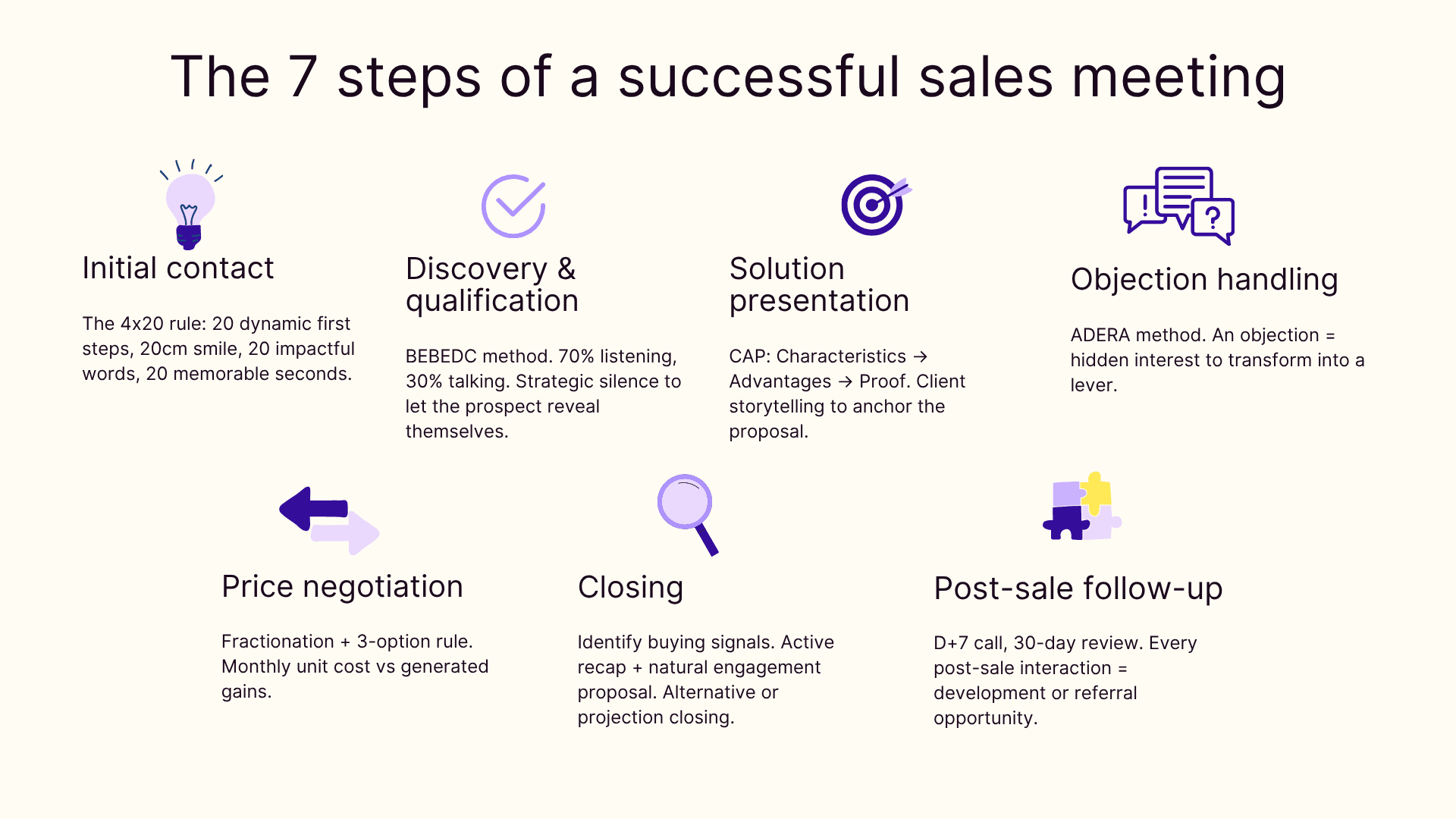
The success of a first contact relies on the first 20 seconds. A sales expert masters the 4x20 rule: 20 dynamic first steps, 20 centimeters of authentic smile, 20 impactful introduction words, 20 seconds of a memorable hook.
Establishing rapport involves subtle synchronization with your contact. Adapt your speaking pace, posture, and vocabulary to create a natural connection.
Here are the key elements of successful initial contact:
- Personalized introduction message
- Active listening from the first exchanges
- Body language aligned with your message
An experienced salesperson also knows how to use the power of open-ended questions to engage conversation and create a climate conducive to constructive exchanges.
Discovery and qualification phase
The discovery phase represents a decisive moment where your expertise makes the difference. An experienced salesperson uses the BEBEDC method (Budget, Team, Need, Timeline, Decision, Competition) to structure their sales diagnosis.
Qualification relies on strategic questions that reveal the prospect's deep motivations. For example, rather than asking "What's your budget?", phrase it as "How do you envision the investment in this project?" This approach naturally reveals financial stakes.
Successful diagnosis involves mastering strategic silence. Let your contact develop their response without interrupting. This technique provides valuable information about the decision context and potential purchase barriers.
Solution presentation
Successful sales presentation relies on methodical structuring of your message. Start by recapping key points identified during the discovery phase, then articulate your solution around concrete benefits for your prospect.
A seasoned professional knows how to adapt their pace to their contact's signals. The optimal ratio: 70% listening, 30% talking. Favor interactive demonstrations that allow the prospect to project themselves into using your solution.
Adopt commercial storytelling techniques to make your presentation memorable. Tell how other similar companies transformed their challenges into opportunities with your solution. Quantified case studies reinforce your proposal's credibility and facilitate decision-making.
That presentation doesn't stop at the meeting: the sales proposal you send afterward must mirror exactly the issues you heard, in substance and in form, or a single page will undo the effect of the entire discovery phase.
Objection handling
An objection often reveals hidden interest from the prospect. The ADERA method transforms each resistance into an opportunity: Accept the objection without contesting it, Discover its real origin, Explore underlying motivations, Respond with tangible proof, Accompany toward agreement.
An experienced salesperson knows how to bounce back from classic reluctance. For example, when a prospect mentions price, the response focuses on ROI rather than gross cost.
Mastering strategic silence after a response reinforces your credibility. This technique allows the prospect to absorb your arguments and encourages their engagement in the sales process.
Price negotiation
Mastering the fractionation strategy radically transforms the price approach. This approach consists of breaking down the total amount into more digestible units: cost per user, per month, or per feature.
A high-performing salesperson knows how to value each price component through tangible benefits. For example, facing a $12,000 annual investment, present it as a $1,000 monthly solution generating $4,000 in quarterly savings.
The three-option rule strengthens your position. Always propose a premium formula above your target, an intermediate offer corresponding to your objective, and a basic version. This strategy naturally guides the choice toward the middle option, optimizing your margins while preserving client satisfaction.
Closing the sale
The art of finalizing a transaction relies on the ability to identify favorable buying signals. A seasoned professional recognizes these indicators: questions about practical details, projection into product usage, or requests for timeline clarification.
The golden rule of modern closing relies on the principle of active recap. Summarize established agreement points, then naturally transition to an engagement proposal. For example: "We've validated together that our solution meets your three main criteria. Would you like to start next week?"
Alternative closing proves formidable: "Do you prefer delivery at the beginning or end of the month?" This phrasing subtly guides toward action while leaving choice to the client.
Post-sale follow-up
Implementing a structured post-sale follow-up system determines the sustainability of your client relationship. A winning strategy consists of planning regular contact points: a call on day 7 to validate immediate satisfaction, then a review meeting after 30 days of use.
Establish a personalized checklist for each client type. For example, for software solution purchases, schedule a technical support session, followed by a satisfaction questionnaire and an advanced features presentation.
The best salespeople transform each post-sale interaction into a development opportunity. A simple courtesy call can reveal complementary needs or generate referrals to other prospects. Systematically document these exchanges to enrich your client knowledge.
The 27 methods in this guide, by stage of the sales cycle
Sales methods aren't rivals. They come in sequence, each at its own stage of the cycle. Here's where each one fits, with a link to its detailed guide.
Booking the meeting
- CROC method: the framework for an outbound call, from first contact to close.
- Social selling: building the relationship on LinkedIn before you sell.
- Inbound sales: handling the prospects who come to you.
- Setting: separating appointment setting from closing.
Winning the first few minutes
- 4x20 rule: what gets decided in the first twenty seconds.
- DISC method: matching your tempo to the buyer's behavioral profile.
- Active listening: getting them talking, restating, confirming.
Discovery and qualification
- Open-ended questions: getting the prospect to talk about what's at stake for them.
- Closed-ended questions: locking down a point before moving on.
- QQOQCP: framing a problem from every angle.
- CQQCOQP: the same grid applied to sales, with the "How much" added.
- 5 whys: working back from the symptom to the real cause.
- SPIN Selling: sequencing your questions all the way to the cost of inaction.
- BANT: the baseline qualification filter.
- BEBEDC: BANT extended with the buying team and the competition.
- MEDDIC: qualifying long cycles with multiple decision-makers.
- Gap Selling: measuring the gap between the current state and the target state.
Reading motivations and building the pitch
- SONCASE: identifying the buyer's dominant psychological lever.
- CAP SONCAS: aligning every argument with that lever.
- CAB method: turning a feature into a concrete benefit.
- SIMAC method: structuring the full meeting in five steps.
- The 4Cs: thinking in total cost and convenience rather than product and price.
- Solution Selling: starting from a diagnosis of the problem.
- Value Selling: quantifying the impact before talking price.
- Challenger Sales: shaking up the customer's view with a teaching insight.
Handling objections and closing
- CRAC method: dig, restate, argue, check.
- Q2C Selling: connecting qualification and closing in one documented process.
Mastering classic sales techniques
The SONCAS method: Understanding motivations
The SONCAS method represents a decisive tool for deciphering psychological levers that guide purchase decisions. Each letter stands for a distinct buying motivation in the original French acronym: Security, Pride (Orgueil), Novelty, Comfort, Money (Argent), and Sympathy.
A savvy salesperson uses this approach from their first exchanges with the prospect. For example, facing a client who regularly mentions guarantees and reliability, you'll activate the Security lever by highlighting your certifications and references.
The art of SONCAS lies in your ability to quickly detect the dominant motivation. A buyer sensitive to Pride will respond favorably to mentions of prestige and exclusivity. Conversely, a Money profile will be more interested in ROI and achievable savings.
The CAP technique for effective argumentation
The CAP technique structures your sales pitch in three strategic phases: Characteristics, Advantages, Proof. This approach transforms each technical characteristic into a concrete benefit for your potential client.
A high-performing salesperson applies this method naturally. Take the example of a data management solution: rather than announcing "1TB cloud storage," present the advantage "instant access to your documents from any device," then reinforce with proof "95% of our users save 2 hours per week."
The power of CAP lies in its ability to create a direct link between product specifics and measurable results for the company. This method is particularly adapted to B2B sales cycles where value demonstration guides decision-making.
The AIDA method: From attention to action
The AIDA model revolutionizes sales message structuring in four strategic phases. The first step, Attention, requires a compelling hook that instantly catches your prospect's attention. For example, a surprising statistic or a provocative question about their industry.
Interest is then cultivated through a targeted presentation of specific benefits for your contact. Desire awakens through concrete proof: case studies, client testimonials, or quantified demonstrations of achieved results.
The final phase, Action, transforms this desire into concrete engagement. A precise call to action like "Reserve your free audit this week" naturally guides toward a decision.
Closing: Techniques to conclude
Successful closing relies on your ability to choose the right approach at the right time. The mirror closing technique consists of reformulating the prospect's words to validate understanding and reinforce their agreement.
Quantified benefits closing presents concrete results: "This solution will allow you to save 20% on operational costs from the first month."
The silent closing method proves formidable: after presenting your proposal, mark a strategic pause. This reflection moment naturally pushes your contact to take a position.
Projection closing invites the prospect to visualize themselves post-purchase: "In three months, when your teams have gained 4 hours per week thanks to this solution, how will you use this saved time?"
Modern sales methods to adopt
Consultative selling and advisory
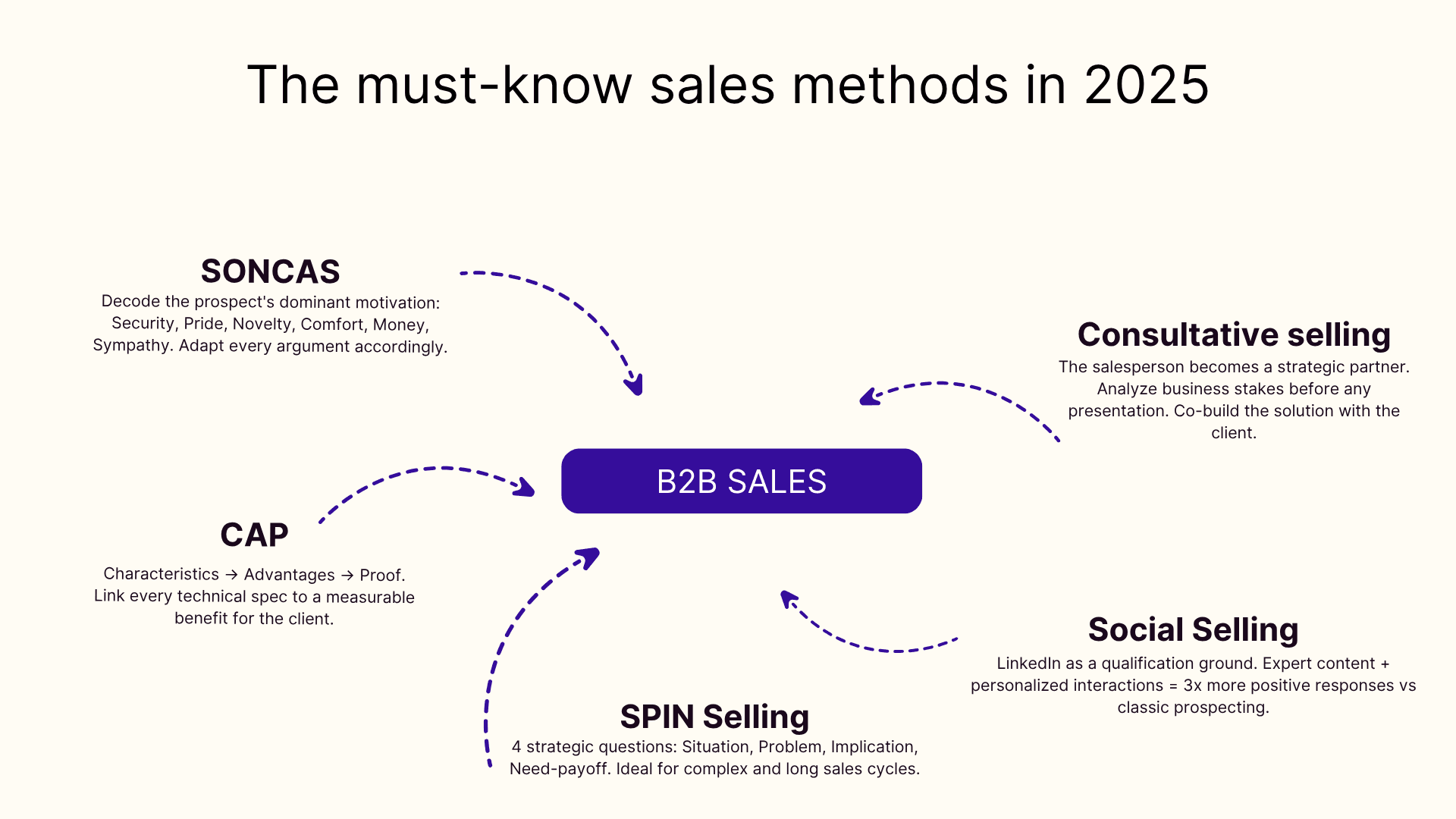
Consultative selling revolutionizes the sales approach by positioning the salesperson as a strategic partner. This method radically transforms client relationships by creating an exchange dynamic based on expertise and problem-solving.
A salesperson mastering this approach meticulously analyzes their prospect's business stakes before any presentation. Facing a CFO seeking to optimize processes, the consultative seller first explores current operational and financial impacts.
This approach's strength lies in its ability to generate customized solutions. The professional accompanies their client in deep reflection, surpassing the simple product framework to reach a global understanding of organizational needs.
Social selling and digital sales
Social selling redefines commercial prospecting codes in 2026. Professional social networks become privileged terrain for identifying and qualifying your prospects with precision.
High-performing salespeople combine a polished digital presence with high-value content. For example, a LinkedIn article on your sector's specific challenges will naturally attract qualified decision-makers.
Social selling success relies on your ability to create authentic interactions. A personalized message based on relevant business news will generate more engagement than classic sales approaches. The numbers back this up: 72% of salespeople already use social networks to research their targets, and those who build social into their prospecting raise their success rate by 51% (Uptoo).
The SPIN method for long cycles
The SPIN method establishes itself as a structuring approach for complex B2B sales. This technique relies on four types of strategic questions: Situation, Problem, Implication, and Need-payoff.
An experienced salesperson uses this sequence to naturally guide their prospect toward the solution. For example, facing an operations director, implication questions explore the financial impact of production delays: "What would be the cost of an additional hour of downtime for your production line?"
Need-payoff questions allow the prospect to verbalize the benefits themselves: "How would a 30% reduction in downtime affect your profitability?" This methodical approach reinforces conversion rates on long sales cycles.
Optimizing your sales performance
The must-have sales tools in 2026-2027
Modern sales performance runs on a strategic stack of digital tools. A powerful CRM is the cornerstone, centralizing your prospect data so you can run your pipeline with precision.
Marketing automation platforms strengthen your prospecting by qualifying leads automatically based on how engaged they are. An e-signature tool speeds up contract finalization, shortening your sales cycle in the process.
Sales intelligence platforms read your prospects' buying signals with AI, helping you spot the right moment to reach out. A structured sales proposal generator turns your pitch into a document built to close, maximizing your odds at every stage.
How to measure and improve your closing rate
Precisely measuring your conversion rate is the foundation of any serious sales optimization effort. A weekly review lets you spot where things are slipping and adjust fast.
Start by segmenting your data by prospect type, industry, and deal size. This analysis often surfaces opportunities you didn't know were there. Measuring in the first place is the real hurdle: 39% of companies don't track their closing rate, or don't know whether they do (Sales Odyssey survey, 2025), which means they're missing exactly the segments where they win most often.
A close look at your negotiation process exposes the critical moments where deals fall apart. Pay particular attention to how you present price and handle technical objections. This kind of methodical review turns every lost deal into a lesson for the next one.
The essential KPIs to track
Tracking your average deal size shows the real value of each transaction and points you toward upsell opportunities. A salesperson who watches this number closely can spot when to expand an account with precision.
Your client retention rate shows how solid your book of business really is. The best teams track it with the same rigor as revenue, because it depends directly on how well they stay on top of client needs.
Also measure your proposal win rate: deals signed divided by proposals sent. This number tells you how well your pitch is actually landing.
Watch the average time between repeat purchases to anticipate renewal cycles. A shrinking gap signals growing client satisfaction and a sales team that's performing.
Winning negotiation strategies
Advanced persuasion techniques
Mastering psychological levers changes how you approach a negotiation. An experienced salesperson uses the principle of reciprocity, offering real expertise before even mentioning a solution. That creates a sense of obligation that works in your favor.
Emotional framing strengthens the connection with your prospect. Telling how a CFO cut costs meaningfully thanks to your solution sticks with people far more than a plain rundown of features.
The "reframe" technique changes how price gets perceived. Facing a large annual budget, break the total down into a cost per day instead: the same number suddenly looks a lot more manageable. Shifting the frame like this makes the decision easier by changing how your prospect sees the number.
Handling complex objections
Facing a sophisticated B2B objection, a structured four-step process maximizes your chances of getting past it. Start by validating that the objection is legitimate, questioning its source and its exact context.
Take a posture of exploration rather than immediate defense. A question like "What makes you say that?" helps you get at what's really driving the concern underneath.
Offer a calibrated response backed by tangible proof: a case study, hard data, or a client testimonial. An objection gets handled with one precise argument, not an avalanche of them. The more justifications you stack up, the more you signal that the point actually worries you.
Confirm your response landed before you move on. A simple "Does that address your concern?" is enough to know the obstacle is cleared.
The psychological levers of decision-making
Understanding the decision-making process changes how you present an offer. Even in B2B, the decision is never purely rational: 84% of buyers expect the salesperson to act as a trusted advisor first (Salesforce), and that trust gets built on relational signals well before it's ever backed up with numbers.
Mental contrast speeds up decisions: present the problematic current situation first, then lay out the benefits of your solution. This creates a natural pull toward change.
The principle of progressive commitment works remarkably well in B2B. Start with a small ask, like attending a webinar, before you propose a personalized demo.
Anchoring shapes price negotiations directly. A good salesperson always presents three options, positioning the preferred offer strategically in the middle.
Training and skills development
Effective training programs
An effective sales training program is built on real role-play, not lectures. The best programs lean heavily on hands-on practice, with just enough theory to make the exercises make sense.
The trainer's quality makes the difference. A practitioner with real field experience passes on know-how through cases drawn from their own career, which makes the learning immediately usable.
Favor programs that include:
- Filmed role-play sessions to analyze your strengths
- Personalized follow-up for several months after training ends
- Measurable tools to track your progress
- Small groups, not large cohorts
Hybrid formats, blending in-person and digital learning, help skills stick through regular, progressive practice.
Self-directed learning and online resources
The rise of digital platforms is changing how people learn sales techniques. Specialized online courses offer structured paths with video modules, practical exercises, and regular checks on your progress.
Sales podcasts are a great way to make commute time productive. Experts share what's working for them and walk through real negotiation cases.
Interactive webinars let you exchange directly with experienced professionals on focused topics like digital prospecting or closing deals remotely. Live Q&A keeps the learning dynamic.
A modern salesperson gets the most out of these resources by combining them to fit their goals and their own pace.
Mentoring and sales coaching
Personalized coaching changes how fast a salesperson improves. Coaching targets the specific gaps each person has, enabling faster growth in the field.
The mentor relationship creates something a course can't replicate: an experienced professional shares what actually works and helps a newer rep sidestep the classic mistakes. This isn't a nice-to-have: two-thirds of salespeople evaluated don't have the level expected to close a sale, and 61% of them rank training above pay as their top motivator (Uptoo).
Modern coaching mixes one-on-one sessions with digital follow-up. Reviewing recorded sales calls sharpens questioning and negotiation technique. This approach speeds up the acquisition of good sales instincts and builds real confidence in the field.
Adapting your techniques to the context
B2B vs. B2C selling
B2B selling stands apart through decision cycles that run considerably longer. A B2B purchase typically pulls in several decision-makers, each one judging the proposal from a different angle: technical, financial, legal.
B2C selling moves on fast emotional decisions, while B2B demands a methodical demonstration of ROI. Management software sold in B2B needs hard proof of the savings achieved, for example, while its consumer equivalent sells on ease of use.
Pricing strategies differ sharply too: B2C runs on fixed prices, while B2B favors tailored pricing based on volume, commitment level, and bundled services. That flexibility calls for real skill in complex negotiation.
The specifics of remote selling
Mastering remote sales technique changes sales performance in 2026. An experienced salesperson knows how to build a genuine connection even through a screen, using body language and gestures suited to video calls.
Questioning takes on a new dimension remotely. Questions need to be sharper and more precise to hold a prospect's attention. A strong salesperson alternates strategic questions with controlled silence, giving the other person room to fully express themselves.
Presenting solutions relies on dynamic visual support: interactive screen shares, live demos, and collaborative documents. This multimedia approach reinforces your message and makes the benefits easier to grasp.
Techniques for key accounts
Winning in key account sales comes down to a multi-level strategic approach. Decision mapping is your best asset: map out every key contact, their role, and their sphere of influence inside the organization.
The "internal champion" technique changes how you prospect. Identify and support a strategic ally who will carry your project inside the company. A convinced operations director, for example, will naturally rally their teams and help win over other departments.
ROI storytelling elevates your key account presentations. Structure your narrative around similar case studies, backed by numbers. An experienced salesperson combines quantitative data with qualitative testimonials to demonstrate value at every level of the hierarchy.
Sales mistakes to avoid
Classic traps for new salespeople
New salespeople often fall into the product monologue trap. Excited about their solution, they talk features nonstop without listening to what the prospect actually needs.
Another common trap is rushing toward the close. A new salesperson quotes a price too early, before they've built up the value of the offer. When asked "How much does it cost?", for example, it's better to answer "Let me understand your needs first, so I can put together a proposal that actually fits."
Fear of silence is a major drag on sales effectiveness. Beginners nervously fill every pause in the conversation, robbing the prospect of valuable thinking time. Mastering strategic silence is what separates an amateur from a seasoned professional.
Bad habits to correct
Experienced salespeople need to watch for counterproductive habits that creep in over time. Interrupting the client to deliver a prepared response seriously hurts the quality of the exchange.
Excessive familiarity is another common pitfall. A seasoned salesperson keeps an appropriate professional distance, even with regular clients.
Sloppy note-taking during meetings weakens client follow-up. A rigorous professional captures the key points immediately after each meeting, documenting specific needs and next steps.
Never questioning your own losses is a major barrier to progress. The best salespeople systematically review their performance to find where they need to improve.
Warning signs to watch for
Spotting early warning signs can save a negotiation. A prospect who keeps checking their watch or phone is signaling growing disengagement from the conversation.
Sudden shifts in body language deserve your full attention. A prospect who crosses their arms after a price presentation, or who leans back slightly, is showing early resistance.
A sudden flurry of questions about minor details sometimes masks a deeper reluctance. An experienced buyer uses this tactic to buy time or set up a bigger objection.
Stay alert to repeated requests for more documentation without any real commitment. This kind of stalling often points to a lack of decision-making power, or just a superficial interest.
Frequently asked questions
What's the fastest way to build strong sales technique?
Build technique through active practice: rehearse reframing client needs, practice presenting your solution in under two minutes, and record yourself to review your delivery. Use a structured questioning framework like SPIN to uncover what's really driving the prospect, and work on your active listening. Test different approaches in the field and adjust based on what actually gets results.
Which sales method should you use for B2B?
The right B2B sales strategy depends on your industry and how complex your product is. For technical solutions, favor a consultative approach built on expertise. Shorter cycles respond well to Challenger Sales, while complex, multi-stakeholder deals call for MEDDIC. Adjust your choice based on how digitally mature your prospects are and how their decision process works.
When and how should you adapt your sales technique?
Watch market signals and how your prospects behave, then adjust your approach accordingly. Change tack when your response rate drops, when you keep hearing the same objections, or when you're facing a new type of buyer. Review client feedback, test different presentation formats, and check what works on a small sample before rolling changes out across your entire approach.