
The fundamentals of Solution Selling
What is Solution Selling theory?
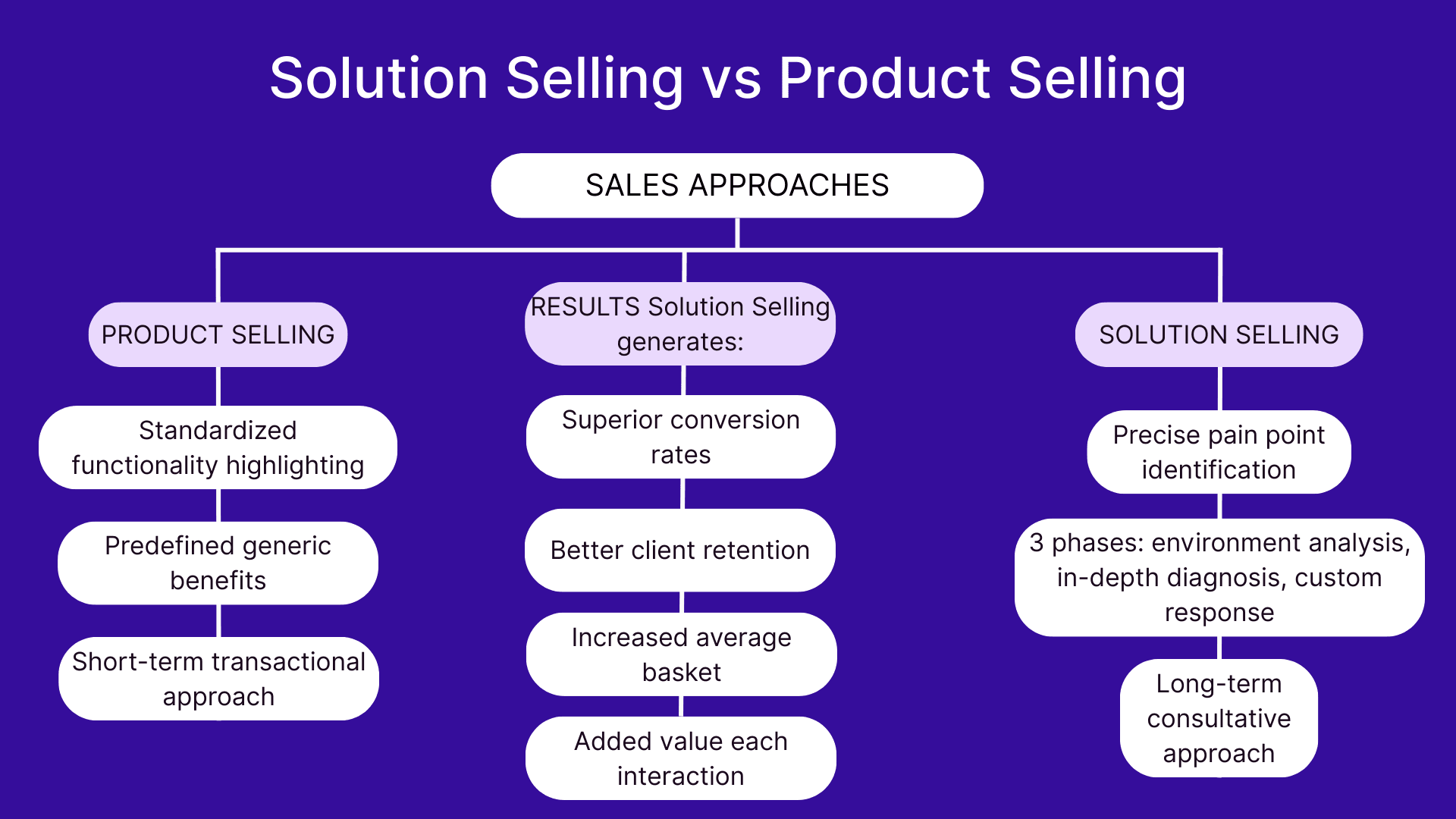
Solution Selling theory rests on a fundamental principle: the precise identification of the prospect's pain points before any product presentation. This structured approach breaks down into three strategic phases.
The salesperson first adopts an analyst posture to understand their contact's complete environment. They then conduct an in-depth diagnosis to reveal latent issues. The final phase consists of building a custom response aligned with the prospect's business objectives.
A concrete example: rather than touting the features of a CRM software, the vendor first analyzes the current customer management processes to demonstrate the potential gains of a new approach.
Solution Selling vs. the product selling approach
Traditional product selling focuses on technical features and standardized benefits. Conversely, the solution approach places the client's specific needs at the center of the commercial process.
Take the example of a cybersecurity solutions provider: while product selling highlights firewall functionalities, solution selling first analyzes the client's infrastructure vulnerability to propose adapted protection.
This method requires more time and expertise but generates remarkable results: higher conversion rates, better retention, and an increased average deal size. The key lies in the ability to transform each interaction into an opportunity to create added value.
The origins: From Bosworth to today
Michael Bosworth formalized Solution Selling in 1983, after leading sales training at Xerox Computer Services, where he was influenced by Huthwaite's research into complex sales, the same research that gave rise to SPIN Selling. His reference book came out in 1994; Keith Eades, of Sales Performance International, published an updated version in 2003, The New Solution Selling.
The methodology experienced tremendous success in the high-tech industry of the 80s-90s. Companies massively adopted this approach that transformed their sales teams into true strategic consultants.
In 2026, Solution Selling remains a global reference, particularly adapted to the digital era. Its evolution now integrates artificial intelligence and social selling, while maintaining its fundamental principle: understand before convincing.
The Solution Selling methodology in detail
The prospect qualification process
Prospect qualification relies on analyzing precise criteria to identify the most promising opportunities. An experienced salesperson first evaluates the financial capacity and decision-making power of their contact.
The MEDDIC method provides a structuring framework to maximize the efficiency of this phase. This approach evaluates key metrics, economic impact, and the prospect's decision process.
Successful qualification involves strategic questions:
- Need maturity: is the prospect actively seeking a solution?
- Available budget: do they have the necessary resources?
- Timeline: what's their implementation schedule?
A precise scoring of these elements optimizes time and sales resources.
Need identification techniques
The art of identifying needs relies on active listening and thorough analysis. A high-performing salesperson begins by establishing a precise mapping of their contact's professional environment. This approach reveals hidden challenges and improvement opportunities.
The SPIN technique provides an excellent investigation framework. It structures the interview around strategic questions about the current situation, encountered issues, and their business impacts. For example, in the B2B software sector, the vendor first explores existing processes before addressing operational friction points.
Diagnosing implicit needs requires particular attention to non-verbal signals and expressed frustrations. This fine understanding then enables the building of a proposal perfectly aligned with the prospect's expectations.
In practice, this diagnosis should show up in the proposal itself: the prospect's own pain points named upfront, the solution next, and as few pages as possible spent talking about the vendor.
Building the value proposition
Creating a compelling value proposition relies on transforming identified needs into measurable benefits. The secret lies in the ability to quantify the business impacts of your solution for the client. An experienced seller knows how to translate each pain point into a potential gain.
Putting a number on these benefits is the job of value selling, the natural extension of the diagnosis: expected financial results, operational gains, risks avoided. Solution Selling comes earlier in the process: it makes sure each of those numbers rests on a pain the client has admitted themselves, not on the seller's assumption.
Your proposition must also stand out through its uniqueness. Analyze the competition to identify your distinctive assets and build an argument that emphasizes your specific added value.
Core concepts of the Bosworth method
From latent pain to a vision of the solution
Bosworth describes three successive states a buyer moves through. The pain starts out latent: the prospect lives with a problem they no longer notice, or believe has no fix. It then becomes admitted: they recognize the problem, can put a cost on it, and are willing to talk about it. Finally comes the vision of the solution: they picture a concrete way to solve the problem, with specific capabilities they can name.
The whole discipline of the method comes down to one rule: the salesperson presents nothing until the other side has reached that third state. A prospect who is shown an offer before admitting their pain compares features; a prospect who has built a vision compares outcomes. The rule applies to the proposal too: the document formalizes a vision already shared in conversation, it does not create one.
The pain chain
A pain point is never isolated. The operations manager deals with delivery delays, the sales director loses renewals because of those delays, the CFO watches the margin erode. Bosworth calls this spread of an operational pain into a financial one, from one contact to the next, all the way to the decision-maker, the pain chain.
Mapping this chain during the diagnosis does two things. It shows who has the most to gain from championing the project internally, so who should be the sponsor. And it gives the salesperson the vocabulary for each level: the same problem gets told in lost hours to the operational contact and in margin points to the leadership team.
The nine-box model
To run the diagnostic conversation, Bosworth proposes a nine-box grid: three stages, each explored with three types of questions.
Diagnose the causes: what's causing the problem, since when, how often?
Explore the impact: who else is affected, what does the situation cost today, what happens if nothing changes?
Build the vision: what capabilities would the prospect need, and what would they actually do with them?
At each stage, the salesperson alternates between three types of questions: open questions ("Tell me how this works today"), control questions that suggest a lead ("Is this related to the fact that...?"), and confirmation questions that lock in what was said ("So, if I understand correctly..."). The prospect ends up doing most of the work themselves, which changes everything when it's time to defend the proposal against competing offers.
Sponsor, power sponsor, and sponsor letter
The sponsor is the contact who has admitted their pain and built a vision with the salesperson. The power sponsor is the one with the authority to sign, or to open the doors all the way to signature; it is often not the same person. The method calls for moving from the first to the second by leaning on the pain chain, and for redoing the diagnosis at that level rather than assuming the pain is identical there.
The sponsor letter puts this work in writing, right at the end of the first conversation: the admitted pain, its causes, the vision of the solution, the next steps, and a date for each. This letter commits both sides and serves as the throughline all the way to the proposal, which reuses its structure. It's the simplest tool in the method, and the one most often skipped.
Modern Solution Selling: complementary methods and tools
Challenger and social selling: complements, not substitutes
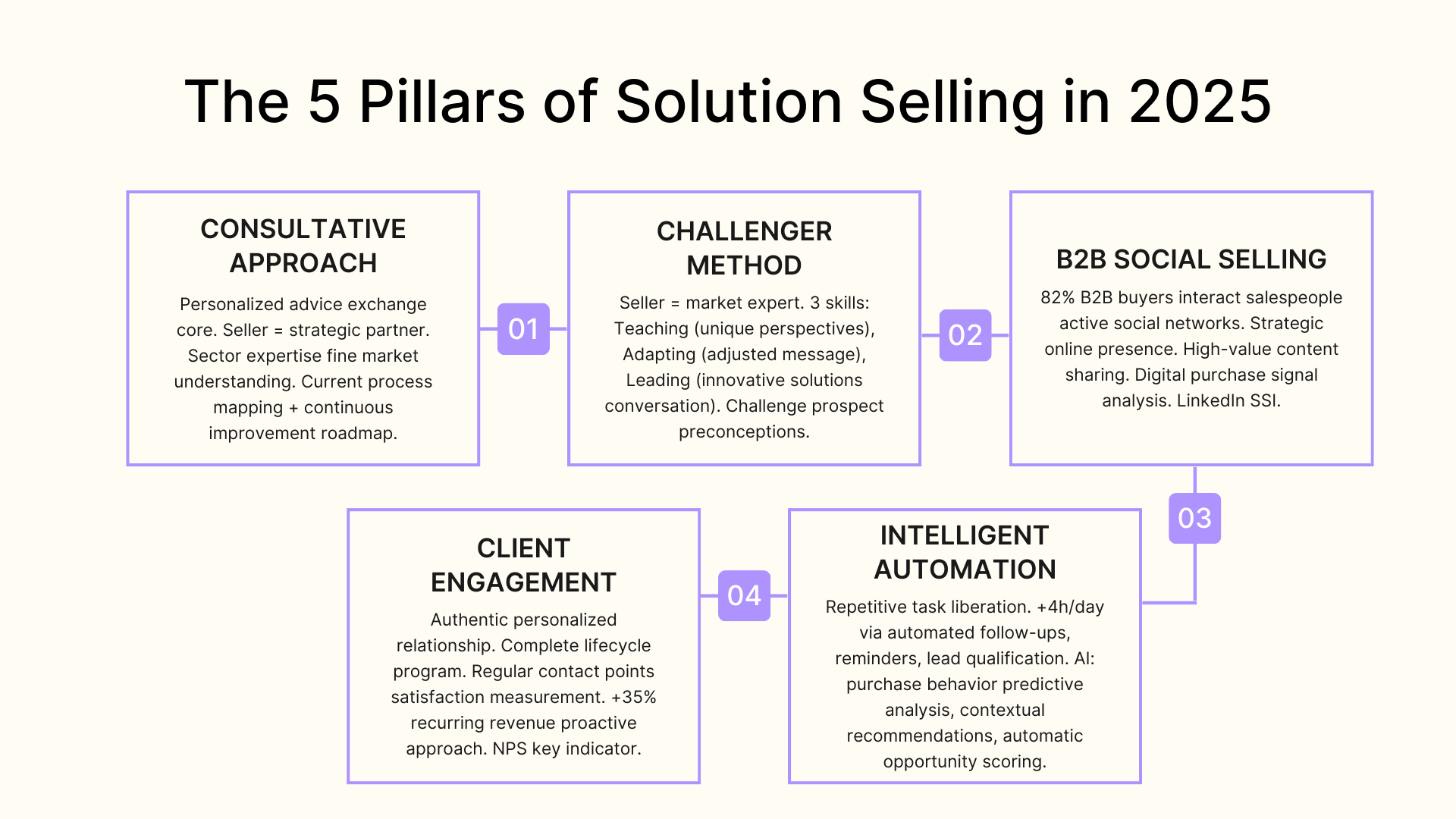
The Challenger method takes over once the prospect has already diagnosed their problem on their own, often before the first contact: the salesperson then teaches them something they don't know about their own business, instead of getting them to talk about a pain they already understand. Social selling, for its part, prepares the ground: a buyer checks out the salesperson's profile before responding, and useful content published beforehand makes that first diagnostic conversation easier to land. LinkedIn's Social Selling Index measures this presence, but it's an individual score, not a study: treat it as a benchmark, not as proof.
Intelligent process automation
Automation revolutionizes Solution Selling by freeing salespeople from repetitive tasks. Next-generation automation tools analyze customer data to prioritize high-value actions and personalize each interaction. According to Spyral Conseil, only 33% of a sales rep's time is actually spent selling; automating follow-ups, reminders, and lead qualification hands reps back hours every week. This increased productivity allows for dedicating more time to a fine understanding of client challenges. Automation is only a prerequisite: the time saved on follow-ups and documents needs to be reinvested in the relevance of every proposal, in substance and in form, because that is where the competition with other vendors under consideration is actually won. The magic happens when automation combines with artificial intelligence: predictive analysis of buying behaviors, contextual recommendations, and automatic opportunity scoring. For example, an intelligent system can identify the optimal moment to propose a demonstration based on the prospect's interaction history.
Optimized client engagement
Commercial success relies on an authentic and personalized relationship with each client. A successful engagement program combines targeted interactions with precise results measurement. High-performing companies adopt an approach based on the complete client lifecycle. From the first contact to renewal, each touchpoint represents an opportunity to enrich the relationship. In practice, an IT services company that sets up regular touchpoints and measures satisfaction with a metric like the Net Promoter Score picks up on expansion or renewal needs before a competitor is ever consulted. The stakes are real: according to Salesforce, 42% of sales leaders say recurring revenue is their main source of revenue.
Practical application of Solution Selling in a B2B context
Prospecting best practices
Successful prospecting relies on a structured and measurable methodology. A precise qualification system enables the quick evaluation of the relevance of commercial opportunities. Modern prospecting relies on thorough research before each contact. A high-performing salesperson analyzes buying signals like recent hires, funding rounds, or organizational changes. Creating a multichannel prospecting sequence reinforces the impact of commercial actions. This approach combines targeted LinkedIn messages, value-added emails, and strategically positioned calls in the prospect's buying journey. Detailed decision mapping forms the basis of successful prospecting, identifying key roles and their specific motivations in the buying process.
Conducting effective sales meetings
Successful sales meetings rely on meticulous preparation and a clear structure. Start by establishing a precise agenda that you share with your prospect at the beginning of the meeting. This transparency creates a reassuring and professional framework. Mastering questioning represents your best asset. Adopt the funnel questioning technique: start with open questions to understand the global context, then progressively refine toward specific points. An experienced salesperson dedicates 80% of their time to listening and 20% to speaking. A revealing example: during an HR solution sale, the salesperson begins with "Tell me about your current organization" before exploring daily challenges. This approach identifies hidden needs and builds a relevant proposition.
Winning closing strategies
Mastering closing relies on the ability to transform buying signals into a concrete commitment. A high-performing seller knows how to recognize these signals: questions about implementation methods, budget discussions, or client reference requests. These signals rarely show up alone: one last objection about price, timing, or change management almost always comes with them. The CRAC method helps you dig into it, reframe it, and answer it with a precise argument, then confirm it's resolved before you close. The progressive closing technique proves particularly effective in B2B. Validate each key point with your prospect before addressing the next one. For example, first obtain their agreement on the solution's relevance, then on the budget, and finally on the deployment timeline. This staged validation works even better when every step of the process, from qualification to closing, has an explicit exit criterion, which is exactly what Q2C Selling proposes to formalize for the whole team. Create natural urgency by linking your proposition to precise business objectives: "Starting next month would enable you to be operational for your September activity peak." This approach reinforces your solution's value while accelerating decision-making.
Training in Solution Selling and team development
Solution Selling onboarding programs
A strong Solution Selling onboarding program starts with the methodological fundamentals. New hires first learn to master needs diagnosis before moving on to solution presentation techniques.
Training unfolds through progressive exercises. Reps start with simple role-plays, then move on to real client situations, coached by an experienced mentor.
Learning leans on modern digital tools: interactive training videos, knowledge-check quizzes, and sales simulators. This approach lets teams pick up Solution Selling's core concepts quickly while building sector-specific expertise.
Integration with modern sales tools
A modern Solution Selling approach succeeds through tight alignment between methodology and technology. The right CRM centralizes key information on every opportunity, while predictive analytics tools anticipate clients' future needs.
The sales proposal platform automates the creation of personalized documents, enriched with data collected during the diagnosis phase. According to the Sales Odyssey 2025 survey, 45% of professionals spend more than an hour creating a single sales proposal: the time saved matters, but the real payoff lies elsewhere, since every document now starts from the actual diagnosis instead of a generic template.
Interactive dashboards let teams visualize their performance in real time. An experienced salesperson, for example, uses these indicators to adjust their approach by industry and by decision-maker profile.
Measuring the success of your Solution Selling approach
Essential KPIs to track
Mastering Solution Selling means tracking the right strategic metrics. The conversion rate of qualified opportunities shows how sharp your client diagnoses really are. A rate that climbs quarter over quarter is the clearest sign your diagnoses are getting more precise. But that requires measuring it in the first place: according to the Sales Odyssey 2025 survey, 39% of companies don't track their closing rate, or don't know whether they do.
Average sales cycle length reveals the impact of your methodology: a cycle that shortens, at a constant qualification standard, signals an effective solution approach. Also track average deal size per client: its growth reflects your ability to create added value.
Keep an eye on these key figures:
- The ratio of proposals sent to proposals signed
- The adoption rate of solutions among end users
- The average time between first contact and signature
A dashboard consolidating these indicators gives you a clear view of your Solution Selling approach.
Continuous process optimization
A successful improvement process relies on regularly analyzing performance and taking targeted corrective action. A monthly diagnosis makes it easy to spot friction points in your sales process quickly.
Client feedback is a goldmine for sharpening your approach. Every piece of feedback, positive or negative, offers a unique angle for strengthening your value proposition. A technology company that adjusts its demo process based on client comments can, for example, shorten its time to signature: objections get handled before the proposal goes out, not after.
Cross-team collaboration plays a central role in this improvement process. Weekly meetings between sales, marketing, and customer service keep strategies aligned and surface new optimization opportunities.
Frequently asked questions
What is Solution Selling?
It's a B2B sales methodology where the salesperson first diagnoses the client's specific problems, their pain points, before proposing a tailored solution to address them.
What's the difference from traditional product selling?
Solution Selling focuses on resolving the client's problems through a tailored solution, while product selling highlights a product's general features and benefits.
What's the key first step in Solution Selling?
The first step is the diagnosis: understanding in depth the prospect's challenges, context, and pain points through active listening and strategic questioning.