The scientific origins of Spin selling: a fact-based revolution
The story of Spin selling begins in the 1970s with Neil Rackham, and leads, in 1988, to the publication of the book Spin Selling. Faced with the lack of scientific foundations in sales techniques of the time, he launched an unprecedented study with his company Huthwaite, funded by giants like IBM and Xerox.
For over ten years, his team analyzed 35,000 sales calls across 23 countries. The conclusions shattered conventional wisdom:
- Traditional sales techniques, effective for small transactions, fail in complex B2B sales.
- Closing techniques taught at the time improved results on small sales, but hurt performance on larger, more complex deals.
- What set the best salespeople apart wasn't the number of open-ended questions, but the systematic use of implication and need-payoff questions. These "top performers" intuitively followed a structured questioning cycle, which would become the Spin method.
Understanding the Spin method: much more than a simple acronym
Spin selling is a complete sales philosophy. The salesperson takes on the role of expert consultant rather than seller.
The Spin acronym structures the approach around four types of questions asked in a precise order. Each type of question serves a specific function to create perceived value and a sense of urgency.
S - Situation questions P - Problem questions I - Implication questions N - Need-payoff questions (needs to address / benefits)
This method excels in complex B2B sales, where sales cycles extend over several months and involve multiple stakeholders.
The four phases of the Spin sales process
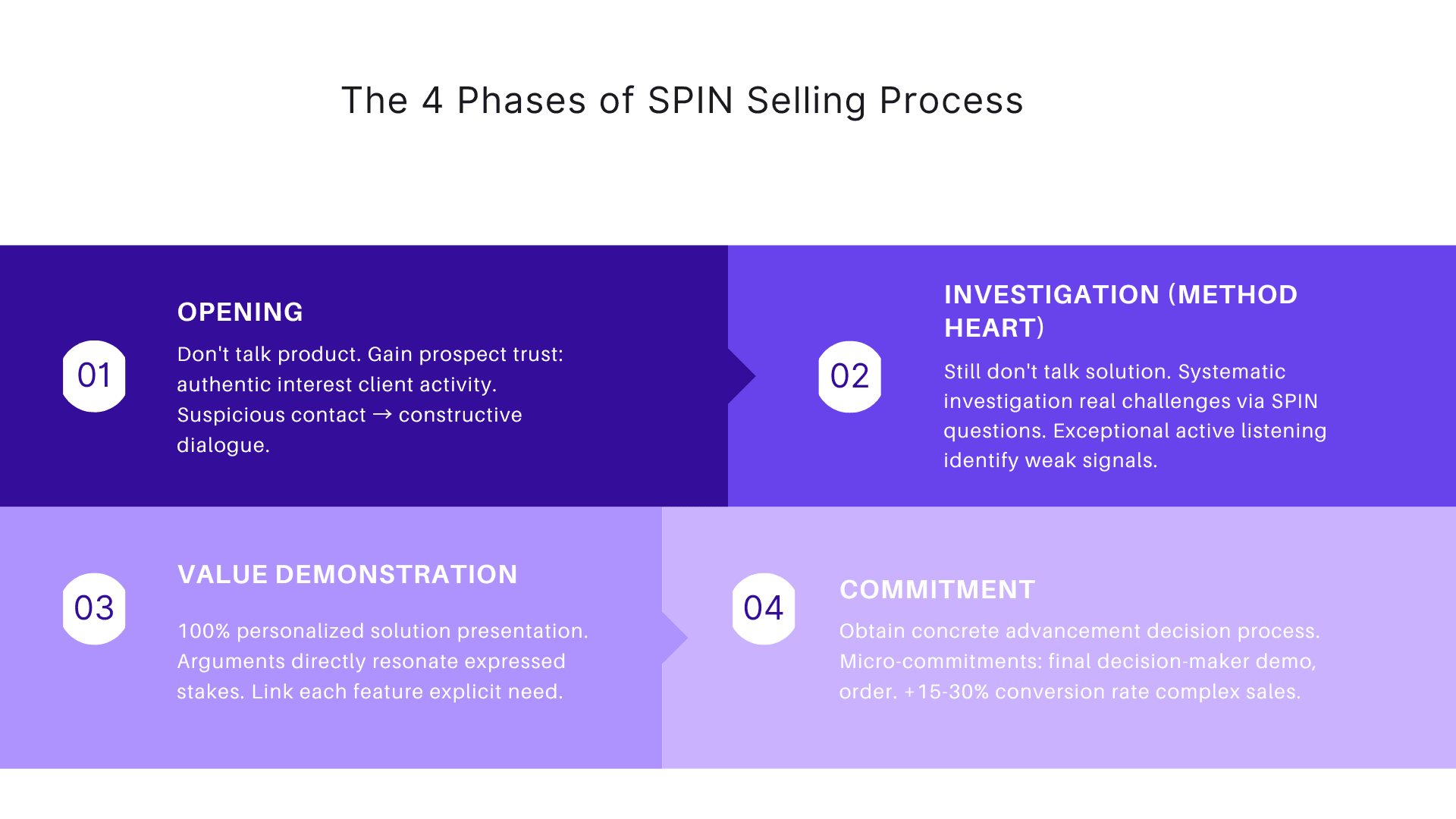
Before diving into the questions themselves, it's essential to understand that they fit into a sales process structured around four major phases. This logical journey ensures you build the relationship before talking solutions, and that your final argumentation is perfectly aligned with your prospect's expectations. Each phase has a precise objective to advance the sale naturally.
Phase 1: the opening
The first rule: don't talk about your product. The objective is to gain your prospect's trust by demonstrating genuine interest in their business. Transform a suspicious first contact into constructive dialogue. This sets the stage for the inquiry phase.
In organizations where a setter qualifies the prospect before the meeting, this opening work is already partly done: the rep inherits a documented context and can spend most of the meeting on problem and implication questions.
Phase 2: the inquiry (the heart of the method)
This is the very essence of Spin selling. You continue not to talk about your solution. You systematically investigate to understand your prospect's real challenges using Spin questions. This phase requires exceptional active listening to identify weak signals and adapt your questioning.
Phase 3: demonstrating value
Once you master the needs and challenges, you can finally present your solution. This presentation is powerful because it's 100% personalized. You use the right arguments that directly resonate with the issues expressed by your prospect. The key is linking each feature to an explicit need.
This logic also applies to the written proposal that follows the meeting: it should echo, in the prospect's own words, the problems and implications they voiced, rather than spending half its pages introducing the vendor.
Phase 4: commitment
The objective is to obtain a concrete "advancement" in the decision process. Your mission is to always aim for an order or advancement (e.g., scheduling a demo with the final decision-maker) by proposing micro-commitments.
Co-building the sales proposal with the prospect, section by section, is one of the most effective micro-commitments: it validates the need-payoff answers and turns the document into an expected deliverable rather than a PDF they merely receive.
These milestones are worth defining in advance for every stage of your process, the way Q2C Selling does it, from qualification through closing: you then know exactly what commitment to ask for at the end of each meeting.
Mastering the 4 types of Spin questions (with examples)
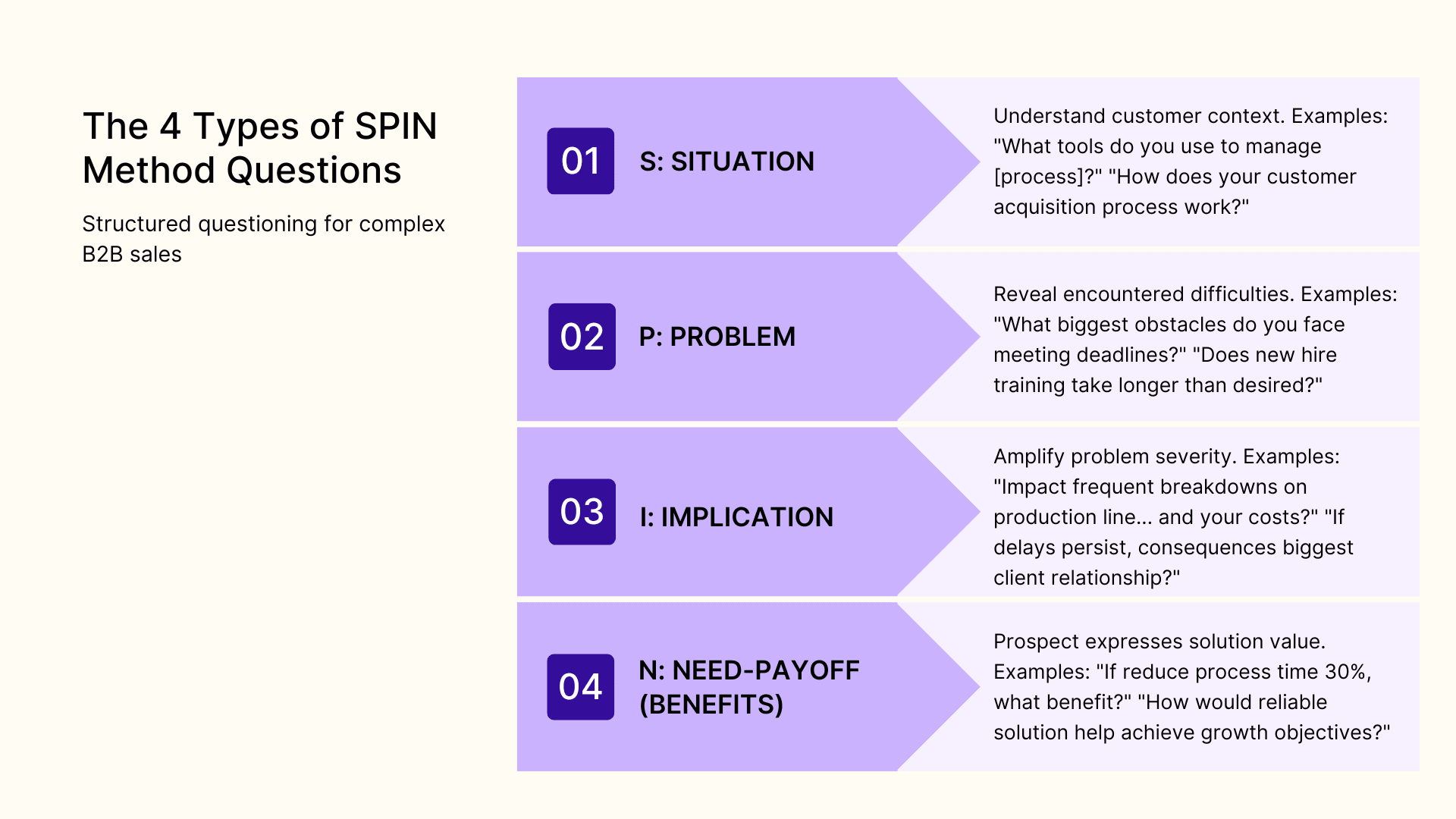
We arrive at the methodology's engine: the four types of questions that make up the S.P.I.N. acronym. Mastering them doesn't just mean knowing them, but knowing how to ask them at the right moment to guide the conversation. They're the real tool that allows moving from a vague, implicit need to a clear, explicit buying desire.
S - Situation questions
Objective: understand the context. Examples:
- "What tools do you currently use to manage [specific process]?"
- "How does your current customer acquisition process work?"
P - Problem questions
Objective: reveal difficulties. Examples:
- "What are the biggest obstacles you face in meeting your deadlines?"
- "Does training your new hires take longer than you'd like?"
I - Implication questions
Objective: amplify the problem's severity. Examples:
- "What's the impact of these frequent breakdowns on your production line... and on your costs?"
- "If these delays persist, what could be the consequences for your relationship with your biggest client?"
N - Need-payoff questions (needs to address / benefits)
Objective: get the prospect to express value. Examples:
- "If you could reduce this process time by 30%, what benefit would that represent for you?"
- "How could a more reliable solution help you achieve your growth objectives?"
Adapting Spin selling to the digital era
Today, much of the "situation" work is done upstream. Use LinkedIn and the company website to prepare your meeting.
Don't ask: "How many employees do you have?"
Instead say: "I saw you hired 50 people in the last 6 months. How do you manage integration and training at this scale?"
This preparation demonstrates your professionalism and allows you to go directly to high-value questions (problem, implication).
To make sure nothing slips through in this prep, a CQQCOQP-style framework (How, What, Who, How much, Where, When, Why) helps you separate the situation details you already have from what you actually need to ask in the meeting.
Concrete benefits of Spin selling
Adopting the Spin method isn't simply a technique change; it's a strategic transformation that generates measurable and lasting benefits for any sales force.
Significant increase in conversion rates
There's no universal statistic on this, but teams that master Spin selling see notable improvements on complex sales. In the validation study Rackham published, reps trained in the method outperformed a control group on large sales. The more dramatic figures that circulate come from training providers and aren't sourced. What matters is the mechanism: better qualification, built on problems the prospect articulated themselves, produces stronger, more committed opportunities.
Shorter sales cycles
Paradoxically, taking time to rigorously apply the inquiry phase accelerates the overall process. By clarifying real challenges, involved decision-makers, and decision criteria from the start, you avoid unproductive back-and-forth, inappropriate proposals, and blockages that usually slow complex negotiations.
Creating lasting business relationships
Spin selling transforms the seller-buyer dynamic into a partner-to-advisor relationship. Your prospects perceive real added value in your exchanges, even before talking about your product. This trust promotes long-term loyalty and transforms satisfied customers into true brand ambassadors.
Practical tips for implementing Spin selling
Theory is one thing, but Spin selling success lies in its rigorous and intelligent application. Here are key tips for effectively integrating this method into your daily routine.
Tip #1: master the art of active listening
Spin success relies on your ability to listen to what's said... and what isn't. Active listening means focusing 100% on your prospect's responses, without preparing your next question simultaneously. Pay attention to words, tone, hesitations. That's where the best opportunities hide for asking a relevant implication question.
Tip #2: practice strategic patience
The biggest difficulty for many salespeople is resisting the urge to present their solution as soon as they hear a problem. Patience here is a strategic weapon. Every minute you invest in the discovery phase (problem, implication) builds such a solid foundation that your final presentation (demonstration) will seem like the only logical and irresistible conclusion.
Tip #3: rely on the right tools
Technology can multiply your Spin approach effectiveness. A CRM is essential for tracking information collected at each phase. But to go further, think about the loop between your questions and your sales proposals.
Smart sales proposal creation tools, for example, perfectly complement the method. After conducting your Spin discovery, you build a customized offer. These tools then allow you to precisely analyze which arguments and sections of your proposal resonate best with your prospects (reading time, clicks, etc.). This valuable data helps you continuously refine your need-payoff questions to maximize the impact of your future presentations. You thus create a virtuous cycle of continuous improvement.
Always a profitable investment
Nearly forty years after its publication, Spin selling remains an essential reference in B2B sales. By positioning yourself as an expert advisor, you radically differentiate yourself in a competitive market.
The investment in training and practice generates lasting returns: better conversions, shorter sales cycles, and more loyal customers. The key to success is practice and continuous analysis.
Frequently asked questions
How long does it take to master Spin selling?
Plan on 3 to 6 months of regular practice to naturally integrate the four types of questions. Full mastery often takes about a year of hands-on application in the field.
Does Spin selling work for all sectors?
It excels in complex, long-cycle B2B sales (SaaS, industrial, consulting...). It's less suited to fast, transactional sales (B2C, retail).
Can you use Spin selling by phone or video conference?
Absolutely. The method adapts perfectly. Active listening becomes even more critical for picking up on vocal nuances when your counterpart isn't in the room.