
Fundamentals of the QQOQCP method
Origin and evolution: from Quintilian's hexameter to the 5Ws
The QQOQCP method traces its roots to ancient rhetoric. The seven circumstances of an act, first described by Hermagoras of Temnos in the 2nd century BCE and later taken up by Cicero and Quintilian, were summarized in the Middle Ages in a Latin hexameter traditionally attributed to Quintilian: quis, quid, ubi, quibus auxiliis, cur, quomodo, quando (who, what, where, by what means, why, how, when).
This set of questions evolved over the centuries. In the Anglo-Saxon world, it simplified into the "five Ws" of modern journalism: what, where, when, who, why. This version later expanded with "how" and "how much" questions, giving birth to today's formula.
Professionals have progressively adapted it to the needs of each role: project management, sales qualification, and corporate problem-solving.
Why use the QQOQCP method today?
In today's professional landscape marked by increasingly complex challenges, the QQOQCP method proves its daily relevance. Its systematic approach enables teams to quickly break down any situation and make informed decisions.
A sales professional can use it to precisely qualify prospect needs, while a project manager leverages it to structure their action plan. This technique's strength lies in its ability to adapt to varied contexts, from marketing to operational management.
Modern companies particularly appreciate its ability to facilitate cross-departmental collaboration. A concrete example: when launching a new product, each department uses the same analytical framework, streamlining communication and accelerating implementation.
QQOQCP vs QQOQCCP: what's the difference?
The main distinction between these two analytical tools lies in adding the "C" for "cost" or "count" in the QQOQCCP version. This quantitative dimension brings essential numerical perspective for evaluating resources, budgets, and impacts.
A sales manager analyzing results would prefer QQOQCCP to precisely quantify sales objectives. Conversely, a manager structuring a team meeting could stick with QQOQCP, sufficient for framing discussions.
The choice between these two variants depends on your analytical needs. Reach for QQOQCCP when measurement and financial factors matter most: budget, volumes, ROI, all the way to pricing a proposal. Use QQOQCP to frame a problem or an action plan and explore its qualitative dimensions. That's the use case the rest of this article covers.
The 6 essential questions of the QQOQCP methodology
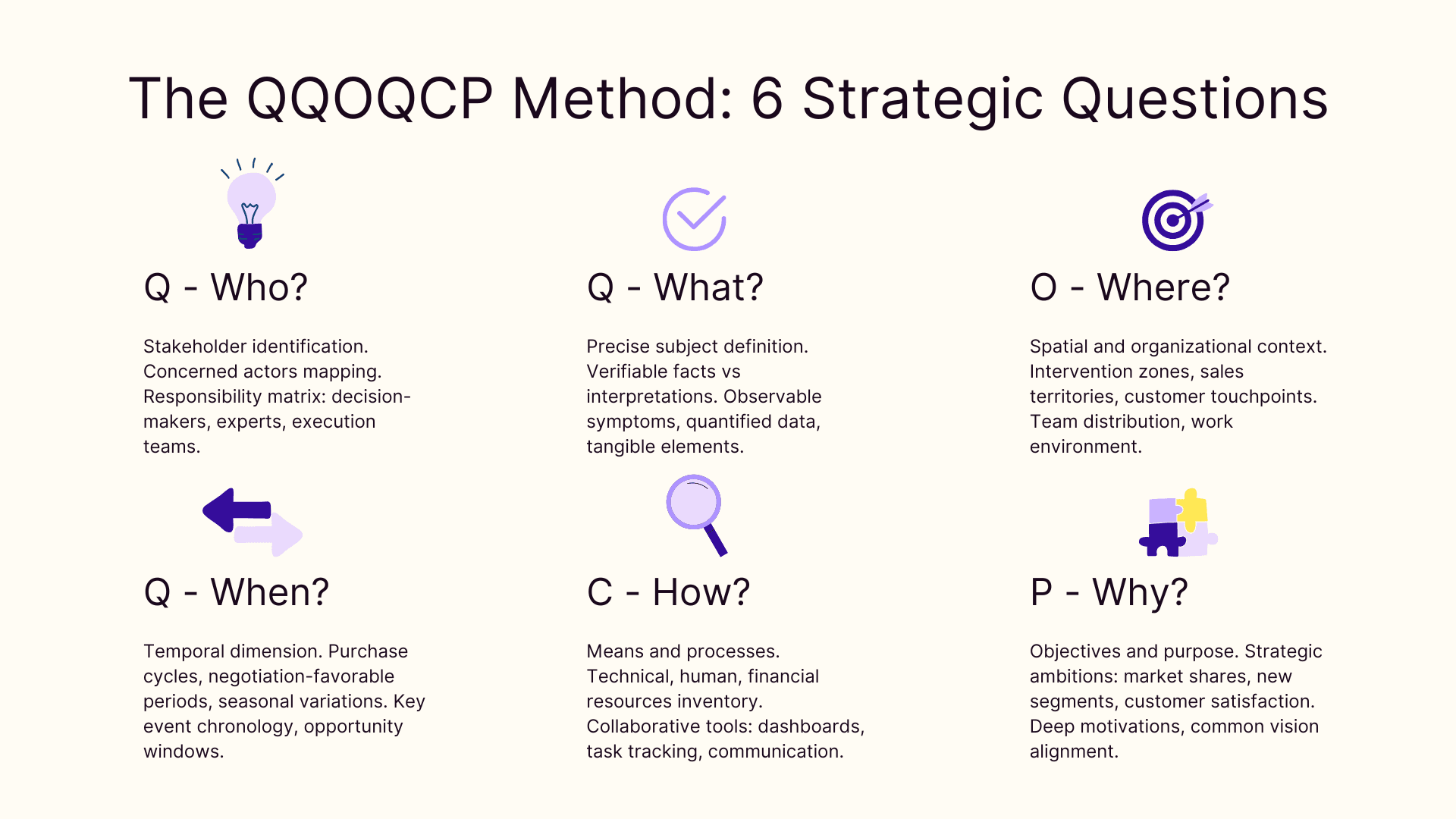
Who are the stakeholders involved?
Identifying stakeholders represents a fundamental step in QQOQCP analysis. A quality manager must map all concerned parties: direct collaborators, support teams, impacted clients or suppliers.
Take the example of a logistics process overhaul. Project success depends on involving warehouse workers, carriers, warehouse managers, and customer service. Each stakeholder brings their unique perspective and specific constraints.
To maximize your analysis effectiveness, create a responsibility matrix. Distinguish key decision-makers, subject matter experts to consult, and teams responsible for implementation. This overview ensures comprehensive consideration of everyone's needs and expectations.
What: precisely defining the analysis subject
The "what" phase requires detailed description of the subject being analyzed. A sales professional studying declining product sales must specify: affected product characteristics, exact nature of the decline, and associated measurable indicators.
For effective analysis, focus on verifiable facts rather than interpretations. For example, "software X sales decreased 25% last quarter" provides a stronger foundation than "sales aren't good."
This measurable gap between where things stand and where they need to be is exactly the raw material of gap selling, which puts measuring it at the center of the sales conversation.
Detail precision guarantees relevant analysis. Document observable symptoms, numerical data, and tangible elements characterizing your situation. This factual approach avoids false leads and guides analysis toward concrete solutions.
Where: spatial and organizational context
Spatial context analysis reveals often underestimated strategic dimensions. A sales manager must map intervention zones, sales territories, and customer touchpoints to optimize their approach.
Physical team distribution within the company deserves particular attention. For instance, a sales team spread across multiple sites requires adapted resource coordination and communication tools.
For a salesperson, the Where question is mostly read from the client's side: where the decision gets made (headquarters, a subsidiary, the purchasing department), where the problem actually shows up (a site, a team, a sales channel), and where your solution will be deployed. Those three answers determine the right contact, the right example, and the right scope for your proposal.
When: the temporal dimension of analysis
Mastering the time factor represents a decisive element in any thorough sales analysis. A sales manager must evaluate purchase cycles, identify negotiation-friendly periods, and anticipate seasonal market variations.
For relevant analysis, establish a precise chronology of key events. For example, an unusual sales spike might be explained by launching a marketing campaign or changes in customer buying habits.
Consider opportunity windows specific to your sector. A B2B salesperson knows that fiscal year-end often constitutes a strategic moment for closing major contracts, while summer periods can slow certain decision-making processes.
The When also applies to the proposal itself: knowing exactly when a prospect opens it, rereads it, or shares it internally tells you far more about where their decision really stands than a blind follow-up call.
How: means and processes
Resource and tool analysis proves decisive in project success. A quality manager must establish a comprehensive inventory of available technical, human, and financial resources.
Implementing structured methodology guarantees process optimization. For example, when overhauling the customer journey, detailed interaction mapping reveals friction points and improvement opportunities.
Teams benefit from adapted collaborative tools: shared dashboards, task tracking systems, and communication platforms. This integrated approach strengthens operational efficiency while facilitating coordination between different departments.
Why: objectives and purpose
Clarifying strategic objectives guides every decision and action. A sales director launching a new offering must define their ambitions: increasing market share, developing new segments, strengthening customer satisfaction.
Deep understanding of motivations enables aligning teams on a common vision. For example, does changing the sales process aim to reduce costs or improve customer experience?
On the buyer's side, that same Why question points to purchase motivations: the SONCASE framework (Security, Pride, Novelty, Comfort, Money, Sympathy, Environment) helps decode them and tailor your pitch accordingly.
Adapted solutions naturally emerge from thorough purpose analysis. A sales manager who precisely identifies their growth objectives will better select potential clients and adapt their sales pitch to maximize impact.
Practical applications in project management with QQOQCP
Effectively structuring an action plan with QQOQCP
The QQOQCP method transforms action plan development into a systematic approach. A sales manager wanting to launch a new service line starts by defining key stages on a precise calendar.
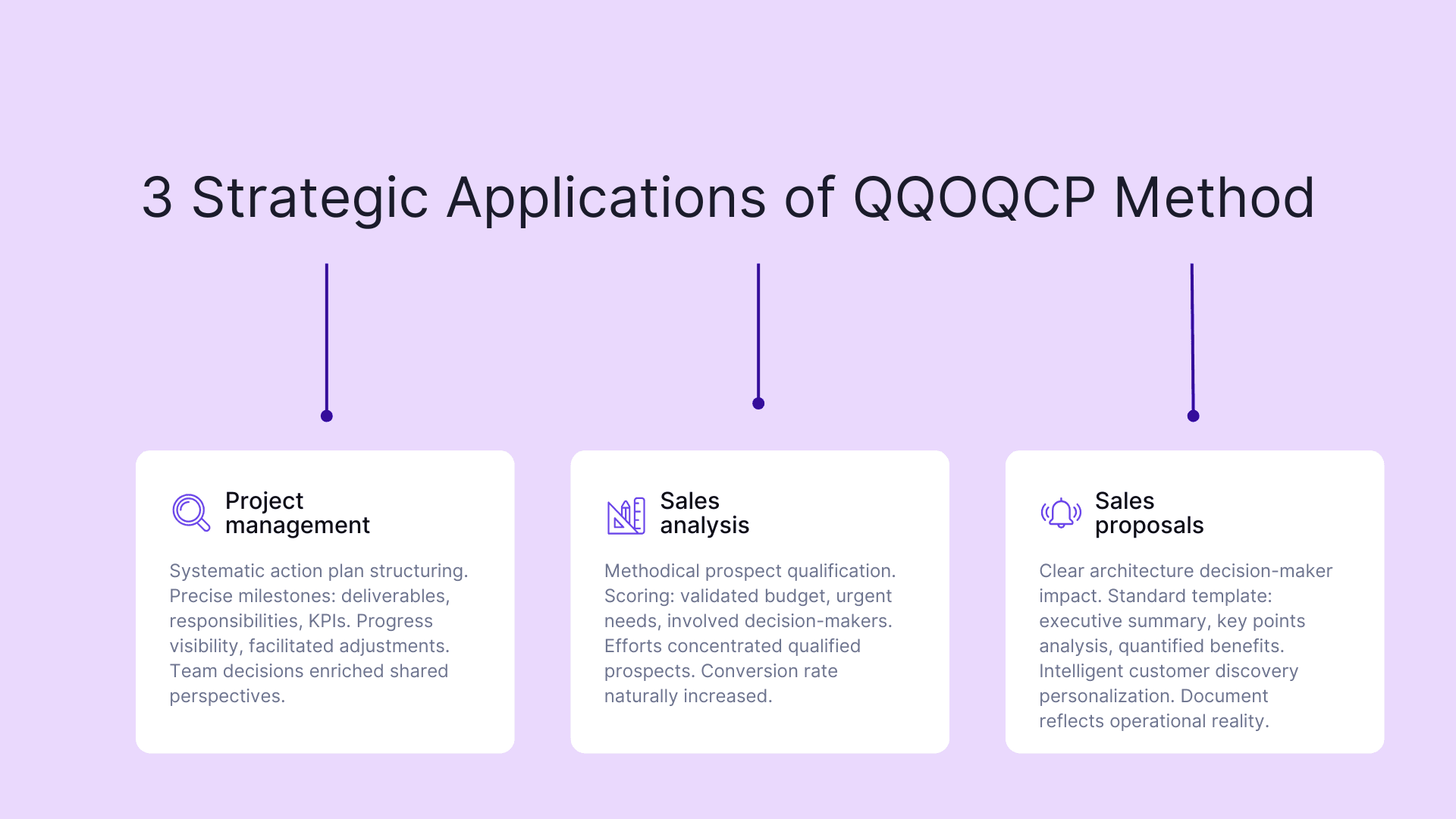
Success lies in milestone precision. Each phase requires detailed description of expected deliverables, assigned responsibilities, and measurable performance indicators.
A concrete example: when deploying a digital solution, the action plan details user training sequences, technical testing schedules, and validation criteria at each stage. This approach guarantees clear visibility of progress made while facilitating necessary adjustments.
Optimizing team decision-making
The systematic questioning of a situation's six dimensions strengthens the quality of collective decisions. Collaborative situation analysis allows teams to share expertise and enrich perspectives.
To maximize decision meeting efficiency, establish a precise exchange framework: distribute facilitation roles, set balanced speaking times, and document key arguments. Managers benefit from visual tools like scoring tables or prioritization matrices.
Successful decision-making processes rely on active participation from each member. Encourage collaborators to prepare their contributions in advance and formulate recommendations based on concrete data. This participative dynamic guarantees informed choices and strengthened commitment to their implementation.
The QQOQCP method for sales analysis
Improving prospect qualification
Prospect qualification gains precision through methodical questioning. An IT services company applies this approach by identifying specific prospect needs: available budget, project timeline, involved decision-makers.
On the phone, a script like the CROC method (Contact, Reason, Objective, Conclusion) lets you work through these questions in a few minutes without making the prospect feel interrogated.
A scoring table based on these criteria enables quick evaluation of each prospect's potential. For example, high scores go to companies with validated budgets and urgent needs.
Salespeople focus their efforts on best-qualified prospects by adapting their pitch to identified challenges. This targeted approach naturally increases conversion rates while reducing time spent on less promising opportunities.
Structuring sales proposals with QQOQCP
Methodical structuring of a sales proposal strengthens its impact with decision-makers. Clear architecture enables readers to quickly grasp your solution's added value.
Start by establishing a standard template adapted to your business sector. Essential elements include compelling executive summary, detailed analysis of project key points, and quantified presentation of expected benefits.
Smart content personalization makes the difference. Integrate data collected during the discovery phase to demonstrate your fine understanding of specific challenges. A sales document gains relevance when it reflects the client's operational reality.
In practice, the six answers become the document's outline: Who names the decision-makers and what's at stake for them, What describes the problem using the client's own numbers, Where sets the deployment scope, When fixes the timeline, How spells out the implementation, and Why restates the goal. A proposal built this way talks about the client from page one, where a generic template spends half its pages talking about the vendor. A proposal generation tool that can pull these answers straight into the document skips the re-typing and frees up time for what actually matters: the argument.
Tools and models for deploying the QQOQCP method
The only tool you really need fits on one page: a six-row table, one row per question, with three columns. The first states the question, the second holds a factual answer (a verifiable fact, never an interpretation), and the third names where the information came from: CRM, billing, a client conversation. That "Source" column is what separates a solid analysis from a list of impressions.
Here's the table filled out for a common sales scenario, declining software sales:
- Who? Three enterprise accounts in decline, all managed by the same team. Source: CRM, order history.
- What? 25% less revenue on software X. Source: last quarter's billing.
- Where? Southeast region only; other territories are stable. Source: territory reporting.
- When? Since Q2, at every annual contract renewal. Source: cancellation dates in the CRM.
- How? Cancellations at renewal, with no prior complaint or request for a commercial gesture. Source: support tickets, cancellation letters.
- Why? A cheaper competitor entered the region. Source: interviews with lost clients.
Copy this table into whatever tool your team already uses, a spreadsheet or a shared workspace, and fill it out together: a table backed by sources can be reviewed, challenged, and completed, while impressions just get argued over endlessly. It's also the format that travels best to decision-makers, speeding up the decision.
Frequently asked questions
What is the QQOQCP method?
It's a structured analysis technique based on six fundamental questions, Who, What, Where, When, How, and Why, used to break down a situation or a problem.
What's the difference between QQOQCP and QQOQCCP?
QQOQCP uses 6 questions, while QQOQCCP adds a seventh, "how much," to capture the quantitative side: costs, resources, and metrics.
When should you use QQOQCP?
It's useful for analyzing problems, structuring action plans, qualifying prospects, or improving decision-making, especially when qualitative analysis matters more than the numbers.