The Fundamentals of B2B Cold Emailing
Definition and Principles of Cold Prospecting Emails
Cold emailing is an initial contact method used to reach B2B professionals who have never interacted with your company. This structured approach involves sending a targeted message to a professional email address.
The success of a cold email campaign rests on three fundamental pillars: precise targeting of recipients based on their industry, a clearly expressed value proposition, and a well-thought-out follow-up sequence.
To maximize your open rate, focus on message personalization, the relevance of the content to the recipient's profile, and the strategic timing of your send.
Differences Between Cold Email and Email Marketing
Cold email is fundamentally different from email marketing by its very nature. A targeted first contact characterizes cold email, whereas email marketing is aimed at an established contact base.
The objective also differs: cold email aims to create a personalized conversation with a specific prospect. Email marketing, on the other hand, seeks to promote products to a broad audience.
Sending frequency marks another major distinction. Cold email is part of a spaced and limited sequence, while email marketing follows a regular communication schedule. A successful cold email triggers a direct exchange, whereas email marketing measures its success in conversions and clicks.
Legal Framework and GDPR Compliance in 2025
The GDPR regulation permits B2B cold emailing under certain conditions. Nominative professional addresses like firstname.lastname@company.com are considered protected personal data. Conversely, generic addresses (contact@, info@) fall outside the scope of GDPR.
To remain compliant in 2026, your prospecting must adhere to two major rules: provide a simple right to object via an unsubscribe link and demonstrate your legitimate interest in contacting the prospect.
Your database requires rigorous documentation: origin of contacts, date of collection, and retention period. A practical tip: create a processing activities register detailing your data protection processes.
Building a High-Performing Cold Email Strategy
Identifying and Segmenting B2B Targets
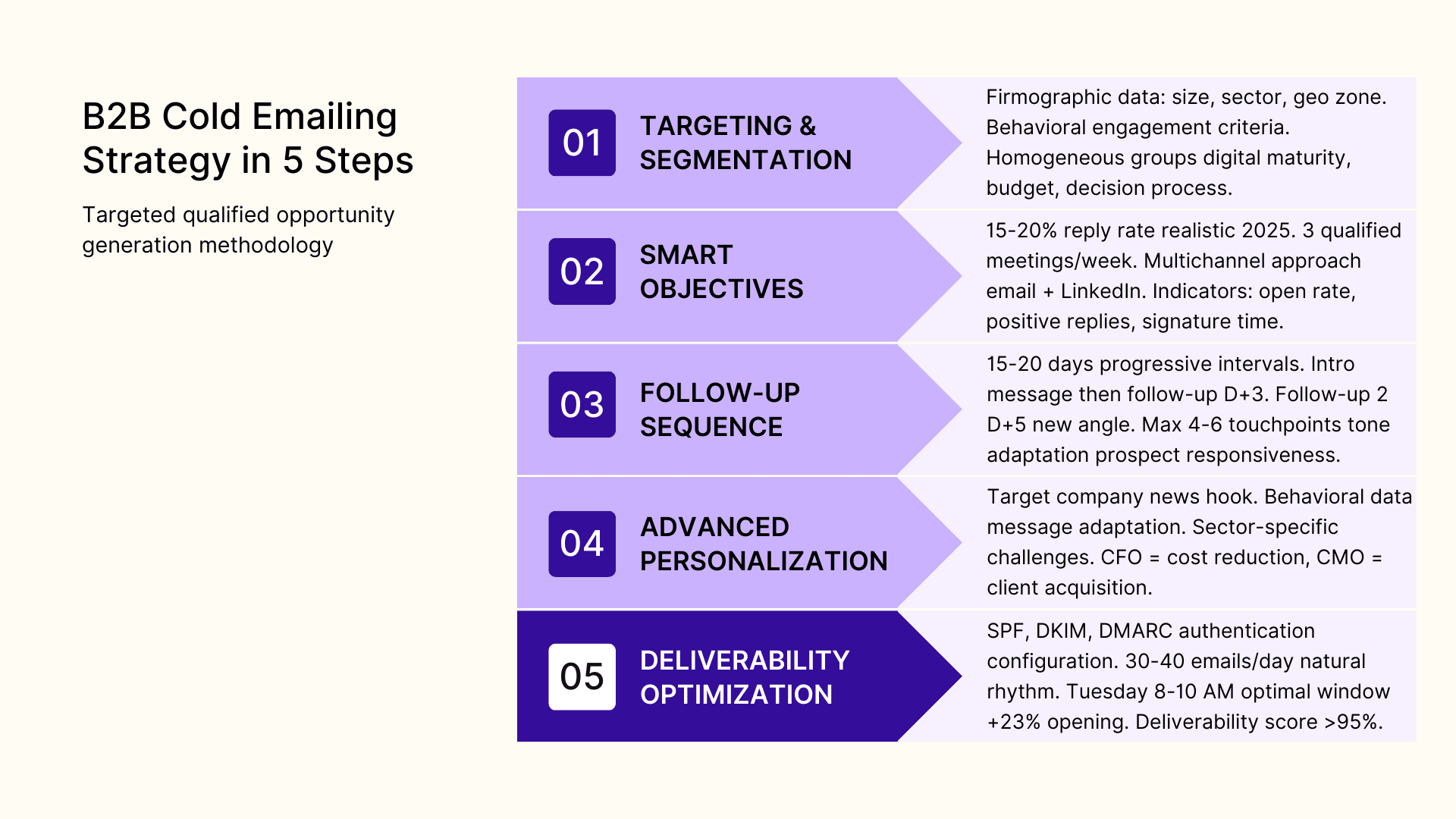
The success of a cold email campaign depends on the precise segmentation of your B2B market. A structured approach begins with analyzing firmographic data: company size, industry, and geographic location.
Behavioral criteria enrich your targeting. Observe interactions on your website, engagement on social media, and purchasing habits to refine your segments.
Create homogeneous groups based on these key characteristics:
- The company's digital maturity
- Available investment budget
- Internal decision-making process
- Sector-specific needs
Refined targeting allows you to tailor your message and significantly increase your reply rates. Prioritize quality over quantity: it's better to reach 100 perfectly qualified prospects than 1,000 approximate contacts.
Defining Prospecting Objectives
The success of a cold email campaign relies on SMART goals (Specific, Measurable, Achievable, Relevant, Time-bound). A reply rate of 15-20% is a realistic target for your initial outreach in 2026.
Set progressive milestones in your sales process: number of qualified first meetings per week, conversion rate into opportunities, and volume of revenue generated. For example, aim for 3 weekly meetings with qualified decision-makers.
Favor a multichannel approach by synchronizing your email actions with LinkedIn. Measure your progress using specific indicators: open rate, number of positive replies, and average time between first contact and signing a deal. This methodology ensures controlled growth in your prospecting efforts.
Planning Follow-up Sequences
An optimal follow-up sequence spans 15 to 20 days, with progressively longer intervals between each contact. Start with an introductory message, followed by a first follow-up after 3 business days.
The second follow-up occurs 5 days later, offering a new perspective or a different argument. To maximize impact, alternate sending times: morning (9-10 AM) for the first contact, after lunch (2-3 PM) for follow-ups.
A structured follow-up plan should include a maximum of 4 to 6 touchpoints. Adapt the tone and content based on the prospect's responsiveness: viewing your signature, visiting your website, or a total lack of interaction. This approach allows you to adjust your message while respecting your recipients' inboxes.
The Art of Writing Emails That Convert
Advanced Personalization Techniques
Contextual personalization will dramatically transform the effectiveness of your emails in 2026. Analyze the target company's recent news to create relevant hooks. For example, a funding round or a new expansion project are opportunities for authentic connection.
Leveraging behavioral data enriches your messages. A prospect who viewed your "Solutions" page deserves a different approach than a visitor just discovering your site. This dynamic message adaptation naturally increases your chances of getting a reply.
Focus on industry-specific personalization by mentioning the prospect's unique challenges. A CFO will be more receptive to a message about reducing operational costs, while a marketing director will be more interested in customer acquisition strategies.
Opening Lines That Capture Attention
A powerful opening line is the key to sparking your recipient's interest. Start with a reference to their company's news: "Your recent expansion into the German market particularly caught my eye."
Leverage professional recognition: "Congratulations on your nomination in the 2026 innovative companies ranking." This approach naturally flatters your contact.
Openers based on a mutual connection work remarkably well: "Following my discussion with Mark Smith at the Digital Week conference." This technique quickly establishes a bond of trust.
Avoid generic formulas like "I'm writing to you to..." Instead, prefer a direct approach related to their problem: "Does reducing your management costs by 30% sound interesting?"
Optimal Structure for the Message Body
The AIDA method (Attention, Interest, Desire, Action) naturally structures your message. Capture Attention with a powerful opening line related to the prospect's news. Build Interest with a short paragraph demonstrating your understanding of their business challenges.
Create Desire with a quantified example of results achieved for similar companies. "A logistics company reduced its costs by 25% in three months with our solution." The final paragraph triggers Action with a clear value proposition and a direct call-to-action.
Follow one golden rule: each paragraph should have a maximum of three lines. An airy message is easier to read on mobile and increases your chances of getting a reply.
Effective Calls-to-Action to Maximize Replies
A compelling call-to-action turns your prospect into an active participant. Use a direct formulation that creates a sense of urgency: "Book your free diagnostic this week" rather than "Contact us for more information."
Prioritize strong action verbs in the present tense: "Let's schedule," "Discover," "Let's validate." Using the first-person plural ("we," "let's") reinforces a collaborative dimension.
The top-performing CTAs in 2026:
- "What time works for you on Tuesday?"
- "Reply with 'OK' to receive the full study"
- "Choose a time on my calendar"
An alternative approach is to ask a strategic open-ended question: "What are your growth objectives for this quarter?"
Best Practices for Optimizing Cold Email Subject Lines
Subject Line Formulas with High Open Rates
Creating a catchy email subject line dramatically transforms your prospecting results. A curiosity-based approach generates open rates above 45%: "Your competitor [X] gave us an idea for [Company]."
The strategic use of numbers boosts engagement: "3 minutes of your time for +30% productivity." Problem-solving formulas naturally capture attention: "The solution to your hiring challenge at [Company]."
Short subject lines, between 6 and 10 words, optimize impact on mobile. A winning format combines the target company's name with a measurable value promise: "[Company]: reduce your costs by 25% in 60 days." Mentioning a mutual contact increases effectiveness: "Following my discussion with [Name] about your digital project."
Common Mistakes to Avoid
The first fatal mistake is behavior that is too automated. Prospects easily spot mass-sent messages. A natural cadence of 30 to 40 emails per day better reflects a human pace.
A lack of prior research on your contacts sabotages your chances of a reply. Take 5 minutes to analyze their LinkedIn news or their website before each send.
Another classic trap: overloading your message with sales arguments. The golden rule in 2026? One key benefit per email, supported by a concrete example.
Superficial personalization is no longer enough. Simply replacing {firstname} with "Peter" generates more suspicion than interest. Instead, mention a specific achievement of your prospect or a challenge unique to their sector.
A/B Testing to Improve Performance
Implementing rigorous A/B tests turns your hypotheses into certainties. Start by testing two versions of a subject line on a sample of at least 200 contacts to obtain statistically reliable results.
Adopt a methodical approach: change only one variable at a time, whether it's the message length, the sending time, or the wording of your value proposition. A recent test shows that a question in the subject line generates 28% more opens than a statement.
Measure your results over 5 to 7 days to account for your prospects' different reading rhythms. The collected data will naturally guide your next campaigns toward the best-performing formats.
Optimizing the Deliverability of Your Cold Emails
Technical Configuration of Sending Servers
Implementing a robust technical infrastructure is the foundation of your deliverability in B2B cold emailing. A dedicated SMTP server ensures full control over your sends and your sender reputation.
The SPF, DKIM, and DMARC protocols authenticate every outgoing email. SPF validates the sending IP address, while DKIM digitally signs your messages. DMARC applies a strict security policy.
DNS configuration deserves special attention. The MX record points to your receiving servers, while PTR records ensure flawless reverse resolution. A good practice is to limit the daily volume to 50 emails per domain when starting out.
Best Practices to Avoid Spam Folders
The key to avoiding the spam folder is to adopt natural, human-like behavior. Start by warming up your email address by exchanging messages with trusted contacts for 2-3 weeks before any campaign.
Limit your sends to 30-40 emails daily to maintain a realistic pace. Vary your texts and avoid trigger words like "free," "promotion," or "limited offer."
Prioritize sending to specific people rather than generic addresses. Contacting mary.smith@company.com generates more replies than contact@company.com.
Establish a relationship of trust by showing you know their industry. Mention a recent article from their blog or relevant news about their company. This personalized approach turns your cold email into an authentic conversation.
Optimal Timing for Sending Campaigns
Data from 2025 reveals that Tuesday morning between 8 AM and 10 AM is the most favorable time for your B2B campaigns. This strategic window corresponds to when professionals check their emails with the most attention.
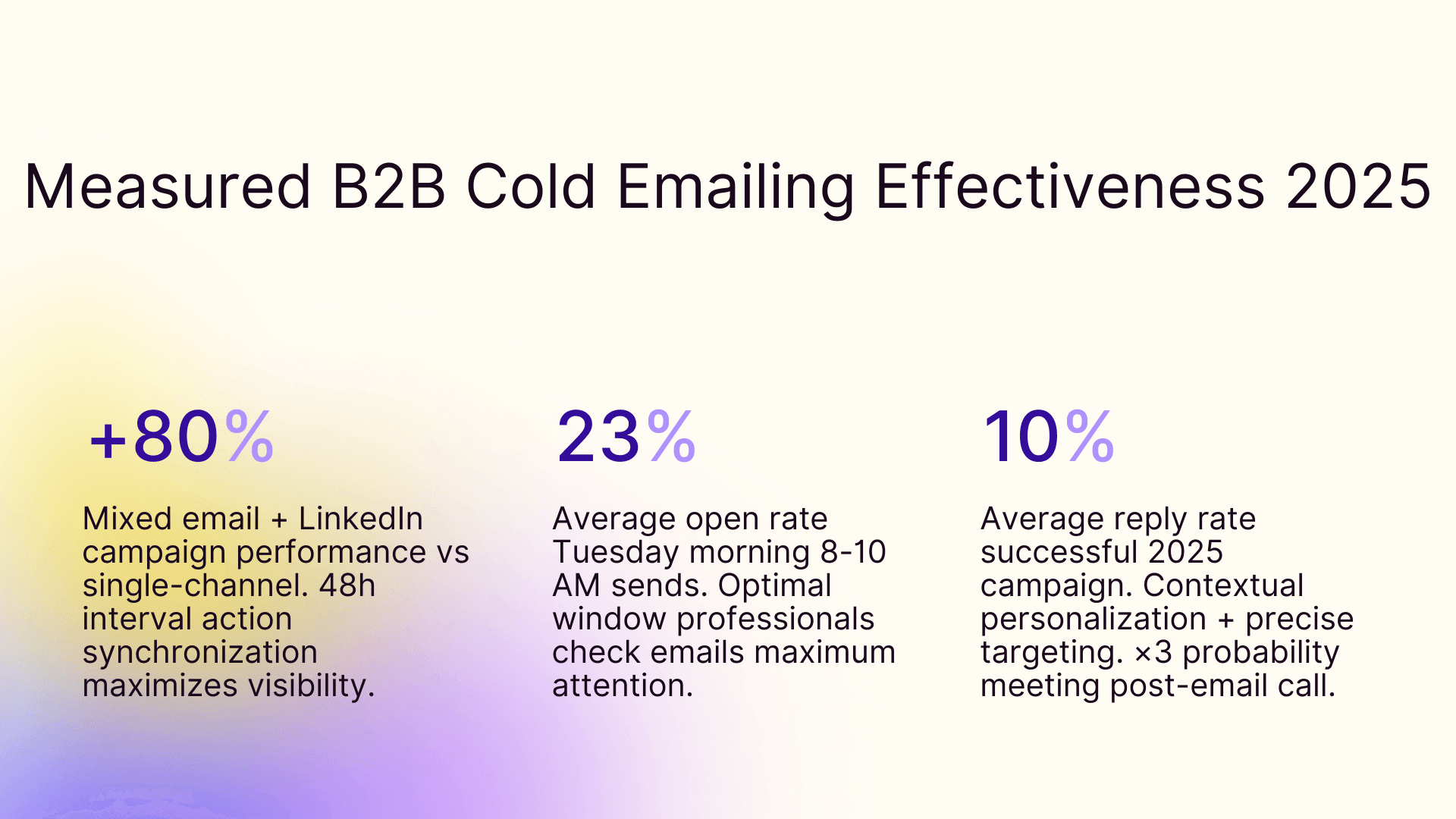
A test conducted on 50,000 campaigns shows that Tuesday sends generate an average open rate of 23%. Wednesday comes in second with 21% opens.
Adapt your strategy to your industry's rhythm. Decision-makers in finance check their emails as early as 7 AM, while marketing managers are more receptive around 10 AM. Time-slot scoring allows you to gradually refine your sending times based on the results.
Avoid Mondays, which are often overloaded, and Fridays, when attention naturally declines.
Cold Email Follow-up Strategies That Work
Automated Follow-up Sequences
Implementing a smart automation strategy dramatically transforms the effectiveness of your B2B follow-ups. Configure your sequences to stop automatically as soon as a prospect replies, avoiding embarrassing situations with unnecessary follow-ups.
A high-performing scenario combines 4 to 5 touchpoints over 3 weeks. The first message recalls the context, the second adds value with a case study, the third shares a relevant resource, and the last offers a final opportunity to connect.
Personalize each step with dynamic variables: company name, job title, industry. This approach naturally increases your reply rates while saving precious sales time.
Personalizing Follow-up Messages
Psychological contextualization dramatically transforms the impact of your follow-up messages. Analyze previous interactions: a prospect who clicked on your first email deserves a follow-up focused on the content that interested them.
Adapting the tone to your contact's behavioral profile multiplies your chances of a reply. A pragmatic decision-maker will appreciate hard data. A creative profile will be more sensitive to an innovative and visual approach.
Enrich your follow-ups with relevant news: a funding round, an award received, or a new project in their sector. This approach proves your engagement and your deep understanding of their professional environment.
Ideal Timing Between Follow-ups
Mastering the intervals between your follow-ups determines the impact of your prospecting. The optimal rhythm starts with a first follow-up 3 days after the initial email. A shorter delay might seem pushy, while a longer wait dilutes interest.
For your second follow-up, wait 5 days. This interval respects the recipient's availability while keeping the conversation going. The third attempt comes 7 days later, with a different angle.
Data from 2025 reveals that a receptive prospect replies within 24 hours of a follow-up. After three unanswered follow-ups, it's best to put the contact on hold for 2 months before starting a new sequence.
Cold Email and LinkedIn for a Multichannel Approach
Synchronizing Email and LinkedIn Actions
Coordinating actions between email and LinkedIn is a strategic lever for your B2B prospecting. Start by spacing your actions 48 hours apart on each channel: a LinkedIn invitation naturally precedes a personalized first email.
A practical example: after visiting a LinkedIn profile on Monday, send a connection request on Wednesday, then an email on Friday. This cadence respects your prospect's natural rhythm while maximizing the visibility of your outreach.
Prioritize tools that provide a unified view of your interactions. This 360° vision prevents duplicates and ensures coherent communication across all channels. For example, mention a news item your prospect shared on LinkedIn in your email.
Cross-Channel Nurturing Strategies
The success of a cross-channel approach relies on a content strategy adapted to each platform. On LinkedIn, focus on sharing industry studies and market analyses, while your emails will provide concrete solutions to the identified challenges.
A potential client interacting with a LinkedIn article will naturally receive an email enriched with practical examples on the same topic. This dynamic personalization strengthens engagement at every touchpoint.
Establish a scoring system based on interactions: a reaction on LinkedIn is worth 5 points, opening an email 3 points, a click on a link 8 points. This method helps identify the right moment for a direct sales approach, turning your digital exchanges into productive conversations.
Essential Tools for Cold Emailing in 2025
Comparison of the Best Prospecting Software
The 2026 prospecting solutions market offers advanced features that are transforming the B2B sales approach. Contextual personalization is becoming a standard with tools like Woodpecker or Lemlist that automatically analyze prospect profiles.
Next-generation platforms like Luna now integrate artificial intelligence to optimize sending times and message content. This is a major asset for maximizing reply rates.
The value for money varies considerably: expect to pay between $30 and $150 per user per month depending on the level of automation required. Premium solutions like SalesLoft or Outreach stand out for their predictive analysis capabilities and their deep integration with major market CRMs.
Automation and Personalization Solutions
Smart automation tools are revolutionizing the personalization of B2B campaigns in 2026. These solutions analyze prospect behaviors to automatically adapt the tone and content of messages.
A concrete example: a prospect who regularly reads your articles on digital transformation will automatically receive messages enriched with case studies in that field. The technology even allows for adjusting the sending time based on each recipient's reading habits.
The new generation of virtual assistants goes further by suggesting content modifications based on prospect reactions. If a type of message generates more positive replies, the system automatically recommends similar adjustments for future sends.
Performance Tracking and Analysis Tools
Modern analytical dashboards are revolutionizing the tracking of cold email campaigns. A good tracking tool allows you to visualize the journey of each message in real-time: opens, clicks, replies, and even the average reading time.
The power of tracking lies in its ability to identify the times of day most conducive to positive replies. For example, a salesperson who notices a peak in favorable replies on Wednesday morning will naturally adjust their sending schedule.
Prioritize solutions that offer automatic interaction scoring. This approach transforms your raw data into actionable insights: a prospect who has opened your email 3 times deserves special attention from your sales team.
Measuring and Optimizing Your Cold Email Campaigns
Essential KPIs to Track
Rigorous tracking of performance indicators ensures the effectiveness of your cold emailing campaigns. The open rate is your first metric: aim for a minimum of 25% in B2B for 2025.
The reply rate is the second pillar: an average of 10% indicates a successful campaign. Also, measure the unsubscribe rate, which should remain below 0.5% to maintain the quality of your database.
Also, monitor the hard bounce rate (below 2%) and the average reading time (target: 30 seconds). These metrics, combined with the conversion rate to qualified meetings (5% recommended), form your strategic dashboard.
A good deliverability score (95% minimum) completes these key indicators for successful B2B prospecting.
Analyzing Conversion Rates by Channel
Sales performance varies significantly depending on the prospecting channels in 2025. Mixed campaigns, combining email and LinkedIn, show a performance that is 80% higher than single-channel approaches.
To maximize your results, examine the specifics of each channel. A phone call after an email exchange triples the probability of securing a qualified meeting.
Industry data reveals marked differences: the legal sector achieves a 6.38% conversion rate, followed by real estate with 6.34%. The medical field stands at 5.47%, demonstrating the importance of adapting your strategy to the target sector.
Continuous Improvement Techniques
Improving your cold email campaigns involves a thorough analysis of qualitative feedback. Use negative replies to refine your approach: a prospect who declines often reveals valuable information about their real needs.
Implementing an interaction rating system allows you to quickly identify the messages that generate the most engagement. Take the example of an IT services company that doubled its positive replies by adapting its pitch based on prospect feedback.
A weekly review process ensures the constant evolution of your practices. Gather your sales team to share successes, analyze failures, and collectively adjust your outreach strategies.
Frequently asked questions
Is cold email still an effective technique for B2B sales prospecting?
Yes, provided it's well-executed: this involves precise targeting, strong message personalization, a relevant value proposition, and compliance with the legal framework (GDPR).
How many follow-ups are recommended in a cold email sequence?
A sequence of 3 to 5 emails (including the initial message) spaced out over a few weeks is often a good balance to maximize the chances of a reply without being intrusive.
What are the most important key performance indicators (KPIs) for measuring the success of a cold email campaign?
The open rate, reply rate, click-through rate (if applicable), and most importantly, the conversion rate to qualified meetings or business opportunities.