
The fundamentals of an effective prospecting plan
Definition and strategic objectives of a prospecting plan
A prospecting plan represents the strategic roadmap for acquiring new customers. This sales approach is based on quantifiable objectives such as the number of qualified appointments per week or the monthly revenue to achieve.
High-performing companies set objectives using the SMART method: 75 targeted contacts per month, 15 weekly sales meetings, or a 25% increase in the customer portfolio over 6 months.
This methodical approach optimizes the return on investment of sales activities. For example, an industrial SME can target 3 new contracts per quarter in its priority geographic area, with a controlled prospecting budget.
Essential components to integrate
A high-performing prospecting plan relies on four fundamental pillars. Start by building a qualified prospect database, regularly updated with relevant information about each contact.
Then select your priority prospecting channels based on your industry: social networks, trade shows, or telemarketing. A B2B service company might favor LinkedIn while a local business would focus on direct canvassing.
Develop a personalized sales script that highlights your offer's added value. Also plan a rigorous follow-up system to measure the time spent on each action and optimize your prospecting efforts.
Why structure your sales approach?
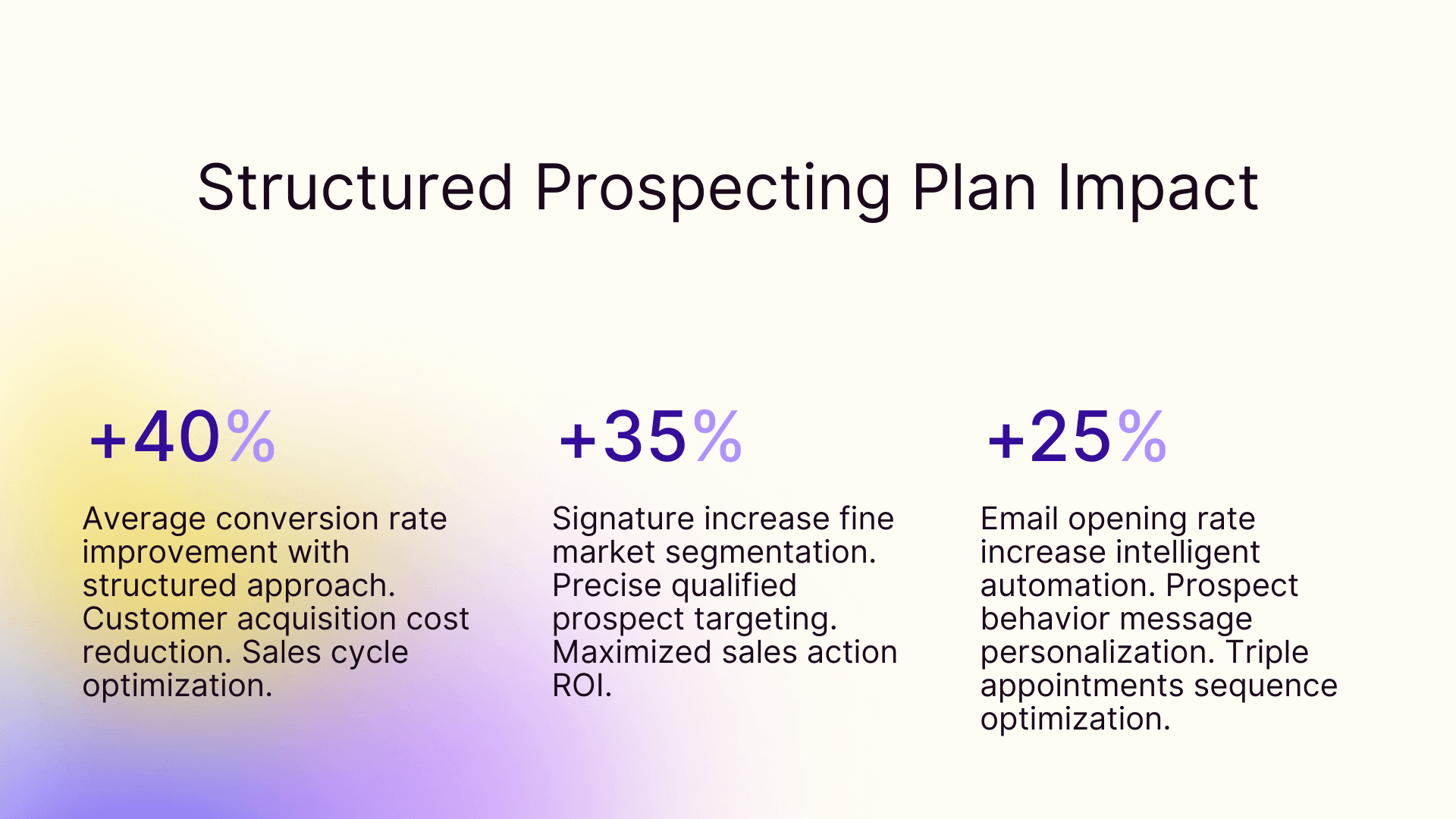
A structured sales approach accelerates the sales cycle while reducing customer acquisition costs. Companies that adopt this approach see an average 40% improvement in their conversion rate.
Implementing an organized strategy facilitates first contact with qualified prospects. For example, a consulting firm doubled its appointment bookings by organizing its prospecting around monthly thematic campaigns.
Precise targeting, combined with appropriate prospecting techniques, strengthens the trust relationship with prospects. This method also optimizes financial resources by concentrating efforts on actions generating the best return on investment.
How to build a B2B prospecting plan
Identification and segmentation of targets
The success of a sales strategy relies on precise market segmentation. A wise sales director starts by analyzing current customer data: company size, industry, and specific needs.
A methodical approach consists of creating homogeneous groups according to relevant criteria. For example, a software company can segment its prospects based on the number of potential users, technology budget, or level of digital maturity.
Mastering a CRM tool facilitates this categorization by automating data sorting and profile enrichment. This method guarantees a better conversion rate: companies practicing fine segmentation observe an average 35% increase in signatures.
Defining priority prospecting areas
The geographic distribution of your sales activities requires a well-thought-out territorial strategy. An in-depth analysis of business potential by area allows you to optimize your travel and resources.
Start by mapping your market according to precise economic criteria: company density, average purchasing power, competitor presence. An industrial machinery manufacturer could, for example, prioritize manufacturing hubs with high factory concentration.
Then divide your territory into distinct sectors, each assigned to a dedicated salesperson. This organization guarantees optimal market coverage while reducing travel time. A detailed action plan by area, with weekly objectives, maximizes your team's efficiency in the field.
Developing the sales action schedule
The success of a sales approach relies on methodical activity planning. The calendar must integrate market highlights: trade shows, target companies' budget periods, product launches.
Monthly breakdown allows alternating different prospecting methods. The first week focuses on physical meetings, the second on email campaigns, while the following ones prioritize social selling and phone follow-ups.
Synchronization with prospecting software facilitates daily task tracking. This automation frees up time for high-value activities like personalizing sales proposals or preparing strategic meetings.
Plan dedicated time slots for updating your prospect file and analyzing weekly results.
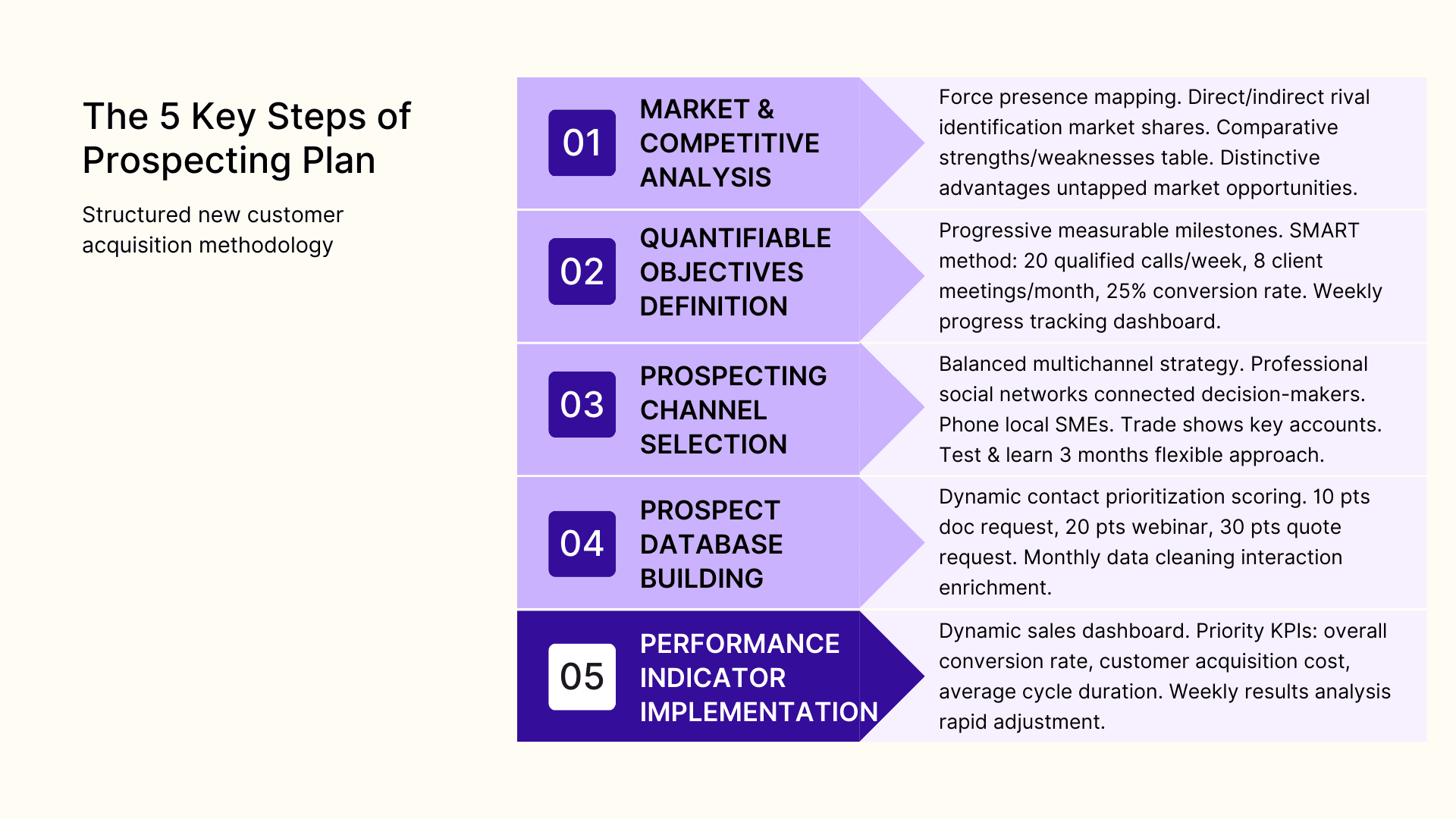
The 5 key steps of a prospecting plan
Market and competitive analysis
A thorough understanding of your business environment requires precise mapping of the forces at play. The first step is to identify your direct and indirect rivals, evaluating their respective market shares.
Adopt a systematic approach to competitive intelligence. A comparative table helps synthesize each major player's strengths and weaknesses. For example, a digital services company would monitor competitors' prices, delivery times, and customer satisfaction.
Finding distinctive advantages then becomes natural. A professional training company could stand out by offering customized modules, while its competitors stick to standard programs. This strategic analysis reveals untapped market opportunities.
Defining quantifiable objectives
Transforming sales ambitions into measurable objectives forms the foundation of successful prospecting. A high-performing salesperson sets progressive milestones: 20 qualified calls per week, 8 client meetings per month, a 25% conversion rate on sent proposals.
The SMART method provides concrete structure to your prospecting objectives. For example, a B2B software publisher can aim to acquire 5 new clients in the industrial sector, with an average basket of $15,000, in the first quarter of 2026.
Create a weekly dashboard to track your progress: number of leads generated, email response rate, average sales cycle duration. This approach allows quick strategy adjustment based on obtained results.
Selecting appropriate prospecting channels
A successful multichannel strategy relies on a balanced mix between digital and traditional. Your choice must align with your prospects' communication habits and their buying journey.
Prioritize professional social networks for connected decision-makers. The phone remains effective for local SMEs. Trade shows maximize impact with large accounts.
Adopt a test & learn approach over 3 months: start with two complementary channels, measure results, then adjust. An industrial equipment manufacturer could combine LinkedIn for brand awareness and field visits for product demonstrations.
Stay flexible in your selection: your prospects' preferences evolve rapidly.
Building the prospect database
Creating a high-performing prospect database starts with identifying essential information to collect: complete contact details, interaction history, qualification level, and business potential.
A dynamic scoring system facilitates contact prioritization according to their purchase maturity. For example, assign 10 points for a documentation request, 20 for webinar participation, 30 for a quote request.
Success lies in regular data updates. Schedule monthly cleaning to eliminate duplicates, verify contact validity, and enrich prospect files with new interactions. This methodical approach guarantees qualified lead generation and optimal conversion rates.
Implementing performance indicators
Creating a dynamic sales dashboard constitutes the cornerstone of successful prospecting. Each team must select its priority metrics based on specific objectives. A field salesperson will monitor daily visits and the ratio of accepted proposals.
Data analysis allows quick identification of improvement areas. For example, a drop in email response rates triggers a review of standard messages and subject lines. Measuring the average time between first contact and signature reveals time-consuming steps in the sales process.
Adopt a weekly results analysis meeting with your team. This best practice encourages experience sharing and continuous optimization of sales activities.
Field and telemarketing prospecting plans
Organizing sales tours
Rigorous planning of field trips maximizes sales performance. Geographic breakdown by concentric zones optimizes distances traveled. For example, a salesperson can cover downtown on Monday, the first ring on Tuesday, and the outskirts at week's end.
Synchronization with your prospect base strengthens visit efficiency. An intelligent route plan considers contacts' purchase maturity and business potential. An experienced salesperson schedules strategic meetings early in the day, when energy is at its peak.
Flexibility remains essential: keep free slots to seize unexpected opportunities. A modern geolocation system facilitates last-minute adjustments and identification of nearby prospects.
Direct prospecting approach techniques
Success in first contact requires solid mental preparation. Before each meeting, research the prospected company to personalize your pitch. A compelling hook based on a sector-specific issue captures attention in 30 seconds.
Body language plays a decisive role. Adopt an open posture, maintain appropriate eye contact, and adapt your speech rhythm to your interlocutor's. The mirroring technique naturally reinforces the trust bond.
Master the art of questioning to understand real needs. Favor open questions that encourage dialogue: "What are your current main challenges?" rather than "Do you need our solutions?"
Script and pitch for phone prospecting
Building a high-performing call script starts with a compelling 20-second hook. Structure your message around concrete benefits for the prospect, rather than your offer's features.
Customize your framework according to industry: a finance director will be sensitive to figures, while a marketing manager will be interested in client feedback.
Qualification questions naturally pace the exchange: "What solution do you currently use?", "What are your main selection criteria?". Prepare responses to the 5 most frequent objections in your market.
A good telemarketing process ends with a concrete action proposal: meeting, documentation sending, or new phone appointment.
Digital prospecting plan in 2025
Social selling and professional networks
Prospecting on professional networks requires a radically different approach from traditional canvassing. Social selling relies on establishing a trust relationship through targeted expertise sharing.
A best practice consists of creating sharp sector intelligence and sharing it regularly with your network. For example, a digital transformation consultant can analyze the latest innovations in their sector and offer weekly summaries to prospects.
The golden rule: bring value before selling. Comment on your prospects' posts, share relevant experience feedback, and propose solutions to their business issues. This method naturally generates qualified business opportunities.
Email campaigns and automation
Email strategy success relies on intelligent message personalization. Automation now allows content adaptation based on prospect behavior: industry, previous interactions, or position in the buying cycle.
Precise prospect scoring automatically triggers appropriate email sequences. Companies adopting this approach observe an average 25% increase in their opening rate.
The key lies in systematic testing of variables: subject, sending time, message length. An industrial SME tripled its appointment bookings by optimizing its email sequences through behavioral data analysis of its prospects.
Content marketing and lead generation
Creating relevant content constitutes a powerful lever for acquiring new qualified contacts. A technical white paper or practical guide captures decision-makers' attention during their information research phase.
Multichannel content distribution amplifies its impact. Your website becomes an expertise showcase, while social networks and targeted advertising maximize its visibility to the right contacts.
High-performing companies transform their prospecting into a lead machine through rich content:
- Detailed case studies
- Thematic webinars
- Sector podcasts
- Market trend analyses
A prospecting file enriched by these qualified interactions naturally accelerates the sales cycle.
Measuring and optimizing your prospecting plans
Essential KPIs to track
Sales performance monitoring relies on strategic metrics. The overall conversion rate reveals sales process efficiency, while customer acquisition cost measures your actions' profitability.
Average sales cycle duration and number of touchpoints before signature provide a clear vision of the customer journey. This data guides tactical adjustments to your sales approach.
Prospect scoring brings valuable qualitative dimension. Analyze engagement rate by channel: email opens, social network interactions, or documentation requests. A prospect active on multiple channels generally presents higher conversion potential.
Also measure return on investment per sales action. This factual approach reveals the most performing channels for your business.
Tracking and reporting tools
A modern digital dashboard centralizes your sales data in real-time. Current CRM solutions offer customizable interfaces to quickly visualize your prospecting actions' progress.
Synchronization between your different prospecting channels provides a 360° vision of the prospect journey. For example, a salesperson can instantly consult the history of email, phone, and social network interactions before a client meeting.
Predictive analysis tools revolutionize sales tracking in 2026. These solutions use artificial intelligence to anticipate buying behaviors and suggest the best moment to follow up with a prospect. An industrial sector SME increased its productivity by 40% thanks to these automated recommendations.
Continuous strategy adjustment
Commercial reactivity constitutes a major asset in a dynamic market. Monthly performance analysis allows quick identification of high-potential actions and those to optimize.
A high-performing salesperson adapts their approach based on field feedback. For example, when a client hook generates positive responses, it deserves sharing with the entire team to maximize its impact.
Regular questioning of traditional methods opens the way to strategic innovations. A company revolutionized its approach by moving from mass prospecting to targeted actions based on buying signals, multiplying qualified appointments.
Frequently asked questions
Why is it so important to have a well-structured sales prospecting plan?
It allows more effective targeting of the right prospects by analyzing their online behavior, needs expressed on social media, and professional signals.
What are the very first steps to start building an effective prospecting plan?
Share relevant expert content, engage in conversations in your industry, and use social selling tools to identify and connect with key decision-makers.
How to choose the best channels to integrate into your prospecting plan?
LinkedIn is the top B2B platform. Other useful channels include X (Twitter), relevant industry forums, and sometimes Facebook or Instagram depending on the sector.