
What is a conversion funnel in 2026?
A conversion funnel represents the digital buying journey that guides each visitor toward a specific action. This structured approach progressively transforms internet users into engaged customers.
Take the example of a B2B company: a professional discovers an article on LinkedIn, visits the website, downloads a white paper in exchange for their email, then participates in a webinar before requesting a demo. At each stage, their engagement deepens.
The funnel's strength lies in its ability to personalize the user experience according to each prospect's specific needs. Modern tools allow automatic adaptation of content, messages, and offers based on observed behavior.
The fundamentals of conversion marketing
The AIDA model applied to the customer journey
The AIDA model structures your conversion funnel into four distinct psychological phases. Attention captures your prospects' focus through a compelling message. Interest builds through relevant content that addresses specific needs.
Desire is activated by highlighting concrete benefits and reassurance elements. Action transforms this motivation into tangible results through strategic calls-to-action.
Take the example of a consulting firm: an eye-catching infographic on LinkedIn attracts attention, a free white paper generates interest, client testimonials create desire, and an exclusive webinar triggers appointment booking.
The AARRR methodology for growth hacking
The AARRR methodology transforms your marketing data into concrete actions through five key metrics: acquisition, activation, retention, referral, and revenue. This measurable approach optimizes every stage of your conversion funnel.
A B2B sales manager applying AARRR monitors the number of qualified visitors (acquisition), demo request rates (activation), product usage duration (retention), client referrals (referral), and generated revenue (revenue).
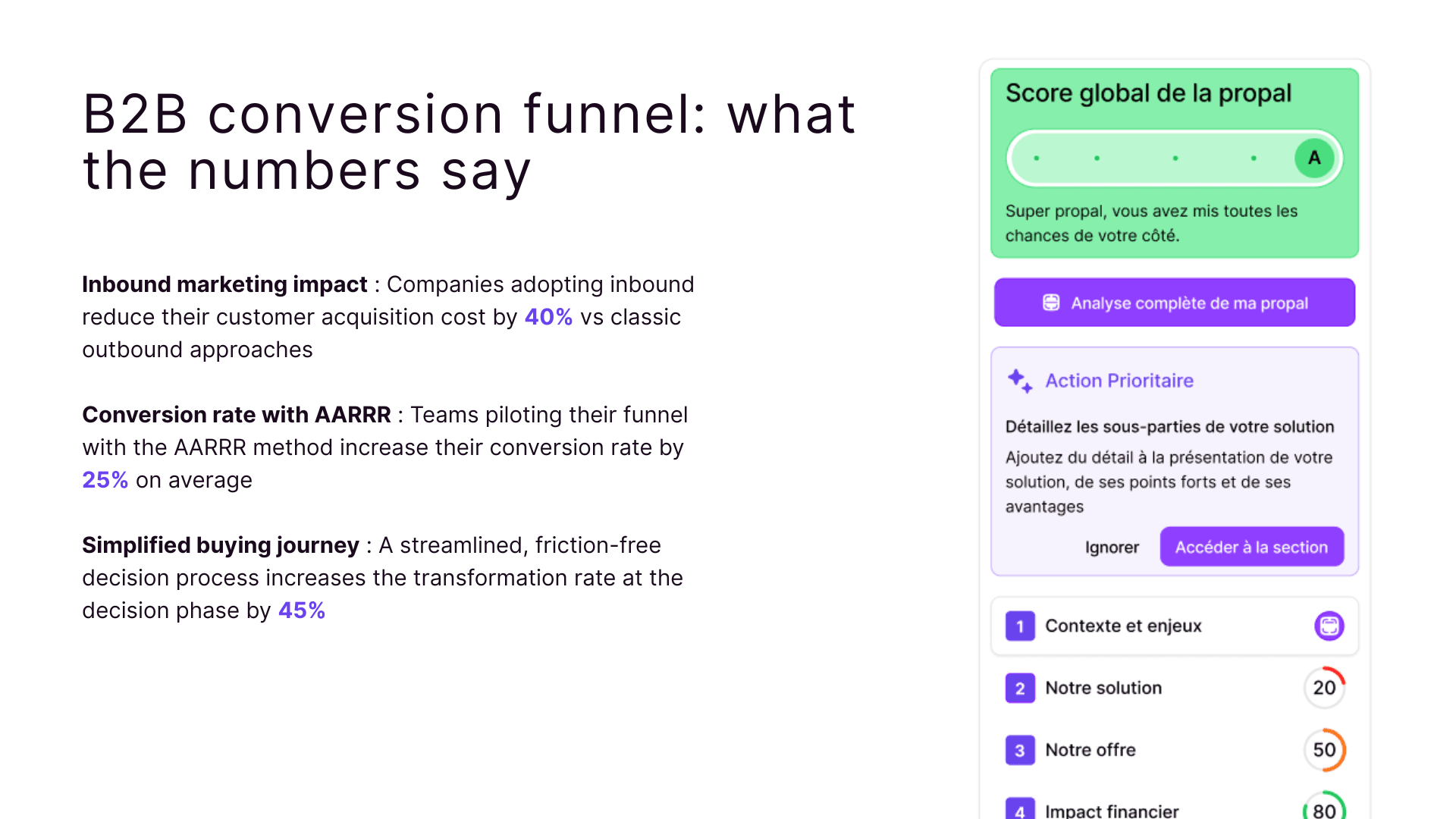
Companies adopting this methodology see an average 25% increase in their conversion rate in 2025. The key lies in precise analysis of friction points at each level to deploy targeted corrective actions.
The inbound marketing approach in the funnel
Inbound marketing radically transforms the sales funnel dynamic in 2026. This natural attraction strategy places quality content at the heart of the conversion process. A well-structured company blog, combined with relevant social media presence, naturally guides prospects toward your solutions.
This approach's strength lies in personalized lead nurturing. For example, a B2B company can create a series of specialized white papers, followed by exclusive webinars, to accompany their prospects at each funnel phase.
Companies adopting this method see a 40% reduction in customer acquisition cost. The key? Perfect synchronization between SEO, optimized landing pages, and strategic calls-to-action.
The 4 essential stages of the sales funnel
Attraction: capturing prospect attention
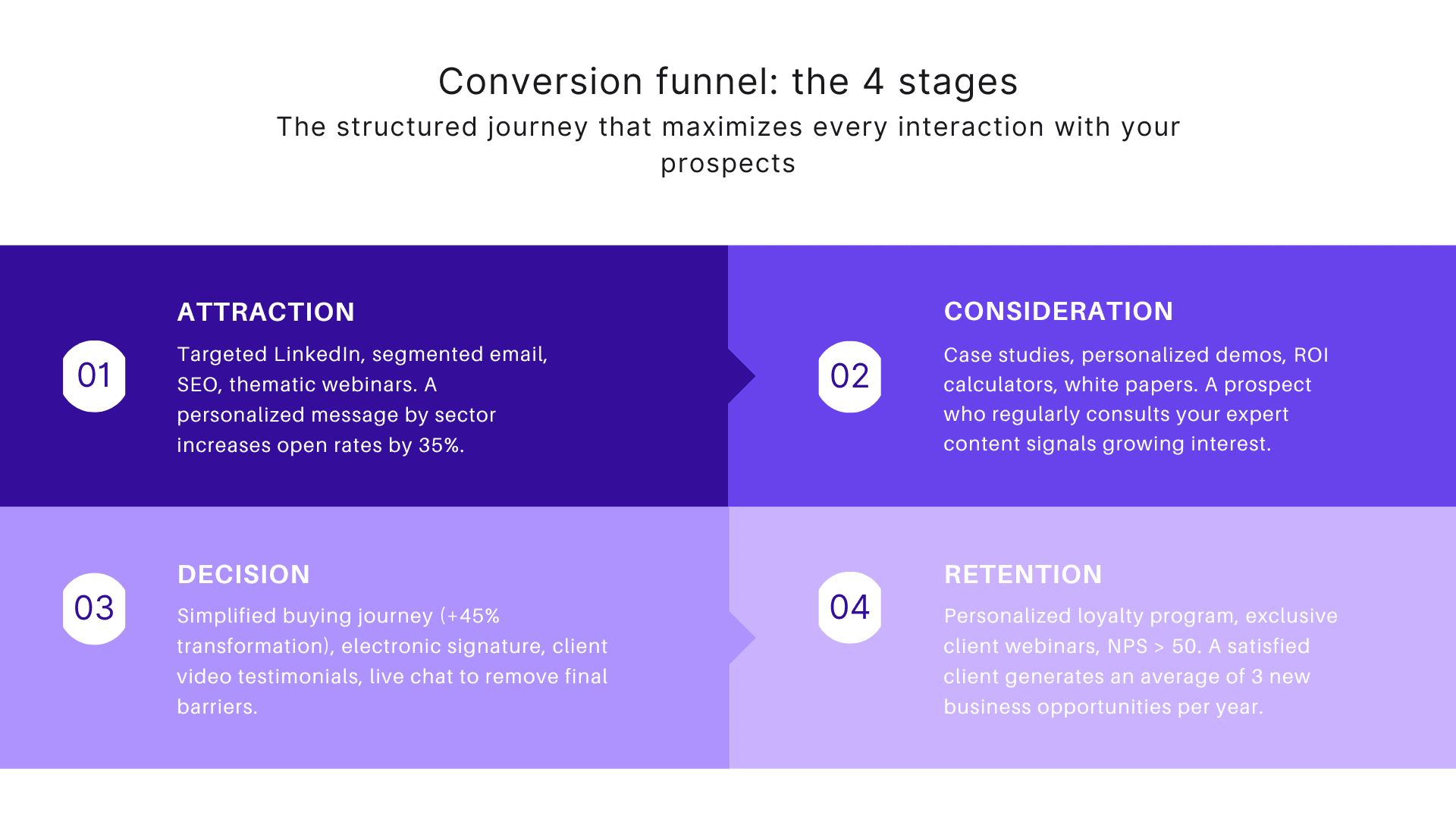
The funnel's first phase requires a multi-channel approach to maximize your visibility. Targeted LinkedIn campaigns allow you to reach decision-makers through compelling messages adapted to their professional challenges.
Email marketing remains effective when you finely segment your database. A personalized message according to industry sector increases open rates by 35%.
Your micro-moments of visibility count: optimize your Google My Business profile, participate in industry events, create thematic webinars. The key lies in message consistency across every touchpoint.
Measure your actions' effectiveness through strategic CTAs: newsletter signup, quote request, resource download. These first interest signals naturally feed the rest of your funnel.
Consideration: engaging interest
The consideration phase requires a deep engagement strategy. Your prospects are actively evaluating market solutions. Provide detailed case studies and personalized demonstrations that precisely address their business challenges.
A well-structured qualification journey builds trust. Organize technical webinars, share specialized white papers, or create ROI calculators. These tools help your prospects make informed decisions.
Measure engagement through time spent on your premium resources and number of touchpoints. A prospect who regularly consults your expert content shows growing interest in your solution.
Decision: facilitating purchase
The decision phase demands a smooth and reassuring buying experience. A simplified journey, with clearly identified steps, increases transformation rates by 45%. Multiple payment methods meet varied professional buyer needs.
Electronic signatures accelerate B2B contract finalization. A comparative offer table or personalized price configurator aids informed decision-making.
Consider integrating reassurance elements: certifications, satisfied client video testimonials, satisfaction guarantee. Live chat or a dedicated number helps remove final conversion barriers.
Measure effectiveness through average signing time and abandonment rate at each purchase process step.
Retention: transforming into brand ambassadors
Transforming a client into a brand ambassador relies on long-term engagement strategy. A personalized loyalty program strengthens the bond with your brand. Exclusive webinars reserved for clients and networking events create an active community around your solutions.
Analyzing client feedback through satisfaction surveys allows continuous service improvement. An NPS score above 50 indicates a solid base of potential ambassadors.
Showcase your clients' successes through detailed case studies. This spotlight naturally encourages experience sharing and spontaneous recommendations. A satisfied client generates an average of three new business opportunities per year.
Optimizing each conversion funnel phase
Creating content adapted to each stage
A conversion funnel's success relies on perfectly calibrated content for each customer journey phase. An informative blog post naturally attracts visitors in the discovery phase. Practical guides and comparative studies address prospects' questions during evaluation.
For the decision phase, focus on personalized demos and detailed ROI analyses. An interactive calculator allows decision-makers to concretely visualize your solution's benefits.
Formats vary according to objectives:
- Short videos to capture initial attention
- White papers to deepen reflection
- Technical sheets for final validation
- Tutorials for post-purchase support
Adapt your tone: more educational at the funnel's beginning, more technical and precise in advanced phases.
Personalizing user experience
Dynamic personalization radically transforms conversion rates in 2026. Artificial intelligence systems analyze visitor behavior in real-time to automatically adjust key buying journey elements.
A personalized dashboard displays only relevant information for each profile. Recommendations are refined through machine learning that identifies navigation patterns and individual preferences.
Behavioral segmentation allows adapting reassurance messages and sales arguments. For example, a pressed decision-maker will directly see ROI and implementation timelines, while a technical user accesses detailed specifications.
Automating recurring actions
Sales task automation frees valuable time for your team. Modern tools simplify prospect follow-up by automatically triggering personalized email sequences based on their behavior.
An automated scoring system classifies your contacts by engagement level. For example, a prospect who downloaded three resources and visited your pricing page will receive priority invitation to a personalized demo.
Synchronization between your CRM and marketing tools optimizes the buying journey. Navigation data feeds predefined scenarios: targeted follow-ups, technical documentation sending, or adapted commercial proposals. This approach reduces administrative task time by 40%.
Measuring your funnel's performance
Essential KPIs to track
Mastering your sales funnel requires tracking strategic metrics. The overall conversion rate measures your buying journey's effectiveness, while stage-by-stage abandonment rates reveal friction points to optimize.
Another revealing indicator: average sales cycle duration. This data helps identify stages that slow your prospects' progression toward purchase decision.
Average transaction value and customer acquisition cost determine your commercial strategy's profitability. A CLV/CAC ratio above 3 guarantees sustainable growth.
Also measure engagement rates on your content: number of resources consulted, time spent on key pages. This data refines your understanding of your prospects' decision-making journey.
Configuring Google Analytics effectively
The first step involves creating a coherent tracking structure in your Google Analytics account. Start by defining your main objectives based on your website's key actions.
Then configure custom segments to analyze new customer behavior compared to returning visitors. Precise event setup captures every significant interaction, from product sheet download to form validation.
For optimal funnel tracking, activate multi-channel funnel visualization. This feature reveals paths your prospects take before their first interaction with your brand. Set up automatic alerts to quickly detect anomalies in your conversion journey.
Using Google Tag Manager for tracking
Implementing Google Tag Manager revolutionizes your conversion funnel tracking. A single container centralizes all tracking tags, from Facebook pixel to GA4 events.
Create custom triggers to capture every micro-conversion: document downloads, action button clicks, or form completions. For example, an "add_to_cart" trigger automatically sends data to your e-commerce dashboard.
GTM variables allow enriching your conversion data with contextual information: traffic source, navigation path, or cart value. This granularity optimizes your customer behavior understanding and refines your marketing strategies.
Industry-specific features
E-commerce: optimizing the buying journey
Online store success relies on a smooth path to purchase. Micro-moment analysis reveals that 75% of abandonments occur due to friction during the ordering process.
To maximize your sales, structure your funnel around these key points:
- Product page and cart loading speed
- Intuitive navigation between categories
- High-quality photos with detailed zoom
- Visible and authentic customer reviews
A multi-option payment system accelerates order completion. Buyers particularly appreciate the ability to save their preferences for future purchases. Personalized notifications about order status strengthen trust and encourage repeat purchases.
B2B: adapting the funnel to long cycles
B2B sales complexity requires specific conversion funnel adaptation. A professional buying journey averages 6 to 12 months. This reality necessitates a custom support strategy.
Precise lead qualification becomes paramount. Establish scoring based on available budget, project maturity level, and decision-making power. For example, a finance director consulting your technical documentation signals a concrete project.
Your funnel must adapt to multiple decision-makers involved. Create targeted content for each profile: ROI for finance, specifications for technical staff, case studies for operations. This personalization strengthens your credibility and accelerates decision-making.