
What is the definition of customer journey in 2026?
The customer journey represents the complete sequence of interactions between a B2B company and its professional clients. This modern mapping goes beyond the traditional sales funnel.
A high-performing customer path in 2026 integrates decisive moments across different channels: professional social networks, dedicated mobile apps, and face-to-face meetings. For example, a CFO searching for a management solution might go from reading specialized articles to consulting user reviews, before attending a personalized demo.
Success relies on behavioral data analysis to create tailored experiences adapted to each industry's specifics.
The fundamentals of modern customer journey
The importance of digital customer experience
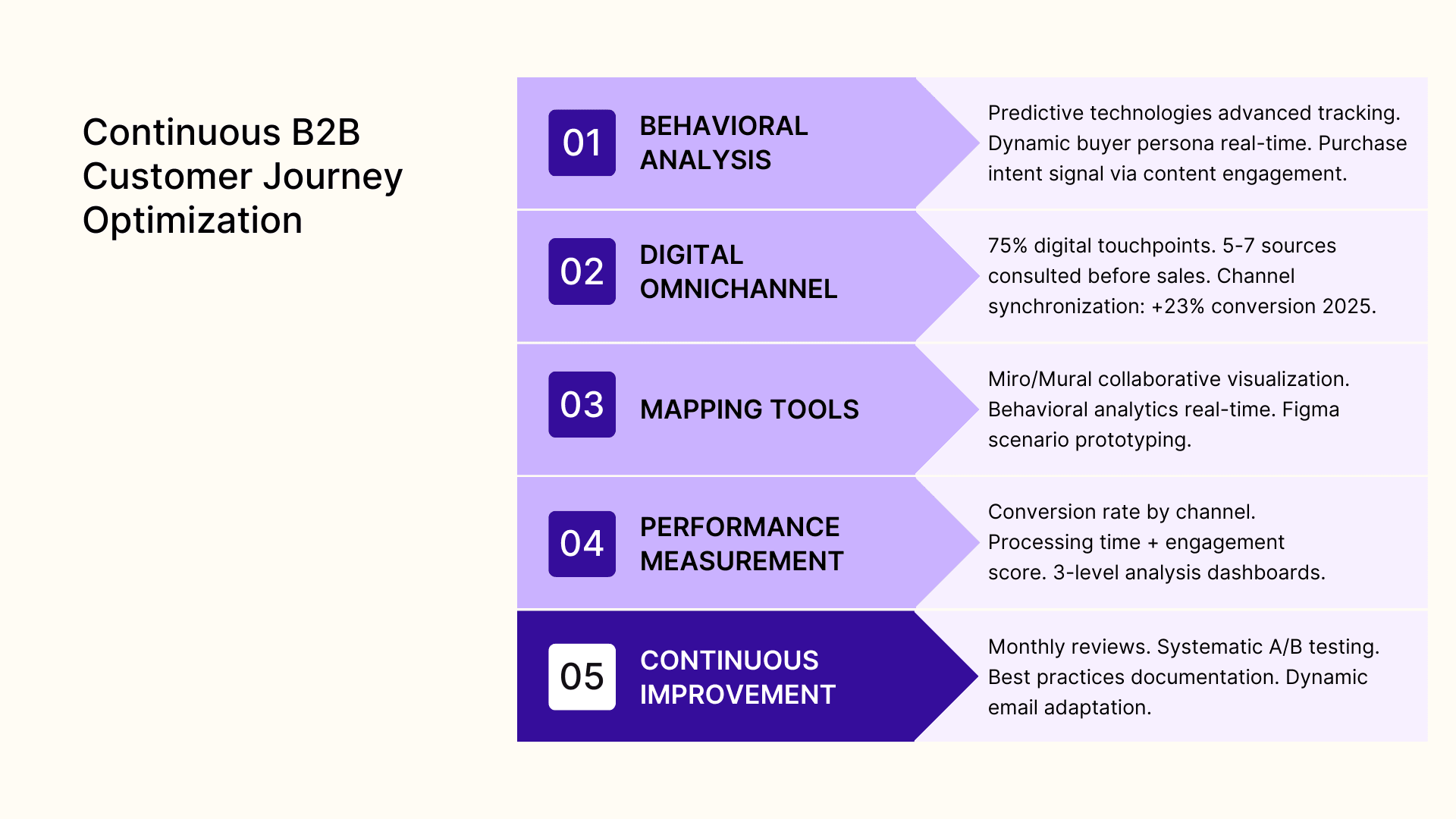
Digital interactions now represent 75% of touchpoints between B2B buyers and suppliers. An executive consults an average of 5 to 7 digital information sources before starting a sales conversation.
The transformation of professional buying habits demands a renewed approach. A purchasing manager looking for a document management solution navigates between specialized blogs, online comparators, and expert reviews before even identifying potential contacts.
Smart content personalization becomes a major differentiating factor. High-performing companies analyze behavioral data to dynamically adapt their interfaces and messages according to the prospect's profile, industry, and maturity in their buying cycle.
Marketing's role in the customer journey
Marketing teams now orchestrate engagement strategy at every stage of the B2B buying journey. A recent study reveals that 82% of decision-makers consume marketing content before any sales contact.
Data analysis helps identify key moments when a professional buyer actively searches for solutions. For example, a purchasing director spends an average of 6 hours consulting specialized blog articles and white papers before starting initial discussions.
Building a lasting relationship relies on the ability to deliver the right information at the right time. High-performing brands adapt their communication according to the prospect's maturity level: educational content during discovery, case studies during evaluation, technical demonstrations as decision approaches.
The impact of omnichannel touchpoints
Touchpoint synchronization radically transforms B2B sales performance. Companies that harmonize their communication channels see an average 23% increase in conversion rates in 2025.
A professional buyer naturally navigates between an on-site sales presentation, a PDF catalog, and an online demonstration. This fluidity builds trust and accelerates the sales cycle.
Added value lies in intelligent interaction orchestration. For example, a prospect viewing a product sheet automatically receives a personalized invitation to a themed webinar, creating a coherent and progressive experience.
How to effectively map the customer journey
Essential customer journey mapping tools
Effective customer journey mapping relies on three complementary tool categories. Collaborative solutions like Miro or Mural enable teams to visualize and build different journey mapping stages together.
Behavioral analytics platforms enrich mapping through real-time interaction data. Combining with Google Analytics provides precise visibility into friction points.
Specialized customer journey mapping software offers advanced features: customizable templates, persona integration, contextual annotations. Tool choice depends on your journey complexity and the level of detail needed in interaction visualization.
Templates and canvas to structure your analysis
The touchpoint analysis matrix forms a fundamental model for visualizing key interactions. This structured approach documents each journey stage through a grid dedicated to professional buyers' emotions, actions, and expectations.
A particularly effective template relies on four-zone breakdown: exploration phase, technical evaluation, commercial negotiation, and post-purchase support. This structure fosters deep understanding of specific needs at each B2B buying cycle moment.
The user experience canvas helps map feelings and potential frustrations. For example, a purchasing manager reviewing technical documentation might express their need for more detailed system compatibility information.
Figma's contribution to visualization
Figma's power lies in its ability to dynamically represent customer interactions. A marketing manager can model the buying path in real-time while a salesperson enriches the mapping with field feedback.
Prototyping features allow testing different customer experience scenarios. For example, a B2B sales team simulates an industrial buyer's journey from first contact to signature, adjusting each touchpoint based on observed reactions.
The collaborative dimension transforms customer journey creation into a team project. Annotations, comments, and simultaneous modifications facilitate shared vision emergence between marketing, sales, and customer service.
The 5 key stages of B2B customer journey
Awareness phase and first contacts
The awareness phase marks the beginning of the B2B buying journey. A recent study shows that 78% of professional decision-makers start their research on search engines before any sales contact.
High-performing companies create high-value content adapted to different buyer profiles. A themed webinar, specialized white paper, or industry conference presentation establishes a qualified first connection.
Behavioral data analysis reveals that B2B buyers consult an average of 5 to 7 different information sources during this initial phase. A multichannel strategy combining websites, professional social networks, and personalized marketing automation maximizes chances of capturing qualified prospects' attention.
Solution evaluation and comparison
The evaluation phase reveals a major transformation in the B2B buying process. Professional buyers now dedicate 45% of their time to thorough solution comparison before any contact with a salesperson.
A purchasing manager mobilizes three specific tools on average: functional comparison matrices, detailed pricing grids, and customer testimonials. This structured approach establishes objective scoring of considered solutions.
Creating a personalized evaluation grid constitutes a winning practice. Priority criteria include technical compatibility, estimated ROI, support quality, and solution scalability. This methodology ensures selection aligned with company strategic objectives.
Decision-making and conversion
The final phase of the B2B buying cycle reveals a marked trend: decision-makers seek tangible guarantees before committing. Recent analysis shows that 82% of professional buyers require a personalized solution demonstration.
Support becomes a determining factor at this stage. High-performing companies offer full-scale testing, allowing technical teams to concretely evaluate the solution in their specific environment.
Contract signing marks the beginning of new dynamics. Best practices include a detailed implementation plan, customized training, and close monitoring during the first weeks. This structured approach reinforces customer confidence in their decision.
Usage experience and satisfaction
Satisfaction level measurement reveals specific expectations from B2B users. Teams now adopt a mixed approach combining quantitative data (CSAT, CES) and qualitative feedback to evaluate experience quality.
A product manager testifies: creating a detailed customer journey map quickly identifies improvement opportunities. This visual representation highlights critical moments where satisfaction can shift.
Technical support responsiveness constitutes a decisive factor in overall appreciation. Leading companies structure their after-sales service around a 2-hour response commitment, creating lasting belonging among their professional clients.
Retention and referral
Transforming a B2B client into an ambassador relies on long-term engagement strategy. 2025 data reveals that a 5% retention rate increase can generate up to 95% profit increase in the professional sector.
A high-performing B2B loyalty program centers around targeted actions:
- Interaction personalization according to industry
- Proactive usage tracking implementation
- Exclusive peer events organization
- Expert user community creation
Spontaneous referral becomes natural when technical teams perfectly master solutions. An industrial company testifies: its loyal customers now generate 40% of new sales opportunities through professional word-of-mouth.

Journey optimization through insights analysis
Behavioral analysis methods
Modern behavioral analysis relies on predictive technologies to decode B2B consumption habits. Advanced tracking tools map every digital micro-interaction, from website navigation to marketing campaign responses.
Implementing a dynamic buyer persona model transforms decision-maker understanding. This approach integrates real-time behavioral data to automatically adapt buying journeys according to observed preferences.
An industrial marketing manager tripled their conversion rate by applying this methodology. Their strategy? Analyze purchase intent signals through technical content engagement, then trigger personalized scenarios according to project maturity.
User experience data exploitation
Transforming user data into concrete actions revolutionizes B2B experience in 2026. Interactive dashboards now enable sales teams to quickly identify friction points in the professional buying journey.
An industrial company reduced quote abandonment by 40% by leveraging customer feedback. The key? A satisfaction-based scoring system that automatically triggers targeted customer service interventions.
Aggregating negative and positive opinions feeds a permanent improvement process. Marketing teams adjust their advertising campaigns according to field feedback, creating a virtuous loop between consumer awareness and essential conversion elements.
Continuous improvement strategies
Implementing continuous improvement relies on regular optimization cycles. B2B sales teams schedule monthly reviews to evaluate action effectiveness and adjust their approach.
An automatic update system for sales proposal templates enables rapid field feedback integration. This agility reinforces the relevance of documents sent to prospects.
Follow-up emails dynamically adapt according to recipient reactions. A decision matrix guides salespeople in choosing corrective actions to take.
High-performing companies adopt a structured approach: defining measurable objectives, systematic A/B testing, best practice documentation, and learning sharing between teams.
Agile customer journey management
Adapting to market changes
Responsiveness to B2B market changes requires permanent strategic monitoring. High-performing companies watch for weak signals: new buying behaviors, disruptive technology emergence, or regulatory changes.
A sales manager testifies: "We created a real-time dashboard that alerts on significant conversion rate variations by segment." This agility enables rapid adjustment of pitches and offers.
Operational flexibility constitutes another major pillar. Organizations adopt collaborative methods to accelerate decision-making. An industrial company reduced its tender response time by 30% by digitalizing its validation chain.
Interaction performance measurement
Precise measurement of sales performance indicators transforms B2B decision-making in 2026. Conversion rate by channel constitutes a fundamental metric, identifying the most effective touchpoints in the buying process.
Average request processing time and customer engagement score reveal interaction quality at each stage. A technology company reduced its sales cycle by 25% by optimizing these key metrics.
Dynamic dashboards now aggregate three analysis levels:
- Prospect engagement by content type
- Proposal opening and response rates
- Average time between each decision stage
This data-driven approach enables rapid sales strategy adjustment according to observed behaviors.
The future of B2B customer journey
B2B customer journey transformation accelerates with advanced predictive technology emergence. Generative artificial intelligence systems revolutionize sales interaction personalization, creating tailored experiences adapted to each industry.
A major shift emerges in how B2B decision-makers search for and evaluate their commercial partners. Augmented reality now enables ultra-realistic virtual product demonstrations, while specialized virtual assistants guide buyers 24/7 in their decision-making.
Next-generation collaborative platforms transform the client-supplier relationship into a true strategic partnership. For example, an industrial manufacturer now offers "digital twins" allowing clients to simulate solution integration in their own production environment.
Frequently asked questions
Why is customer journey mapping so important?
It helps visualize all customer interactions, identify friction points, optimize each touchpoint, and ultimately improve overall customer satisfaction and conversion.
What are the main tools for creating a customer journey map?
Customer journey mapping should be reviewed at least annually, or whenever there's a significant change in your product, service, or customer behavior patterns.
How can you concretely improve a customer journey once it's mapped?
Through KPIs like customer satisfaction scores (NPS, CSAT), conversion rates at each stage, customer retention rate, and time spent at each touchpoint.