Origins of the QQOQCCP method and its author
This analytical approach traces its roots back to antiquity. The name most closely tied to it is Marcus Fabius Quintilianus, a Roman rhetorician of the 1st century AD, whose method aimed to establish the moral responsibility for actions. He was not, however, its inventor.
The system actually originates with the Greek rhetorician Hermagoras of Temnos (2nd century BC), who defined the seven circumstances of an act, including "quem ad modum" (in what manner) and "quibus adminiculis" (by what means). Cicero, in the 1st century BC, and later Quintilian, in the 1st century AD, both adopted this framework for teaching rhetoric. The Latin hexameter that summarizes it (quis, quid, ubi, quibus auxiliis, cur, quomodo, quando) was not attributed to Quintilian until the Middle Ages.
In 1948, Harold Dwight Lasswell adapted this questioning approach to communication sciences with his formula "who says what, through which channel, to whom, with what effect." Anglo-Saxon journalism had already turned it into its "Five W's" as early as the start of the 20th century, and postwar quality management approaches adopted it in turn, in the 5W2H form, to frame problem analysis before solving it.
Quintilian's hexameter: The 7 key questions
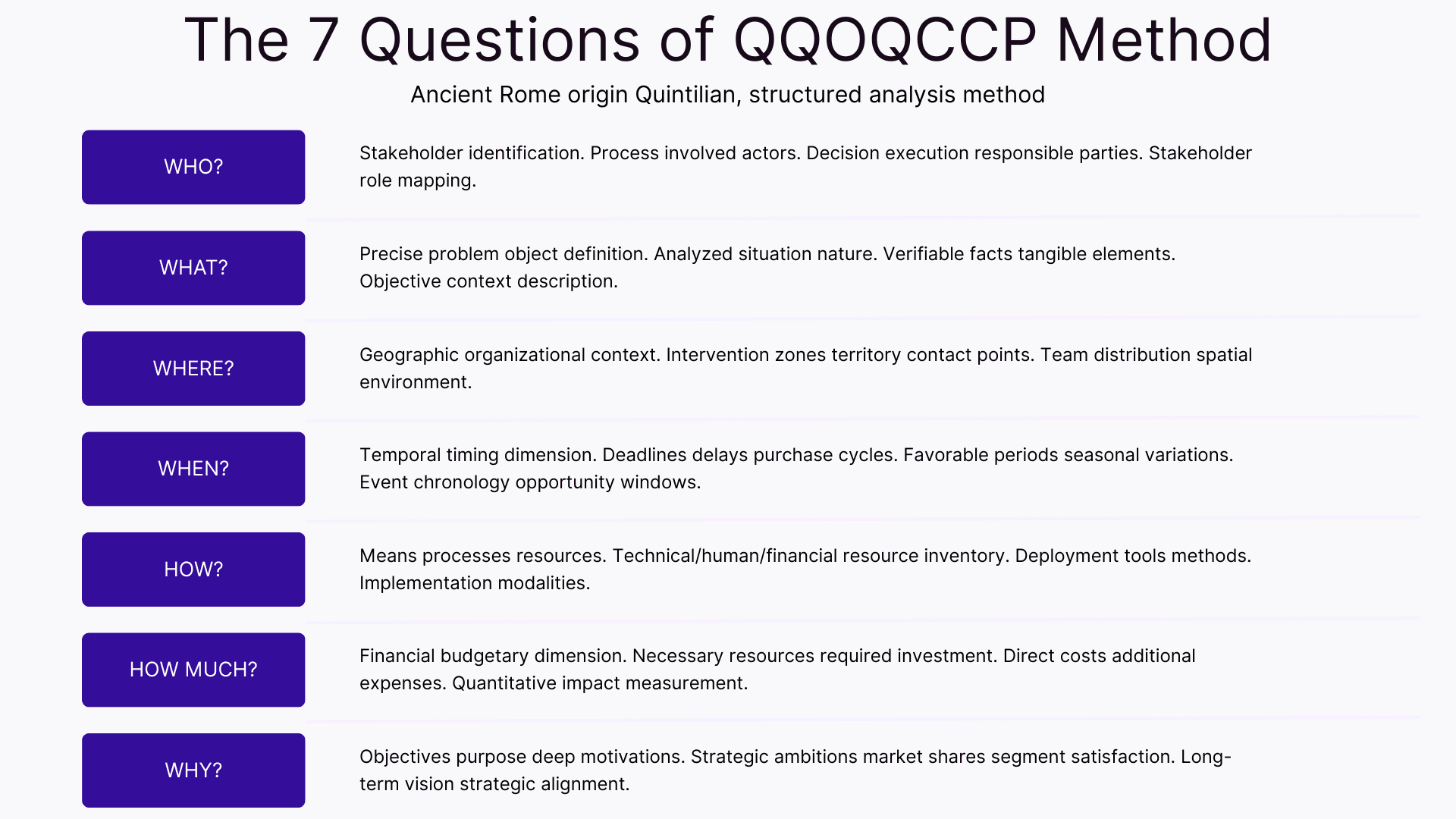
The power of this questioning lies in its ability to explore every aspect of a situation. The seven fundamental questions enable a complete diagnosis: Who identifies the stakeholders involved, What precisely defines the object or problem, and Where establishes the geographical context.
When determines timing and deadlines, while How analyzes the necessary means and processes. The financial dimension is evaluated through How Much, which measures the required resources. Why, the ultimate question, reveals deep motivations and targeted objectives.
The six-question variant, 5W1H, leaves out How Much. It works well enough to frame a meeting or describe a situation, but in sales the budget and volumes at stake almost always come up, which is why the full version earns its place.
Take the example of a product launch: Who are our target customers? What exactly are we launching? Where will we market it? When should we plan the launch? How do we proceed? How much should we invest? Why this product now?
Understanding the method in English: The Five W's and beyond
In the Anglo-Saxon world, this methodical approach became popular under the name Five W's in early 20th-century journalism. Rudyard Kipling gave it its most quoted lines, in 1902: "I keep six honest serving-men: What and Why and When and How and Where and Who." American journalism schools later turned it into the basic rule for any news article.
The English formula "Who did What, Where, When and Why" perfectly synthesizes the essence of the questioning. Professionals often add "How" to enrich the analysis, creating the 5W+H variant.
This simplified version proves particularly effective in modern journalism where speed of execution is paramount. A reporter must capture the essence of an event by answering these key questions in their first paragraph, a technique called the "lead paragraph" in the United States.
How to apply the QQOQCCP method in business
Situation analysis and decision making
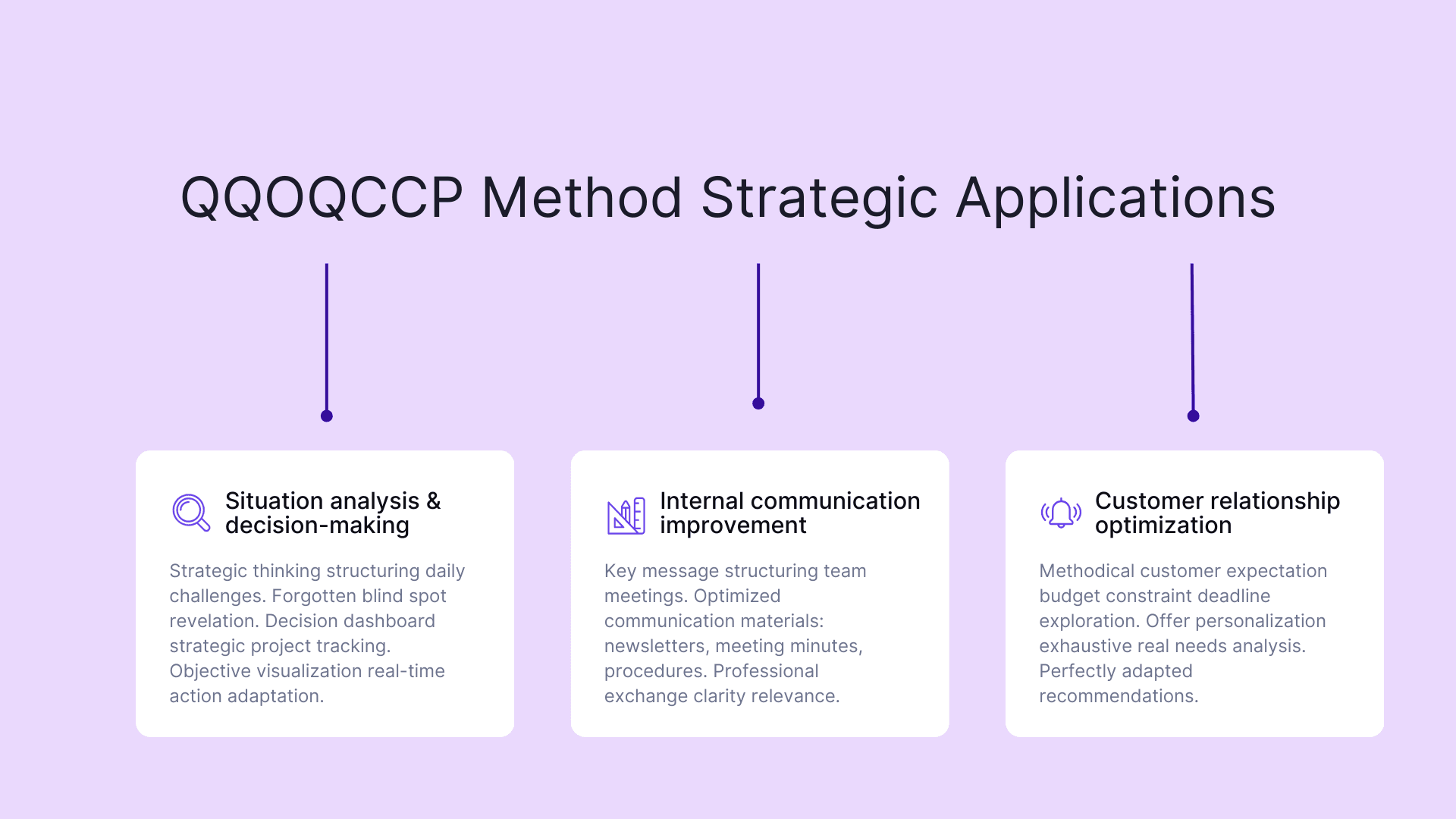
Applying this method clarifies business decision-making. Managers use it to structure their strategic thinking when facing daily challenges. A sales director can, for example, evaluate launching a new product line by methodically examining each variable.
The power of this approach lies in its ability to reveal blind spots that are often overlooked. Applied to a digital services company's repositioning, the grid forces clear answers to Who (which customers, which decision-makers), Why (what problem you solve better than competitors), and How Much (what budget those customers allocate to it): the resulting strategy stands out on facts, not intentions.
A decision dashboard based on this method facilitates strategic project tracking. Teams can better visualize their objectives and adapt their actions in real-time based on observed results.
Improving internal communication
The CQQCOQP method structures communication practices within organizations. HR teams use it particularly to structure their key messages during team meetings or feedback sessions. A team leader can, for example, prepare annual reviews by analyzing every aspect of the employee's performance.
This systematic approach strengthens the quality of professional exchanges. Applied to a front and back-office team's daily briefings, the grid forces everyone to spell out who does what, by when, and why: the misunderstandings that start with "I thought that was you" disappear once the Who column is filled in.
Rigorous application of CQQCOQP questioning also optimizes communication materials. Internal newsletters, meeting minutes, and procedures gain clarity and relevance through this comprehensive analysis framework.
Customer relationship optimization
Applying systematic questioning frames your customer interactions. A deep understanding of needs relies on methodical exploration: customer expectations, budget constraints, deadlines, professional environment.
Applied to an IT services company's sales meetings, the grid requires the budget, timeline, and decision-maker to be documented before a single line of the offer gets written. The proposals that come out of it answer a precise need rather than an assumed spec sheet, and the conversion rate shows it: a prospect who recognizes themselves in the diagnosis compares less on price.
Sales teams leverage this method to personalize their offers. A concrete example: an automotive salesperson precisely identifies vehicle usage, budget, and family constraints. This exhaustive analysis leads to recommendations perfectly adapted to the customer's real needs.
A practical table to structure your QQOQCCP thinking
A table format greatly facilitates applying CQQCOQP questioning. Organize your columns according to the seven fundamental questions and add rows to note your answers and observations.
To maximize effectiveness, start by clearly defining your objective at the top of the table. Then note your answers concisely in each corresponding cell. Using color codes helps to prioritize and quickly spot critical points.
For each question, plan for three lines: the current finding, the action to take, and the source of the information. Example for the How Much column: finding "budget not approved," action "get the range from the CFO by the 15th," source "meeting on the 3rd." An empty cell stands out at a glance: it is a question you have not asked yet, so a blind spot in your analysis.
Regular table updates ensure optimal project tracking and facilitate team decision-making.
Concrete applications of QQOQCCP in project management
Creation and planning phase
A project's initial phase requires a thorough analysis of needs and available resources. An experienced project manager begins by establishing a clear vision of the objectives to achieve, mobilizing their team around a structured kickoff meeting using the CQQCOQP method.
Project success largely depends on this preparatory stage. Take the example of a technology company launching a new application: meticulous planning allows for anticipating technical challenges, allocating necessary resources, and defining a realistic timeline.
Using appropriate management software reinforces this methodical approach. Modern digital tools centralize information, visualize progress, and quickly adjust the project's trajectory based on field feedback.
Objective monitoring and control
The monitoring dashboard is only as good as its link back to the seven questions asked during framing. Each column flows from them: Who (the person responsible for the action), What (the expected deliverable), When (the milestone and its gap against the schedule), How Much (budget spent against budget planned), How (the method chosen and its roadblocks), Where (the scope or site concerned). Why, meanwhile, stays at the top of the table: the project's objective, reread at every review, keeps the team from chasing milestones that no longer serve the original decision. A dashboard built this way reads in a few minutes and surfaces gaps without multiplying meetings.
Complex problem resolution
When facing a delicate situation, the CQQCOQP analytical approach reveals its full power. A quality manager at an automotive plant recently put it into practice to resolve recurring defects on a production line. Their first step consists of precisely mapping the observed malfunctions.
Methodical question structuring allows for exploring each dimension of the problem. A pharmaceutical company adopted this approach to resolve chronic delivery delays. The analysis revealed unsuspected flaws in the logistics chain, leading to a complete overhaul of the shipping process.
The key lies in the rigorous application of questioning at every level. A telling example: a tech startup facing high user abandonment rates discovered, thanks to this method, that the main cause wasn't technical but related to a lack of initial training.
The method in sales: Maximizing your results
Customer needs analysis
Strategic sales questioning speeds up and sharpens customer needs discovery. The first phase consists of exploring your prospect's global context: their industry, size, and current challenges.
The art of questioning relies on active and benevolent listening. Open-ended questions encourage your contact to share their deep expectations, while closed questions validate your understanding point by point.
Modern sales investigation techniques recommend alternating between factual and emotional questions. For example: "What are your quantified objectives?" followed by "What personally motivates you in this project?" This mixed approach reveals both explicit and implicit prospect needs.
Sales proposal development
Writing a winning offer begins with a methodical structuring of the information gathered during the discovery phase. An experienced salesperson organizes their data according to the 7 CQQCOQP axes before starting to write.
Take the example of a proposal for industrial equipment: the technical section details precise specifications, while the financial part presents a calculated 3-year ROI. The final document integrates a realistic deployment schedule and measurable performance indicators.
The How Much matters most here: a proposal that quantifies the cost of the problem and the expected return using the customer's own numbers carries far more weight than a pricing grid dropped at the end of the document. A proposal generation tool that pulls these seven answers in automatically saves you from starting over with a generic template, half of whose pages describe the vendor.
To maximize your proposal's impact, create a correspondence matrix between expressed needs and provided solutions. This visual approach reinforces your offer's relevance and facilitates prospect decision-making.
Follow-up and retention
A personalized follow-up program transforms your customers into brand ambassadors. Setting up regular appointments allows you to anticipate their expectations and measure their satisfaction through precise indicators.
This follow-up actually starts as soon as the offer is sent: knowing when the prospect opens the proposal, which sections they reread, and who they forward it to internally lets you follow up at the right moment, with the right argument, instead of guessing blind.
After signing, ask the seven questions again at regular intervals: have the What and the How Much shifted (new needs, new budget), has the Who changed (new decision-maker, new user), does the When signal an upcoming deadline (renewal, contract end, a new site opening)? This structured review surfaces additional sales opportunities before the customer even voices them, and puts you in position to propose them before a competitor does.
Log these answers in the same table used during discovery: the account then reads like a living file, not a record frozen on signature day.
Complementary tools: Mind maps and training
Mind maps represent an excellent visual support for structuring the CQQCOQP approach. This visualization technique allows salespeople to quickly map customer needs during sales meetings.
Applications like XMind or GitMind, available in a free version, facilitate the creation of these diagrams. A salesperson can, for example, note their prospect's responses in real-time while maintaining a coherent overview.
Mastering these tools is acquired through specialized training modules. These programs combine theoretical learning and practical exercises on real cases: needs analysis, sales proposal preparation, or customer problem resolution.
Frequently asked questions
What is the CQQCOQP method?
It's a questioning technique based on 7 questions (How, What, Who, How Much, Where, When, Why) to analyze a situation or problem exhaustively.
What are the main advantages of this method?
It ensures a complete analysis, structures thinking, improves communication, helps in informed decision-making, and facilitates problem resolution.
In which areas can CQQCOQP be used?
It's very versatile and applies to project management, strategy, sales, internal communication, customer relations, and any complex situation analysis.