
The fundamentals of the SIMAC technique
Origins and principles of the SIMAC sales method
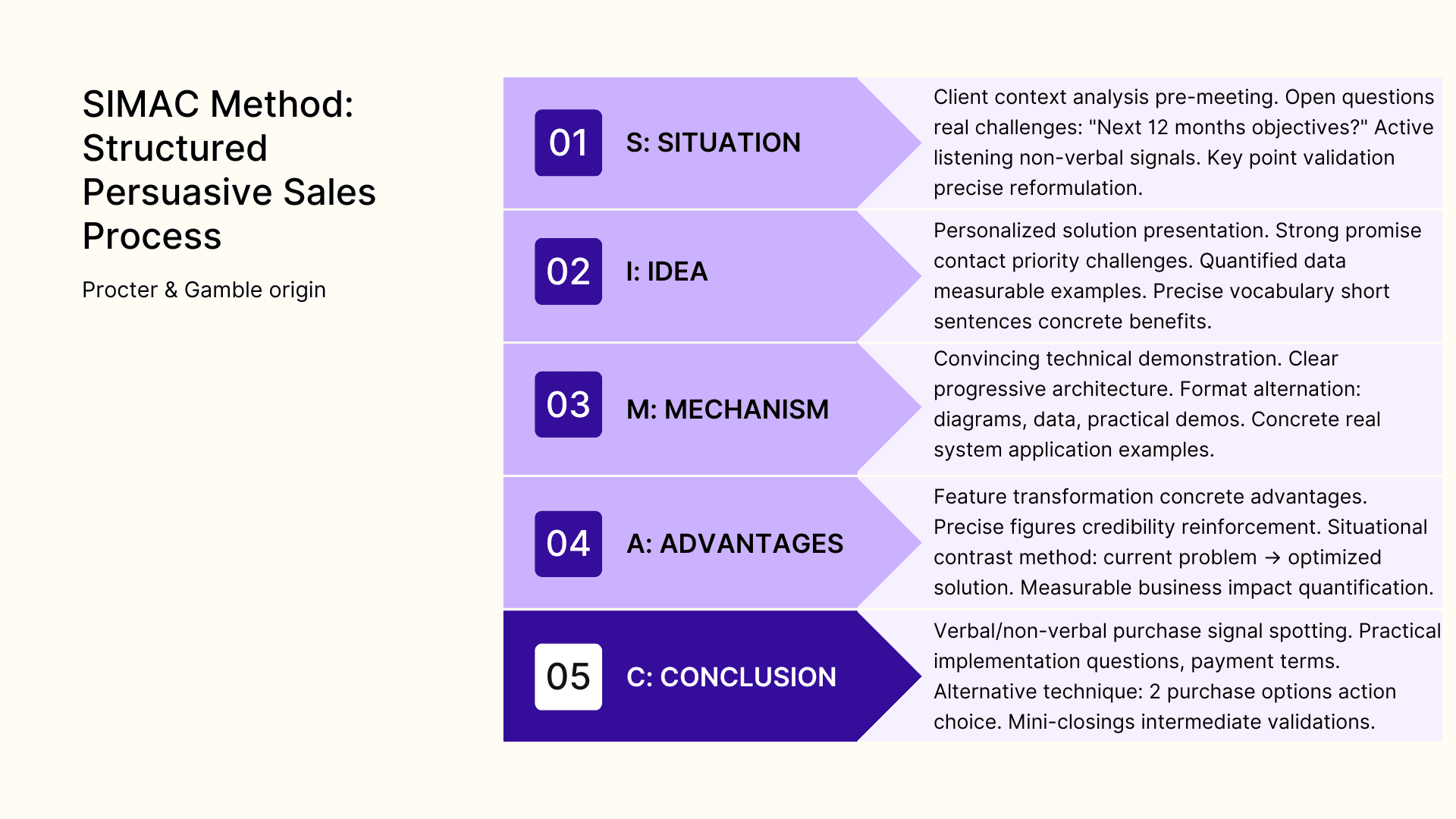
SIMAC traces back to the Persuasive Selling Format developed by Procter & Gamble's sales force for its distributor presentations: summarize the situation, state the idea, explain how it works, restate the key benefits, and propose a simple next step. The acronym captures that sequence and gives a natural structure to a sales conversation.
The strength of this strategy lies in its flawless logic. The salesperson begins by understanding their contact's context before proposing a tailored solution. This approach transforms the seller into a true business partner.
Its practical application relies on a structured process that guides each stage of the exchange, from initial assessment to decision-making. It has outlasted decades of sales fads because it enforces the hardest discipline to hold in a meeting: understand before you pitch.
Why adopt this persuasive approach?
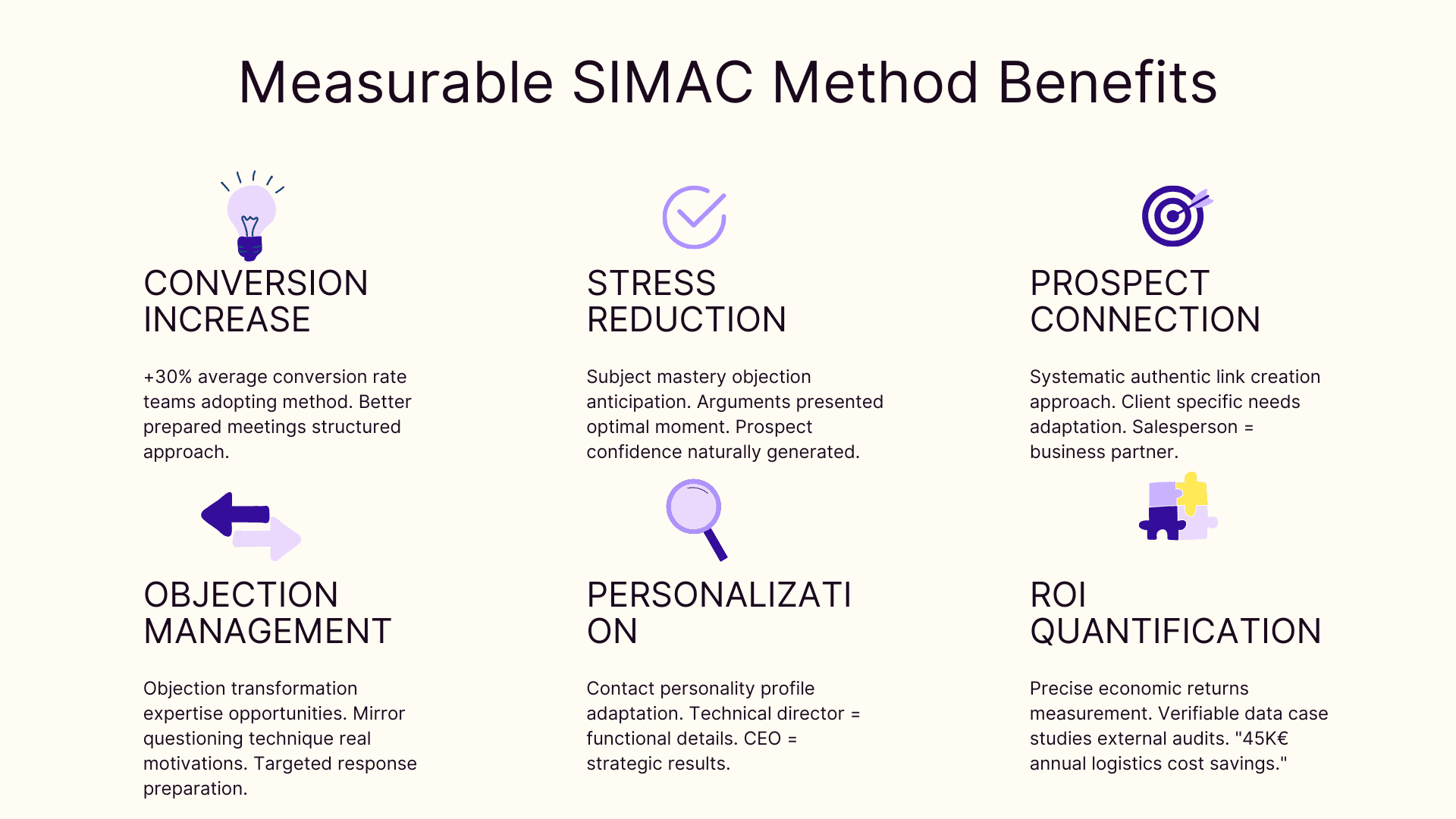
SIMAC's biggest payoff isn't a conversion percentage, it's the end of pitches that miss the point: the salesperson only talks about their solution once the client's situation has been validated, which makes every argument land.
This discipline matches a measurable expectation: according to Salesforce, 86% of B2B buyers are more likely to buy from a company that understands their goals. Teams that adopt SIMAC mostly report shorter meetings, fewer late-stage objections, and proposals that echo the client's own words.
The method also significantly reduces meeting stress. Sellers master their subject, anticipate objections, and present their arguments at the right moment. Structured preparation naturally generates prospect confidence.
Optimal usage contexts
The SIMAC method adapts to different sales scenarios. In B2B, it particularly shines during complex negotiations with long cycles, such as selling technology solutions or professional services.
In retail, salespeople successfully apply it to present a new product line or optimize store layout. A store manager can structure their pitch to convince management to invest in a special promotion.
Field teams leverage this method during strategic meetings: presenting a premium offer, contract renewal, or key account acquisition. Its format adjusts according to the available time, from a 10-minute express pitch to an hour-long in-depth meeting.
Situation: The foundation of a solid sales pitch with SIMAC
How to analyze client context
Client context analysis begins with meticulous preparation before each meeting. Review available company data: industry, size, recent news, and market presence.
A high-performing salesperson focuses on key indicators: revenue, market share, and growth dynamics. These elements help to identify improvement opportunities and potential friction points.
Adopt a structured approach during your first meeting. Observe the work environment, listen to the vocabulary used, and spot non-verbal signals. These details often reveal unexpressed needs that will enrich your understanding of the context.
Key questions to ask
A successful sales diagnosis relies on the quality of your questions. Prioritize open-ended questions that reveal real challenges: "What are your priority objectives for the next 12 months?" or "How do you currently manage this process?"
Deepen your understanding with quantifiable questions: "What annual budget do you allocate to this solution?" and "How much time does your team spend on these tasks?"
Explore decision barriers tactfully: "Who participates in the decision-making process?" and "What criteria will guide your final choice?" A skilled salesperson also knows how to identify timelines: "What's your deadline for implementing this solution?"
Validate each key point with precise reformulation: "If I understand correctly, your priority is to..."
Active listening techniques to master
Good questioning only pays off if the listening that follows is just as sharp. The techniques behind quality listening (open posture, silence after a response, reformulation, validation) get their own dedicated guide. For SIMAC, keep the essentials: let the prospect finish their sentences, build on their own words to dig deeper, and get each point confirmed before you move on to the Idea. Those moments of silence often surface motivations a direct question would never have drawn out.
Structured note-taking allows you to capture essential elements without losing the conversation thread. Note numbers, dates, and proper names that will enrich your future sales proposal.
The idea: Presenting a relevant solution with SIMAC
Formulating an impactful proposal
A successful presentation's success relies on your ability to transform gathered information into a personalized solution. Start by synthesizing the essential points identified during your listening phase.
Structure your pitch around a strong promise that directly addresses your contact's priority challenges. A marketing manager will be more sensitive to increased conversion rates, while a CFO will be more interested in the return on investment.
Support your recommendations with quantified data and measurable examples. A presentation announcing a "20% savings on your operational costs" will have more impact than vague talk about resource optimization.
Keep in mind that every word counts. Use precise vocabulary and short sentences that highlight concrete benefits for your prospect.
Adapting your pitch to the client profile
A successful sales meeting relies on your ability to modulate your presentation according to your contact's personality. A technical director will appreciate functional details while a CEO will be interested in strategic results.
Observe your contact's rhythm and communication style. An analytical profile prefers a methodical demonstration while a dynamic profile expects quick, punchy answers.
Adjust your body language and verbal communication to mirror your contact. This natural synchronization strengthens the connection and facilitates mutual understanding. A skilled salesperson also knows how to adapt their presentation tempo: slow down with a thoughtful prospect, speed up with a busy decision-maker.
Common mistakes to avoid with the SIMAC method
A botched presentation of the SIMAC method can compromise your sales success rate. Avoid a prolonged monologue that drowns your prospect in too much information at once. Rushing to a conclusion without solidly establishing each step represents another fatal error.
Stay vigilant against classic traps:
- Neglecting the listening phase to jump directly to solutions
- Standardizing your approach without adapting your message to the industry
- Multiplying technical arguments without a connection to expressed needs
Be careful not to fall into an overconfidence that would make you skip certain steps. An experienced seller knows that a successful sale requires a methodical and complete application of the SIMAC process.
The mechanism: A convincing demonstration with SIMAC
Structuring your technical presentation
A successful technical presentation revolves around a clear and progressive architecture. Start with a synthetic overview before deepening specific technical aspects.
Adopt a dynamic rhythm by alternating formats: explanatory diagrams, quantified data, and practical demonstrations. This variation maintains your audience's attention while reinforcing the understanding of key points.
Precise and accessible vocabulary constitutes the key to a convincing demonstration. Use technical terms adapted to your contact's expertise level. For example, with a technical director, explore product specifications. For a marketing director, focus on concrete and measurable benefits.
Concrete examples of SIMAC method application
Imagine a logistics solutions seller facing a warehouse manager. After identifying a 12% loss rate in inventory management, the salesperson presents an automated tracking system.
Their demonstration relies on a real-time simulation. The prospect visualizes how the system reduces errors by 75% from the first month of use. The salesperson reinforces their argument with industry references: three similar warehouses increased their productivity by 30%.
Another illustration: an industrial equipment supplier proposes an energy optimization solution to a manufacturer. The presentation highlights a 25% cost reduction over one year, observed at a reference client. Figures in hand, the manufacturer agrees to an on-site energy audit, a concrete first step toward the order.
Advantages: Showcasing your offer with the SIMAC method
Benefit highlighting techniques
Benefit enhancement relies on a strategic approach that transforms technical features into concrete advantages. A skilled salesperson systematically establishes the link between product functionalities and their real impact on the client's business.
Using precise figures reinforces your argument's credibility. Rather than a simple savings promise, present a measurable 25% operational cost reduction over 6 months.
This discipline sits at the heart of value selling: you sell a quantified outcome for the client, and the price gets discussed against that outcome rather than in absolute terms.
The situational contrast method amplifies benefit perception. First, describe the prospect's current problematic situation before introducing your solution as the bridge to an optimized reality. This technique creates an immediate awareness of the added value. Then position your offer against the alternatives the client is weighing, which is exactly what a competitive analysis beforehand makes possible: an advantage is only worth what it's worth relative to what the prospect could get elsewhere.
Personalization according to motivations
Understanding your prospect's motivational drivers guides your personalization strategy. A security-sensitive buyer will appreciate certifications and guarantees, while a performance-focused profile will be interested in measurable productivity gains.
Adapt your vocabulary to the identified priorities. For a prestige-focused decision-maker, highlight your solution's exclusivity and innovation. With a pragmatic prospect, emphasize concrete aspects like return on investment and realized savings.
Motivation mapping enriches your presentation. For example, when selling HR software, emphasize ease of use for an HR director seeking operational efficiency, or regulatory compliance for one concerned about legal security.
Quantifying business impact
The precise measurement of economic returns reinforces your sales credibility. An argument based on tangible data demonstrates, for example, that an inventory management solution reduces losses by 18% from the first quarter of use.
Present relevant metrics for your sector: conversion rates, average processing time, customer satisfaction, or return on investment. Numbers gain power when they tell a story: "Our system enabled a similar client to save $45,000 on their annual logistics costs."
Rigorous quantification relies on verifiable data: detailed case studies, quantified testimonials, and external audits. The prospect must be able to concretely visualize your solution's financial impact on their results.
These numbers are meant to carry straight into the proposal that follows the meeting. A proposal that repeats the client's situation, the idea you landed on, and the quantified advantages in SIMAC order keeps the argument moving, where a generic deck that spends half its pages on the vendor lets it drop.
Objections almost always surface between Advantages and Conclusion. Don't handle them on the fly: objection handling follows its own sequence (probe, reformulate, argue, check). A price objection at this stage usually means the Advantages step didn't put a number on the gap between the client's current situation and the one you're proposing.
Conclusion: Moving toward a signature with the SIMAC method
Purchase signals to spot
Recognizing verbal and non-verbal purchase signals requires attentive observation. A prospect ready to conclude asks practical questions about implementation or payment terms. Their body language changes: they lean forward and nod in approval.
A request for details about delivery times or technical documentation reveals marked interest. The prospect begins to project themselves into using the product, mentioning concrete application cases in their company.
Another strong signal appears when your contact checks their calendar or mentions budget constraints. These remarks reflect advanced thinking about implementing your solution. Detailed note-taking during your presentation also suggests a growing commitment toward a purchase decision.
After the meeting, the same signals show up on the document you send: a proposal opened several times, shared internally, or revisited on the pricing page tells you the decision is moving forward, and points to the right moment to follow up.
Closing techniques adapted with SIMAC
The alternative method proves formidable in B2B: propose two purchase options rather than just one. For example: "Do you prefer to start with the standard version or directly with the premium version?" This approach offers a choice while directing toward action.
Recap closing synthesizes the key points validated during the meeting. Naturally follow up with an engaging question: "If we summarize, our solution meets your three main criteria. What start date would work best for you?"
For complex decisions, the mini-closing technique allows for obtaining intermediate validations. Validate each aspect (budget, planning, specifications) before reaching a final agreement. This progressive approach secures B2B signatures.
Optimizing the SIMAC method daily
Integration with sales tools
A high-performing CRM constitutes the cornerstone of a successful SIMAC method implementation. Digitalizing each step optimizes client follow-up and reinforces sales effectiveness.
Automating repetitive tasks frees up valuable time for meeting preparation. An enriched database centralizes crucial information about each prospect: exchange history, identified needs, and raised objections.
Creating personalized templates in your sales proposal tool accelerates the closing phase. A dedicated dashboard visualizes each opportunity's progression through the SIMAC steps, offering a clear vision of priority actions to take.
Measuring and improving performance
Rigorous tracking of key indicators allows for optimizing SIMAC method application. Measure your transformation rate at each step: qualified first contacts, obtained meetings, sent proposals, and finalized signatures.
Analyze your average sales cycle duration and identify phases requiring more attention. For example, if your transformation rate drops after presenting advantages, strengthen this step with more compelling quantified proof.
Establish realistic weekly objectives and evaluate your progress regularly. Comparing your results with industry averages helps to identify your priority improvement areas.
Frequently asked questions
What is the SIMAC method in sales?
It's a structured sales technique in 5 steps (Situation, Idea, Mechanism, Advantages, Conclusion) to guide the sales meeting from client understanding to signature.
Why is the "Situation" step so important in SIMAC?
Because it allows a deep understanding of the client's context, needs, and challenges through active listening and relevant questioning before proposing anything.
How is SIMAC a persuasive approach?
Its logical structure (understand before proposing, demonstrate before enhancing value) creates solid argumentation and builds client confidence at each step toward the conclusion.