
The customer success manager profession: much more than a client manager
Customer success management fundamentals
A customer success manager's success rests on three fundamental pillars. First, deep knowledge of the customer journey allows them to anticipate needs at each key stage.
A CSM must master scoring methodology to precisely evaluate their client portfolio's health. For example, analyzing feature adoption rates quickly reveals disengagement risks.
Proactivity constitutes the third pillar: the CSM contacts their clients regularly for constructive checkpoint meetings. This preventive approach transforms each interaction into an optimization and growth opportunity.
Performance metrics guide their daily actions: retention rates, NPS (net promoter score), and expansion revenue are scrutinized to measure the impact of their interventions.
The difference between CSM and account manager
The customer success manager focuses on users' long-term success. Their main mission: maximize the value created by the product for each client. Conversely, the account manager directs their actions toward revenue growth through renewals and business development.
A concrete example illustrates this nuance: facing a client who underutilizes certain features, the CSM will organize training sessions to optimize usage. The account manager, meanwhile, will look for cross-sell opportunities on other modules.
The complementarity of these two roles proves strategic: the CSM builds the satisfaction that will allow the account manager to realize business opportunities.
The importance of CSM in a B2B strategy
In today's B2B context, a well-structured customer success program reduces churn rates by 15 to 30%. The CSM transforms the supplier-client relationship into a true strategic partnership. Their proactive role allows them to anticipate needs and quickly adapt solutions to market evolution.
Data shows that a company with a high-performing CSM strategy increases its monthly recurring revenue by 20% on average. The CSM actively participates in growth by identifying expansion opportunities with existing clients.
The direct impact on ROI is measured through key indicators: increased feature adoption rates, reduced onboarding times, and continuous improvement based on user feedback.
Key missions of a customer success manager
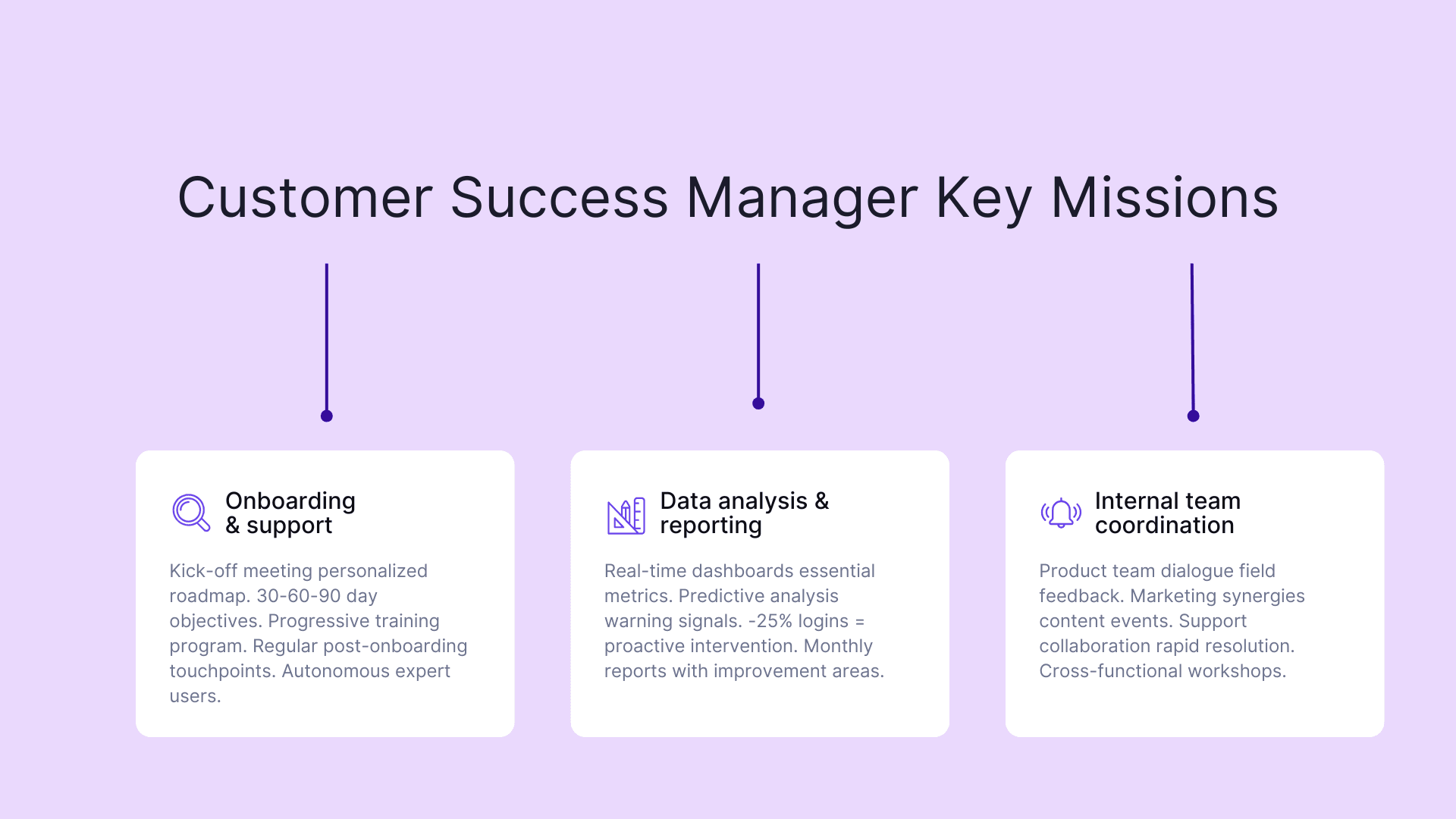
Onboarding and client support
Successful onboarding begins with a kick-off meeting that lays the foundation for successful adoption. The CSM establishes a personalized roadmap, setting precise objectives at 30, 60, and 90 days.
A customized training program guarantees progressive user skill development. The CSM facilitates practical sessions, creates adapted user guides, and implements a progress tracking system.
The post-onboarding support phase revolves around regular touchpoints: monthly usage reviews, optimization workshops, and best practice sharing. This structured approach transforms new users into autonomous experts, capable of fully exploiting the solution's potential.
Client data analysis and reporting
A modern CSM relies on data intelligence to drive their actions. Personalized dashboards allow real-time tracking of essential metrics: feature usage rates, satisfaction scores, and adoption trends.
Predictive analysis reveals early warning signals. For example, a sudden 25% drop in weekly logins triggers proactive CSM intervention before the situation deteriorates.
Data visualization transforms raw numbers into actionable insights. A CSM uses these insights to adjust their support strategy and demonstrate created value to stakeholders. Consolidated monthly reports highlight successes and improvement areas, guiding strategic decisions to optimize client experience.
Coordination with internal teams
A CSM's success relies on their ability to orchestrate actions between different departments. Constant dialogue with the product team allows enriching the roadmap based on field feedback. The CSM transforms client requests into concrete specifications for developers.
Synergy with marketing brings a strategic dimension: creating content adapted to user needs, organizing community events, highlighting success stories. The CSM also collaborates with technical support to guarantee rapid problem resolution.
A telling example: when a client expresses a specific need, the CSM brings together the relevant teams in a dedicated workshop. This cross-functional approach accelerates decision-making and strengthens client satisfaction.
Essential skills to succeed as a CSM
Mastering management tools and CRM
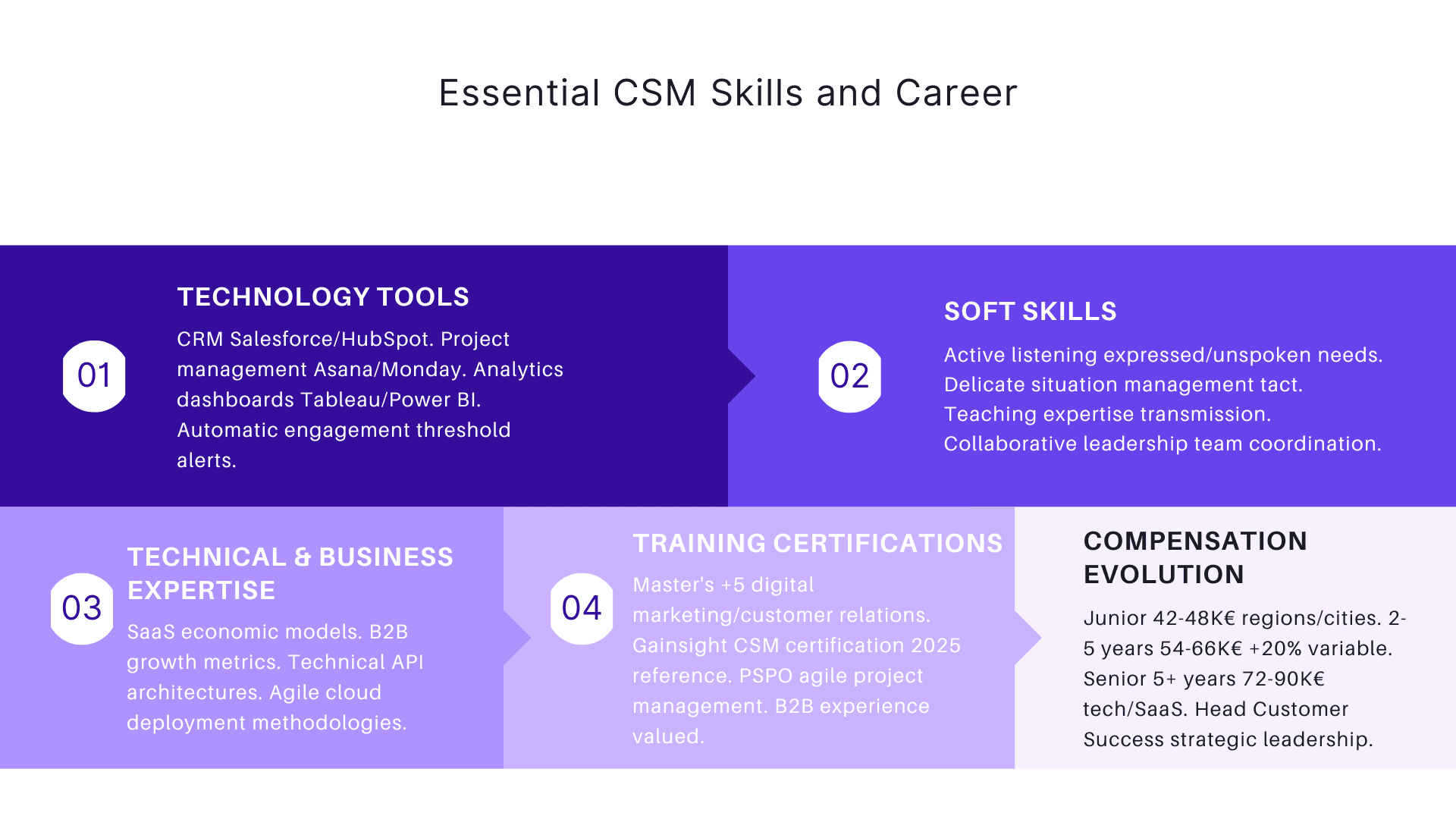
A CSM's success relies on mastering modern CRM platforms like Salesforce or HubSpot. These solutions centralize client data and enable precise interaction tracking.
A high-performing CSM also leverages project management tools such as Asana or Monday to structure their actions. Combining with marketing automation solutions strengthens retention campaign effectiveness.
Analytical dashboards like Tableau or Power BI transform raw data into relevant visualizations. A concrete example: creating automatic alerts when a client's engagement drops below a critical threshold allows for quick intervention.
Indispensable soft skills for excellence
The relational dimension makes the difference in the CSM role. Active listening constitutes the cornerstone of this function: understanding both expressed needs and unspoken ones allows anticipating user expectations.
A CSM stands out through their ability to handle delicate situations with tact. Facing an unhappy client, their composure and constructive approach transform tensions into improvement opportunities.
Teaching ability plays a central role in daily support. An excellent CSM adapts their discourse according to their audience, simplifies complex concepts, and transmits their expertise in an engaging way.
Collaborative leadership represents another essential quality: rallying internal teams around client objectives while maintaining fluid communication with different stakeholders.
Required technical and business expertise
Mastering business fundamentals constitutes an essential prerequisite: SaaS economic models, growth metrics, and B2B market dynamics. A CSM must understand financial stakes to demonstrate ROI to decision-makers.
Deep knowledge of technical architectures allows quickly identifying blocking points. For example, facing an API integration problem, the CSM effectively guides teams toward the appropriate solution.
Technical background extends to agile methodologies, automation processes, and cloud deployment strategies. This versatility facilitates exchanges with product teams and strengthens credibility with technical clients.
Becoming a customer success manager in 2025
Recommended training and certifications
A business school path at bachelor's+5 level offers a solid foundation to start in customer success. Specialized masters in digital marketing or customer relationship management particularly prepare for this role.
Gainsight's CSM certification establishes itself as an international reference in 2026. This accreditation validates your skills in customer satisfaction management and B2B support methodologies.
Short programs in agile project management strengthen your ability to manage complex deployments. For example, PSPO (professional scrum product owner) certification brings valuable methodology to structure your client actions.
Valued professional experience
Experience in B2B client relations positions constitutes a major asset for evolving toward customer success. Recruiters particularly seek candidates who have worked in technical support or client account management.
SaaS startup experience brings valuable understanding of sector-specific challenges. Mastering complex sales cycles, acquired in sales or marketing functions, strengthens credibility with strategic clients.
Profiles from consulting or project management demonstrate their ability to manage complex deployments. A concrete example: a former digital project manager will naturally know how to orchestrate enterprise client onboarding while coordinating internal teams.
Building an impactful resume
Highlighting your quantifiable achievements makes the difference on a CSM resume. Mention achieved client retention rates, number of simultaneously managed accounts, and revenue impact.
Structure your resume around key skills sought in 2026: CRM tool mastery, data analysis capability, and agile project management. An optimized LinkedIn profile completes your application with client recommendations.
Strategic keywords give weight to your background:
- B2B client portfolio management
- Performance indicator management
- Cross-functional team coordination
- Innovative solution deployment
CSM evolution and compensation
Salary according to experience and location
In 2025, a customer success manager's compensation starts at $42,000 gross annually in regional areas. In major cities, this amount rises to a $48,000 minimum for a junior profile.
For experienced CSMs with 2 to 5 years of practice, the range is established between $54,000 and $66,000 gross per year, with a variable component that can reach 20% of the base salary.
Senior professionals with over 5 years of expertise negotiate packages between $72,000 and $90,000 in large metropolitan companies. Compensation varies by industry sector: tech and SaaS companies generally offer the best conditions.
Prospects toward head of customer success position
Access to the head of customer success position requires deep mastery of strategic challenges. Companies seek leaders capable of building long-term vision and rallying their teams around ambitious objectives.
The role demands sharp management skills to orchestrate a CSM team and collaborate with leadership. A solid sales background allows understanding business dynamics and optimizing overall department performance.
Candidates must demonstrate their ability to define innovative client support processes. For example, implementing a mentorship program between senior and junior CSMs strengthens collective skill development while improving service quality.
Remote work and international opportunities
The customer success market experiences strong international growth in 2026. European tech companies offer 100% remote positions, with attractive compensation often exceeding local market standards by 20%.
English mastery opens doors to multicultural teams based in London, Amsterdam, or Berlin. These opportunities allow acquiring valuable experience in varied business contexts.
The hybrid model establishes itself as the norm: 3 days remote, 2 days in office to maintain team connections. Scale-up startups show particular flexibility, even offering "workation" possibilities abroad for several months.
Frequently asked questions
What's the main difference between a customer success manager (CSM) and an account manager?
The CSM focuses on client success and product/service adoption to maximize value. The account manager is more focused on account revenue growth (sales, renewals).
What are the most important soft skills for a customer success manager?
Empathy, excellent communication and teaching abilities, patience, as well as aptitude for handling delicate situations and problem-solving.
How does a customer success manager concretely contribute to company growth?
By reducing churn (client loss), increasing retention and satisfaction, and identifying upsell or cross-sell opportunities with existing clients.