
What Is an Elevator Pitch and Why Is It Crucial?
The Origins of the Elevator Pitch Concept
The concept of the elevator pitch originated in the United States in the early 20th century, with the emergence of the first skyscrapers. Salespeople, determined to seize every opportunity, quickly understood the strategic value of elevators where they could run into company executives.
This practice then developed in the Silicon Valley of the 1980s, where entrepreneurs sought to capture the attention of venture capitalists in record time. The method proved so effective that it quickly spread throughout the business world.
Today, this concise presentation technique is an indispensable tool for professional networking, especially valued at business events and strategic meetings.
The Objectives of an Effective Quick Pitch
A well-constructed quick pitch aims to turn a chance encounter into a business opportunity. Its first mission: to capture your listener's attention within the first 30 seconds.
Beyond a simple presentation, your pitch must trigger an immediate positive reaction. For example, a salesperson presenting a document management solution might mention the 40% time savings observed by their current clients.
The ultimate goal is to secure a more in-depth meeting to detail your proposal. A good pitch sparks curiosity without revealing all your cards. The key lies in your ability to quickly demonstrate the added value of your solution while leaving your audience wanting more.
The Importance of the Pitch in the Professional World
In the professional world of 2026, mastering the pitch is a decisive asset for your success. Recent studies show that 85% of recruiters make their decision within the first 90 seconds of a job interview.
The digital world amplifies this reality: on LinkedIn, you have 20 seconds to make an impression. A well-constructed pitch becomes your professional signature, whether during a strategic meeting or a B2B sales presentation.
Professionals who excel at this skill increase their conversion rate by an average of 40%. Take the example of a marketing director who secured a $500,000 budget with a perfectly calibrated 2-minute pitch during a board meeting.
The Fundamentals of a High-Impact Elevator Pitch
The Ideal Length to Maximize Impact
The golden rule for a high-impact elevator pitch: adapt its length to the context. For an unplanned meeting or networking event, aim for a maximum of 30 seconds, which is about 75 well-chosen words.
In a more formal professional setting, like a B2B meeting, you have 60 to 90 seconds to develop your argument. An experienced salesperson knows that attention drops drastically beyond this duration.
To maximize your impact on social media, shorten your pitch to 15-20 seconds. Short formats, especially on LinkedIn or Instagram, better capture the attention of busy decision-makers.
Essential Elements to Include
A convincing pitch is built on four fundamental components. A clear presentation of your unique value allows you to stand out instantly. Illustrate your point with concrete metrics, such as a 30% increase in productivity.
Demonstrating your industry expertise reinforces your message's credibility. A sales manager might mention their deep understanding of digital transformation challenges in their sector.
Your pitch must also include:
- A memorable hook that resonates with your target's concerns
- The presentation of a specific problem and its solution
- Tangible proof of results achieved
- A clear call to action for the next step
Common Mistakes to Avoid
A presentation that is too self-centered is the first fatal mistake of a pitch. Your listener is interested in the concrete benefits for their business, not your detailed resume.
A lack of preparation proves just as damaging. An improvised pitch often lacks structure and loses its audience in the first few sentences. For example, a salesperson who fumbles for words for 3 minutes systematically misses their objective.
Overloading with technical information is another classic trap. An IT manager who drowns their audience in product specifications will see their main message diluted. Prefer a concise approach focused on business value.
The last major mistake: failing to adapt to your audience. Serving the same pitch to all your prospects, without personalization based on their industry or challenges, drastically reduces your chances of success.
The Winning 5-Step Structure of an Elevator Pitch
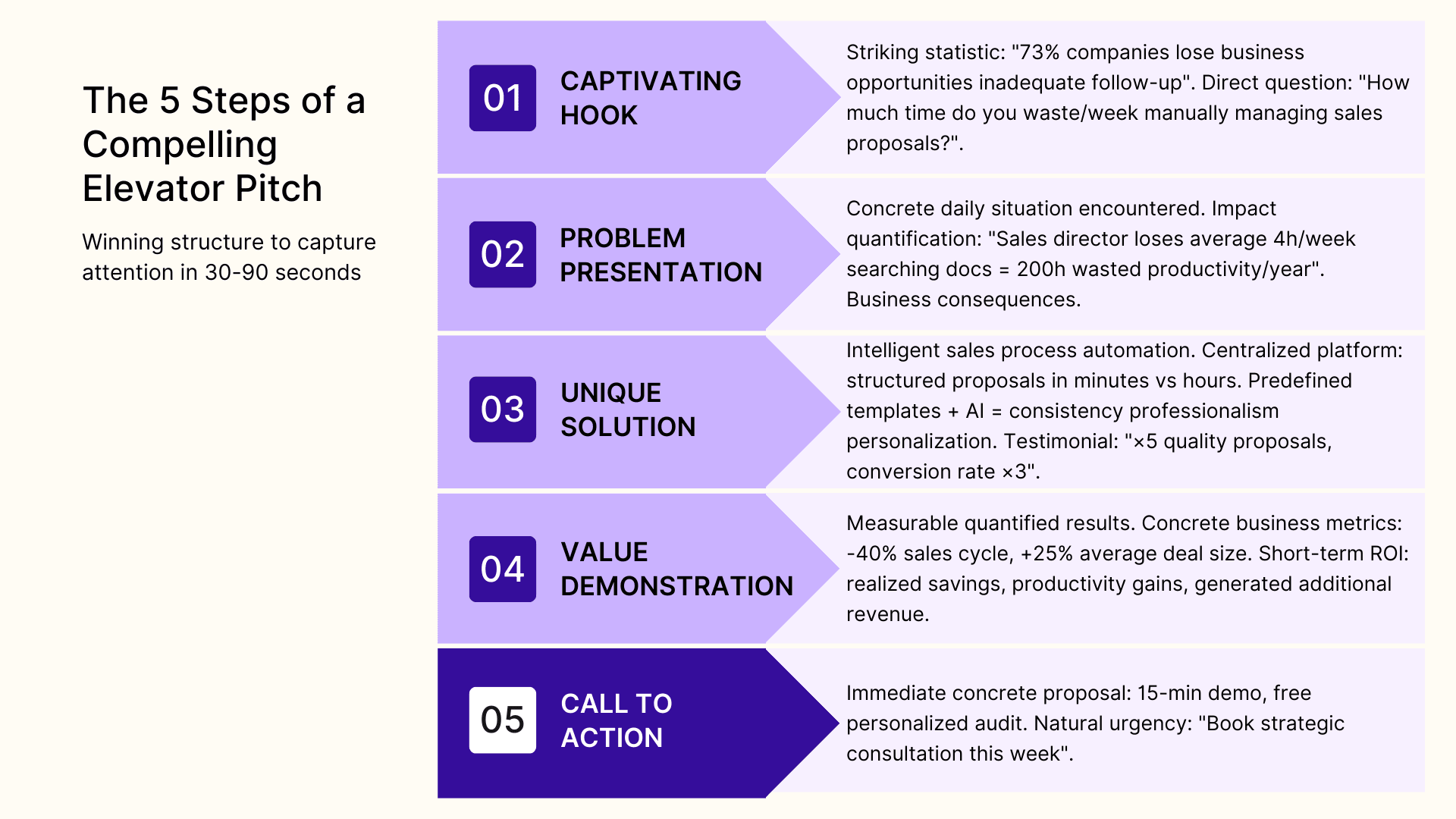
1. The Attention-Grabbing Hook
A powerful hook is built around a striking sentence that resonates with your listener's concerns. Striking statistics work particularly well: "73% of companies lose business opportunities due to inadequate follow-up."
The direct questioning technique is formidable: "How much time do you waste each week manually managing your sales proposals?" This approach immediately puts your prospect into an active thinking mode.
A client anecdote is another winning strategy. For example: "A sales director used to spend 12 hours a week creating quotes. Today, he dedicates that time to prospecting." This method makes your message concrete and memorable.
2. Presenting the Problem or Need
The strength of a good sales pitch lies in your ability to present a problem that resonates with your listener. Start by describing a concrete situation your prospect encounters daily, such as the time lost on repetitive administrative tasks.
Quantify the problem's impact on the company's performance. "A sales manager loses an average of 4 hours per week searching for and updating sales documents, which is nearly 200 hours of wasted productivity per year."
Highlight the direct business consequences: missed opportunities, team stress, delays in responding to customers. This pragmatic approach helps your listener clearly visualize the stakes and be receptive to your solution.
3. The Unique Solution You Offer
The answer to these challenges lies in the intelligent automation of sales processes. "A centralized platform allows you to create structured sales proposals in minutes, instead of hours."
Adopt a standardized yet customizable approach. "Pre-defined templates, enhanced by artificial intelligence, ensure consistency and professionalism while adapting to each client's specifics."
Next-generation tools radically transform the experience: real-time scoring, contextual improvement suggestions, a dynamic content library. One salesperson testifies: "I now generate 5 times more quality proposals, with a conversion rate that has tripled."
4. The Value Demonstration
Measuring gains is the foundation of a high-impact value demonstration. Present quantified results on operational cost reduction, conversion rate increases, or customer satisfaction improvements.
Support your argument with concrete business metrics. "A sales manager who adopted a structured approach reports a 40% reduction in the sales cycle and a 25% increase in the average deal size."
Reinforce your credibility by highlighting short-term profitability. Calculate the precise return on investment: savings achieved, productivity gains, additional revenue generated. This factual approach reassures your listener about the relevance of your solution for their business.
5. The Effective Call to Action
A powerful call to action is built around a concrete and immediate proposal. Suggest a simple next step, such as a 15-minute demo or a free personalized audit.
The wording should create a natural sense of urgency. For example, "Book your strategic consultation this week" generates more engagement than a simple invitation to get in touch.
Personalize your final proposal based on the context. A busy decision-maker will appreciate a short format like, "Block 20 minutes on my calendar by scanning this QR code." For an informal meeting, opt for, "Let's grab a coffee next week to discuss these points further."
Prepare several alternative calls to action adapted to your listener's possible reactions.
Different Types of Pitches for Different Contexts
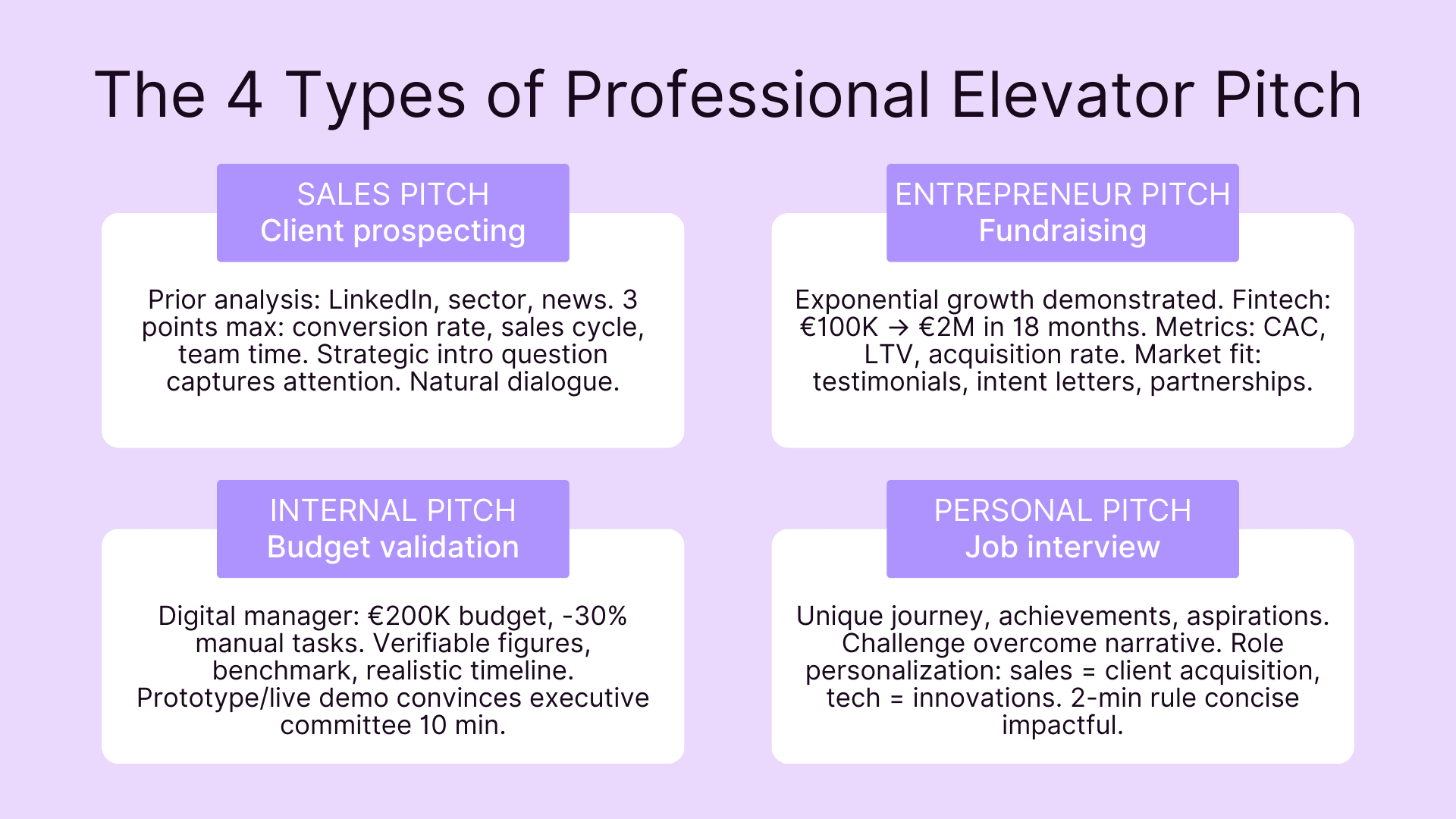
The Sales Pitch for Prospecting
The success of a prospecting pitch relies on meticulous preparation. Start by analyzing your prospect's LinkedIn profile, their latest news, and their industry to identify their priority challenges.
Structure your message around a maximum of 3 key points. For example, a sales director will be more receptive to a pitch focused on increasing the conversion rate, reducing the sales cycle, and optimizing their team's time.
Favor a dynamic approach by asking a strategic question in the introduction: "Do you know how much time your salespeople spend on administrative tasks instead of active prospecting?" This technique sparks reflection and naturally opens the dialogue.
The Entrepreneur's Pitch to Investors
When facing investors, your pitch must demonstrate your project's potential for exponential growth. A fintech startup won over its investors by presenting a realistic growth projection: from $100K to $2M in recurring revenue in 18 months.
Focus on impactful business metrics: customer acquisition rate, acquisition cost, lifetime value. A summary dashboard reinforces the credibility of your entrepreneurial approach.
Your pitch gains impact with a demonstration of market fit. Illustrate your point with customer testimonials, signed letters of intent, or strategic partnerships already in place. This tangible proof reassures investors about the viability of your business model.
The Project Pitch within a Company
The success of an internal pitch depends on your ability to rally decision-makers around your vision. A digital manager recently secured a $200K budget by focusing their presentation on concrete operational gains: a 30% reduction in manual tasks and improved customer satisfaction.
Prioritize a pragmatic approach based on verifiable figures. A benchmark of existing solutions, accompanied by a realistic deployment timeline, reinforces the credibility of your proposal.
Focus on visualizing short-term benefits. A functional prototype or a live demo turns the abstract into the tangible. One project manager testifies: "My 10-minute pitch with an interactive mockup convinced the executive committee in a single meeting."
The Personal Pitch in an Interview
The success of an interview pitch comes from an authentic and memorable presentation. Structure your discourse around three key moments: your unique journey, your significant achievements, and your professional aspirations.
Adopt a narrative approach that highlights your meaningful experiences. For example, tell a story about how you overcame a professional challenge, reflecting your key skills and adaptability.
Personalize your message for the specific role. A candidate for a sales role will highlight their successes in acquiring new clients, while a technical profile will emphasize their innovations and deployed solutions.
Always keep the 2-minute rule in mind: concise yet impactful. This duration keeps the recruiter's attention while leaving room for dialogue.
Frequently asked questions
What is the ideal length for a truly effective elevator pitch?
Generally between 30 and 60 seconds. The key is to be concise while delivering your core value proposition and creating enough interest to continue the conversation.
What are the absolutely essential elements of a good elevator pitch?
A strong elevator pitch typically includes: who you are, what problem you solve, how you solve it differently, and a clear call to action or conversation opener.
How can you make your elevator pitch more impactful and memorable in a short amount of time?
Adapt your pitch to your audience, practice it regularly, use concrete examples or numbers, and always end with an engaging question or clear next step.