Fundamentals of effective first contact
Strategic objectives of first contact
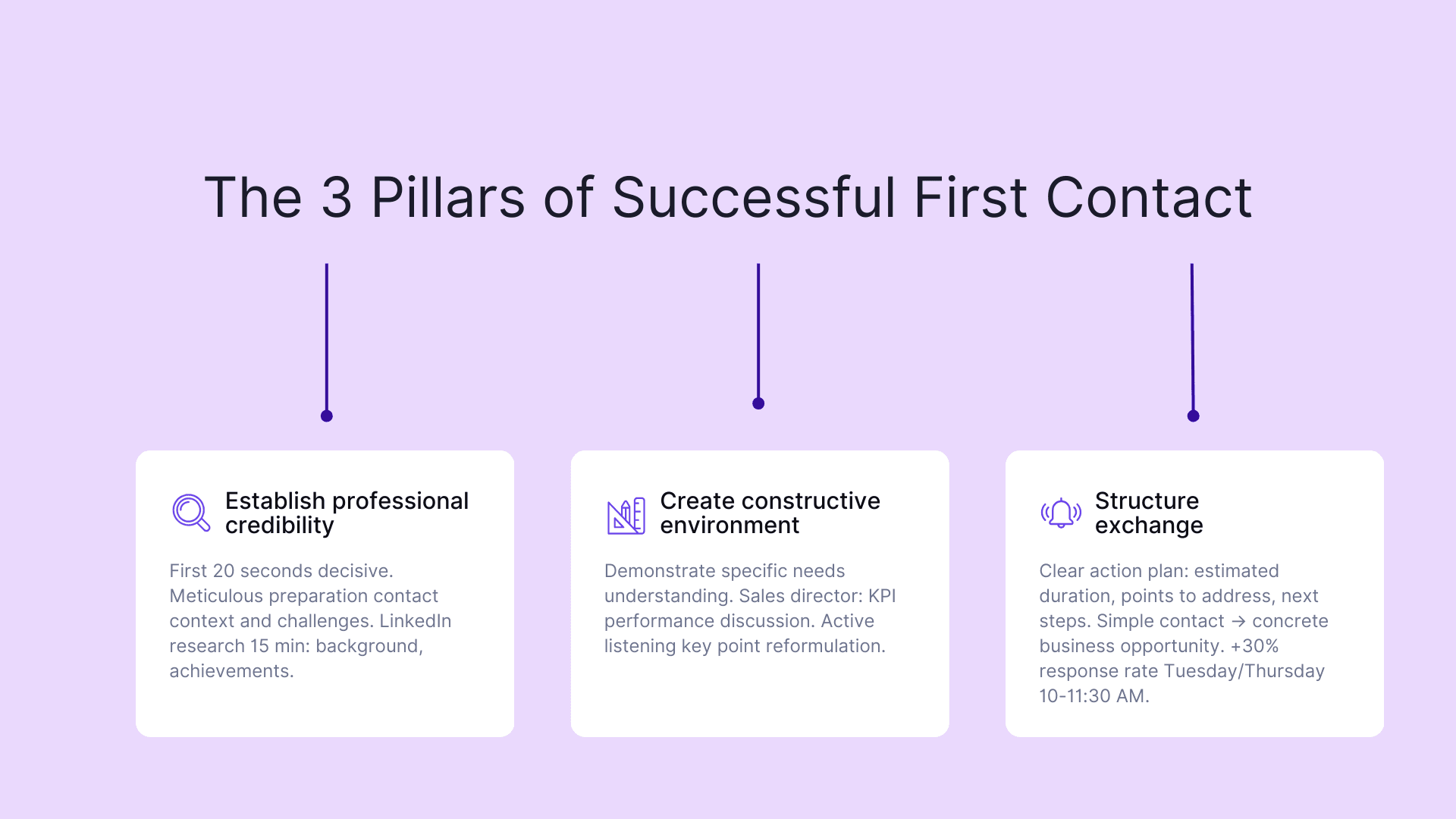
A successful first exchange is based on three fundamental strategic objectives. First, establish your professional credibility within the first 20 seconds through meticulous preparation of your contact's context and challenges.
Next, create a constructive exchange environment by showing your understanding of specific needs. For example, a sales director looking to optimize their sales cycle will appreciate a discussion focused on performance indicators.
Your final objective is to structure the exchange by proposing a clear action plan. Present the estimated duration, points to be addressed, and envisioned next steps. This method transforms a simple contact into a concrete business opportunity.
The 5 essential steps of a successful approach
The initial phase requires thorough research on LinkedIn and professional networks to precisely identify your contact. Take 15 minutes to analyze their background and achievements.
The second step involves personalizing your hook message by mentioning a common point or relevant news about their company.
Then formulate a clear and concise value proposition, adapted to your contact's challenges. For example, for a marketing director, highlight quantified results on conversion optimization.
Fourth step: plan the optimal moment for your first contact. Tuesday and Thursday mornings statistically generate the best response rates.
Finalize with an invitation to exchange, proposing two specific time slots and an appropriate meeting format.
How to create a memorable impression
Creating a memorable imprint relies on mastering subtle details. Open body language, combined with a firm handshake and authentic eye contact, instantly establishes a strong professional connection.
Adopt active listening by reformulating the key points mentioned by your contact. This technique demonstrates your genuine engagement in the exchange and reinforces dialogue quality.
Distinguish yourself through impactful storytelling. Rather than coldly presenting your services, share a relevant professional anecdote that illustrates your expertise. For example, tell how you solved a similar challenge for another client, emphasizing the concrete results obtained.
Master the art of the memorable 30-second pitch: capture attention with a surprising fact related to your sector, then follow up with the unique solution you offer.
Preparing your first contact strategy
Analyzing your contact's profile
Deep understanding of your contact's profile begins with observing their behavioral signals. Their gestures, speech rhythm, and vocabulary reveal essential communication preferences.
A pragmatic manager will appreciate quantified data and concrete examples, while a creative director will be more sensitive to innovative concepts and evolution perspectives. Adapt your approach accordingly.
The DISC method constitutes an effective analysis framework. For example, when facing a dominant profile, favor synthetic discourse focused on results. For a stable profile, emphasize the security and reliability of your solutions.
Systematically note your observations in a dedicated notebook. This practice progressively refines your ability to quickly decipher different personality types.
Defining your communication objectives
The success of first contact relies on precise and measurable communication objectives. Establish a clear hierarchy between your short and long-term goals. For example, transform 30% of your first contacts into qualified meetings within 15 days.
Consider segmenting your objectives according to the channel used. A LinkedIn message first aims to create a trust relationship, while a phone call seeks to secure a sales meeting.
Adopt the 3P rule to maximize the impact of each exchange:
- Relevance: align your objectives with your contact's challenges
- Progressiveness: plan realistic intermediate steps
- Performance: set quantifiable indicators for each objective
Keep a written record of your objectives and adjust them based on field feedback.
Choosing the right timing and suitable channel
The success of professional first contact greatly depends on the chosen moment. Studies show that Tuesday and Thursday between 10 AM and 11:30 AM generate the best response rates, with a 30% increase in positive returns.
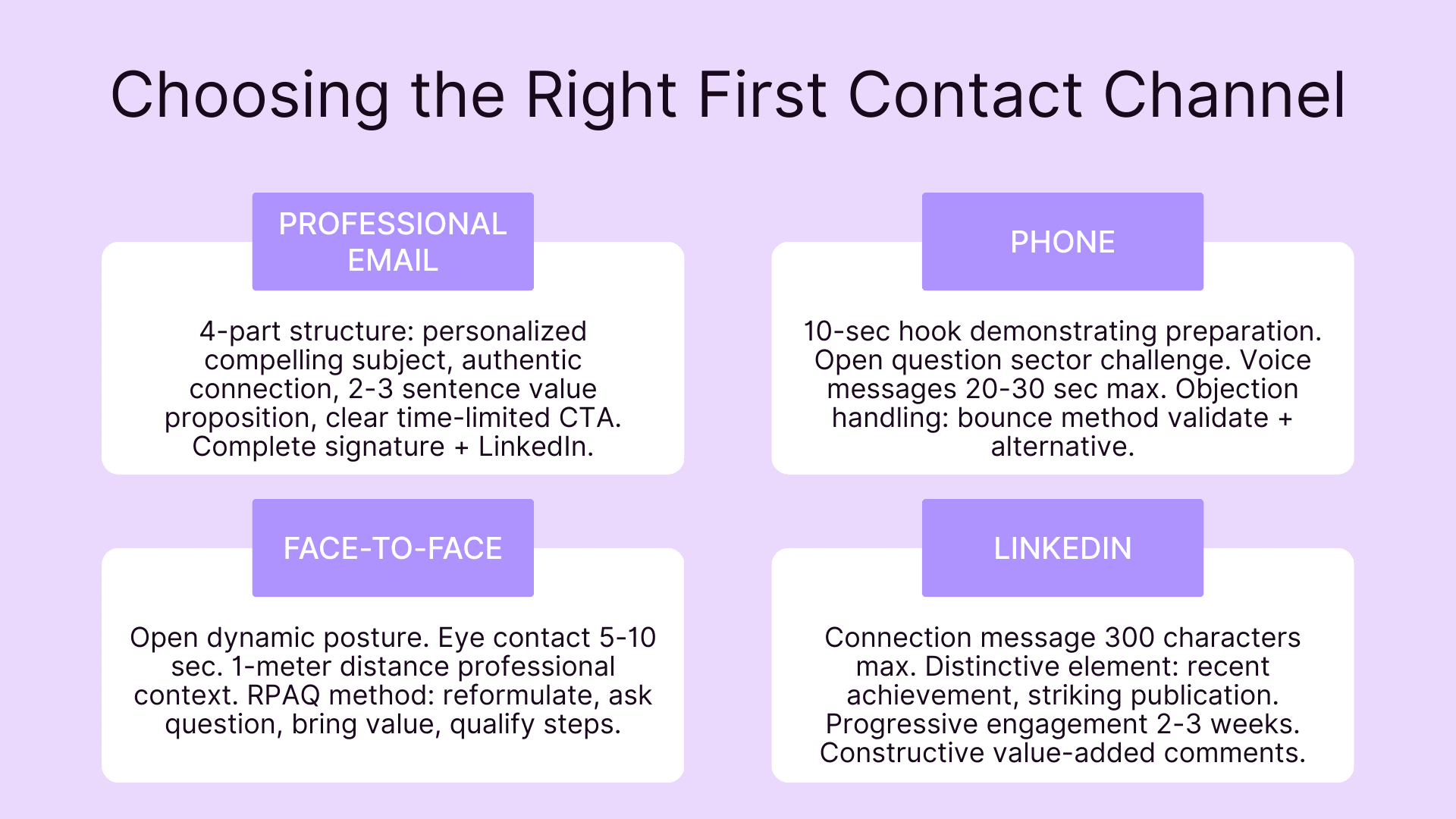
Channel choice varies according to context. Email works ideally for a formal first approach, while LinkedIn excels at establishing a progressive relationship. The phone remains preferred for urgent or strategic situations.
Adapt your approach to the business sector: a startup leader will be more receptive via LinkedIn, while a traditional company executive will prefer contact by email followed by a call. For highly solicited decision-makers, a recommendation through a common contact on social networks increases your chances by 65%.
First contact and the art of professional email
Structure of a first contact email
The success of a professional email relies on a 4-part structure that maximizes its impact. Start with a compelling subject line that personalizes your approach, like "Following your publication on digital innovation."
The first paragraph should establish an authentic connection by mentioning a common point or shared reference. For example: "Your presentation at the Digital First trade show particularly impressed me."
The message body exposes your value proposition in 2-3 concise sentences. Favor direct formulations that highlight benefits for your recipient.
End with a clear and precise call to action, limited in time: "Would you accept a 15-minute exchange this Thursday or Friday morning?" The signature should include your complete contact information and a link to your LinkedIn profile.
10 examples of compelling email subjects
The strength of an email subject lies in its ability to trigger immediate message opening. "Martin, your AI expertise impresses me" attracts attention through targeted personalization. "3 minutes to boost your sales by 25%" relies on a precise quantified benefit.
"Following your LinkedIn article" shows your interest in the recipient's activities. "Possible collaboration? 2 ideas to submit to you" arouses curiosity while remaining professional. "The cybersecurity challenge: let's discuss it Tuesday?" combines current events and concrete action.
Formulations that work: "Your new project inspires me," "Coffee to discuss innovation?," "Congratulations on your appointment," "Recommended by Sophie Martin," "Quick question about your digital strategy."
Email templates according to context
The first commercial contact requires a different approach depending on the situation. For a meeting request after a professional trade show, mention your encounter and a striking point from your exchange before proposing a specific date.
When dealing with a third-party recommendation, value the common connection from the introduction: "Following my discussion with [name], I would like to present a solution that could optimize your sales process."
A cold prospecting email benefits from bouncing off company news: "Congratulations on your expansion into the German market. Our automation expertise could accelerate your international development."
The post-event follow-up deserves advanced personalization: "Your presentation on digital transformation at the Digital Summit perfectly illustrated the challenges we address."
Mastering phone first contact
Phone hook techniques
An impactful phone hook is built in three stages: capture attention in the first 10 seconds, create an authentic connection, then expose your added value.
Start with a sentence that shows your preparation: "Hello Marie, I'm contacting you following your LinkedIn publication on sales automation." This approach demonstrates your professionalism and sincere interest.
Follow up with an open question about a specific challenge in their sector: "How do you currently manage the optimization of your sales process?" This technique naturally engages the conversation.
Keywords that trigger interest: performance, optimization, measurable results. Avoid vague terms like "innovative solution" or "market leader" that dilute your credibility.
Managing gatekeepers and objections
Mastering phone gatekeeper handling relies on meticulous preparation. Anticipate standard responses to classic phrases like "Call back later" or "Send an email." A constructive comeback transforms these obstacles into dialogue opportunities.
When facing objections, adopt the bounce method: validate your contact's point of view before proposing an alternative. For example, to the objection "We already work with a competitor," respond "Excellent choice. Actually, our complementary approach would optimize your current results."
Transform each barrier into a springboard toward your objective. A "He's not available" becomes an opportunity to qualify the best callback time. The key? Stay professional and benevolent, even in tense situations.
Voice messages that capture attention
An impactful voice message is built around a three-part structure: your identity, the purpose of your call, a clear action proposal. "Hello Marc, Sarah Dupont from the sales team. Following our meeting at the Digital Innovation trade show, I would like to deepen our discussion about your automation needs."
The optimal duration? 20 to 30 seconds maximum. Your tone should remain dynamic and natural, without giving the impression of reading a script. For maximum impact, mention a specific trigger element: "Your recent LinkedIn publication on digital transformation challenges particularly interested me."
Conclude with a concrete proposal: "I suggest a quick exchange Tuesday at 10 AM or Wednesday at 2 PM. My direct number is..."
Succeeding at face-to-face first contact
Body language that inspires confidence
An open and dynamic posture constitutes the foundation of successful non-verbal communication. Keep your shoulders relaxed and your torso straight to naturally project an image of confidence.
Your gaze represents your best asset for establishing an authentic connection. Favor stable eye contact for 5 to 10 seconds, then alternate with pause moments to create a comfortable rhythm.
Your gestures should remain measured and fluid. Broad hand movements, palms open upward, reinforce the clarity of your message while demonstrating your sincerity.
An appropriate physical distance, about one meter in a professional context, allows your contact to feel comfortable while maintaining a framework conducive to constructive exchanges.
The art of professional conversation
Mastering a professional conversation relies on proven techniques. Favor open questions that encourage your contact to develop their thinking: "What challenges do you currently face in your sector?"
Master the art of active silence: leave strategic pauses after your contact's responses. This technique naturally invites them to deepen their point.
Adopt the RPAQ method: reformulate key points, pose a relevant question, bring added value, qualify next steps. For example: "If I understand correctly, automation is your priority. How do you envision its implementation?"
A successful conversation always ends with a concrete action proposal, aligned with expressed needs.
Effective networking techniques
Networking success relies on a strategic and authentic approach. Participate in professional events with a specific objective: meet three relevant people rather than randomly distribute twenty business cards.
Adopt an attitude of mutual assistance. Spontaneously offer your expertise or contacts when an opportunity presents itself. This professional generosity naturally creates lasting bonds and generates positive returns.
Professional groups on social networks constitute ideal spaces for establishing targeted contacts. Share your expertise through constructive comments and quality publications. A solid network is built on value-added exchanges rather than accumulating superficial connections.
First contact: optimizing your LinkedIn presence
Personalizing your connection messages
Writing an impactful connection message begins with careful observation of your future contact's profile. Identify a distinctive element: a recent achievement, a striking publication, or a common professional interest.
Limit your message to 300 characters by getting straight to the point. A winning structure: greet by first name, mention the element that caught your attention, briefly expose your motivation to connect. For example: "Hello Marc, your B2B market analysis published last week aligns with my observations. Would an exchange on our experience feedback interest you?"
Authentic personalization remains your best asset. Ban standardized formulas in favor of a unique approach, adapted to each profile.
Engagement strategies with influencers
Approaching B2B influencers on LinkedIn begins with a 2-3 week observation phase. Analyze their publications, comments, and interactions to understand their professional interests and communication style.
The progressive engagement strategy starts with regular interactions on their content. Favor constructive comments that bring real added value to the discussion. An original viewpoint, supported by your industry expertise, will naturally attract their attention.
Create content that echoes their favorite subjects, bringing a new or complementary angle. This approach establishes your professional credibility before the first direct contact.
Propose collaboration based on mutual benefit: expertise sharing, cross-interview, or participation in a professional event.
Follow-up and relationship nurturing
Building a lasting professional relationship requires a methodical approach. Establish a regular contact schedule: one interaction every 15 days maintains the link without creating fatigue. Alternate between constructive comments on LinkedIn publications and sharing relevant articles for their activity.
Focus on reciprocity in your exchanges. When a contact shares a success, congratulate them with a personalized message. This attention naturally reinforces your professional bond. An intelligent reminder system helps you identify opportune moments to restart the conversation: job change, professional anniversary, or article publication.
Transform each interaction into a mutual learning opportunity. Propose concrete experience feedback on common issues. This approach establishes your credibility while nourishing a relationship based on knowledge exchange.
First contact in an international context
Adapting your approach according to cultures
The success of international business contact relies on a fine understanding of cultural codes. A business meeting in Japan requires, for example, meticulous preparation of business cards, to be given and received with both hands as a sign of respect.
The art of negotiation varies radically by country. In North America, direct and factual communication proves winning. Conversely, Middle Eastern partners favor a preliminary phase of informal exchanges to establish a personal relationship.
Respect for hierarchies and protocol becomes essential in certain regions. In Southeast Asia, address the highest-ranking decision-maker first. This consideration of social rank naturally opens doors to fruitful collaboration.
Communicating effectively in English
Mastering professional English relies on specific communication techniques. Favor short and precise sentences rather than complex constructions that increase error risks.
Mastered B2B vocabulary reinforces your credibility. Memorize key expressions like "streamline our processes," "leverage our expertise," or "drive results." These formulations demonstrate your understanding of business challenges.
For virtual meetings, prepare your key points in English in advance. This method reduces stress and allows more fluid expression. Always keep a personalized lexicon of your essential industry terms at hand.
During informal exchanges, stay natural without seeking grammatical perfection. Authenticity and message clarity take precedence over form.
Measuring and improving your first contact performance
Key success indicators
Precise measurement of your first contact performance relies on strategic indicators. The positive response rate to first messages constitutes a reliable barometer. A score above 25% signals an effective approach.
Analysis of the average delay between first contact and actual meeting reveals your ability to generate interest. The best salespeople obtain a meeting within 10 days following the initial approach.
Also monitor the transformation rate of first meetings into qualified opportunities. A 30% ratio represents excellent performance in B2B sales. Also measure exchange quality by the number of contacts who spontaneously recommend you to their peers.
Tracking and optimization tools
A centralized dashboard constitutes the cornerstone of effective professional contact management. Modern solutions integrate personalized alerts to not miss any follow-up opportunity and behavioral analysis modules that reveal propitious moments for exchanges.
Synchronization with your professional messaging allows automating prospect qualification according to their engagement level. Pre-formatted message templates, adaptable in a few clicks, accelerate your first contacts while maintaining a personalized approach.
Advanced artificial intelligence features now analyze exchanges to suggest the best approach angle. For example, AI can identify that a prospect regularly consults your content on innovation and recommend focusing your next message on this theme.
Continuous improvement techniques
The micro-adjustment method radically transforms the effectiveness of your first contacts. Test a new formulation each week in your approach messages, then analyze the reactions obtained.
Peer learning brings valuable collective dimension. Organize monthly experience-sharing sessions where everyone presents their successes and failures. This practice accelerates the entire team's progression.
A structured feedback system revolutionizes your progress. Systematically ask your prospects why they accepted or refused the exchange. This raw feedback constitutes a goldmine for refining your approach.
Frequently asked questions
What is the best time to make a professional first contact?
Tuesday and Thursday mornings, generally between 10 AM and 12 PM, or early afternoon (2 PM - 4 PM) tend to be the most effective for reaching B2B prospects.
How can you effectively personalize a first contact by email or LinkedIn?
Prepare your pitch and key talking points, research the prospect beforehand, have a clear objective for the call, and anticipate common objections.
What to do if my contact is protected by a "gatekeeper" (assistant, switchboard) during a phone call?
Persistence is key: it typically takes 6-8 attempts to reach a prospect. Vary your approach across calls and combine with email and LinkedIn touchpoints.