
Definition and core principles of open-ended questions
What is an open-ended question?
An open-ended question is a powerful dialogue tool that invites your contact to develop their thoughts freely. Unlike a yes-or-no response, it encourages deep reflection and generates detailed answers.
Let's take a concrete example in a sales context: instead of asking "Are you satisfied with your current vendor?", ask "What aspects of your collaboration with your current vendor give you satisfaction?" This approach reveals valuable information about the client's real needs and expectations.
Open-ended questions foster constructive dialogue and allow you to discover unexpected elements that are essential for mutual understanding in any professional relationship.
The difference between open and closed questions
Closed questions limit responses to predefined choices: "yes/no" or a selection from options. They are practical for quickly validating information and are suitable for situations requiring precise data. For example, during recruitment: "Have you ever managed a team?"
Conversely, open-ended questions stimulate reflection and generate elaborate responses. In the same context: "How do you approach team management?" This formulation reveals the candidate's vision, experience, and personality.
The choice between these two types depends on your objective: to collect factual data or to explore a topic in depth. A winning strategy often combines both approaches to maximize the quality of exchanges.
Impact on the quality of exchanges
Open-ended questions reshape the dynamics of professional conversations. An exchange enriched by this type of question provides access to more nuanced information and unexpected perspectives.
In a meeting, an open-ended question tossed out to the whole room ("What's holding you back on this deal?") gets people talking who would never have answered "Is everything fine?" This approach also fosters new ideas and strengthens team cohesion.
Take the example of a creative brief: replacing "Do you like this proposal?" with "How does this proposal address your objectives?" generates constructive, detailed feedback essential for project advancement.
Different types of open-ended questions
Exploratory questions
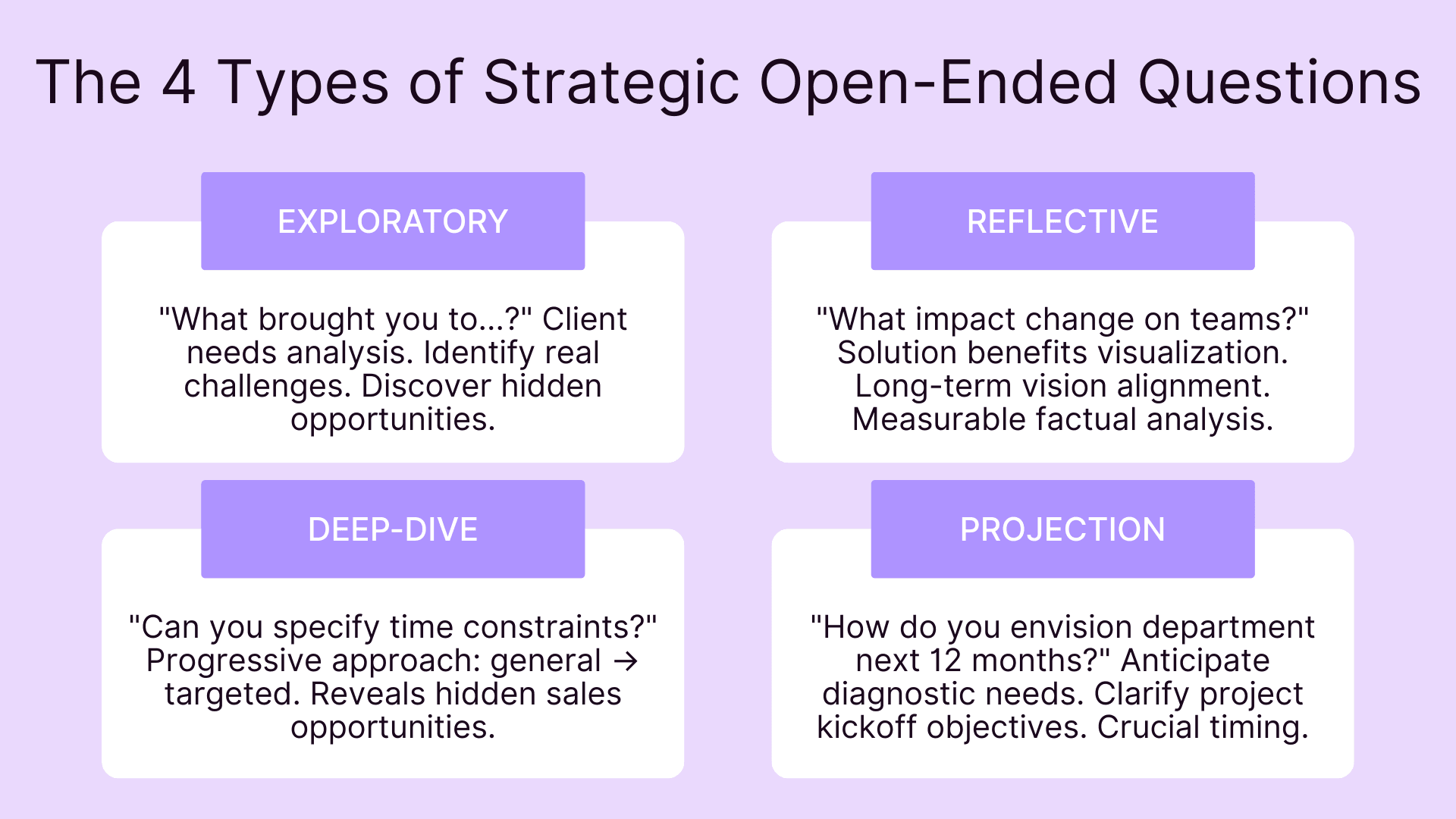
Exploratory questions are a powerful lever for discovering your contacts' deep motivations. Through formulations like "What brought you to...", you naturally invite the person to share their journey. In the context of a client needs analysis, an exploratory approach helps to identify real challenges. For example, rather than asking directly about the budget, question previous investments: "How have you structured your previous similar projects?" Exploratory questions prove particularly effective for understanding the overall context of a situation, identifying barriers not spontaneously expressed, and discovering hidden opportunities in a client's discourse.
Reflective questions
Reflective questions stimulate deep analysis and perspective-taking in your contact. An experienced salesperson will use, for example, "What would be the impact of this change on your teams?" to get their prospect to concretely visualize the benefits of a solution. The strategic formulation of these questions naturally pushes toward introspection. "To what extent does this approach align with your long-term vision?" allows you to align the discussion with the decision-maker's strategic objectives. A manager can also use "How do you evaluate the impact of this decision on our productivity?" This question encourages a factual, measurable analysis essential for informed decision-making.
Deep-dive questions
Deep-dive questions are a precision technique that allows you to get essential details on a specific point. A savvy salesperson uses this method to dig into their prospect's responses: "You mention tight deadlines - can you specify your time constraints?" A progressive approach proves particularly effective. Start with a general question about the topic, then refine with targeted questions. For example: "How do you currently manage your sales proposals?" followed by "Which steps in the process take you the most time?" Deep-dive questions often reveal hidden sales opportunities. A prospect briefly mentioning a productivity problem could reveal, after a few targeted questions, an urgent need for process automation.
These answers lose all their value if they stay in a notebook. Carried word for word into the sales proposal, in the prospect's own vocabulary, they make the difference between a tailored offer and a generic document.
Projection questions
Projection questions are a powerful decision-making tool for getting your contacts to visualize the future. A sales manager might ask "How do you envision your department evolving over the next 12 months?" This approach helps the prospect to solidify their future needs. Mastering the timing proves crucial in using projective questions. The ideal moment occurs when your contact expresses concern about their upcoming challenges. Projection questions reveal their full potential in key situations, such as anticipating needs during a commercial diagnosis, exploring ambitions during annual reviews, or clarifying objectives at a project kickoff.
Advantages of open-ended questions in a professional context
Better understanding of needs
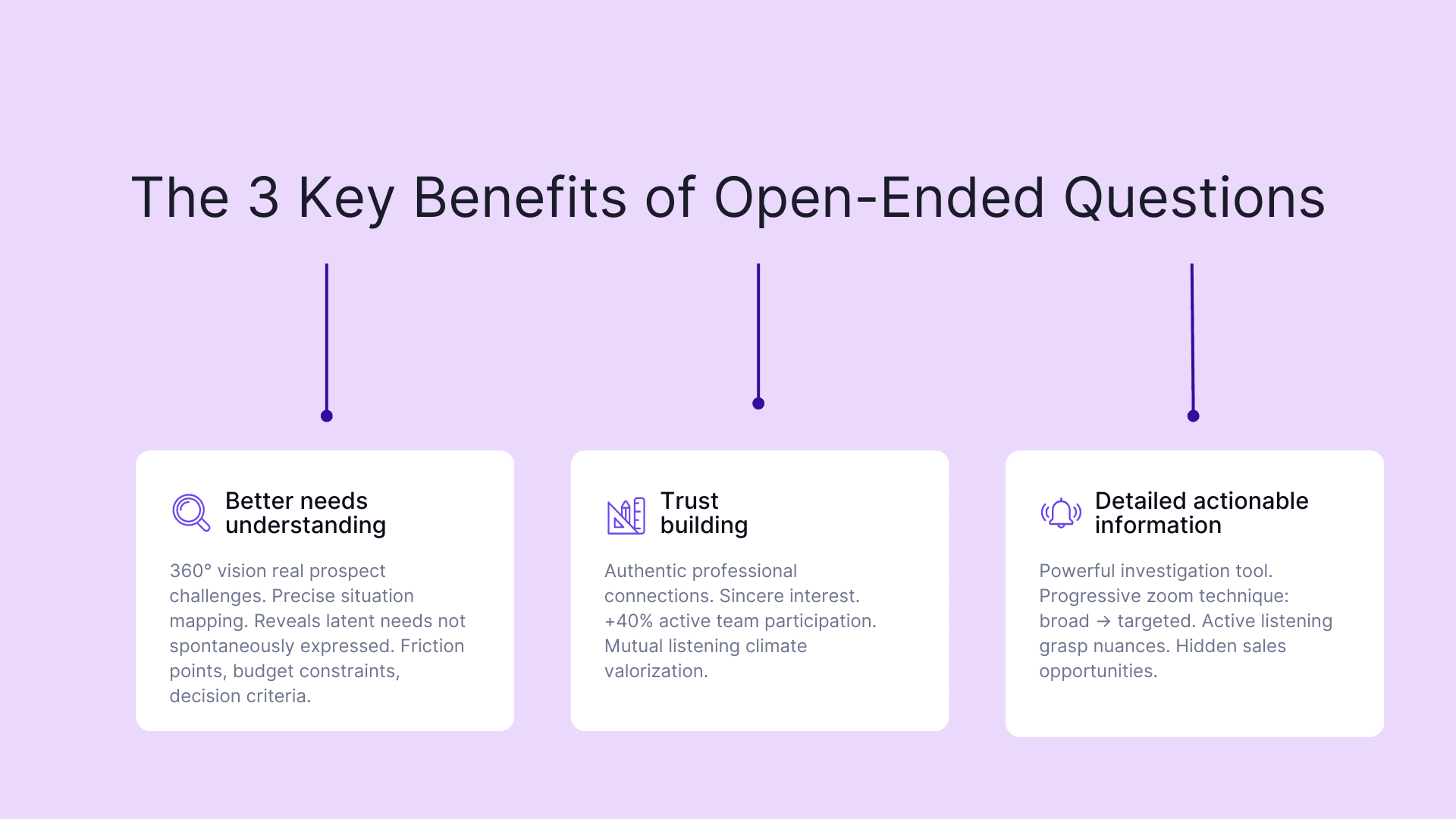
Open-ended questions change how we perceive our contacts' expectations. A salesperson who asks "Tell me about your current process" rather than "Are you satisfied with your solution?" gets a 360° view of the prospect's real challenges.
The richness of the responses allows you to precisely map the situation. For example, a buyer describing their daily routine naturally reveals their friction points, budget constraints, or decision criteria.
This method also unveils latent needs - those the client doesn't express spontaneously. A marketing manager mentioning difficulties in tracking performance could be masking a deeper need for report automation.
Building trust
The art of open-ended questioning is a fundamental lever for establishing authentic connections with your professional contacts. A team leader who asks "What motivates you about this new project?" creates a space for constructive dialogue.
The regular practice of open-ended questions demonstrates your genuine interest in the other person's perspective. For example, during annual reviews, replacing "Are you satisfied with your position?" with "How do you experience your role within the team?" encourages a richer, more personal discussion.
This approach generates a climate of mutual listening where everyone feels valued. A manager who asks "What solutions do you envision for this situation?" empowers their team members while strengthening their sense of belonging.
Obtaining detailed information
Open-ended questions represent a powerful investigation tool for gathering precise, actionable data. An experienced salesperson knows how to alternate between broad and targeted questions to create a complete picture of their prospect's needs.
The "progressive zoom" technique maximizes response quality. Start with an overview: "How do you currently manage your sales processes?" Then gradually tighten: "What specific aspects would you like to optimize?"
Active listening remains paramount for grasping nuances and building on essential points. An apparently mundane response can hide a major sales opportunity, provided you know how to dig deeper at the right moment with the right question.
Techniques for formulating open-ended questions
Interrogative words to prioritize
Key interrogative words transform your professional exchanges. "How" reveals processes and methods: "How have you structured your sales strategy?" "Why" unveils the deep motivations of your contacts: "Why is this project a priority?"
"What" and "which" explore concrete facts: "What exactly are you looking for in a solution?" "When" places actions in time: "When would you like to start this change?" "Where" contextualizes situations: "Where do you see the main opportunities for improvement?"
An experienced salesperson alternates these dialogue triggers according to their objectives. Facing a prospect mentioning difficulties, "how" first helps to understand the situation, then "why" helps to identify the underlying issues.
Structure and effective construction
The methodical construction of an open-ended question relies on a precise structure. Start by identifying your question's objective before even formulating it. A clear, concise formulation maximizes the chances of getting a detailed response.
Adopt a progressive approach in your questioning. For example, facing a dissatisfied prospect, begin with "Tell me about your experience with this service" before moving to "What improvements would you like to see?" This method fosters a natural, constructive dialogue.
The ideal structure of an open-ended question meets three criteria: it remains neutral, uses vocabulary appropriate to your contact, and focuses on one aspect at a time. A sales manager will gain efficiency by asking "Describe your current decision-making process" rather than a question that's too general or leading.
Common mistakes to avoid
The first fatal error consists of chaining multiple questions in one sentence. A salesperson asking "How do you manage your sales, what are your objectives, and what tools do you use?" risks overwhelming their contact.
Another frequent mistake lies in formulating leading questions that suggest the answer: "Don't you think our solution would be perfect for you?" This approach biases the dialogue and hampers authentic expression.
Questions that are too vague represent another classic trap. "How is your company doing?" lacks precision and often generates superficial responses. Prefer targeted questions like "What changes have you observed in your sales results this quarter?"
Applying open-ended questions in a sales context
Open-ended questions for prospecting
Prospecting calls for questioning techniques suited to each stage of the conversation. A strong first contact starts with "What are your main criteria for choosing a partner?" rather than "Are you looking for a new vendor?"
The SPIN method is a formidable prospecting tool: open with the Situation ("How do you currently manage this process?"), explore the Problem ("What difficulties are you running into?"), have the prospect quantify the Implication ("How much do these difficulties affect your business?"), then move toward the expected payoff, the Need-payoff ("What would change if you could solve these issues?")
The best results come from varying your angle based on the prospect's profile. With a CFO, lead with "What return are you targeting?" while an operations manager responds better to "How do you optimize your processes?"
That return-on-investment question opens the door directly to value selling, where the pitch is built on quantified value for the client rather than on the price of the solution.
Open-ended questions in negotiation
Negotiation calls for strategic questioning techniques that move the discussion toward a mutually beneficial agreement. A winning approach explores the prospect's priorities: "What criteria will guide your final decision?"
Open-ended questioning also helps you reinforce the value of your proposal. For example, after presenting a solution: "How well does this feature address your current challenges?"
At decisive moments, favor questions that engage reflection:
- "What do you actually expect from this partnership?"
- "What results do you want to see in 6 months?"
- "In what ways does this solution stand out to you?"
This constructive approach uncovers the real motivations behind the purchase and makes it easier to shape an offer that fits.
Open-ended questions for closing
The final stage of the sale calls for strategic open-ended questions that guide the conversation naturally toward signature. An experienced salesperson might ask, "What would it take for you to make a decision today?" This phrasing surfaces any remaining objections without applying excessive pressure.
Engagement tracking on your proposal tells you when to ask it: a prospect who has just reopened the pricing page, or forwarded the document to a colleague, is ready to talk.
To confirm alignment before wrapping up, try "How do you picture rolling this solution out inside your organization?" That mental projection strengthens the prospect's commitment.
The timing of the close deserves particular care. A question like "What would be the best time for you to get started?" presupposes agreement while still respecting the client's decision-making pace. This subtle approach turns the conversation into constructive planning rather than a sales standoff.
Open-ended questions to prepare the sales proposal
The discovery call has one concrete purpose: the sales proposal that follows it. According to the Sales Odyssey survey (2025), 55% of companies struggling with their proposals cite difficulty personalizing for each client. The problem rarely starts at the drafting stage. It starts with a discovery call that ran too short, one where the salesperson never gathered enough material to write anything beyond a generic document.
Four open-ended questions supply that material. "What made you decide to take this on now?" gives you the context to reference in your opening. "How will you measure whether this project succeeds?" sets the criteria your argument should be built around. "Who else will be involved in the decision, and what does each of them expect?" surfaces the readers of your proposal you will never actually meet. "What other options are you looking at?" places the competition in context: you are not selling into a vacuum, but against competitors and the status quo.
Those four answers then structure the document itself: context, success criteria, decision-makers, alternatives. A proposal built this way reads like a continuation of the conversation; a template where half the pages talk about the vendor reads like a mass mailing. A sales proposal tool speeds up the formatting, provided you asked these questions first: the time saved on production gets reinvested in the relevance of the content.
Using open-ended questions in professional surveys
In a survey, limit yourself to three or four open-ended questions, placed after the closed context questions: by that point, respondents are more at ease and their answers gain in precision. Phrase them neutrally ("How do you rate the quality of our service?" rather than "What do you think of our excellent service?") and cover only one topic per question.
To make use of the answers, group them by theme (speed, quality, communication, price) and count occurrences: patterns emerge quickly, with no need for sophisticated tools. Then cross-reference those themes against respondent profiles. A CFO and an operations manager rarely flag the same priorities, and reading the results by function feeds directly into your next round of discovery calls.
Adjusting your questioning strategy
Regularly evaluating your questioning techniques helps you sharpen your approach. Methodically tracking the reactions you get reveals which formulations work best with which contacts.
Test different versions of the same question to find the one that draws out the most detailed answers. For example, swap "What do you need?" for "How does your purchasing department prioritize its decisions?"
Adapt your vocabulary to your contact's industry. A marketing director responds better to language tied to performance and ROI, while a technical director cares more about operational details.
Build a bank of high-performing questions, sorted by context and objective. This personalized resource steadily grows your questioning arsenal over time.
Frequently asked questions
What is an open-ended question?
It's a question, often beginning with "How," "Why," or "What," designed to encourage the prospect to share detailed information rather than just a yes/no answer.
Why use open-ended questions at work?
They help uncover the prospect's real needs, motivations, and challenges, enabling the salesperson to propose a more relevant and personalized solution.
What's the main difference from a closed question?
The closed question aims for a short, factual answer (yes/no, a number), while the open-ended question invites your contact to share their point of view and think out loud.