
What is Q2C Selling (Qualification to Closing)?
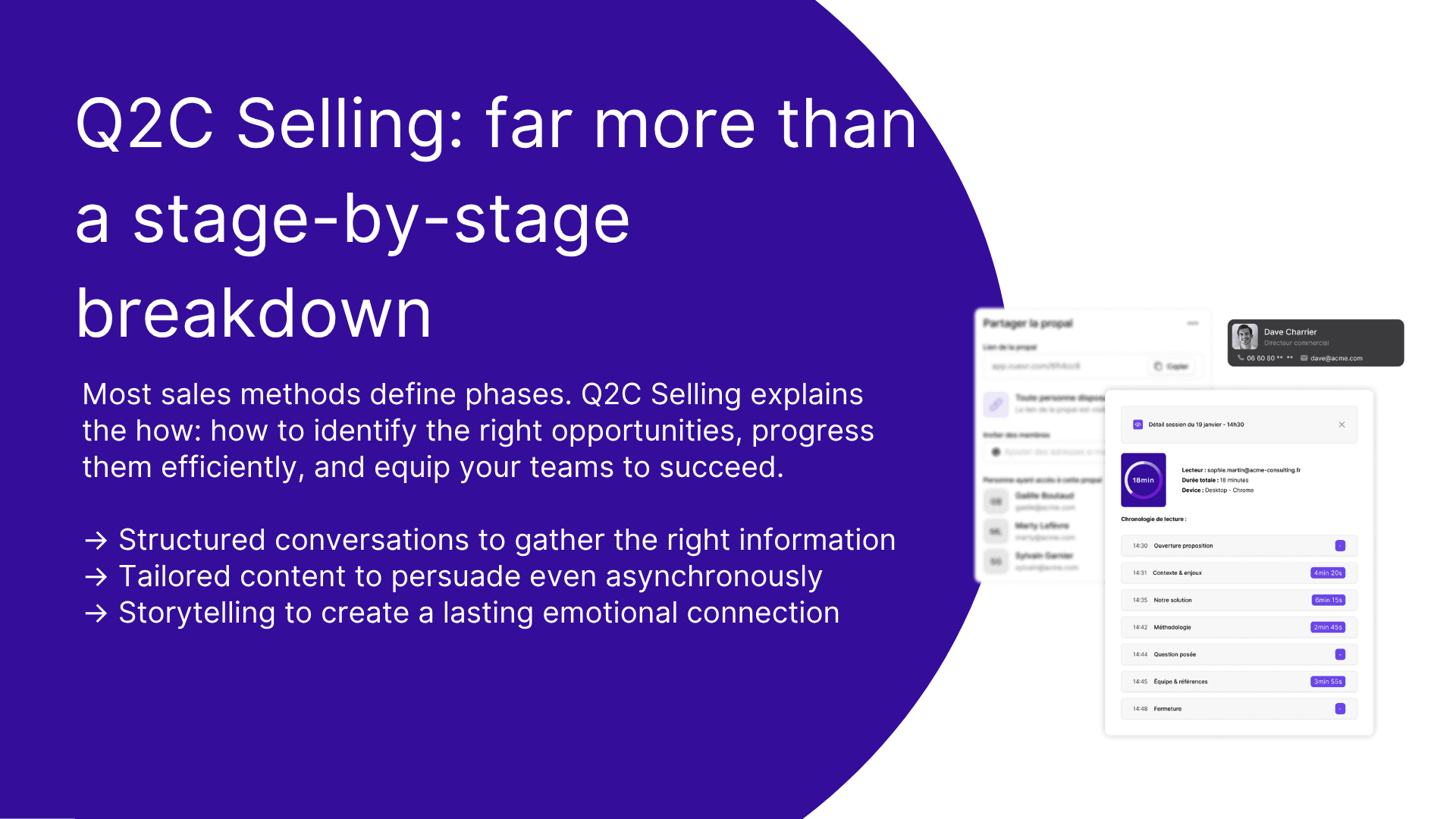
Q2C Selling isn't just another sales technique; it's a comprehensive methodology developed to structure the sales process end-to-end (from Qualification to Closing) and provide concrete levers to excel at every stage. The method was created by Nicolas Delignières, who formalized it in the book Q2C Selling, drawing on his hands-on experience with SMEs and mid-market companies. Unlike approaches that limit themselves to breaking the cycle into phases (often reducible to Qualification, Value Proposition, Closing), Q2C Selling tackles the how: how to identify the right opportunities, how to progress them efficiently, and how to equip your teams to succeed.
The 3 key phases revisited by Q2C Selling
While Q2C Selling acknowledges the fundamental phases (Qualification, Value Proposition, Closing), it approaches them with new depth. It's no longer just about knowing which CRM column to move a deal to, but understanding what and who defines a truly qualified opportunity, an impactful value proposition, and a successful closing (or a quick and assumed abandonment).
Beyond the stages: The importance of enrichment in Q2C selling
The real strength of Q2C selling lies in its ability to enrich each stage. It transforms the sales process from a simple transaction into a value experience for the prospect, using specific tools like structured conversations, relevant content, and storytelling to guide and positively influence the cycle, even when the salesperson isn't directly involved.
A method for your unique sales process
Q2C Selling doesn't offer a rigid copy-paste model. It provides a framework and tools to analyze your reality (your products/services, your customers, your team) and build a customized, high-performing, and adaptable process, by taking a step back on what works specifically for your business.
Where does Q2C Selling sit next to BANT, MEDDIC, or Gap Selling?
BANT and MEDDIC are qualification grids: they list the information to gather (budget, decision-maker, decision criteria, timeline) to judge whether an opportunity is worth the effort. Gap Selling is a discovery posture: dig into the gap between the prospect's current situation and the one they're aiming for, to give weight to change. These methods are solid, but each applies to a single phase. None of them tells you how to chain the phases together, when to stop, or what the prospect should experience between two meetings.
Q2C Selling operates at a different level. It's the framework that decides which grid to use, at what point, and with what rule for moving from one phase to the next, for your company and your customers. Nothing stops you from borrowing MEDDIC's criteria for your Go/No-Go Tree, or running your qualification conversations in the spirit of Gap Selling. What Q2C Selling adds is the assembly: written rules specific to your business, then tools to enrich each phase once the structure is in place. Your competitors know the same acronyms you do; the difference is made by the complete process, not the grid.
Structure your sales process with the Q2C Selling method
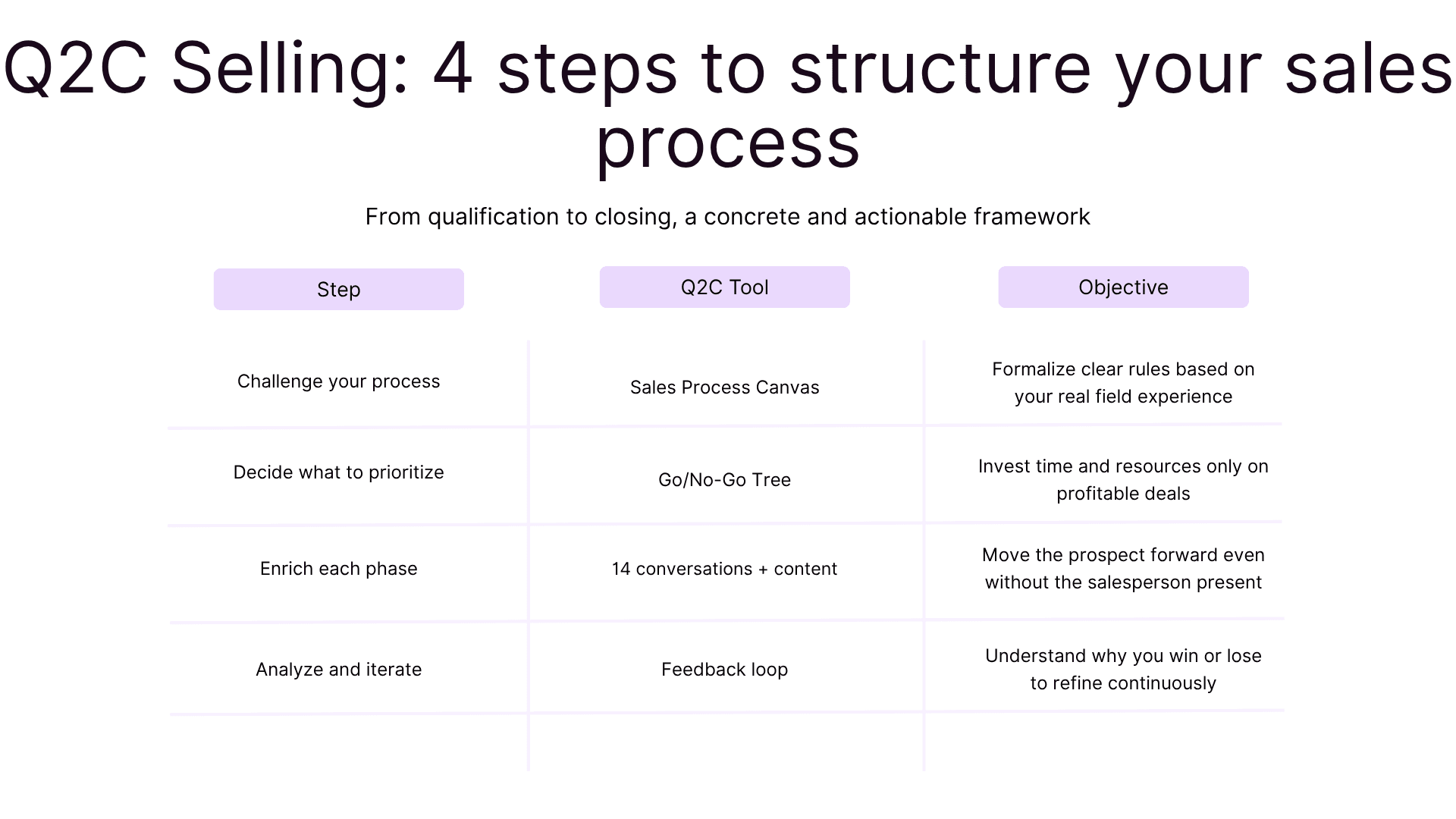
The Q2C Selling method offers a structured 4-step approach to build or redesign your sales process and make it more efficient and profitable.
Step 1: Challenge your process with the Sales Process Canvas
Everything starts with guided introspection. The Sales Process Canvas, a one-page framework inspired by the Business Model Canvas, pushes you to ask the right questions. It breaks the cycle into its 3 key phases (Qualification, Value Proposition, Closing) and gives each one two boxes to fill in, by systematically questioning the "What?" (What projects/products are profitable/performing? What convinces? What blocks closing?) and the "Who?" (Who are the good/bad customers? Who to convince? Who can make the sale fail?). The goal is to formalize clear rules (e.g., "An opportunity is qualified when...") based on your reality.
Example rule, as an IT services company might formalize it: "An opportunity is qualified when a decision-maker has confirmed the need, the stated budget exceeds €25K, and a deadline is set within six months; otherwise, it goes back into marketing nurturing."
The BANT criteria (budget, authority, need, timeline) are a solid starting point for writing this rule, provided you weight them against what actually wins or loses your deals.
Step 2: Define progression rules with the Go/No-Go Tree
Your salespeople's time is precious. The Go/No-Go Tree is a powerful decision tool from Q2C Selling. It allows you to define clear and objective criteria to decide whether an opportunity deserves the investment of time and resources, and what path it should follow. By formulating rules like "If [Criterion X] is validated, THEN [Action Y], OTHERWISE [Action Z]," you ensure that effort is always proportionate to expected gain, avoiding wasting resources on unprofitable or doomed deals.
Example rule in a Go/No-Go Tree: "If the decision-maker hasn't been met by the second meeting, THEN request a meeting with them before any proposal, OTHERWISE move the opportunity to watch status."
Step 3: Enrich each phase through Q2C selling tools
Once the structure is set, it needs to be animated. This is where process enrichment comes in via Q2C selling's specific tools: guided conversations to get the right information and move the prospect forward, tailored content to educate and persuade (even asynchronously), and stories (storytelling) to make an impression and transmit key messages more effectively than simple arguments.
Step 4: Prioritize and analyze for continuous improvement
Q2C Selling is an iterative approach. After applying the first steps, you'll identify improvement points. The method guides you to prioritize actions (focusing first on high-impact or most profitable processes) and to establish a culture of continuous analysis based on feedback (why do we win? why do we lose?) to constantly refine your approach.
Concrete Q2C Selling tools to boost your efficiency
Q2C Selling doesn't settle for concepts; it provides pragmatic tools to transform your sales teams' performance on a daily basis.
The 14 conversations: The backbone of your exchanges
Q2C Selling details 14 types of structured conversations, distributed across the Qualification phases (e.g., Identity, Problem, Value), Value Proposition (e.g., Solution, Who to convince), and Closing (e.g., Offer, Cost of inaction, Failure). These conversations serve as a guide to conduct rich exchanges, obtain crucial information, bring up objections, and move the prospect forward smoothly and naturally.
The cost-of-inaction conversation, in particular, borrows its logic from Gap Selling: quantify the gap between the prospect's current situation and their goal so the status quo becomes the costliest option.
Here are the 14 conversations as the method defines them, with the objective of each.
Qualification (6 conversations): make sure the prospect is a good fit for you, and you're the right company for them.
- Identity: build rapport and map the prospect's profile: their role, their company, and who influences them.
- Journey: anchor the sale in context: maturity, timeline, buying process, people involved, alternative options.
- Proof: establish the legitimacy of the stakeholders: decision-makers, budget, competitors in the running.
- The problem: understand the problem in full, what's already been tried, and the goals of the prospect and their company.
- The value: measure the value of the problem and its financial impact.
- The future: project the prospect into the success of the collaboration and identify the key success factors.
Value proposition (4 conversations): verify the prospect is convinced of your ability to address their problem.
- The solution: present your product or service, surface objections, and validate the fit with the problem.
- The future made possible: project the prospect into solving their problem through your solution.
- Who to convince: spot the people who've been overlooked and those slowing the project down, then bring them into the process.
- The competitors: identify the forces in play, their approaches, and how to counter their offers.
Closing (4 conversations): trigger the decision as fast as possible and learn from every process, whatever the outcome.
- The offer: present your offer and confirm it's well understood; hidden objections surface here.
- The cost of inaction: counter the number one cause of failure, the absence of a decision, by making the consequences of the problem concrete.
- The final obstacle: remove the last hesitation and trigger the decision.
- The failure: understand the reason for the refusal and spot the gap in the process to fix the next one.
The 4 content types to influence the sales cycle
Content is essential for managing modern sales asynchronicity. Q2C Selling identifies 4 content families: Information/Education (often marketing, but key for sales), Co-creation (built with the prospect to involve them), Persuasion (hyper-personalized to convince on a specific point), and Sales Support (to facilitate the salesperson's work). Good Marketing-Sales alignment is crucial here.
The sales proposal belongs to both the co-creation and persuasion content families: built with the prospect from the qualification conversations, personalized in substance and in form, it becomes a piece of the process rather than a PDF sent at the finish line.
This is precisely the territory of inbound sales: a prospect who has consumed your educational content arrives at qualification with a maturity level the salesperson needs to measure rather than assume.
Storytelling: Tell to convince with Q2C selling
Rather than cold arguments, Q2C selling promotes the use of storytelling. By relying on proven narrative structures (narrative schema, hero's journey), salespeople can build impactful stories to transmit complex messages, simplify their memorization, and create a stronger emotional connection with the prospect. Specific templates are offered to facilitate this exercise.
Prospect tasks and modalities: engage and adapt
Involving the prospect through small tasks ("engagement escalation") increases their closing chances. Q2C Selling encourages this practice, as well as adapting interaction modalities (phone, video, email, face-to-face) according to the prospect and the stage objective, for maximum flexibility and efficiency.
Each modality has its own rules: on the phone, the CROC method (Contact, Reason, Objective, Conclusion) remains the most reliable structure for keeping a short call on track without losing sight of the stage's objective.
The benefits of Q2C Selling for salespeople and executives
Adopting the Q2C Selling method brings tangible and strategic benefits, particularly relevant for SMEs and mid-market companies and their sales teams.
A clear and differentiating sales process against competition
Having a well-defined and mastered Q2C Selling process becomes a competitive advantage. It brings value to the prospect through its clarity and efficiency, reinforces the company's image of seriousness, and allows moving faster than competitors.
Accelerated training and skill development for sales teams
A structured process enriched by Q2C Selling tools greatly facilitates the integration and training of new salespeople. It provides them with a clear roadmap and proven techniques, reducing dependence on supposed individual "talent" and allowing everyone to become productive more quickly.
Informed decision-making through the Go/No-Go Tree
The Go/No-Go decision tree brings indispensable rigor. It helps salespeople (especially juniors) and their managers make objective decisions about pursuing or stopping an opportunity, optimizing the allocation of sales resources toward the most promising and profitable deals.
Improved conversion rates and sales profitability
By focusing on the right opportunities, progressing them more efficiently through adapted conversations and content, and avoiding wasting time on dead ends, Q2C Selling mechanically leads to improved transformation rates and protects profitability.
Strategic sales management: Q2C selling's impact
Q2C selling encourages sales management that goes beyond simple CRM tracking and pressure on objectives. It emphasizes coaching, collaboration, analysis of success/failure causes, and questions the sole motivation by variable compensation, favoring a longer-term vision and better talent retention.
Creating a valuable customer experience
A fluid, structured sales process where the prospect feels understood and guided by an expert (thanks to relevant conversations and content) directly contributes to a positive customer experience, even before signing.
The sales process is part of the offer's packaging: the quality of the exchanges, the documents sent, and the follow-up afterward are already, in the prospect's eyes, a preview of what the collaboration will be like.
Q2C Selling (Qualification to Closing) offers a structured and equipped response to modern sales challenges for businesses. By going beyond simply defining stages to focus on building a customized process, its constant enrichment, and developing associated skills, this method allows companies to transform their sales approach. Adopting Q2C Selling means investing in a smarter, more profitable, and more human sales process, capable of generating sustainable growth and creating a real competitive advantage. It's time to analyze your current practices and discover how Q2C Selling can help you sell better, faster, and more confidently.
Frequently asked questions
What is Q2C Selling?
It's a comprehensive methodology aimed at building, structuring, and especially enriching a personalized and efficient sales process, from Qualification to Closing (Q2C).
How does Q2C Selling differ from other methods?
Rather than limiting itself to defining stages, Q2C focuses on the "how" to master and enrich each phase with precise tools (conversations, content...).
What are the specific tools of Q2C Selling?
It offers tools like the Sales Process Canvas, the Go/No-Go Tree, 14 types of guided conversations, 4 types of content, and storytelling to improve efficiency.