
What is value selling today?
Value selling represents a sales philosophy centered on creating measurable value for each client. This approach relies on a deep understanding of the prospect's business challenges to formulate personalized solutions.
B2B buyers seek partners capable of directly contributing to their growth: according to Salesforce, 86% of them are more likely to buy when a company understands their goals. A salesperson practicing value selling analyzes their prospect's strategic objectives: cost reduction, revenue increase, or productivity improvement.
This method distinguishes itself through its ability to quantify expected results. That's what sets it apart from solution selling, its direct predecessor: where solution selling stops at diagnosing the problem and tailoring a solution, value selling demands you put a number on the impact, in dollars and in time, before price ever comes up. For example, an automation solution won't be presented solely from a technical angle, but through concrete gains: "30% time saved on your administrative processes."
The fundamentals of value-based methodology
The importance of structured sales process
A formalized sales process constitutes the backbone of a successful value-based approach. Without it, there's nothing to measure or improve: according to the Sales Odyssey 2025 survey, 39% of companies don't track their closing rate, or don't know whether they do.
Implementing clearly defined stages allows for quickly identifying bottlenecks and optimizing each client interaction. Q2C Selling offers exactly this: a process built step by step, from qualification to closing, spelling out for each stage the questions to ask and the proof of value to bring. For instance, a sales team that follows a precise framework for needs qualification reaches the proposal stage with the information already in hand, instead of piecing it together while drafting.
Standardizing best practices also facilitates new salespeople's integration and accelerates their skill development. This methodical approach ensures consistent customer experience, regardless of the contact person.
The strategic approach to value selling
Value selling success relies on thorough market analysis and perfect mastery of the client ecosystem. A high-performing salesperson maps key players, understands their interactions, and identifies value creation levers specific to each sector.
Implementing an evaluation grid allows scoring each opportunity based on precise criteria: transformation potential, expected return on investment, implementation complexity. This analytical approach ensures optimal alignment between deployed resources and each account's potential.
A concrete example: an industrial maintenance provider works out with the prospect the cost of one hour of line downtime, then how many hours of downtime their contract prevents. That number becomes a decisive factor in the decision.
Value selling vs feature selling: the differences
Limitations of feature-based selling
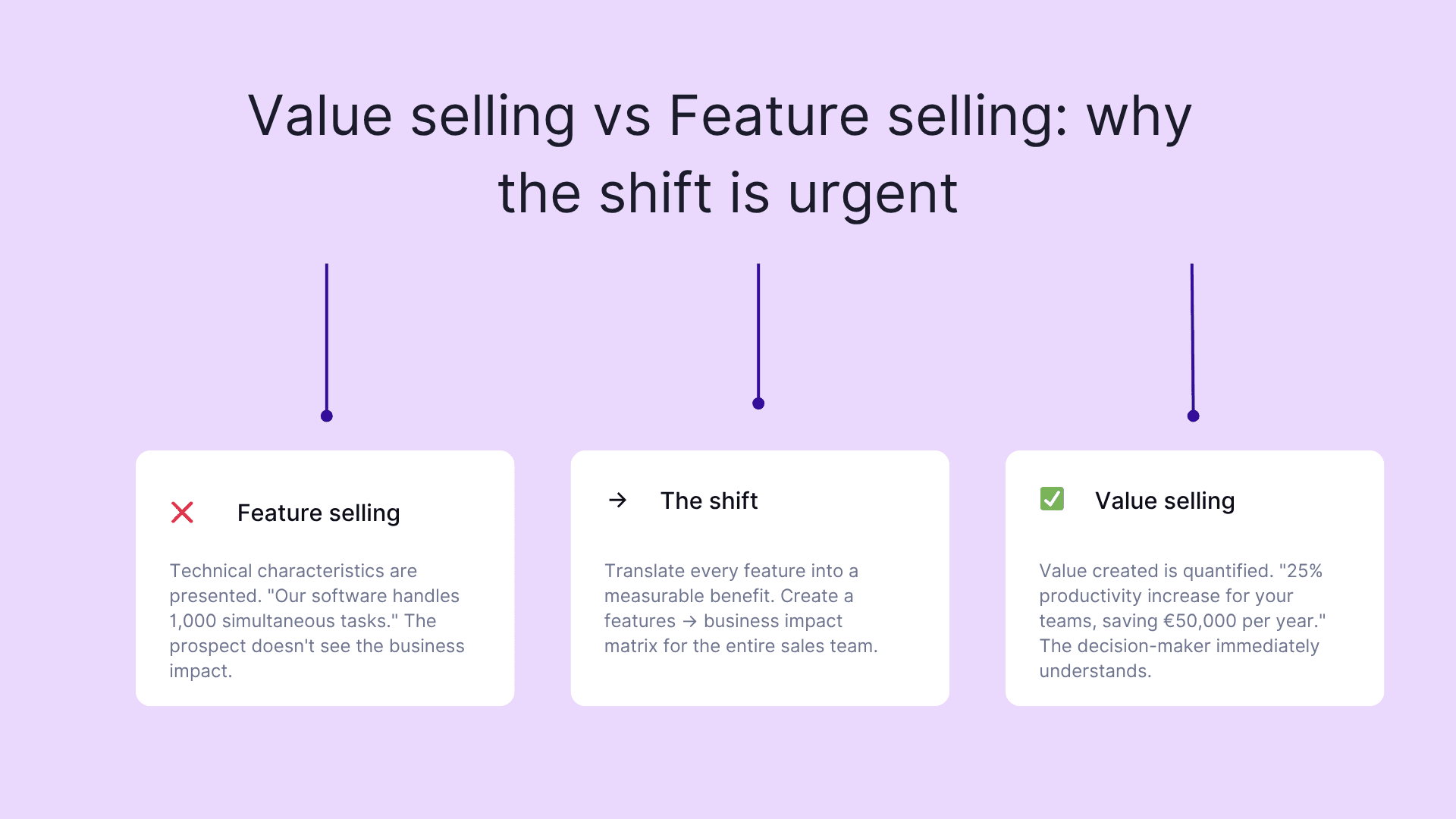
Feature-based selling quickly shows its weaknesses against modern B2B requirements. A salesperson focusing solely on technical functionalities misses their prospect's real business challenges.
Take the example of project management software: presenting its ability to handle 1000 simultaneous tasks doesn't resonate as much as demonstrating a 25% increase in team productivity. Simply listing characteristics also makes differentiation from competition more difficult.
B2B buyers seek solutions to their business problems, not a list of technical specifications. This traditional approach misses the opportunity to create a strategic connection with the decision-maker.
Advantages of the value-based approach
The value-based approach changes the nature of the buying decision. Organizations that formalize their proof of value generally see higher conversion rates and firmer pricing; the exact magnitude depends on the industry and the starting level of maturity. According to Salesforce, 76% of buyers are looking to maximize the value of every purchase: that's precisely the conversation value selling starts.
A cybersecurity provider illustrates this well: instead of listing features, they work out with the prospect the cost of an incident (downtime, remediation, penalties, reputational damage) and how much of that risk their offer removes. This approach justifies premium positioning and shortens sales cycles, because the decision-maker is comparing a cost to a risk avoided, not two quotes against each other.
The value-based methodology also strengthens long-term client relationships. Buyers perceive the salesperson as a strategic partner capable of bringing real added value to their business, beyond the simple product or service sold.
How to transition from feature to value selling
The transition to value selling begins with transforming your client questioning. Abandon closed questions about technical specifications. Favor open questions about business objectives: "What results do you want to achieve in the next 12 months?"
Picture a salesperson in the logistics sector. Instead of touting how fast their system is, they work out with the prospect what each late delivery actually costs (contract penalties, backup shipping, lost clients), then how much of that cost their system removes. The price is then discussed against that number, not against a competitor's quote.
The key lies in your ability to translate each feature into measurable benefits. Create a correspondence matrix between technical characteristics and business impacts. This systematic approach facilitates gradual adoption of value selling by your teams.
The value selling framework in practice
Client needs identification
A successful value selling approach relies on a structured client discovery methodology. Thorough diagnosis reveals strategic challenges hidden behind expressed needs.
Take the example of an industrial machinery manufacturer: during discovery interviews, the sales team uncovered that the initial automation request concealed a broader objective of reducing energy waste.
Gap Selling formalizes exactly this kind of reading: document the current state, the desired state, and the gap between the two, because the size of that gap is what sets the value the client will agree to pay for.
SPIN questioning techniques prove particularly adapted for exploring business pain points. This progressive method reveals underlying issues and measures their real impact on the prospect's organization.
Using visual mapping tools facilitates synthesizing gathered information and ensures shared understanding of client priorities within the sales team.
Building the value proposition
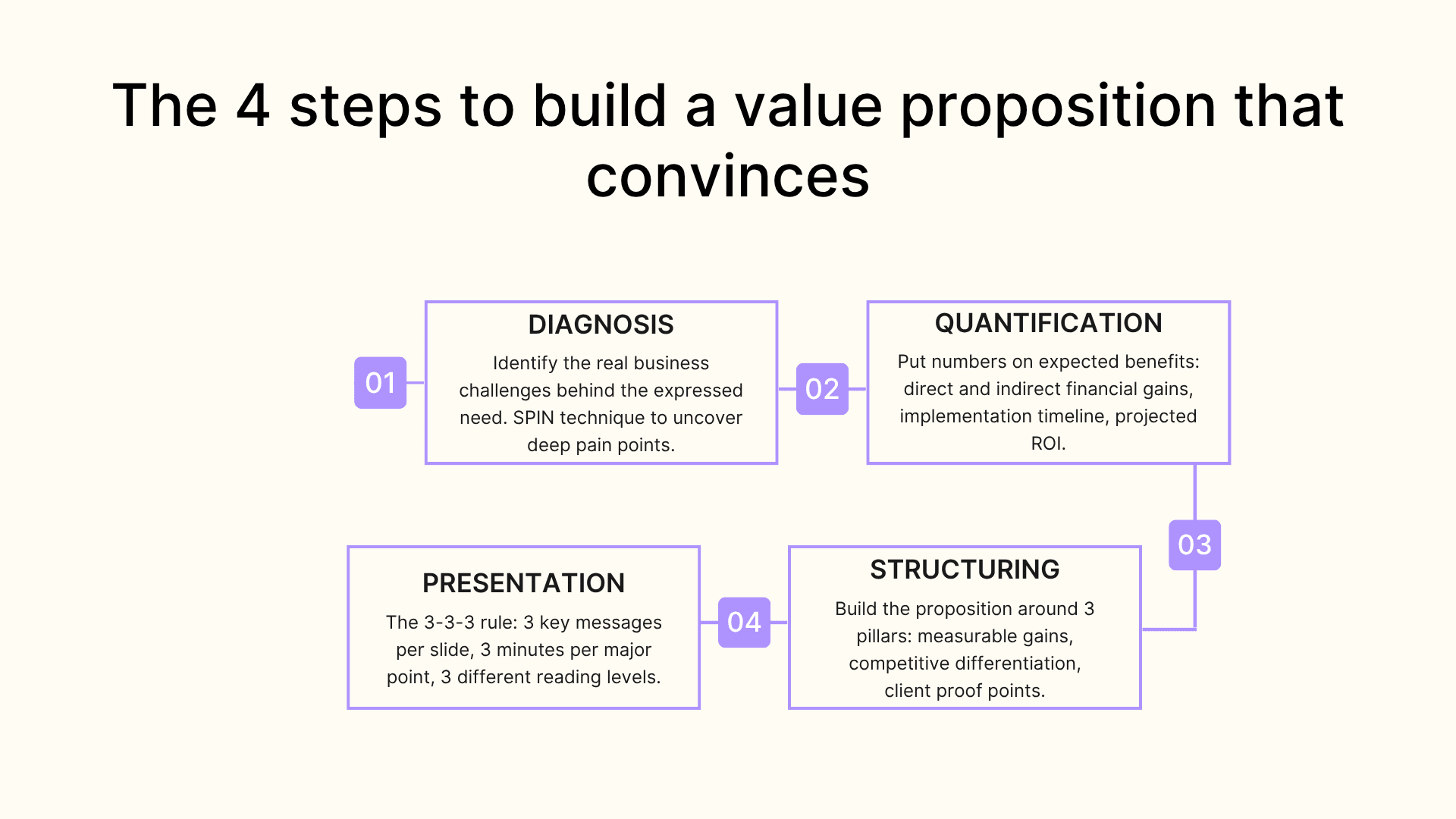
A compelling value proposition doesn't describe your offer: it describes what the client gets, measured in their own units. Start by quantifying the expected benefits. "On your current volumes, this frees up two days a week for your team on administrative processing" says more than a vague promise of optimization.
Structure your argument around measurable ROI. Picture an integrator selling a time-tracking tool to a consulting firm: they start from the billable hours lost each month to missing entries, value them at the firm's average hourly rate, and derive the annual shortfall. This quantified approach reinforces your offer's credibility.
This business case should open the sales proposal itself: the quantified gains for this client, their indicators, their timeline, before any description of the offer. A document that spends half its length on the vendor destroys the value the conversation built. The stakes aren't cosmetic: according to the Sales Odyssey 2025 survey, professionals estimate the impact of proposal quality on their closing rate at 68% on average.
Your final proposition must articulate three key elements:
- Quantifying gains, direct and indirect, calculated from the client's own numbers
- Differentiation from the alternatives (competitors and the status quo), backed by proof from comparable clients
- Performance indicators and implementation timeline, chosen with the client
Building the business case in five steps
The business case is the centerpiece of value selling: it's what your contact will hand up to their leadership, often without you in the room. It gets built with the client, not for them.
- Measure the current situation using the client's own numbers, not yours: volumes handled, time spent, the cost of an error, margin lost. A starting point the prospect recognizes as their own is worth more than any industry benchmark.
- Pick two or three value levers, no more. A business case that promises everything proves nothing.
- Write the assumptions down in black and white (adoption rate, rollout time, scope covered) and get the client to validate them before any calculation. A validated assumption can't be challenged later in committee.
- Calculate two scenarios, a conservative one and a target one. The conservative scenario should be enough on its own to justify the investment; the target scenario shows the upside.
- Plan to measure the value actually realized six months after signing, against the indicators set in the first step. That checkpoint sets up renewal, expansion, and referrals.
A business case the client helped build is one they'll defend internally, in front of a CFO who never sat in on your meetings. It's also the one a later-arriving competitor will find hardest to challenge.
Effective presentation techniques
Mastering presentation techniques determines the impact of your value selling approach. Favor a dynamic presentation format where each slide illustrates a measurable benefit for your prospect.
A proven technique consists of structuring your narrative around the customer journey. Start with the current situation, expose encountered challenges, then demonstrate the value created by your solution with precise metrics.
A value presentation holds together in a few messages: one number per slide, the client's situation before your offer, and a comparable client case at the close. Order matters: the overview first, then the detailed gains, then the proof. A decision-maker remembers what they understood in three slides, not what they read across thirty.
Results measurement and optimization
Value selling success relies on precise, measurable performance indicators. Sales proposal conversion rate is a foundational metric. Set your target from your own historical data rather than a benchmark: according to the Sales Odyssey 2025 survey, among companies that track their closing rate, 37% report a rate at or below 25%.
An effective dashboard also integrates average sales cycle duration and average transaction amount. High-performing companies also measure post-purchase customer satisfaction via Net Promoter Score, revealing actually delivered value.
Analyzing gaps between promised and realized value allows refining your approach. Read-tracking on a sent proposal gives you an early signal: if the ROI section is the one the prospect keeps re-reading, value has become the topic; if it's ignored, the diagnosis didn't land. Over time, a salesperson who systematically documents the real gains clients obtain (lower operating costs, added revenue, productivity gained) walks into every new opportunity with proof that competitors don't have.
Value selling in B2B: practical cases
Digital and technological solutions
The digital solutions sector requires a particularly adapted value selling approach. Technology decision-makers seek partners capable of understanding their strategic challenges beyond technical specifications.
An HR software publisher transforms their sales approach by demonstrating how their tool reduces talent turnover through better employee experience. Their value proposition articulates around measurable business impacts: increased productivity, reinforced engagement, and enhanced employer brand.
High-performing technology companies build their argumentation on three pillars:
- Strategic alignment with digital transformation objectives
- Operational risk reduction and cybersecurity
- Measurable competitive advantage in their market
Professional services and consulting
The consulting sector demonstrates value selling's power through quantifiable results. A firm that presents the expected return on investment from its very first exchanges changes the nature of the discussion: the prospect compares a cost to a gain, not one set of fees to another.
The method gains efficiency when highlighting concrete metrics. For example, a procurement consulting firm documents the gains realized at each client: savings negotiated on supplier contracts, renegotiated payment terms, disputes avoided.
High-performing firms adopt a proactive approach. They anticipate future market needs and position their expertise as a measurable growth accelerator. This approach reinforces their expert status and naturally justifies premium fees.
Industrial sector and manufacturing
The manufacturing sector transforms its sales dynamics through value selling. An industrial equipment manufacturer that quantifies its machines' impact on clients' productivity (output rates, scrap rate, unplanned downtime) shifts the negotiation from purchase price to total cost of ownership.
Added value also expresses itself in personalized support. An automated line builder now proposes detailed ROI analysis from the pre-project phase. This approach reinforces their expert position with industrial management.
Manufacturing companies gain relevance when they demonstrate their contribution to overall performance. A packaging solutions supplier conquered a strategic market by presenting the quantified environmental impact of their innovations: waste reduction and logistics optimization.
Training and skill development
Key skills to master
Value selling mastery relies on fundamental abilities that go beyond simple sales technique. A high-performing salesperson knows how to finely analyze their prospect's strategic challenges and precisely quantify created value.
The art of questioning becomes a crucial skill. The best salespeople perfectly master active listening and know how to ask questions that reveal their contacts' real business challenges.
The ability to build a business case represents another essential pillar. This expertise allows translating your solution's benefits into measurable financial impacts, like operational cost reduction or revenue increase.
Value selling also requires excellent knowledge of the client ecosystem: competitors, regulatory constraints, and strategic objectives.
Value selling training program
A successful value selling training program combines theoretical learning and intensive practice. Short but regular sessions allow better concept assimilation, with exercises based on real cases.
Modern training integrates personalized video simulations where each participant practices conducting discovery interviews and building compelling value propositions. For example, a seller practices quantifying CRM solution benefits for different decision-maker profiles.
The best programs include post-training follow-up with individualized coaching sessions. This approach ensures concrete application of learning in the field and achievement of measurable objectives like increased transformation rate or reduced sales cycles.
Maximizing ROI with value selling
Value-based pricing strategies
Pricing aligned with created value changes how price gets negotiated: it's discussed against a demonstrated gain, not against a competitor's rate. High-performing companies adopt a structured approach that precisely quantifies the benefits generated for each client segment.
A cloud solutions provider that documents the ROI of every offer (infrastructure savings, productivity gains, reduced operational risk) sells broader scopes: each additional module is justified by an identified gain, not by a discount.
The key lies in adapting price to each client's specificities. For example, an energy management provider indexes its pricing grids on the impact measured at each client: consumption avoided, power peaks smoothed out, overage penalties eliminated.
Cost of sales optimization
Mastering cost of sales represents a strategic lever for sales profitability. According to Spyral Conseil, only 33% of salespeople's time is actually spent selling. Cutting acquisition costs therefore starts with automating administrative tasks: follow-ups, CRM entry, document prep. The time freed up gets reinvested in high-potential accounts and in the quality of proposals.
High-performing companies rationalize their sales investments by prioritizing high-value-added actions. Implementing precise lead scoring allows identifying the most promising opportunities and concentrating resources on strategic accounts.
A monthly dashboard centered on sales ROI offers clear vision of improvement areas:
- Sales team productivity
- Digital tool effectiveness
- Profitability by client segment
Frequently asked questions
What is value selling?
It's a sales methodology (especially B2B) that focuses on demonstrating and quantifying economic added value (ROI, savings...) for the client, rather than on product characteristics.
What's the difference with feature selling?
Instead of listing product functions, value selling translates these functions into measurable business benefits relevant to the client's strategic objectives.
Why is value selling effective today?
Because B2B buyers seek solutions that have a direct and quantifiable impact on their results. This approach meets this need and justifies the investment.