
What training fits your objectives?
Degree and certification programs
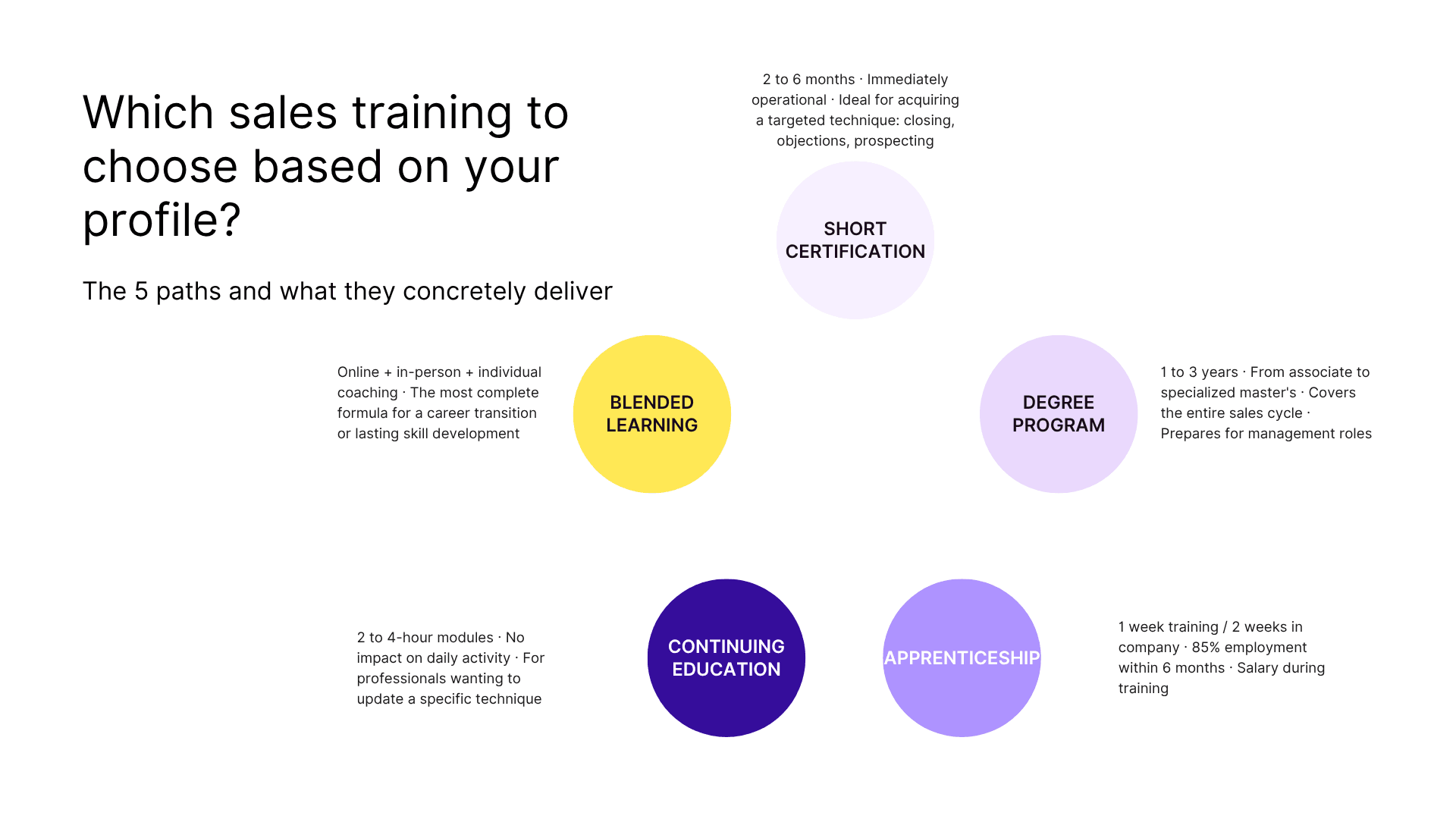
Certification programs allow you to acquire targeted new skills in 2 to 6 months, with immediate professional recognition. Particularly suited for retail salespeople or sales advisors, they focus on practical aspects like closing deals or handling objections.
Degree programs offer in-depth expertise over 1 to 3 years. From Associate's degrees to specialized Master's programs, these curricula cover the entire sales cycle and prepare you for leadership roles in major corporations.
Both paths include hands-on simulations and guarantee measurable sales effectiveness over the long term.
Professional sales advisor certificate
The Professional Sales Advisor Certificate prepares you for modern retail challenges in an omnichannel environment. This level 4 certification (high school equivalent) is built around two major skill blocks: retail unit management and customer experience enhancement.
Students develop their sales technique mastery through real-world scenarios. An 8-week practical internship strengthens their ability to build trust with customers and optimize the sales process.
The training covers essential aspects like:
- Active listening and needs analysis
- Product and service value proposition
- Personalized customer support
- Point-of-sale optimization
Short specialized training programs
Short programs meet the needs of professionals seeking rapid skill development. These intensive modules, lasting 2 to 5 days, provide operational know-how that's immediately applicable in the field.
A salesperson can specialize in cold calling, complex negotiation, or creating a favorable environment for deal closure. Sessions alternate between theoretical learning and practical exercises to maximize concept retention.
Participants develop expertise in specific areas like prospect behavioral analysis, advanced closing methods, or sales cycle optimization. This targeted approach guarantees measurable progress as soon as they return to work.
Different sales training paths
Sales training through apprenticeships
Apprenticeship represents an excellent path for starting in sales. This approach lets you gain solid field experience while earning a monthly salary—a major advantage for future salespeople.
The apprenticeship rhythm, typically one week in training and two in the company, creates a perfect balance between theory and practice. The results speak for themselves: 85% of apprentices find employment within 6 months of completing their program.
A salesperson trained through apprenticeship quickly develops expertise through daily customer contact in a professional environment. This immersion accelerates mastery of sales conversations and builds the self-confidence essential for success in this field.
Continuing education for professionals
Continuing education represents a strategic lever for experienced salespeople. A good time to update your methods comes during slow periods or before major meetings with key prospects.
Short modules, lasting 2 to 4 hours, allow you to acquire targeted techniques without impacting your daily work. For example, a workshop on selling complex products can radically transform your approach the very next day.
A sales technique expert recommends combining theoretical learning with field application. This method guarantees rapid assimilation of new sales skills. Schedule a practice session after each module to test learned concepts with your customers.
Workforce development programs
Workforce development agencies offer customized training that meets market needs in the sales sector. These fully funded programs adapt to job seekers' profiles who want to develop their sales skills.
On-the-job training programs provide tailored training of up to 400 hours maximum. A salesperson in career transition will master sales fundamentals through an intensive program, followed by company immersion.
Distance learning programs have multiplied since 2024, with flexible paths integrating virtual coaching and real-world simulations. For example, an online sales program combines 3 months of theoretical learning and 2 months of practical internship for maximum effectiveness.
Master essential sales techniques
Prospecting and lead qualification
Mastering lead qualification represents a strategic skill for any modern salesperson. A structured approach helps you quickly identify a prospect's potential through specific criteria: available budget, decision-making power, and purchase timeline.
A high-performing salesperson dedicates 30% of their time to analyzing prospect maturity. This crucial step guarantees better conversion rates and optimizes time invested in each opportunity.
The BANT method (Budget, Authority, Need, Timing) provides a proven framework for evaluating lead relevance. For example, a B2B salesperson qualifies prospects by verifying their budget capacity before starting in-depth negotiation.
Negotiation and effective closing
Successful sales negotiation relies on mastering positive influence techniques. An expert seller knows how to create trust from the first minutes of interaction. Verbal and non-verbal synchronization with their contact allows them to establish an authentic connection.
The progressive closing method turns each point of agreement into a mini-commitment. For example, a salesperson who gets their prospect's approval on three key benefits increases their signing chances by 40%.
Natural closing flows from well-conducted negotiation. Rather than forcing the decision, the seller guides their prospect toward a logical conclusion. This respectful approach strengthens the commercial relationship long-term.
Customer relationship management
Customer retention relies on a personalized relationship strategy. Regular follow-up after the sale helps anticipate future needs and maximize satisfaction at every interaction.
Modern digital tools radically transform sales follow-up. A well-structured customer database reveals additional sales opportunities and facilitates churn prevention.
Implementing a customized loyalty program generates tangible results: spontaneous referrals, increased average order value, reduced acquisition costs. Smart salespeople organize regular check-ins with their strategic customers to maintain a privileged relationship over time.
Specializations by industry
B2B sales and business-to-business commerce
Business-to-business sales requires specific methodology adapted to complex buying cycles. A high-performing B2B salesperson masters strategic challenge analysis and knows how to identify the multiple decision-makers involved in the purchasing process.
B2B success relies on the ability to build structured sales proposals. The best sellers develop personalized solutions that address their prospects' business challenges, rather than simply presenting product features.
Professional buyers expect tangible proof: case studies, measurable ROI, and industry references. A smart B2B salesperson systematically prepares these elements to strengthen their credibility during crucial meetings.
Automotive and vehicle training
Sales in the automotive sector demands dual technical and commercial expertise. Training programs combine learning vehicle characteristics with negotiation strategies adapted to this market.
A high-performing automotive salesperson masters both model specifications and the art of field demonstration. Current training includes modules on new powertrains and onboard technologies, essential given market evolution.
Industry certification represents a standard recognized by professionals. It validates key skills like trade-in appraisal, financing package assembly, and dynamic vehicle presentation.
The best programs include real-world scenarios at dealerships to develop product expertise and customer approach.
Specialized retail and pet store training
Pet store training combines animal technical knowledge with sharp sales skills. The Professional Animal Sales Advisor program provides comprehensive expertise in 3 years, with practical modules on animal behavior and retail management.
Students develop specific skills like animal welfare assessment, safe handling of different species, and owner needs analysis. A 16-week professional internship reinforces this essential field approach.
The required certification for animal sales usefully complements this initial training. Professionals can also choose short modules focused on specific species like exotic pets or aquaculture.
Leading training organizations
Commerce and sales training centers
With over 200 locations throughout the country, training centers offer professional programs adapted to field realities. Their strength lies in personalized support and intensive sales technique practice.
Instructors, all from the professional world, share their expertise through real-world scenarios. A remarkable 70% placement rate demonstrates the relevance of their teaching approach.
Modern training facilities faithfully reproduce retail environments. This immersion guarantees smooth employment transition. Students also benefit from 6-month post-training follow-up to maximize their professional success chances.
Community college networks
Community college networks provide sales training adapted to job market needs. Present in every region, they offer flexible programs from certificates to degrees, with adjustable modules based on your professional goals.
Qualified instructors support each student in their project through personalized guidance and modern teaching methods. The network's strength lies in its ability to combine theoretical learning with concrete applications.
Sales training systematically includes company periods, enabling rapid acquisition of sought-after commercial skills. A dedicated advisor guides you in choosing the path best suited to your situation and ambitions.
Certified private organizations
Certified private organizations represent a high-performing alternative for your sales training. Certification guarantees pedagogical excellence and rigorous progress monitoring.
To choose your organization, evaluate program relevance relative to your professional objectives. A good private organization stands out through its ability to customize its offering and propose formats adapted to your constraints.
Prioritize structures that highlight their success rates and provide concrete testimonials from former participants. Transparency about teaching methods used and instructor qualifications also constitute essential selection criteria.
Optimize your learning path
Online and distance learning
Digital sales training offers maximum flexibility in your skill development. Modern platforms provide 24/7 accessible interactive modules, combining videos, practical exercises, and virtual simulations.
A major advantage lies in the ability to practice sales techniques through realistic simulations. For example, sellers train on customer objections through personalized scenarios that reproduce authentic situations.
Integrated performance analysis tools let you measure your progress and identify improvement areas. Detailed statistics on your practical exercises guide your learning toward essential skills to develop.
In-person training
In-person sales training creates unique learning dynamics through direct interactions. Physical presence promotes accelerated sales technique acquisition through observation and immediate replication of best practices.
Real-world scenarios allow participants to perfect their non-verbal communication and persuasive power. A seller learns to decode subtle buying signals and adapt their body language to reinforce their message.
Peer exchanges enrich the training: everyone shares their field experiences and solutions to daily challenges. This collective intelligence, combined with personalized instructor feedback, quickly consolidates professional knowledge.
Blended solutions and personalized coaching
Blended programs cleverly combine digital learning and in-person sessions to maximize sales skill acquisition. This approach allows sellers to alternate between autonomous platform work and enriching peer meetings.
Individualized sales coaching reinforces this approach through customized support. A seller can, for example, work on their negotiation techniques remotely then refine them during a practical session with their coach. Sessions adapt to specific needs: stress management, argument construction, or commercial leadership development.
This hybrid formula guarantees constant progress. Sellers consolidate their theoretical knowledge while benefiting from expert follow-up to perfect their field practice.
Keys to successful sales career transition
Required skills assessment
Self-diagnosing your abilities represents the first step toward successful sales career transition. Start by analyzing your natural talents: listening skills, ability to convince, relationship ease. These qualities represent a valuable foundation for your future sales career.
Then measure your mastery of essential technical skills: digital tool usage, time management, administrative organization. A high-performing salesperson combines these know-how elements with excellent communication.
Conduct an objective assessment of your previous professional experiences. Every situation where you successfully negotiated, convinced, or retained a contact enriches your sales potential. This thorough analysis will guide your training choice and accelerate your advancement in sales.
Professional project construction
Successful sales career transition requires methodical project structuring. Start by defining your target market and unique sales positioning. A salesperson specialized in B2B digital solutions won't have the same path as a retail seller.
Establish a realistic timeline with progressive objectives. Plan your skill development over 6 to 12 months, alternating theoretical learning with field practice. For example, dedicate one month to prospecting before tackling advanced negotiation techniques.
Build your professional network now. Attend industry trade shows, join specialized LinkedIn groups, and connect with experienced professionals. These contacts will enrich your career vision and open concrete opportunities.
Funding and available assistance
Professional development accounts represent the first resource to mobilize for financing your sales training. This budget envelope accumulates throughout your professional career.
Transition programs provide valuable financial support, notably through professional transition systems that maintain your salary during training. A salesperson in career transition can, for example, benefit from complete coverage for 6-month qualifying training.
Regional authorities offer grants adapted to job seekers targeting the sales sector. These aids cover up to $2,000 for skills validation or 100% of training costs for certain priority programs.
Workforce development training compensation offers monthly income to people without unemployment benefits during their sales training.
Frequently asked questions
What type of sales training should I choose when starting in the field?
For beginners, certification training (like Professional Sales Advisor Certificate) or apprenticeship programs offer solid practical foundations and initial experience.
Is it possible to effectively train in sales techniques remotely?
Yes, many quality online programs offer interactive modules, sales simulations, and sometimes virtual coaching for flexible learning.
What are the most important skills acquired in sales training?
Prospecting and qualification techniques, active listening, persuasive argumentation, negotiation, closing methods, and customer relationship management.