
What is a high-performing sales policy?
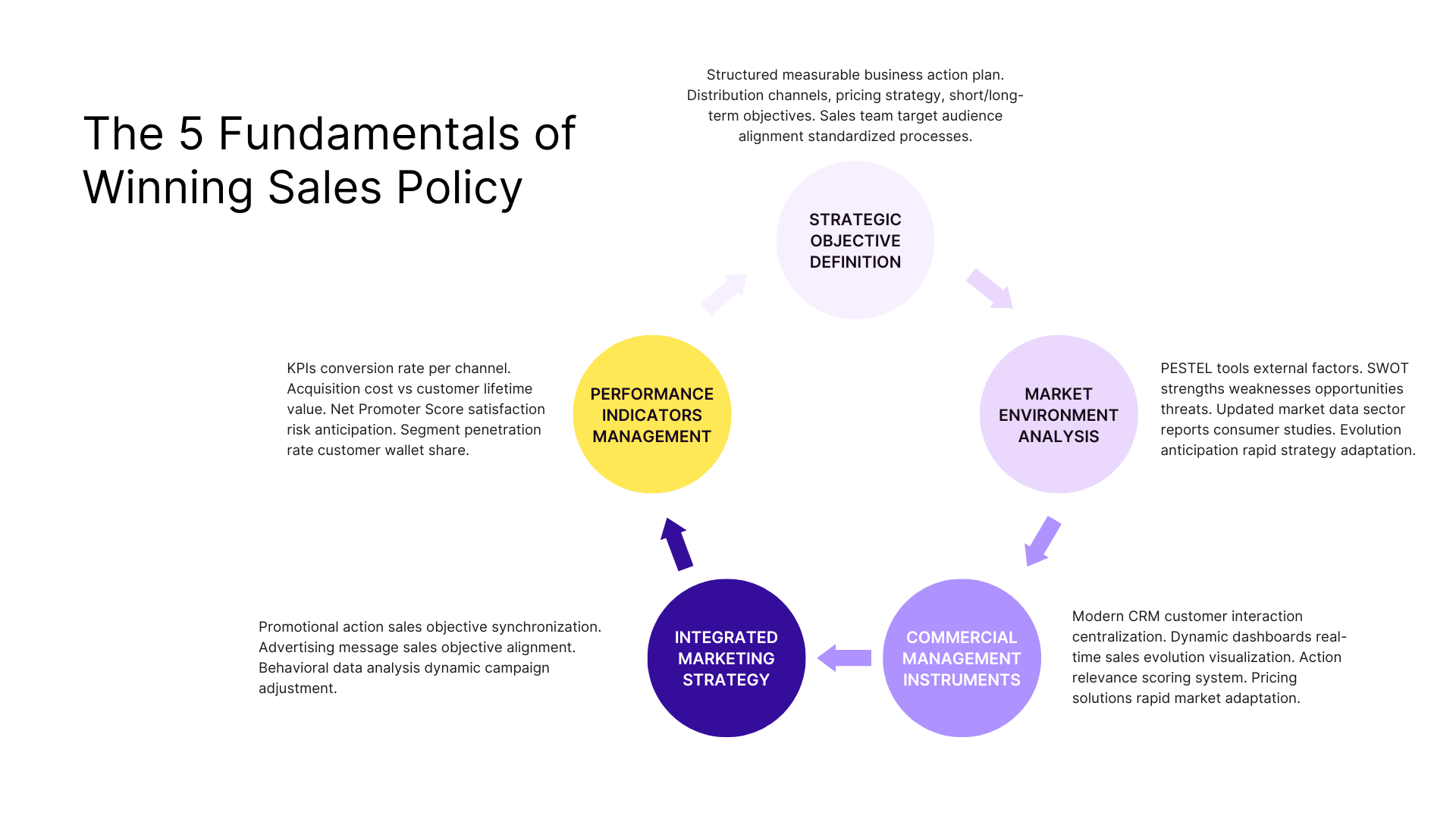
A high-performing sales policy is built around a structured and measurable business action plan. It precisely defines distribution channels, pricing strategy, and short and long-term sales objectives.
The key lies in alignment between sales teams and the target audience. High-performing companies establish standardized sales processes while leaving room for adaptation to each client's specific needs.
Here are the essential components:
- A price positioning consistent with brand image
- Distribution channels optimized according to the business sector
- Communication adapted to different customer segments
- A sales performance measurement system
Fundamentals of a winning business strategy
Strategic definition and business objectives
The success of a sales approach depends on measurable objectives aligned with the company's vision. 2025 data shows that high-performing organizations set specific targets: 30% aim for growth between 5% and 10%, while 8% adopt higher ambitions, between 10% and 20%.
Establishing a clear roadmap involves prioritizing target markets and defining quantifiable indicators. A concrete example? A technology sector SME could aim to acquire 100 new B2B clients over 6 months, with an 80% retention rate.
Digital transformation now plays a central role in achieving results. Companies that integrate digital solutions into their sales approach significantly increase their chances of success.
Analyzing the company and its environment
A successful strategic analysis relies on mastering PESTEL and SWOT tools. The PESTEL model deciphers external factors: political, economic, social, technological, ecological, and legal influences on your market.
The SWOT approach complements this vision by evaluating your strengths, weaknesses, opportunities, and threats. A concrete example? A textile company identifies the growing ecological trend through PESTEL, then uses SWOT to capitalize on its local production.
Updated market data reinforces this analysis. Study sector reports, consumer studies, and competitive intelligence to anticipate changes in your industry. This deep understanding allows you to quickly adapt your strategy to market changes.
Sales policy instruments
The success of a sales policy relies on high-performing management tools. A modern CRM centralizes customer interactions and automates opportunity tracking. Dynamic dashboards visualize sales evolution by segment and territory in real-time.
Pricing configuration solutions allow rapid tariff adaptation according to markets. Commercial proposal generators accelerate the sales cycle while maintaining consistency in client approach.
A scoring system evaluates the relevance of sales actions and guides teams toward the most promising opportunities. Integrated coaching strengthens sales professionals' skills through personalized recommendations based on performance analysis.
Collaborative tools facilitate best practice sharing between teams and standardize winning sales processes.
Types of sales policies to adopt
Integrated marketing strategy
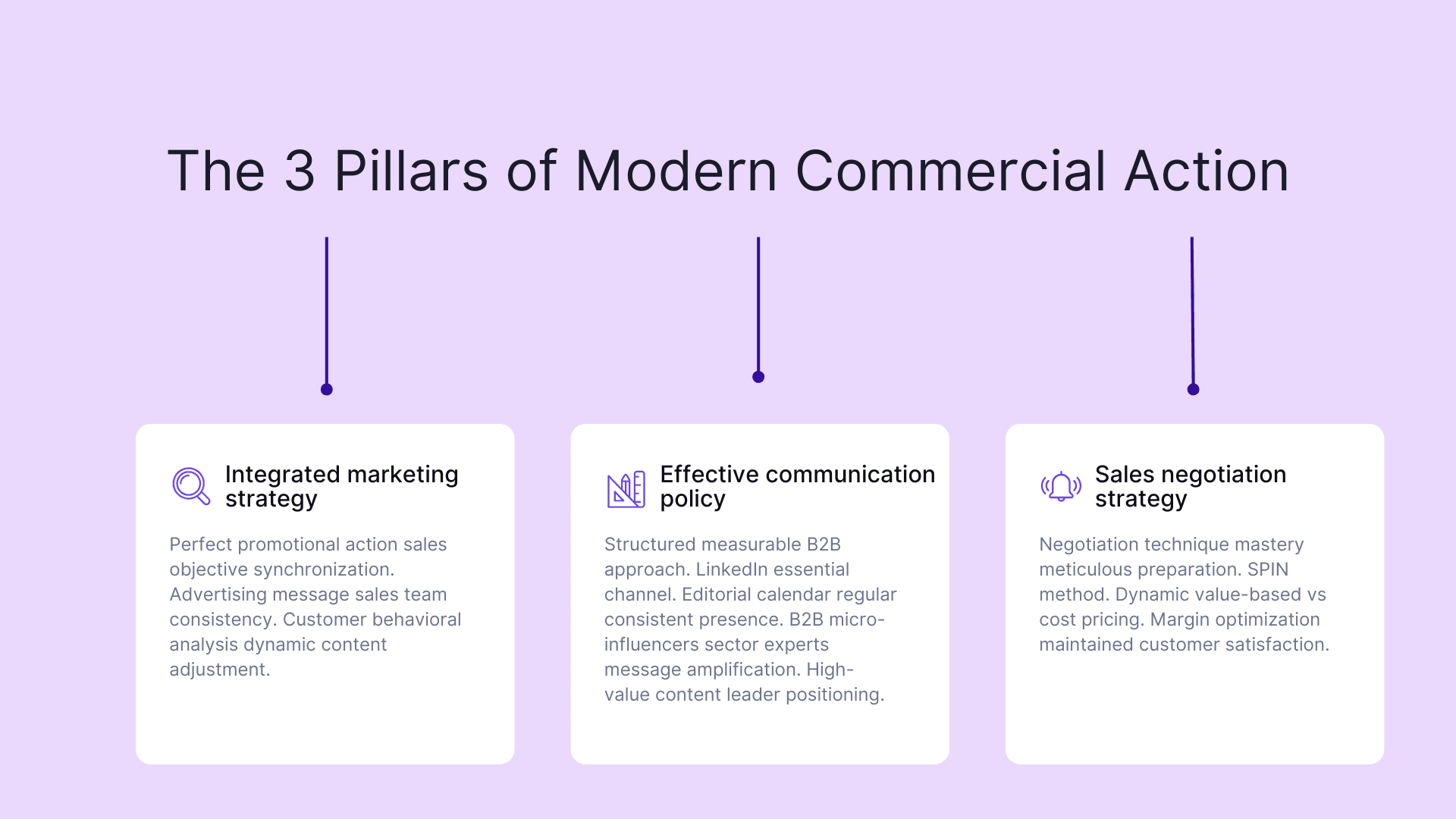
A winning marketing approach depends on perfect synchronization between your promotional actions and sales policy. This harmonization requires precise alignment of advertising messages with your sales objectives.
Take the example of an organic cosmetics brand: its communication highlights environmental commitment while its sales teams emphasize environmental certifications with distributors. This consistency reinforces brand credibility.
Customer behavioral data analysis allows dynamic campaign adjustments. A professional furniture manufacturer increased conversions by 40% by adapting its content based on purchase paths observed on its website.
Effective communication policy
Implementing a B2B communication strategy requires a structured and measurable approach. Professional channels like LinkedIn become essential: 94% of decision-makers spend more than 6 hours weekly there.
Establishing an editorial calendar maintains regular and consistent presence. An industrial sector company strengthened its brand awareness through weekly publication of case studies and customer testimonials.
B2B micro-influencers represent an emerging lever in 2026. These sector experts, with their targeted but engaged audiences, amplify message reach. A software publisher tripled its qualified leads by collaborating with specialized consultants in their market.
Creating high-value content, such as white papers or technical webinars, positions the company as a leader in its field.
Sales and negotiation strategy
Mastering negotiation techniques forms the foundation of a high-performing sales strategy. A winning approach depends on meticulous interview preparation and adaptation to different buyer profiles.
A technology sector sales director transformed his results using the SPIN method: identifying situations, problems, implications, and prospects' specific needs. This technique increased his conversion rate by 35%.
Pricing tactics play a decisive role in negotiation success. A cloud solutions provider applies dynamic pricing based on perceived value rather than costs. This strategy allowed them to optimize margins while maintaining excellent customer satisfaction rates.
How to develop an international policy?
Strategic examples: Decathlon and Carrefour
Decathlon's international success relies on an adaptive multi-local approach. The company adjusts its offering according to each country's sports practices. In China, cycling and badminton dominate sales, while in Spain water sports take precedence.
Carrefour adopts a different strategy with an evolving franchise model. The group partners with local players who master market specificities. In Brazil, this partnership with Grupo Pão de Açúcar enabled rapid expansion in urban areas.
Both groups share a common vision: centralizing purchases while personalizing assortments. This approach guarantees economies of scale without sacrificing local relevance.
Divergent approaches: France vs China
French and Chinese sales methods present fundamental contrasts in implementation. France favors an approach based on added value and innovation, with longer negotiation cycles but reinforced customer loyalty.
The Chinese approach is characterized by exceptional responsiveness to market changes. Chinese companies excel in cost optimization and rapid offer adaptation, as evidenced by the success of digital marketplaces.
A French industrial machinery manufacturer recently transformed its Chinese strategy by shortening decision cycles and proposing modular solutions. This adaptation allowed them to increase market share by 25% in 2024.
Impact of protectionist policies
Protectionist measures radically transform global trade dynamics. Recent tariff barriers between major economic blocs force companies to rethink their export strategies. A European automaker relocated production to the United States to bypass steel taxes, reducing costs by 30%.
Rising protectionism drives supply chain diversification. Companies adopt multi-source strategies to secure their value chains. An electronics component manufacturer developed partnerships with suppliers in Vietnam and Malaysia, reducing dependence on Chinese imports by 45%.
The European Union strengthens its common commercial policy in response to these tensions. Bilateral agreements become strategic tools to guarantee access to priority markets.
Strategic management: monitoring and optimization
Key performance indicators
Mastering sales performance indicators ensures precise business management. Tracking conversion rates by channel reveals the effectiveness of each prospect touchpoint. The customer acquisition cost ratio relative to customer lifetime value measures the real profitability of your marketing actions.
A high-performing sales dashboard also integrates customer satisfaction via Net Promoter Score. This predictive score anticipates cancellation risks and growth opportunities. Measuring average sales closing time allows sales cycle optimization.
The most successful companies also monitor their penetration rate by market segment and customer wallet share. These strategic metrics guide commercial resource allocation decisions.
Process optimization tools
Digital transformation of sales processes relies on adapted technological solutions. A modern CRM facilitates repetitive task automation and sales best practice standardization.
Adopting electronic signature and pricing configuration tools accelerates transaction completion. Sales teams save valuable time by automating quote generation and follow-up management.
Collaborative platforms centralize sales document sharing and streamline inter-service communication. An automotive manufacturer reduced its sales cycle by 40% through an automated commercial proposal management solution.
Synchronization between these different tools guarantees a unified view of the customer journey and maximizes the impact of sales actions.
The future of sales policies in 2025
Profound changes in the 2026 commercial landscape are redefining the rules of the game. Artificial intelligence revolutionizes customer approach personalization. Companies adopt predictive models to anticipate purchasing behaviors and adjust strategies in real-time.
The rise of social commerce transforms social networks into genuine marketplaces. Brands develop immersive shopping experiences, blending augmented reality with authentic community interactions.
Sustainable development becomes a decisive criterion in commercial relationships. Companies that integrate eco-responsible policies gain consumer trust and strengthen their position in international markets.
Frequently asked questions
What are the essential elements of a high-performing sales policy?
Clear objectives, solid market analysis, consistent price positioning, adapted distribution channels, and targeted communication.
How to analyze your company's environment for its sales policy?
Use tools like PESTEL (external context: political, economic...) and SWOT (internal strengths/weaknesses, external opportunities/threats).
Why is it crucial to measure your sales policy performance?
To verify objective achievement, identify what works or doesn't, and quickly adjust strategy to optimize results.