
What is a unique selling point in marketing?
The USP (unique selling proposition) represents the distinctive characteristic that makes your offer irreplaceable in the market. A concept created by American expert Rosser Reeves in the 1940s, the USP rests on three fundamental pillars: uniqueness, persuasion, and customer value.
A compelling example? A B2B logistics company guarantees delivery in under 2 hours in major metropolitan areas, while its competitors offer standard 24-hour timeframes. This unique promise addresses a specific need and constitutes a true differentiation lever.
To succeed, your USP must solve a specific problem for your target audience, be difficult for competitors to imitate, and remain consistent with your marketing positioning.
The strategic importance of the value proposition
The value proposition drives growth for high-performing companies in 2025. A recent study shows that 78% of B2B decision-makers consider the value proposition as decisive in their buying journey.
A compelling example: an IT services company increased its conversion rate by 45% by reformulating its value proposition around predictive cybersecurity. This targeted approach addresses the major concerns of modern CIOs.
The value proposition transforms your distinctive strengths into measurable advantages for your customers. It structures your sales message and guides your teams toward unified messaging. Your customer benefit then becomes the central point of every commercial interaction.
Essential components of effective unique selling points
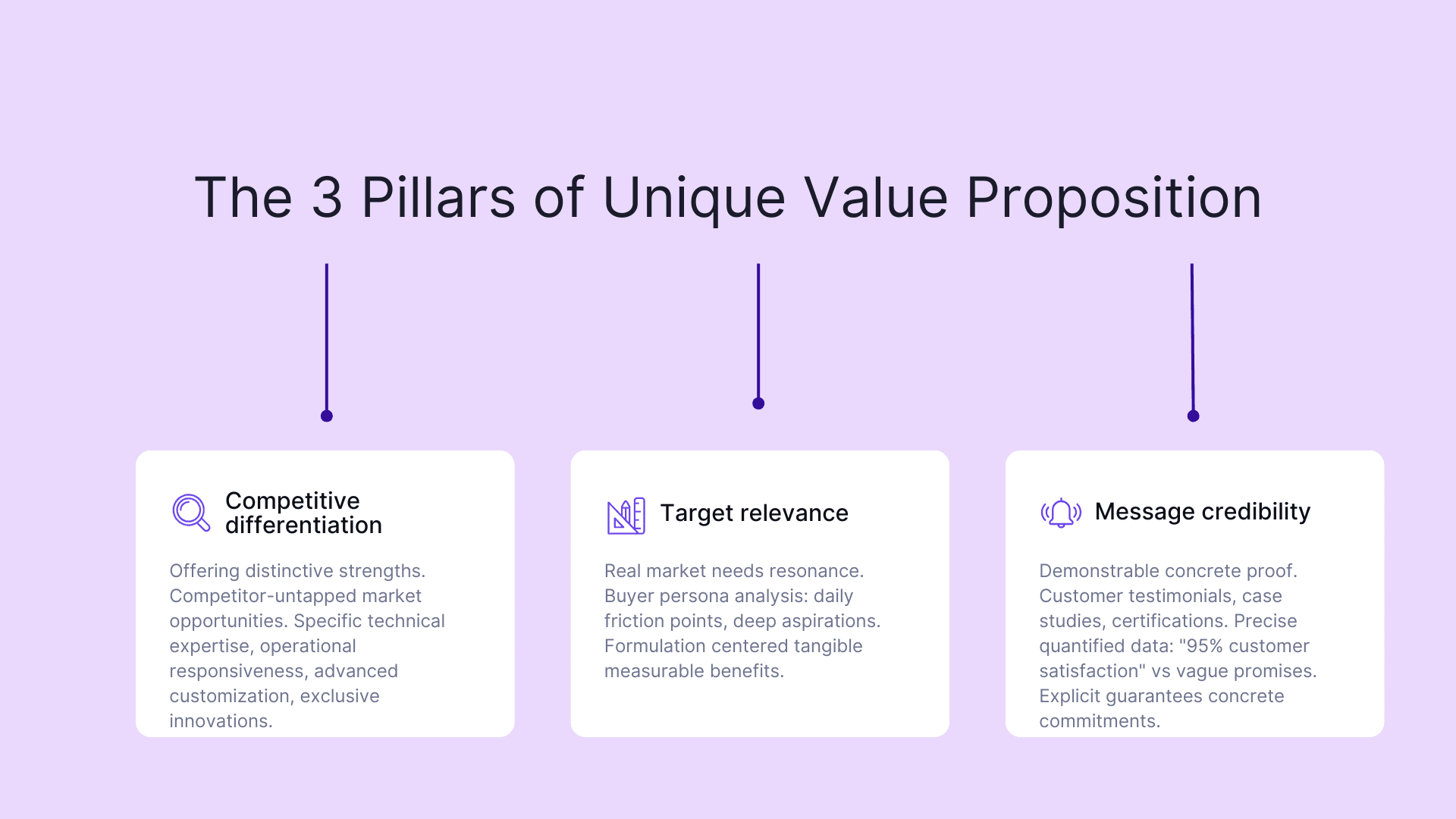
Differentiation from the competition
The differentiation strategy relies on precise identification of your offering's distinctive strengths. Market analysis reveals opportunities unexploited by your rivals.
Take the example of a cloud services company that focuses on personalized 24/7 support, while its competitors only offer standard daytime support. This assistance promise addresses customers' critical needs.
To maximize your impact, focus on these drivers:
- Specific technical expertise
- Operational responsiveness
- Advanced customization
- Exclusive innovations
Distinctive positioning transforms your unique features into lasting competitive advantages.
Relevance to the target audience
Resonance with your market's real needs determines your USP's impact. An in-depth buyer persona analysis reveals daily friction points and deep aspirations of your potential customers.
Take a SaaS company that transforms its message from "innovative cloud solution" to "save 4 hours per week for your teams." This reformulation centered on tangible benefits speaks directly to decision-makers' concerns.
Field validation remains essential. Customer feedback, usage data, and satisfaction surveys refine your understanding of expectations. Constant dialogue with your market allows you to adjust your value proposition and maximizes its resonance with your target audience.
Message credibility
A commercial promise's strength relies on its ability to be demonstrated concretely. Tangible proof like customer testimonials, case studies, or certifications instantly reinforces potential buyers' confidence.
A message gains legitimacy when it's supported by precise quantified data. For example, a professional training company announcing "95% customer satisfaction" rather than a vague promise of "exceptional quality" strengthens its credibility with prospects.
Explicit guarantees, like 30-day money-back or measurable results commitments, transform promises into concrete engagements. This transparency naturally reassures decision-makers in their purchasing process.
How to write effective unique selling points
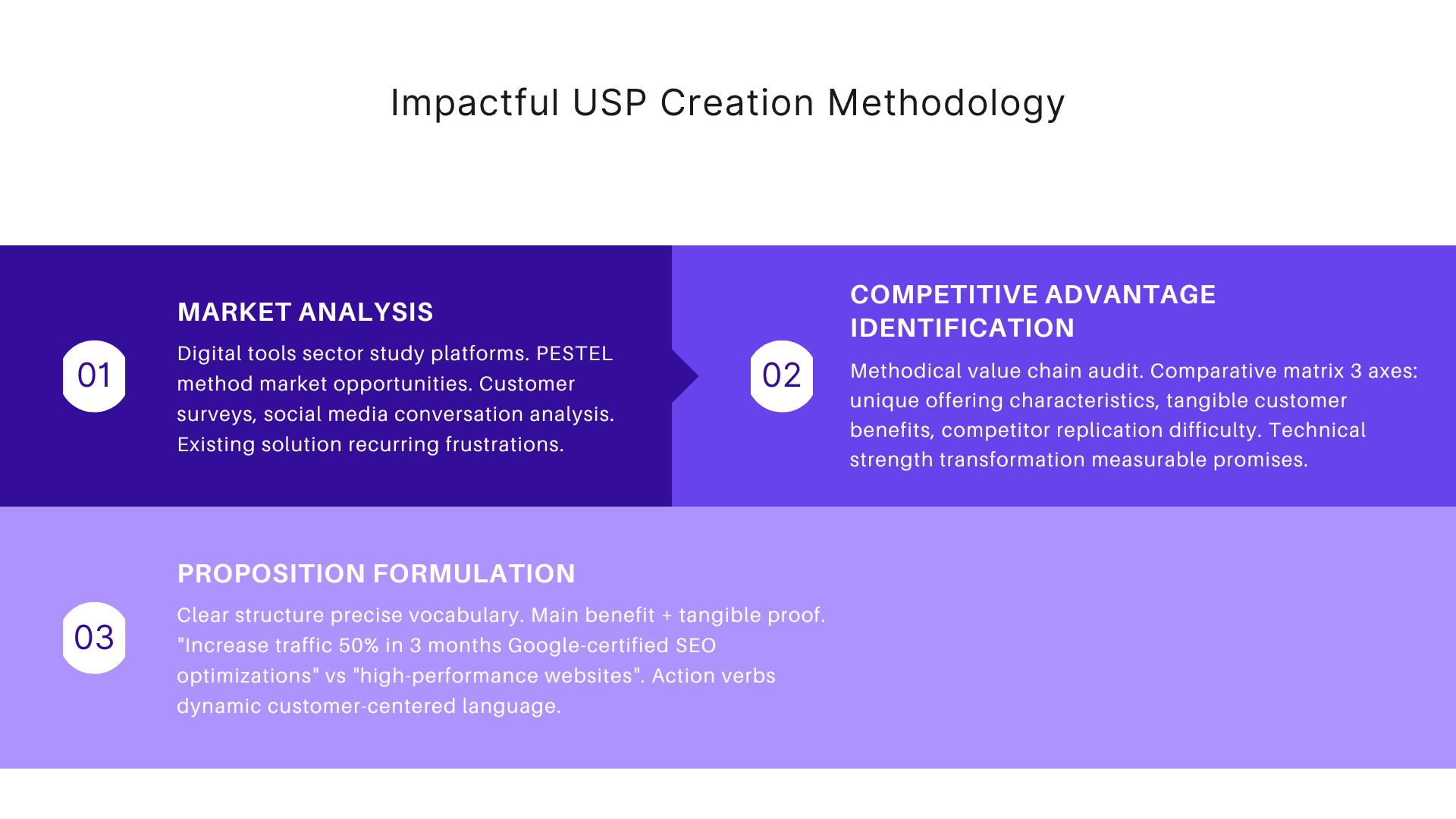
Market analysis
Thorough market analysis forms the foundation of an impactful USP. Modern digital tools like sector study platforms or competitive intelligence software allow precise mapping of your commercial environment.
The PESTEL method reveals unexploited opportunities in your market. An HR consulting firm recently identified a growing need for remote work support through this structured approach.
Customer surveys and social media conversation analysis reveal recurring frustrations with existing solutions. This deep field understanding guides the creation of truly differentiating sales arguments.
Identifying competitive advantages
Precise mapping of your distinctive strengths begins with a methodical audit of your value chain. Each link reveals differentiation opportunities: technical expertise, innovative processes, or exceptional customer relations.
A practical exercise involves creating a comparative matrix structured around three axes: your offering's unique characteristics, tangible benefits for your customers, and replication difficulty for your competitors.
Take the example of a software company that transforms its technical responsiveness into a guarantee of resolution time under 2 hours. This measurable promise becomes a powerful competitive advantage against market standards set at 24 hours.
Proposition formulation
Writing an impactful commercial proposition requires clear structure and precise vocabulary. A winning formula involves articulating your message around the main benefit, followed by tangible proof that reinforces its credibility.
Take the example of a web agency that transforms "high-performance websites" into "increase your traffic by 50% in 3 months through our Google-certified SEO optimizations." This specific and measurable formulation speaks directly to decision-makers.
Word choice remains crucial. Favor dynamic language with action verbs. Replace "we offer" with "you get," emphasizing customer added value. Every term must contribute to reinforcing your central message.
Unique selling points that made marketing history
Apple's USP: innovation as DNA
The "Think Different" signature marked a turning point in technology marketing history. Apple successfully transformed its innovation culture into a unique customer promise. The brand doesn't sell computers or smartphones, but a cutting-edge vision of technology.
This approach materializes through a complete ecosystem where each product reinforces the overall experience. From MacBook to iPhone, including Apple Watch, the brand creates perfect synergy between its devices.
Apple's USP rests on three fundamental pillars:
- Minimalist design that redefines aesthetic standards
- Fluid and intuitive user experience
- Harmonious integration between hardware and software
This strategy has allowed Apple to maintain premium pricing while building loyalty among a passionate user base.
Nike's USP: self-transcendence
The "Just Do It" signature transcends simple sports equipment sales to embody a universal philosophy of personal achievement. This promise resonates with an audience much broader than just high-level athletes.
Nike excels in the art of transforming every advertising campaign into an inspiration source. The brand showcases authentic stories of perseverance, where ordinary athletes push their limits, creating a powerful emotional connection with their audience.
This USP's success lies in its ability to unite sports performance and societal message. Campaigns like "Dream Crazier" or "You Can't Stop Us" demonstrate how Nike concretely translates its vision of self-transcendence, touching both sports enthusiasts and the general public.
Coca-Cola's unique selling point: happiness in a bottle
Coca-Cola's marketing strength lies in its ability to sell much more than a carbonated beverage. The brand has built its global empire around a simple emotional promise: sharing moments of happiness.
This strategy proved particularly successful during the launch of the "Share a Coke" campaign in 2011. By personalizing its bottles with first names, Coca-Cola transformed a mass product into a unique personal experience.
The brand excels in the art of creating strong emotional connections through its advertising campaigns. From the illuminated Christmas truck to unity messages during the pandemic, every marketing action reinforces its positioning as a creator of joyful moments.
Its USP relies on a unique alchemy between its mythical secret recipe and its ability to constantly reinvent itself while remaining faithful to its fundamental promise: making everyday life more sparkling.
Unique selling point by sector: examples and best practices
USP for B2B companies
In the B2B universe, building a USP requires an approach centered on measurable results. A cloud services company can transform "secure storage solutions" into "99.99% availability guarantee with data recovery in under 4 hours."
An HR consulting firm demonstrates its expertise with "40% turnover reduction in 6 months through our patented methodology." This quantified approach reassures decision-makers seeking concrete impacts on their KPIs.
Added value must be expressed in terms of ROI, productivity, or savings achieved. Take the example of a software publisher that promises "75% automation of administrative tasks, freeing up 15 hours/week for your teams."
USP products and services
In the consumer products universe, emotional differentiation takes center stage. Take the example of Petit Gervais yogurts, which transform a simple snack into a magical moment for children.
Natural cosmetics brands focus on complete ingredient transparency, addressing consumers' growing health concerns. This authentic approach strengthens customer trust.
A winning strategy involves creating unique rituals around your product. Nespresso capsules revolutionized coffee breaks by offering a premium experience accessible at home. Personalized after-sales service and capsule recycling complete this distinctive promise.
Mobile applications stand out through their intuitive interface and exclusive features, like Waze which combines GPS navigation and real-time community alerts.
Premium brand USP
Luxury brands excel in the art of creating a distinctive signature. Take Hermès which focuses on exceptional craftsmanship and calculated rarity of its products. Their strategy relies on absolute mastery of traditional know-how, creating unmatched perceived value.
Rolex has built its empire on the notion of intergenerational transmission. The brand transforms each watch into precious heritage, far beyond simple timekeeping function. This approach reinforces product desirability while justifying its pricing positioning.
Chanel perfumes cultivate their exclusivity aura through ultra-selective distribution and minimalist advertising campaigns. This calculated sobriety reinforces their status as a timeless icon.
Frequently asked questions
What makes a unique selling point (USP) truly "unique"?
Its distinctive character that competitors don't offer, or can't easily imitate, while addressing a specific customer need.
How can I identify the right arguments to create my unique selling points?
By deeply analyzing your target clientele's needs, your competitors' offers, and the real and differentiating strengths of your product or service.
Must a unique selling point (USP) necessarily focus on the lowest price?
No, not necessarily. Uniqueness can also reside in superior quality, innovation, exceptional customer service, or strong emotional benefit.