
What is client segmentation in practice?
Implementing client segmentation starts with analyzing your database. Examine past purchases, interactions, and customer feedback to identify recurring patterns.
Take the example of a clothing brand: one group only buys during sales, a second prioritizes new arrivals, while a third seeks premium items. This classification allows you to adapt your marketing actions to each profile.
Data analysis also reveals lifestyles, interests, and consumption habits. A 25-year-old urban customer won't have the same expectations as a rural family. This deep understanding guides your product choices and communication.
The fundamentals of effective client segmentation
Essential segmentation criteria
The success of a segmentation strategy relies on choosing the right analysis parameters. A balanced mix of quantitative and qualitative data maximizes the relevance of your segments.
Socio-professional criteria reveal purchasing power and consumption habits. An executive doesn't seek the same added value as a student. Family situation also plays a determining role: the needs of a couple with children radically differ from a single person's expectations.
Purchase history reveals product preferences, ordering frequency, and average basket size. A regular customer buying premium products deserves a different approach than an occasional buyer sensitive to promotions.
The importance of target market
Precise definition of your target market radically transforms the effectiveness of your sales actions. A B2B software company saw its conversion rate increase by 45% after refocusing its strategy on SMEs in the industrial sector.
Deep knowledge of your target market strengthens your positioning against competition. Rather than dispersing your resources, concentrate your efforts on the most promising segments. For example, a natural cosmetics brand doubled its revenue in six months by focusing exclusively on urban women aged 25-35 who are environmentally conscious.
Target market choice also guides your product innovation decisions. Fine analysis of each segment's specific expectations promotes developing offers perfectly aligned with your customers' real needs.
Client portfolio analysis
In-depth analysis of your portfolio reveals hidden opportunities in your client base. A consulting firm recently discovered that 30% of its premium clients were underutilizing certain high-value services. This observation identified untapped growth potential.
The ABC method represents a powerful tool for classifying your clients. A clients generate 60% of revenue, B clients 30%, while C clients complete the remaining 10%. This distribution guides optimal allocation of your sales resources.
A digital services company transformed its approach by creating personalized support programs for each segment. Result: better retention of strategic clients and increased cross-sales on secondary segments.
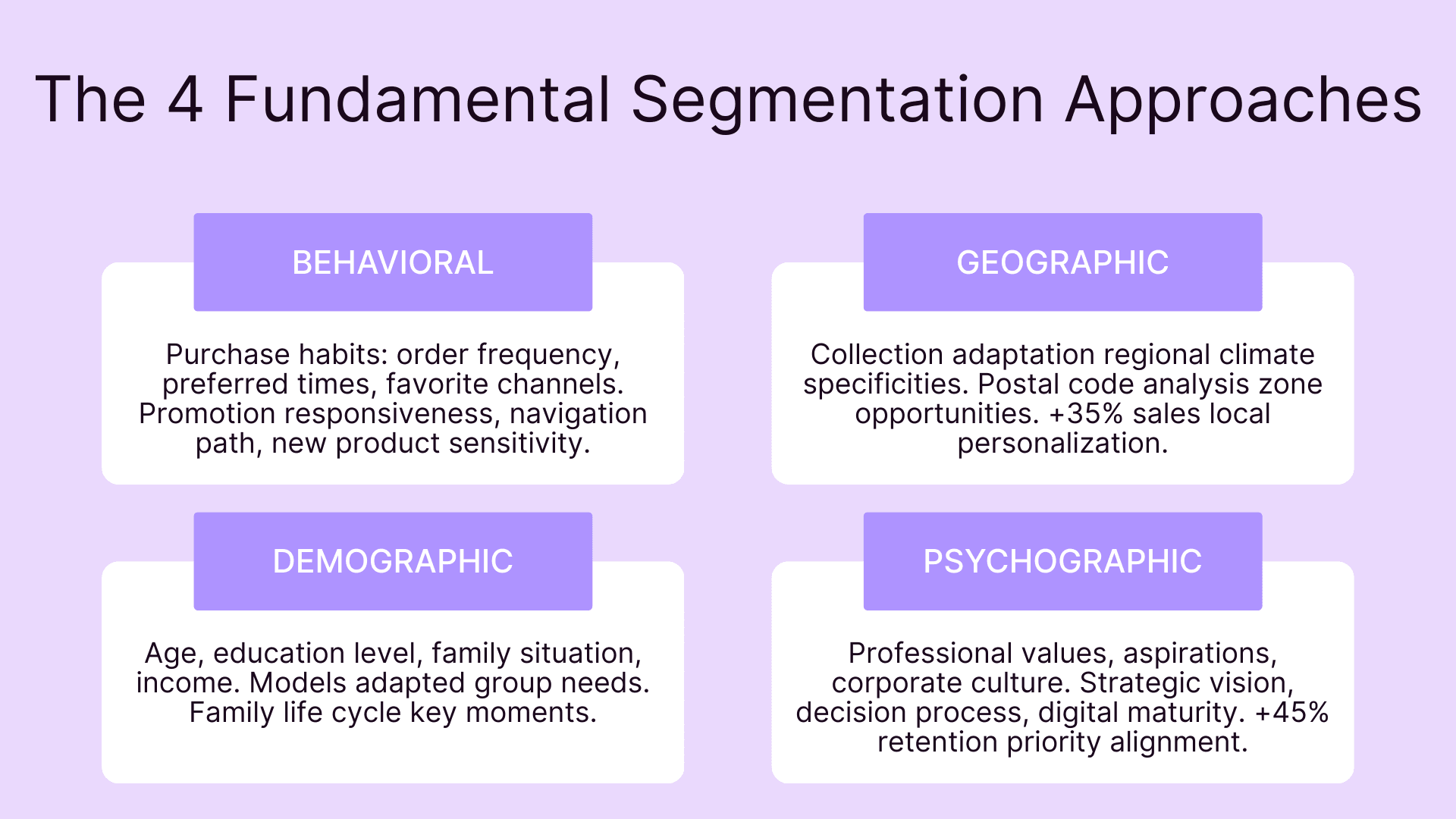
The 4 fundamental types of client segments
Behavioral segmentation
Behavioral segmentation analyzes your buyers' concrete actions to better anticipate their future needs. Purchasing habits reveal valuable patterns: order frequency, preferred times, favorite channels.
A telling example: an office supplies company identified that 40% of its clientele systematically ordered Monday mornings. This observation allowed adapting inventory and sending targeted reminders on Fridays.
Behavioral criteria include:
- Responsiveness to promotions
- Website navigation path
- Preferred payment methods
- Sensitivity to new products
This approach transforms your usage data into personalized marketing action levers.
Geographic segmentation
Geographic segmentation places location at the heart of your sales strategy. A ready-to-wear brand increased its sales by 35% by adapting its collections to each region's climatic specificities.
Postal code analysis reveals unsuspected opportunities. A restaurant chain discovered high-potential areas by crossing demographic data and commercial density. This approach guided opening three new profitable locations from the first year.
Geographic criteria also enrich marketing message personalization. A service company boosted its engagement rate by 28% by modulating its communications according to local cultural particularities and consumption habits specific to each territory.
Demographic segmentation
Demographic segmentation groups your clients based on their personal characteristics. A connected watch manufacturer redirected its range by creating models adapted to each age group's specific needs.
Education level and family situation directly influence purchasing decisions. A furniture brand developed targeted collections for young urban educated parents, with remarkable success on social media.
Considering income refines your pricing strategy. A financial services company now offers modular packages according to each segment's budget capacity, multiplying conversions on its marketing campaigns.
Family life cycle analysis transforms message personalization. A decoration retailer adapts its communications to key moments: first home, family expansion, moving.
Psychographic segmentation
Psychographic segmentation analyzes your B2B buyers' deep motivations. This approach reveals their professional values, aspirations, and corporate culture. A digital services company increased its retention rate by 45% by aligning its messages with clients' environmental priorities.
Essential psychographic factors include:
- Strategic vision and growth objectives
- Innovation and agility values
- Decision-making process
- Management culture
A consulting firm transformed its sales approach by creating buying journeys based on prospects' digital maturity. This strategy generated a 30% increase in contract signatures on major accounts.
RFM methodology: optimize your segmentation
Definition and principles of the RFM model
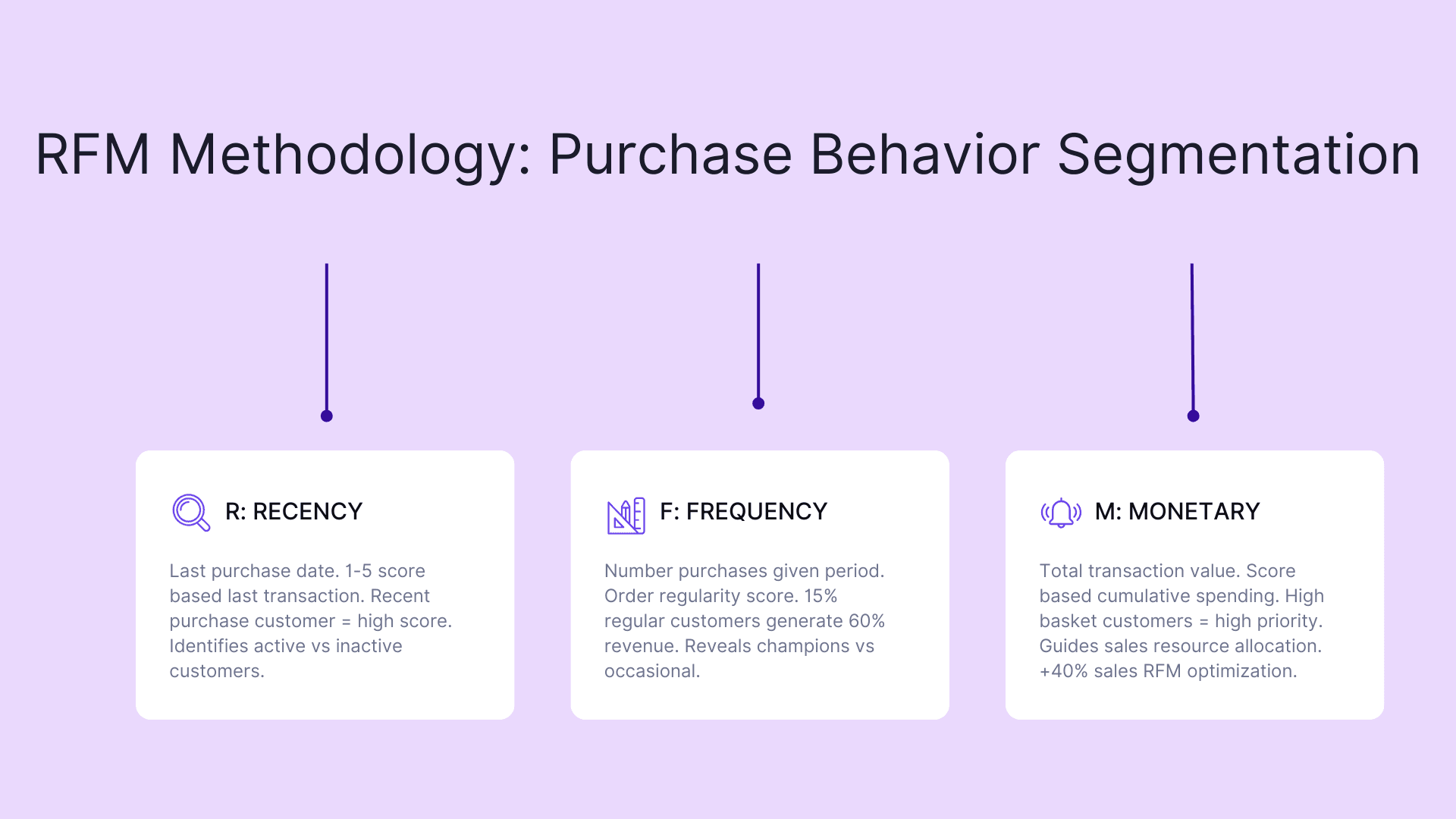
The RFM model represents a segmentation methodology based on three fundamental pillars of purchasing behavior: Recency (last purchase date), Frequency (number of purchases over a period), and Monetary (total transaction value).
This method transforms your client data into actionable segments through precise scoring. A customer who made a recent purchase, orders regularly, and spends large amounts will obtain a high score. Conversely, an occasional buyer with small amounts will be classified differently.
RFM scoring offers a clear and objective vision of your client base. A restaurateur using it discovered that 15% of his regular customers generated 60% of his revenue. This revelation guided his marketing choices toward increased message personalization for each segment.
Implementing RFM analysis
Deploying RFM analysis begins with structured collection of transactional data. A cosmetics company succeeded in increasing its sales by 40% by following a precise calendar: monthly purchase extraction, classification by date and value, then attribution of R, F, and M scores on a 1 to 5 scale.
Project success relies on segment breakdown quality. A professional furniture manufacturer optimized its approach by defining thresholds adapted to its sales cycle: 3 months for recency, 4 annual purchases for frequency, $5,000 for monetary amount.
Process automation radically transforms results exploitation. A dashboard updated weekly allows quickly spotting behavior changes and adjusting sales actions in real time.
Interpreting RFM results
Exploiting RFM scores reveals client segments with distinct purchasing behaviors. In-depth analysis allows identifying champion customers, characterized by regular high-value purchases, and customers to reactivate, marked by recent activity decline.
Cross-reading the three RFM dimensions provides valuable insight into commercial dynamics. For example, a high Recency score but low Frequency signals a new high-potential customer requiring personalized support.
RFM indicators guide marketing action prioritization: loyalty programs for premium segments, reactivation offers for dormant customers, or upselling strategies for regular small-basket buyers.
Essential tools for segmentation
CRM solutions and databases
Modern CRM platforms excel at organizing and exploiting client data. A company can now create distinct groups according to multiple criteria: purchase history, digital interactions, or communication preferences.
Marketing task automation frees valuable time to refine your strategy. Customizable dashboards allow quickly visualizing trends by segment and adapting your sales actions in real time.
The best solutions also offer AI features to anticipate purchasing behaviors. For example, an automatic scoring system classifies your prospects according to their conversion potential, optimizing sales resource allocation.
Client analysis platforms
Advanced analysis solutions transform raw data into strategic insights for your segmentation. A service company optimized its conversions by 45% by exploiting predictive models to anticipate purchasing behaviors.
Current tools combine behavioral analysis and dynamic segmentation. For example, cross-channel journey tracking reveals friction points and optimization opportunities by segment.
Machine learning power now allows automatically identifying relevant micro-segments according to actual usage. An industrial manufacturer discovered an untapped segment representing 25% growth potential through weak signal analysis in its transactional data.
Data visualization tools
Interactive dashboards transform how you exploit your client segments. A sales director instantly visualizes purchasing trends by region through dynamic heat maps. Comparative charts reveal seasonal variations in purchasing behaviors.
Modern tools' power lies in their ability to create meaningful visual representations. An industrial SME reduced client base analysis time by 40% through flow diagrams that map each segment's purchasing journey.
Intuitive interfaces allow sales teams to adjust their visualizations without technical expertise. A marketing manager can switch between different views: age pyramid, geographic distribution, or purchase cycles, to adapt their strategy according to identified segments.
Applications by business sector
E-commerce segmentation
An online store's success relies on its ability to create relevant buyer groups. An e-commerce specialist in sports revolutionized its approach by classifying its visitors according to their practice level: beginner, intermediate, or expert.
This categorization allows instantly adapting its catalog and product recommendations. Beginners receive starter kits while experts discover the latest technical innovations.
Dynamic segmentation also transforms mobile experience. A fashion boutique adjusts its visuals and purchase funnel depending on whether the user browses from their smartphone during lunch break or evening from their tablet. This tailored approach naturally led to doubled mobile conversions.
Real estate approach
Real estate market reality requires precise demographic segmentation of potential buyers. A Parisian firm classifies its prospects according to their investment capacity, purchase timeline, and priority selection criteria.
This method allows adapting virtual and physical visits to specific needs. First-time buyers receive detailed information on assistance programs, while investors access personalized profitability analyses.
Geolocated segmentation makes perfect sense in this sector. A Southeast agency optimizes its proposals by crossing socio-demographic data by neighborhood with local market trends. Marketing messages precisely target each zone: suburban families, young downtown professionals, seniors seeking tranquility.
Restaurant strategy
Client segmentation revolutionizes customer experience in restaurants. A Parisian gourmet restaurant increased its occupancy rate by 35% by adapting its menus according to profiles: express business lunch at noon, extended tastings in the evening.
Behavior analysis transforms client relationships. Performing restaurants classify their guests by consumption moments: business lunches, romantic dinners, weekend family meals. This classification guides layout choices and staff training.
Marketing message personalization reinforces engagement. A modern bistro doubled its attendance through targeted communications: special event newsletters for group customers, promotional SMS for lunch regulars.
Automotive methods
The automotive sector applies multi-criteria segmentation adapted to market specificities. Performing dealers combine vehicle lifecycle analysis with owners' maintenance habits.
A premium manufacturer established buyer profiles based on usage: connected urbanites, traveling families, mobile entrepreneurs. This categorization allows anticipating after-sales service needs and personalizing equipment proposals.
Vehicle usage data enriches customer knowledge. Personalized messages adapt to key moments: warranty renewal, scheduled maintenance, or new model launch corresponding to driver criteria. This method reinforces loyalty throughout the ownership cycle.
Segment activation: winning strategies
Sales offer personalization
Offer personalization relies on deep understanding of each group's specific expectations. A rigorous client segmentation process allows refining your sales proposals according to your buyers' unique characteristics.
Through segmentation, you adapt your solutions to each category's real challenges. For example, an IT services provider modulates its support packages according to prospects' digital maturity and transformation objectives.
Success lies in your ability to reach customers at the right time with a tailored proposal. A professional training company developed a modular catalog where each module addresses a segment's precise challenges: technical skill development, management development, or regulatory certification.
Communication adaptation
Fine analysis of client segmentation types radically transforms your message impact. An urban furniture brand revolutionized its communication by creating specific messages for each geographic zone, with visuals adapted to local cultures.
Relationship management also evolves according to information consumption preferences. Executive managers prefer short email summaries in the morning, while technical teams appreciate detailed content they can consult at their own pace.
Your communication gains relevance when it aligns with your segments' business sectors. A software publisher adapts its newsletters: regulatory updates for lawyers, technological innovations for CIOs, ROI for financial decision-makers. This targeted approach naturally reinforces each group's engagement.
Customer journey optimization
Customer journey optimization begins with precise interaction mapping. A financial services company transformed its conversion rate by identifying decisive moments where its prospects hesitate before signing.
Sales channel synchronization reinforces the overall experience. A B2B distributor unified its touchpoints: its web portal now reflects the same information as its sales service, creating consistency appreciated by its professional buyers.
Customer feedback analysis reveals priority improvement areas. An industrial solutions brand implemented targeted questionnaires after each major interaction, allowing continuous refinement of its sales process and after-sales follow-up.
Measuring your segmentation effectiveness
Key performance indicators
Regular tracking of strategic KPIs guarantees performing segmentation. Measure engagement rate by segment to evaluate your marketing actions' relevance. A monthly dashboard allows tracking ROI by customer group.
Customer lifetime value (LTV) by segment reveals untapped growth opportunities. Also monitor conversion rate according to each group's characteristics to refine your targeting.
Adopt metrics specific to your activity: retention rate for recurring services, average basket for retail, or sales cycle duration in B2B. This data guides your strategic choices and validates your segmentation effectiveness.
Adjustments and continuous optimization
Segmentation success relies on your ability to evolve your approach. A quarterly audit allows identifying underperforming segments and those with untapped potential. For example, a service company discovered that a segment considered unpromising generated 40% of client recommendations.
Your sales teams' field feedback enriches your segment understanding. These daily observations often reveal improvement opportunities invisible in raw data. A software company thus adapted its offers after noticing certain clients used its products unexpectedly.
Market dynamics regularly transform purchasing behaviors. Stay alert to weak signals: usage evolution, new expressed needs, or decision process changes. These continuous adjustments guarantee your segmentation's lasting relevance.
Common mistakes to avoid
Over-segmentation represents a classic trap. Multiplying micro-segments makes your strategy unmanageable and dilutes your marketing resources. A tech company gained 45% efficiency by merging its 12 segments into 4 targeted groups.
Lack of data updates hampers your performance. Purchasing behaviors evolve rapidly. A textile brand lost 30% of its revenue by maintaining obsolete segmentation for 18 months.
Two other major pitfalls deserve your attention:
- Segment rigidity that prevents adaptation to behavior changes
- Exclusive use of quantitative data without considering qualitative feedback
Successful segmentation remains flexible and relies on a balanced mix of numerical data and field observations.
Frequently asked questions
What are the main criteria types for effectively segmenting your clientele?
Behavioral criteria (purchasing habits), geographic, demographic (age, income), and psychographic (values, lifestyle) are the main segmentation types.
How is the RFM method (Recency, Frequency, Monetary) useful for client segmentation?
It allows you to focus resources on the most profitable segments, personalize marketing messages, and better meet each group's specific needs.
How can you effectively activate client segments once they're defined?
Yes, segmentation must be regularly reviewed (at least annually) to adapt to market changes, new trends, and shifts in consumer behavior.