
The fundamentals of sales performance
Definition and business challenges
Sales performance measures an organization's ability to generate revenue while optimizing its resources. Studies show that in 2025, 65% of B2B companies consider it their number one development priority.
Today's market demands a structured approach combining three essential dimensions: operational excellence, customer satisfaction, and profitability. Companies that master these aspects show conversion rates 40% higher than the market average.
A high-performing strategy relies on precise indicators: sales volume, closing rate, customer satisfaction. The key lies in the balance between ambitious objectives and the means deployed to achieve them.
The different types of performance to master
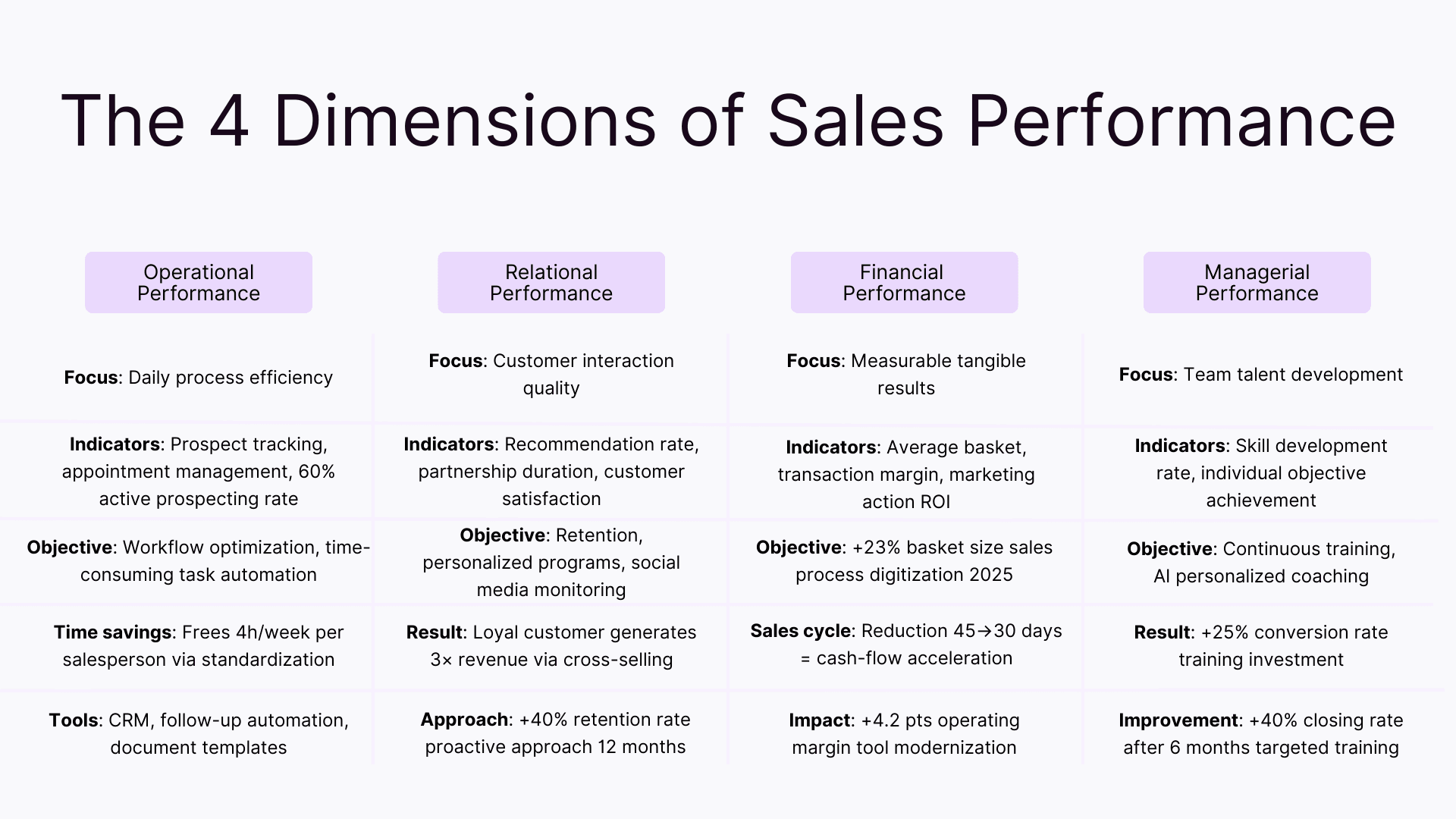
The success of a sales team relies on four key areas. Operational performance measures the efficiency of daily processes like prospect tracking and appointment management.
Relational performance evaluates the quality of interactions with clients, particularly through recommendation rates and partnership duration.
Financial performance analyzes tangible results: average basket, margin per transaction, and marketing action profitability.
Managerial performance examines the ability to develop talent, with indicators like skill development rate and individual objective achievement. A balanced dashboard integrates these four dimensions for a complete view of results.
Impact on financial growth
An optimized sales strategy generates measurable financial results. Companies that digitized their sales processes in 2025 show an average increase in basket size of 23%.
Reducing the sales cycle from 45 to 30 days through sales proposal automation frees up cash flow and accelerates capital turnover. Teams gain in productivity: a salesperson now spends 65% of their time on high-value activities.
Improving the conversion rate, combined with reducing customer acquisition costs, directly boosts operating margin. An average gain of 4.2 points was observed among B2B companies that modernized their sales tools.
The 4 essential pillars of sales excellence
Sales organization and processes
Building an efficient sales system relies on a clearly defined action sequence. An initial diagnostic identifies the strengths and weaknesses of your current organization.
High-performing teams standardize their methods with precise workflows: lead qualification, personalized follow-up, structured proposals. Using tools like LinkedIn Sales Navigator facilitates targeted prospecting by industry sector.
Reducing time-consuming tasks involves workflow automation: automatic follow-ups, pre-established document templates, calendar synchronization. An approach that frees up to 4 hours per week for each salesperson.
The manager plays a central role in aligning processes with the overall strategy. Their mission: guide their teams toward operational excellence through regular monitoring of key indicators.
Human capital and continuous training
Skill development represents a key success factor for sales teams in 2025. Data from the Edflex barometer reveals that 58% of salespeople take training to optimize their field performance.
Continuous learning is structured around three major axes: advanced sales techniques, digital tool mastery, and soft skills development. Companies that invest in these areas observe an average 25% increase in conversion rate.
Personalized coaching gains ground with the emergence of artificial intelligence. This approach allows precise identification of individual needs and real-time adaptation of training paths. The results speak for themselves: 40% improvement in closing rate after 6 months of targeted training.
Technologies and digital tools
Digital transformation revolutionizes the sales approach in 2026. Automation solutions free teams from repetitive administrative tasks, allowing them to dedicate more time to high-value customer interactions.
Modern CRM platforms now integrate artificial intelligence features to analyze purchasing behaviors and suggest the best sales actions. For example, automated lead scoring allows quick identification of the most promising prospects.
Sales proposal creation and management tools are improving, combining advanced personalization and predictive analytics to maximize signing chances. An integrated scoring system guides salespeople toward best practices, significantly reducing sales cycle duration.
Customer relationship and retention
Building a successful retention strategy relies on deep understanding of customer expectations. 2025 market data shows that a loyal customer generates 3 times higher revenue through cross-selling opportunities.
High-performing brands focus on personalized programs: digital loyalty cards, customized rewards, and exclusive benefits. A system that values each interaction and strengthens long-term engagement.
Implementing regular monitoring via social networks and satisfaction surveys allows anticipating needs and quickly adapting offerings. Companies adopting this proactive approach see a 40% increase in retention rate over 12 months.
How to effectively measure your results?
Essential sales KPIs
Precise performance measurement involves tracking four key indicators in 2026. The conversion rate qualifies sales process efficiency, with a B2B sector average of 27%. Average basket analysis reveals value created per transaction.
The sales cycle deserves particular attention: its average duration of 45 days can be optimized through good closing practices. Rigorous tracking of active prospecting rate, ideally maintained at 60% of sales time, ensures a robust pipeline.
High-performing companies also monitor:
- Gross margin per customer
- Customer acquisition cost
- Customer lifetime value (LTV)
- 12-month retention rate
Calculating ROI of your sales actions
The return on investment formula is simple: (Benefits - Costs) / Costs x 100. A salesperson who invests $5,000 in a trade show and generates $15,000 in sales achieves a 200% ROI.
ROI measurement requires rigorous tracking of marketing and sales expenses. Every dollar invested in tools, travel, or training must be precisely accounted for.
Modern analysis tools facilitate this calculation by automating sales data collection. A centralized dashboard allows quick visualization of each sales action's profitability, from cold calling to email campaigns.
Dashboard: metrics to track
Creating an effective dashboard starts with clear data organization. Prefer a 3-level structure: daily activities, strategic objectives, and financial results. A maximum of 8 indicators per page ensures quick reading and facilitated decision-making.
Using dynamic charts strengthens trend understanding. For example, a colored gauge allows instant visualization of target market share achievement. For the performance department, an automatic alert system signals significant deviations requiring immediate action.
Distribute your metrics according to their analysis frequency: daily for signed revenue, weekly for customer relationships, monthly for variable compensation. This structured approach optimizes sales management and promotes good sales performance.
Performance improvement levers
Sales cycle optimization
Reducing conversion time represents a major lever to accelerate your sales in 2026. Thorough analysis of each stage identifies bottlenecks that slow your sales process.
High-performing sales directors precisely map their sales funnel, from first contact to purchase decision. This method reveals friction zones and automation opportunities, particularly on low-value tasks.
Integration of innovations like HubSpot facilitates prospect qualification and action synchronization between teams. Companies adopting this approach reduce their sales cycle by 35% on average.
Team management and motivation
A sales strategy's success relies on the manager's ability to create a stimulating environment. Inspiring leadership involves recognizing individual talents and valuing collective successes.
Implementing team rituals strengthens cohesion: dynamic morning meetings, victory celebrations, experience sharing. These unifying moments transform daily challenges into progression opportunities.
Personalized support of salespeople constitutes a major success key. The manager adapts their coaching style according to profiles: some thrive in competition, others seek technical excellence or recognition. This tailored approach maximizes each collaborator's potential.
Sales process digitization
Digital transformation of sales processes requires a structured methodology. Phone numbers and customer contacts, previously scattered, now centralize in a unified database. This centralization guarantees optimal customer follow-up and better team coordination.
Implementing modern digital tools allows performance optimization at each customer journey stage. Companies see an average 25% increase in their conversion rate through administrative task automation.
Subsequently, analyzing collected data reveals valuable behavioral patterns. This deep understanding guides salespeople toward the most relevant actions, maximizing each customer interaction's impact.
Performance diagnosis and analysis
Evaluating sales action quality
Qualitative analysis of sales actions requires a structured methodology. Creating a multi-criteria evaluation grid allows objective scoring of each initiative according to its customer impact, profitability, and strategic alignment.
A simple scoring system, on a 1-to-5 scale, facilitates comparison between different actions. Key criteria include measured customer satisfaction, generated recommendation rate, and perceived added value relative to mobilized resources.
To guarantee reliable results, combine quantitative data and qualitative feedback. For example, associate new signed contracts with customer verbatims collected during satisfaction interviews. This dual reading enriches your understanding and guides future decisions.
Identifying priority improvement areas
The impact/effort matrix constitutes a powerful tool to prioritize your sales improvement areas. Classify each opportunity according to its potential impact on results and the effort required for implementation.
Prioritize "quick wins" first: high impact and low effort. For example, standardizing sales proposal templates can quickly increase your conversion rate by 15%.
Monthly sales interview audits identify recurring friction points. Focus on the three major obstacles that most often prevent signing: poorly mastered price arguments, poorly personalized sales proposals, or insufficient post-meeting follow-up.
Creating a 90-day optimization roadmap with precise and measurable objectives transforms these improvement areas into concrete action plans.
Implementing regular monitoring
The key to high-performing sales management lies in the regularity of control points. A weekly rhythm allows analyzing essential indicators and quickly adjusting field actions.
30-minute flash meetings every Monday morning energize results tracking. This sustained pace maintains team motivation and facilitates early detection of performance deviations.
A real-time updated dynamic dashboard simplifies daily monitoring. Managers save precious time by automating data collection and can dedicate more energy to personalized support of their salespeople.
Implementing monthly in-depth analysis rituals completes this system. These sessions evaluate corrective action impact and refine sales strategy.
Winning strategies for 2025
Artificial intelligence in sales service
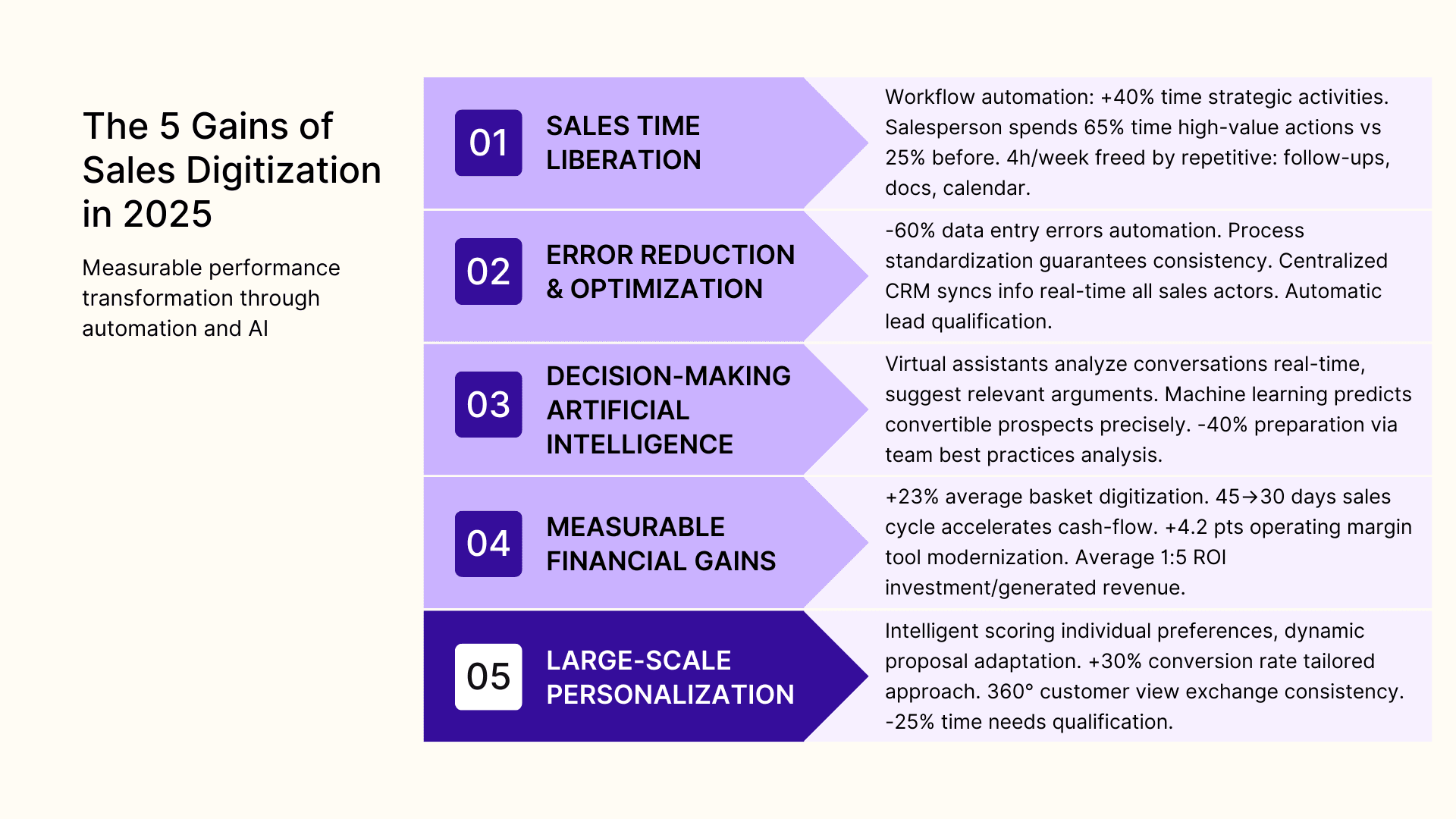
The AI revolution radically transforms the sales approach in 2026. Augmented virtual assistants now analyze customer conversations in real-time, suggesting relevant arguments and adapting sales discourse according to detected reactions.
Machine learning also revolutionizes lead qualification. By cross-referencing behavioral data with sales history, these technologies precisely predict prospects most likely to convert.
A salesperson equipped with modern AI tools reduces preparation time by 40% while personalizing each proposal. This technology analyzes team best practices and provides concrete recommendations to maximize signing chances.
Personalization and customer-centric approach
Advanced personalization of sales interactions becomes a major differentiating factor in 2026. High-performing companies adopt a proactive listening strategy, analyzing each touchpoint to better understand their clients' specific challenges.
An intelligent scoring system identifies individual preferences and dynamically adapts sales proposals. Results are convincing: an average 30% increase in conversion rate for teams implementing this tailored approach.
Creating a unified customer repository facilitates information sharing between different departments. This 360° view guarantees consistency in exchanges and strengthens sales recommendation relevance. Companies see a 25% reduction in time needed to precisely qualify each prospect's needs.
Time-consuming task automation
Sales process simplification becomes a strategic challenge in 2025. Sales teams still spend 40% of their time on administrative tasks. Automating follow-ups, prospect tracking, and document creation frees precious time.
A salesperson adopting automation tools reduces time spent on repetitive tasks by 75%. Automated sales proposal creation generates professional documents in minutes instead of an hour.
Measurable automation benefits manifest quickly:
- 60% reduction in data entry errors
- 3x multiplication of contacted prospects
- Standardization of sales best practices
Mistakes to avoid for success
Common sales management pitfalls
Effective sales management requires a balanced approach. The first pitfall consists of setting objectives disconnected from field reality. A manager must adapt expectations to the economic context and available resources.
Excessive micromanagement represents another major trap. Monitoring every salesperson action limits their autonomy and hinders their development. The key lies in constructive support that values initiatives.
Poor communication also undermines team dynamics. Vague or contradictory briefings create confusion and demotivation. The solution involves structured exchanges and clearly defined expectations.
Poor indicator usage
Multiplying KPIs without prioritization harms decision-making. A sales team overwhelmed by more than 15 indicators loses an average of 3 hours per week analyzing irrelevant data.
Another frequent pitfall: exclusively tracking quantitative metrics. Companies neglecting qualitative indicators like customer satisfaction or interaction quality miss 40% of improvement opportunities.
Absence of SMART objectives for each KPI makes their interpretation hazardous. An optimal dashboard limits itself to 5-7 key indicators, each associated with a precise alert threshold and predefined corrective action. This targeted approach increases team reactivity to performance deviations by 25%.
Digital change resistance
Sales process digital transformation regularly encounters team apprehensions. A recent study reveals that 75% of blockages stem from lack of support rather than real technology opposition.
Successful digital tool adoption relies on three key factors. First, personalized training that respects each person's learning pace. Then, valuing first successes, even modest ones, to create positive momentum. Finally, implementing a mentoring system where advanced users share their experience.
Concrete demonstration of individual benefits often transforms reluctance into adherence. A salesperson having adopted new tools gains an average of 90 minutes per day on administrative tasks.
Tools and solutions for performance
CRM and sales management solutions
A modern CRM facilitates customer data centralization and accelerates sales decision-making. Its strength lies in its ability to synchronize information in real-time between all sales actors.
Current platforms integrate advanced features like automatic lead qualification or purchase behavior prediction. For example, a salesperson can instantly visualize complete interaction history with a prospect and receive personalized action suggestions.
To maximize usage, prioritize solutions that adapt to your existing sales process. A customizable dashboard, configurable alerts, and optimized mobile interface guarantee better team adoption.
Analysis and reporting software
Advanced analysis solutions transform your raw sales data into exploitable dashboards. Microsoft Power BI and Tableau stand out for their ability to create dynamic visualizations that reveal hidden trends in your results.
These tools' power lies in their adaptability. A sales director can analyze performance by region, product, or salesperson with a few clicks. Teams gain an average of 4 hours per week through automatic report generation.
For successful deployment, prioritize a progressive approach. Start with essential indicators like conversion rate and sales cycle. Then add more sophisticated analyses according to your teams' needs.
Continuous training platforms
Modern learning platforms revolutionize sales team skill development. These digital environments offer personalized paths that adapt to each salesperson's pace and level.
A microlearning system allows quick acquisition of sales techniques through short 5-to-15-minute modules. Salespeople can strengthen their skills between two appointments, directly from their smartphone.
Collaborative features enrich the experience: help forums, video coaching sessions, best practice sharing. An approach that stimulates engagement and accelerates knowledge acquisition.
Progress measurement happens in real-time via role-playing and interactive quizzes. Managers precisely visualize areas mastered by their teams.
Building an effective sales team
Talent recruitment and integration
Sales success relies on a recruitment strategy adapted to 2026 challenges. High-performing companies prioritize a mixed approach, combining technical skill evaluation and essential soft skills analysis for modern sales.
Successful integration of a new salesperson involves a structured 90-day journey. The first phase focuses on product mastery and internal processes. The second develops sales techniques specific to your market. The last stage empowers the salesperson with their first objectives.
A mentoring program, pairing each recruit with an experienced salesperson, accelerates best practice acquisition. This approach reduces the time needed to reach optimal performance by 40%.
Training and skill development
Sales expertise advancement requires a learning strategy adapted to 2026 challenges. Short micro-training modules allow quick acquisition of targeted sales techniques between client appointments.
A personalized plan alternates practical sessions and real-life simulations to maximize knowledge assimilation. Salespeople strengthen their negotiation techniques through immersive virtual reality exercises.
Progress measurement relies on regular evaluations via filmed sales simulations. This method reveals an average 30% progression in conversion rates after 3 months of intensive training.
Creating a performance culture
Implementing a performance culture relies on a subtle balance between demands and benevolence. A transparent recognition system values individual and collective successes through weekly victory celebration rituals.
Best practice sharing becomes natural through structured exchange sessions where each salesperson presents their successes. This collaborative dynamic strengthens team cohesion and accelerates winning strategy diffusion.
A stimulating environment builds around creative challenges that go beyond simple numerical objectives. Salespeople develop their expertise by participating in co-development workshops where they analyze complex cases together.
Frequently asked questions
What are the key indicators (KPIs) for measuring sales performance?
Conversion rate, average basket, sales cycle duration, customer acquisition cost (CAC), and customer lifetime value (LTV) are among the most critical.
How can digitization improve sales performance?
By analyzing trends, identifying underperforming areas, setting benchmarks, and using data to make informed decisions about strategy adjustments and resource allocation.
What is the manager's role in improving their team's sales performance?
Monthly review is recommended for tactical adjustments, with quarterly deep-dive analyses for strategic decisions. Real-time monitoring is ideal for fast-moving metrics.