
What Is the Strategic Role of a Sales Engineer?
The Sales Engineer is positioned as a key decision-maker in a company's growth. With a 360° view of business challenges, they transform market opportunities into concrete advantages for their organization.
Their dual expertise allows them to quickly identify high-potential projects and allocate resources optimally. A clear example: in the renewable energy sector, they anticipate future customer needs to design innovative and profitable offers.
This ability to combine strategic vision with operational pragmatism makes them a true architect of business development. They actively participate in investment choices and guide the company's innovation policy.
The Key Day-to-Day Missions of a Sales Engineer
Business Development and Key Account Management
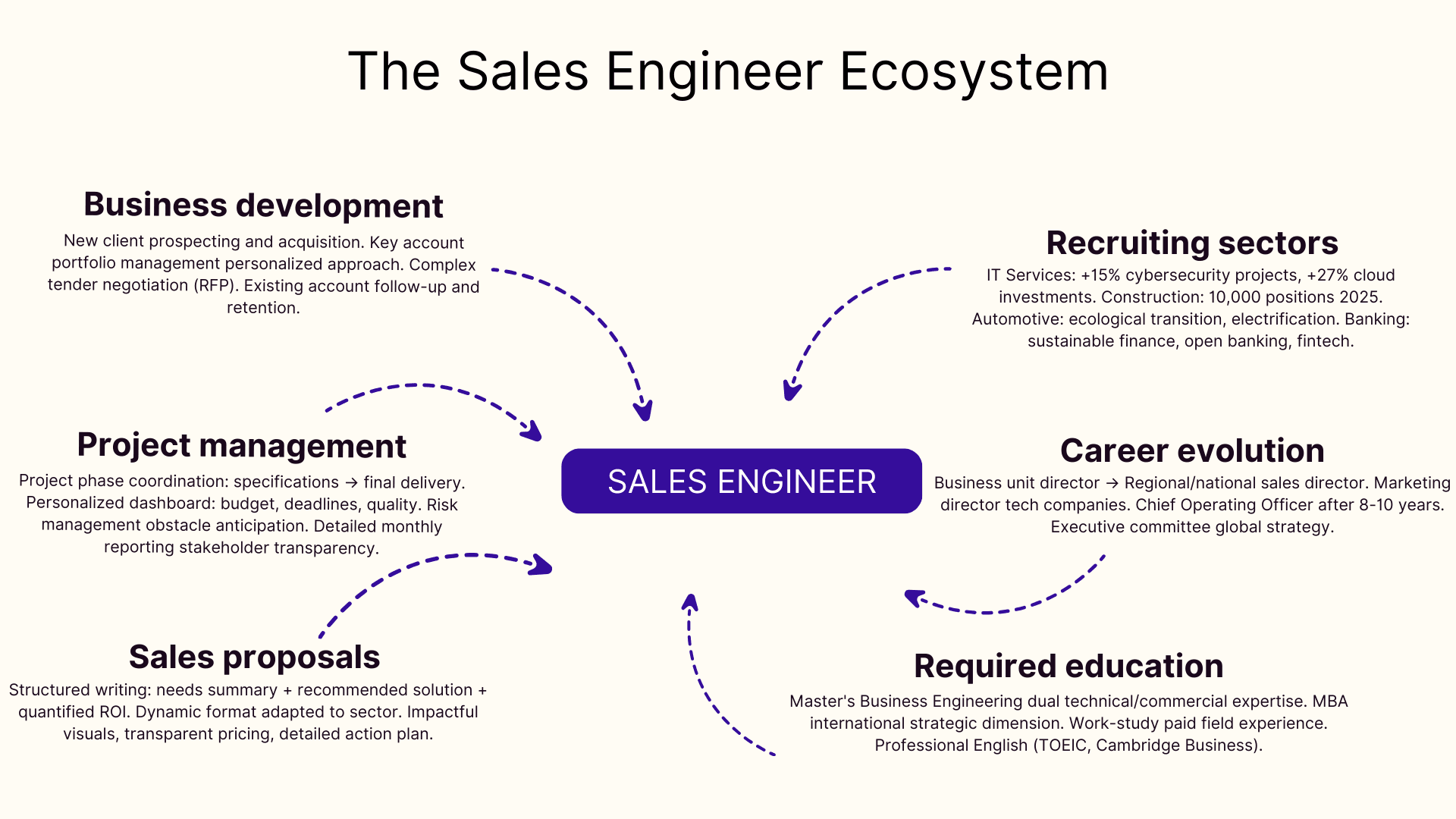
Prospecting and acquiring new customers are at the heart of the job. A portfolio of key accounts requires a personalized approach: the Sales Engineer analyzes the specific needs of each company to offer suitable solutions.
Mastery of negotiation techniques is essential when managing complex tenders (RFPs). For example, during an industrial equipment project, the Sales Engineer coordinates the technical and commercial teams to build a relevant offer.
Monitoring and retaining existing accounts is another major focus. The goal: to maximize revenue while maintaining a lasting relationship of trust with key decision-makers.
Project Management and Customer Follow-up
The success of a project relies on a structured methodology and effective tracking tools. The Sales Engineer coordinates the various project phases, from the initial specifications to the final delivery.
A personalized dashboard allows for tracking key indicators: budget, deadlines, and quality. For example, in a digital transformation project, regular checkpoints with the client ensure alignment between their expectations and the project's execution.
Risk management plays a central role. Anticipating potential obstacles, such as supplier delays or scope changes, allows for quick adjustments to the project's trajectory. Detailed monthly reporting maintains transparency with all stakeholders.
Developing Sales Proposals
Drafting a sales proposal requires a strategic approach that combines clarity and personalization. A structured document first presents a summary of the identified needs, then details the recommended solution with its measurable benefits.
The art lies in building a compelling argument that demonstrates the unique added value of your solution. A winning proposal is based on differentiating elements: industry references, case studies, and a quantified return on investment.
Best practices include:
- A dynamic format adapted to the industry
- Impactful visuals to illustrate key points
- Transparent and justified pricing
- A detailed action plan with implementation steps
Education to Succeed as a Sales Engineer
Master's Degrees and MBAs in Business Engineering
Master's level education is the royal road to this demanding profession. A Master's in Business Engineering develops dual technical and commercial expertise, with courses focused on complex negotiation and project management.
An MBA provides an additional international and strategic dimension, which is particularly sought after by large corporations. The average starting salary is $45,000 gross per year, potentially rising to $55,000 with an industry specialization.
The most recognized programs include practical modules: negotiation simulations, real-life case studies, and corporate projects. Selection is based on application review and interviews, with special attention paid to internships and initial professional experiences.
Work-Study Programs and Specialized Training
A work-study program (or apprenticeship) is an excellent path to becoming a Sales Engineer. This format allows students to gain valuable field experience while being paid. A typical schedule alternates one week of training with three weeks at the company.
Specialized programs stand out for their industry focus: cybersecurity, renewable energy, or cloud solutions. These specializations meet the growing needs of companies in 2026. A student in a work-study program in the tech sector, for example, can directly participate in prospecting and negotiation phases with clients.
Schools offer strong corporate partnerships, facilitating professional integration. The search for a work-study position is ideally conducted between February and May for a September start, with possibilities for deferred entry in January.
Importance of English Proficiency
Proficiency in English is a differentiating asset in a Sales Engineer's career. This language skill allows them to negotiate directly with international clients and manage cross-border projects.
The expected level goes beyond simple conversational English. A Sales Engineer must master the technical vocabulary specific to their sector and understand cultural nuances in negotiations. For example, presenting a cloud solution to an English-speaking client requires a perfect command of technological jargon.
Companies particularly value professional certifications like TOEIC or Cambridge Business English. These qualifications attest to a real ability to operate in an English-speaking professional environment.
Salaries and Career Prospects for Sales Engineers
Compensation Based on Experience and Sector
A Sales Engineer's salary evolves significantly with experience. A junior profile starts at $40,000 gross per year, while after 3 years of expertise, the package reaches $60,000 to $70,000.
Senior professionals with more than 5 years of experience earn between $80,000 and $90,000 annually. The technology sector offers the best prospects, with salaries that can exceed $100,000 for experts.
The variable portion represents 20% to 30% of the total salary, based on sales objectives. Large groups offer additional benefits: a company car, phone, and premium health insurance.

Evolution Toward Management Positions
A Sales Engineer's natural career progression leads to strategic roles within the company. A classic path begins with managing a business unit, before moving on to regional and then national sales director responsibilities.
Marketing director positions are another popular route, particularly in tech companies where a technical understanding of products is crucial. The Chief Operating Officer role also attracts Sales Engineers due to their dual technical and commercial expertise.
Appointment to the executive committee generally occurs after 8 to 10 years of successful experience. These positions require a deep understanding of business challenges and the ability to define the company's overall strategy.
Sectors That Recruit Sales Engineers
IT Services Companies in High Growth
The digital services market is undergoing a major transformation in 2026. IT services companies are adapting their offerings toward artificial intelligence and cloud computing, creating new opportunities for Sales Engineers.
The sector shows promising dynamics in specific areas: cybersecurity is seeing a +15% increase in projects, while cloud solutions attract 27% of investments. A Sales Engineer specializing in these technologies can negotiate high-value assignments.
Digital startups are particularly looking for business developer profiles who can understand technical challenges. For example, selling AI solutions today requires a dual skill set: strategic vision and an understanding of business use cases.
Construction and Automotive Industry
The construction market offers substantial opportunities, with 10,000 positions to be filled in 2025 among major industry players. Automakers are looking for Sales Engineers who understand the challenges of the ecological transition and vehicle electrification.
Technical design offices value dual skills: technical expertise in sustainable construction and sales talent. A Sales Engineer in the automotive industry, for example, must know how to present the advantages of new composite materials to decision-makers.
The average salary in these sectors reaches $75,000 per year for a profile with 5 years of experience. Large construction groups offer packages including profit-sharing and a thirteenth-month bonus.
Banking and Financial Services
The digital transformation of the banking sector is creating strong demand for specialized Sales Engineers. Sustainable finance and open banking are generating exciting missions, requiring dual technical and regulatory expertise.
Financial institutions particularly value profiles with expertise in artificial intelligence applied to banking services. A concrete example: selling algorithmic trading solutions requires a deep understanding of financial markets.
Investment banking offers attractive packages starting at $70,000 for juniors, which can reach $120,000 with bonuses for fintech experts. Fintechs, in full expansion, are actively seeking talent capable of supporting their international growth.
Frequently asked questions
What is the main difference between a traditional salesperson and a Sales Engineer?
The Sales Engineer has strong technical expertise that allows them to handle complex technical questions, design tailored solutions, and support the salesperson during technical demonstrations.
What type of education is generally preferred to become a Sales Engineer?
They typically need a combination of engineering/technical education and sales skills, often with experience in both technical and commercial roles.
In which sectors does a Sales Engineer find the most professional opportunities?
They bridge the gap between client technical requirements and the sales team, providing technical credibility, conducting demos, and helping craft solutions that meet specific needs.