
The fundamentals of sales enablement in business
The strategic role of sales enablement
Implementing a sales enablement program radically transforms commercial organization. This structured approach allows companies to precisely identify their teams' needs and respond with tailored solutions.
A compelling example: a tech company reduced administrative task time by 30% through automated sales reporting. Sales reps can now focus on high-value interactions with their prospects.
The sales enablement manager orchestrates this transformation by creating synergies between different departments. Their expertise ensures coherent resource deployment and progressive team skill development.
Process standardization and real-time access to relevant data allow salespeople to quickly adapt their approach based on field feedback.
The pillars of a successful sales enablement strategy
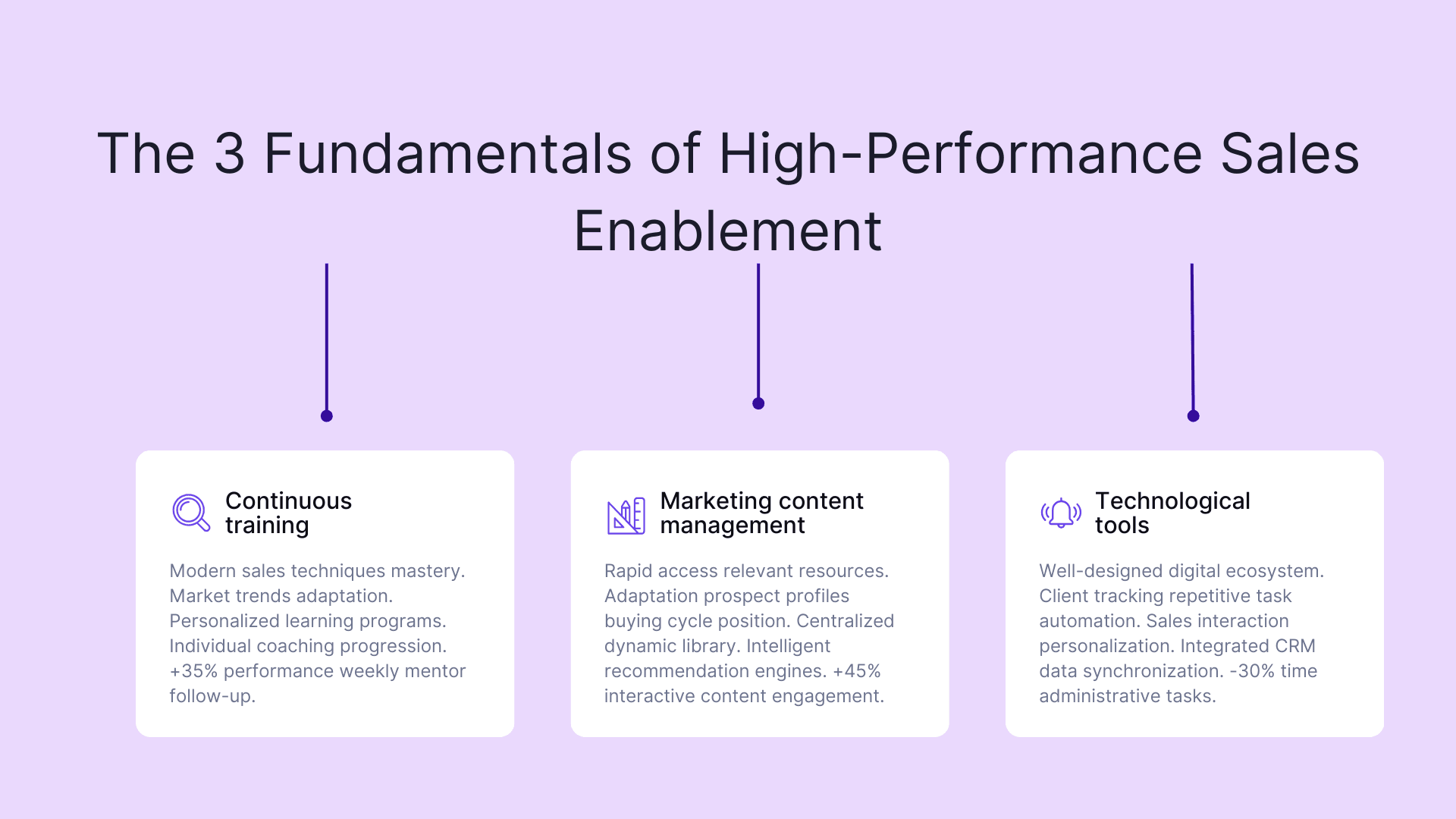
A high-performing sales enablement approach rests on three inseparable fundamentals. Continuous training forms the first pillar: it ensures mastery of modern sales techniques and adaptation to market trends.
The second pillar revolves around intelligent marketing content management. Sales teams quickly access relevant resources based on prospect profiles and their position in the buying cycle.
The third pillar relies on using technological tools. A well-designed digital ecosystem facilitates client tracking, automates repetitive tasks, and enables deep personalization of sales interactions. These three pillars work in symbiosis to maximize the impact of field sales activities.
Impact on sales performance
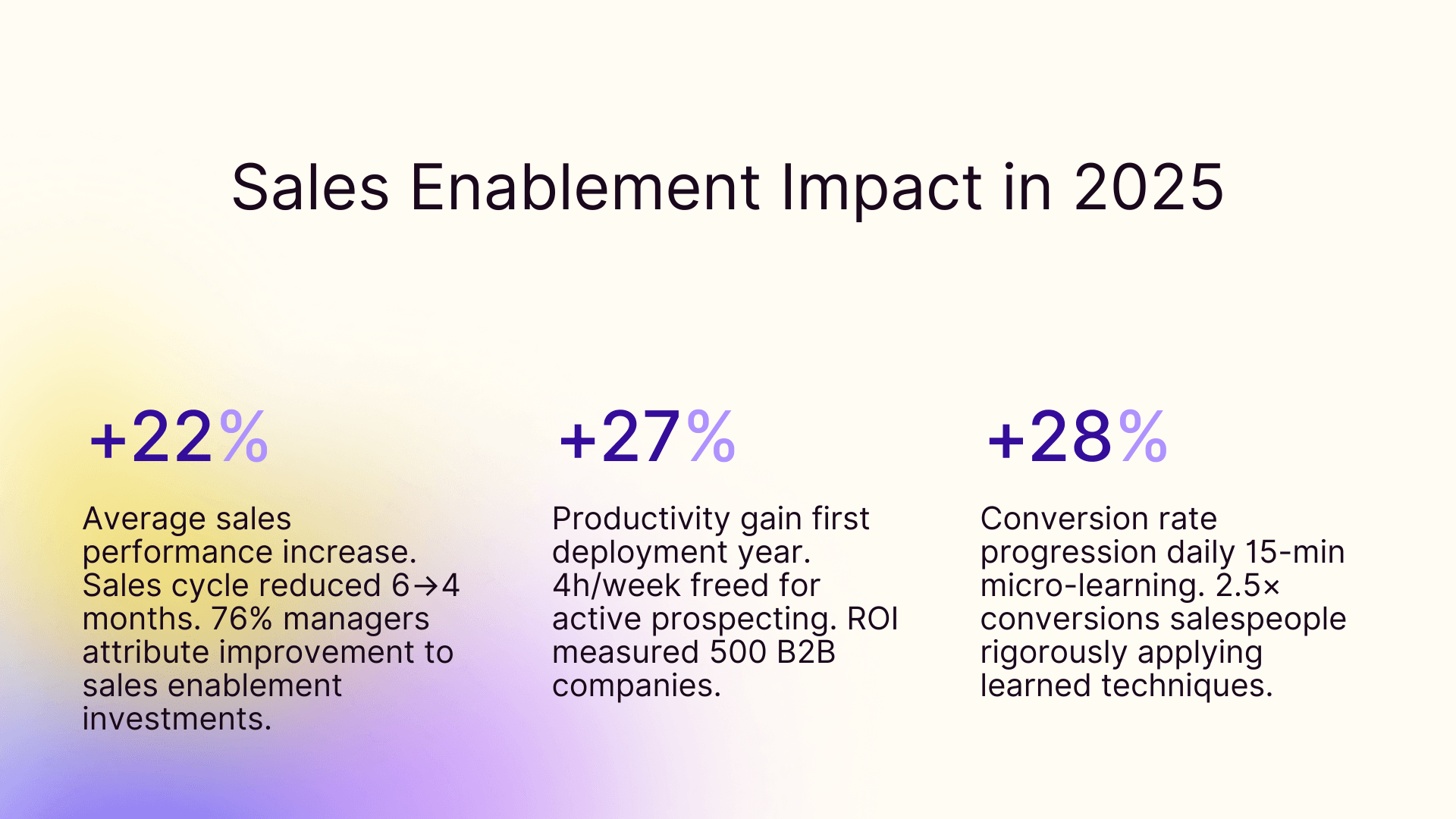
Companies deploying a sales enablement strategy see an average 22% increase in their sales performance. This progression is explained by a notable reduction in sales cycles, dropping from 6 to 4 months on average.
Implementing personalized coaching radically transforms team results. A recent study shows that 76% of sales managers directly attribute their performance improvements to their sales enablement investments.
Administrative task automation frees up to 30% of sales reps' time, allowing them to refocus on active prospecting and client relationships. This optimization translates into a significant boost in conversion rates, achieving 15 to 25% growth depending on the industry sector.
The benefits of a sales enablement approach
Sales cycle optimization
Teams equipped with a sales enablement strategy shorten their closing timelines through a structured approach. Personalized prospect guidance at each stage accelerates their decision-making.
A French SaaS company reduced the average duration between first contact and signature by 45% by equipping their sales reps with tools tailored to each prospect's specific needs.
Targeted content plays a determining role in this acceleration. Personalized presentations, case studies, and automated email sequences allow buyers to advance more quickly in their purchasing process. The CRM centralizes these resources for optimal use at the right moment.
Improved conversion rates
Companies adopting sales enablement see remarkable progression in their sales results. Precise tracking of client interactions reveals key moments in the buying journey where conversion accelerates.
Implementing behavioral analysis tools provides valuable insights into prospect expectations. This data guides the creation of content adapted to each sales funnel stage, maximizing transformation chances.
Sales team coaching takes on a new dimension with analysis of winning conversations. Salespeople learn to spot and leverage buying signals, while automation of repetitive tasks frees up time to focus on high-potential opportunities.
Strengthening sales-marketing alignment
Synergy between marketing and sales teams relies on well-defined collaborative processes. Weekly meetings allow sales reps to share their field feedback, guiding relevant content creation by marketing.
A shared dashboard centralizes both teams' objectives and results. This transparency reinforces their mutual commitment to collective success. For example, a B2B company established monthly sessions where marketing and sales co-create sales pitches.
Best practice sharing is organized through a dedicated platform. Sales successes are documented there, allowing marketing to identify messages that resonate with clients. Sales reps actively participate in persona development, enriching marketing strategy with their field expertise.
The modern sales enablement manager profile
Key skills and responsibilities
A modern sales enablement manager masters data analysis to optimize buying journeys. Their ability to leverage artificial intelligence tools allows them to anticipate prospect needs and adapt sales strategies in real-time.
Talent management constitutes an essential part of their mission. They develop customized skill development programs and individually support each sales rep in their progression. Their multidimensional expertise encompasses both training and performance evaluation.
Relationship skills play a central role in their success. Their ability to unite teams around common objectives and orchestrate change durably transforms sales practices. Their pragmatic approach relies on deep knowledge of business challenges and clear strategic vision.
Career evolution and compensation
A sales enablement manager begins their career with annual compensation between €43,000 and €47,000 gross. Companies generally offer packages including a variable portion tied to sales team performance, potentially reaching 20% of fixed salary.
After 5 years of experience, evolution opportunities target revenue enablement director or VP sales operations positions, with compensation exceeding €85,000 annually. The technology sector offers the most attractive packages, particularly in high-growth scale-ups.
International mobility represents a major career accelerator. Anglo-Saxon markets, more mature in these functions, offer compensation 30% higher on average than French salaries.
Relationships with sales teams
Creating trust relationships with sales forces constitutes the cornerstone of a winning strategy. Daily field support allows understanding of real challenges and providing support tailored to each salesperson's specific needs.
Weekly exchange meetings become privileged moments where sales reps openly share their successes and difficulties. For example, a monthly collaborative workshop can bring together the entire team to analyze complex client cases and build innovative solutions together.
Providing practical tools, like summary sheets or personalized interview guides, reinforces this close relationship. This customized approach values individual expertise while encouraging best practice sharing within the group.
Building an effective sales enablement strategy
Needs analysis and objectives
A structured needs analysis approach begins with precise evaluation of current performance. Measuring key indicators like conversion rates or sales cycle duration reveals priority improvement areas.
Auditing existing resources highlights gaps between available tools and field expectations. This detailed mapping guides selection of solutions adapted to each sales team's specificities.
Setting quantified objectives relies on measurable criteria: revenue increase, signature delay reduction, or client satisfaction rate improvement. A personalized dashboard ensures regular progress tracking and rapid corrective action adjustment.
Action plan and implementation
Sales enablement success relies on progressive and controlled deployment. A detailed calendar sequences priority actions over 3 to 6 months, depending on company size.
Field team support constitutes a key factor. Regular training sessions allow sales reps to master new tools at their disposal. Naming ambassadors within each team facilitates good practice adoption.
Continuous manager support plays a decisive role in project success. Their commitment translates into weekly check-ins with salespeople to identify obstacles and quickly adjust strategy to field realities. For example, a B2B company implemented bimonthly workshops where managers share their experience feedback.
Measuring and optimizing results
Implementing a dynamic dashboard enables precise tracking of key indicators. Companies regularly measuring their sales enablement performance see an average 23% conversion rate progression.
In-depth sales data analysis reveals best practices to replicate. For example, a technology company identified that sales reps using the sales enablement platform more than 3 hours per week achieved 40% additional sales.
A continuous evaluation system allows rapid action adjustment based on field feedback. Leading companies combine quantitative data (signature rates, cycle duration) and qualitative data (client satisfaction, tool adoption) to refine their strategy and maximize return on investment.
Essential technological tools
Leading sales enablement platforms
The sales enablement platform market is experiencing remarkable growth, with progression estimated at $4.23 billion by end of 2025. Highspot distinguishes itself through advanced predictive analysis capabilities and native integration with major market CRM systems.
The Seismic platform revolutionizes client experience through automatic sales content personalization features. Its artificial intelligence technology analyzes buying behaviors to recommend the best actions to salespeople.
Sales teams also acclaim HubSpot Sales Hub for its intuitive interface and attractive pricing starting at €45 per month for two users. This solution particularly shines in repetitive task automation and marketing tool synchronization.
CRM solutions and Salesforce integration
Native synchronization between Salesforce and sales enablement tools radically transforms sales teams' daily work. Salespeople instantly access relevant client data directly in their usual work environment.
A concrete example: an industrial company reduced data entry time by 35% through interconnection between their CRM and sales enablement platform. Data fusion allows sales reps to visualize complete client interaction history without juggling between different interfaces.
CRM integration with sales enablement solutions also facilitates performance tracking. Managers have a unified view of their teams' activity and can adapt their coaching in real-time based on observed results.
Content management tools
Effective sales resource management relies on modern content management systems. These tools centralize sales documents, presentations, and pitches in a dynamic library accessible remotely.
Advanced features allow marketing teams to track content usage and identify the most effective materials. An automotive manufacturer found that its interactive product sheets generated 45% more client engagement than traditional PDF catalogs.
Intelligent recommendation engines automatically suggest the best content based on prospect profile and buying cycle stage. This dynamic personalization maximizes sales interaction impact while ensuring brand message consistency.
Team training and development
Personalized training programs
Successful training program success relies on precise adaptation to each sales rep's specific needs. Sales enablement experts design customized learning paths combining practical exercises, role-playing, and theoretical modules. For example, a junior sales rep will follow a program focused on prospecting techniques, while a senior will deepen complex negotiation skills.
Modern learning emphasizes format flexibility to maximize engagement. Sales reps alternate between interactive virtual sessions, mobile micro-learning, and in-person workshops according to their preferences. A tech company revolutionized its approach by creating short 5-minute video modules, allowing their teams to learn during travel while maintaining optimal engagement rates.
Coaching and continuous support
Implementing a structured mentoring system radically transforms sales team results. 2025 data shows 35% performance progression among salespeople receiving weekly follow-up from an experienced mentor.
Using predictive analytics allows managers to identify key moments requiring intervention. An intelligent dashboard automatically signals improvement opportunities, creating collective excellence dynamics.
Field coaching sessions reinforce mastery of complex sales techniques. Sales reps learn directly from experts during real client meetings, ensuring optimal skill transfer in concrete situations.
Educational resources and materials
Modern learning materials adapt to sales teams' new digital usage patterns. A centralized library offers practical guides, thematic podcasts, and explanatory videos accessible on all devices.
Educational quality relies on proven methodology: interactive exercises, sales simulations, and real case studies. An industrial distributor reduced its integration time by 40% through gamified mobile modules.
Resources also include customizable templates for each sales cycle stage: pitches, client presentations, and ROI calculators. This digital toolkit allows sales reps to quickly access relevant content based on their context.
Sales enablement metrics and KPIs
Essential performance indicators
Precise results measurement radically transforms the sales enablement approach in 2026. A dynamic dashboard tracks content adoption rate evolution by sales reps, revealing materials that generate the most client engagement.
Behavioral data analysis enriches sales cycle understanding. Teams now measure time spent on each resource, consultation moments, and usage sequences leading to signatures.
Business impact metrics demonstrate concrete added value: 23% average sales cycle reduction, 15% average basket increase, and 28% client renewal rate progression. These figures guide strategic adjustments and validate investments made.
Dashboards and reporting
Modern data visualization transforms decision-making through intuitive and customizable interfaces. Sales teams access their results via mobile dashboards, enabling real-time tracking even while traveling.
Automated weekly report sharing ensures smooth communication between different hierarchical levels. An automotive manufacturer optimized its performance by creating region-specific views with personalized alerts on at-risk opportunities.
Modern platform collaborative features facilitate annotation and best practice sharing. Sales reps add comments directly on charts, enriching collective analysis and accelerating team skill development.
ROI analysis and business impact
Measuring return on investment for a sales enablement strategy reveals compelling results for companies in 2025. A study conducted among 500 B2B companies shows an average 27% productivity gain from the first deployment year.
Tangible benefits manifest at several levels: reduced training costs, accelerated sales cycles, and increased average basket size. For example, a technology sector company saved €120,000 annually by optimizing its sales processes through sales enablement tools.
In-depth data analysis allows stakeholders to precisely identify value creation levers. Sales teams gain an average 4 hours per week, time they reinvest in active prospecting and client relationship development.
Digital sales enablement in 2025
Artificial intelligence and automation
Generative AI integration revolutionizes sales enablement practices in 2026. Sales reps benefit from virtual assistants capable of generating personalized sales proposals in seconds, freeing valuable time for client interactions.
Predictive technology analyzes buying behaviors and suggests the best actions to take. For example, a B2B services company saw its engagement rates increase by 40% through contextualized recommendations during client calls.
Intelligent automation optimizes lead qualification and sales action planning. Sales teams receive proactive alerts on high-potential opportunities, while administrative tasks are automatically managed by expert systems.
Large-scale personalization
Massive personalization radically transforms the sales approach in 2026. Sales reps now leverage sophisticated tools to create unique interactions with each prospect, based on deep understanding of their specific needs.
A French SaaS company perfectly illustrates this evolution: their teams use advanced predictive models to instantly adapt their sales proposals based on industry sector, size, and prospect's digital maturity. This customized approach generates notable signature increases.
Modern platforms allow salespeople to access detailed behavioral insights, facilitating identification of key moments to engage their prospects. This deep client journey knowledge considerably reinforces sales action effectiveness.
New technological trends
Augmented reality emergence revolutionizes remote product demonstrations in 2026. Sales reps now lead immersive presentations where clients virtually manipulate proposed solutions.
Conversational machine learning analyzes verbal exchanges in real-time during meetings to suggest the most relevant arguments. This technology relies on millions of successful sales interactions to optimize each discussion.
Professional wearables now equip field teams. These connected accessories provide contextual insights during negotiations while measuring prospect engagement levels through advanced biometric sensors.
Implementation framework and methodology
Key deployment stages
Sales enablement deployment success relies on structured methodology in distinct phases. The first phase begins with thorough audit of existing sales processes and identification of priority improvement areas.
Pilot teams constitute the project cornerstone. A small group of experienced sales reps tests new tools for 4 to 6 weeks, allowing strategy adjustment before broader deployment.
Targeted training represents a key success factor. A pharmaceutical company focused on weekly 2-hour sessions, alternating theory and practice, to achieve 95% adoption rate of new methods.
Implementing a sponsorship system, where senior sales reps support their colleagues, facilitates good practice appropriation in the field.
Change management
Transforming sales practices requires a structured approach to support teams. Employee buy-in comes through transparent communication about expected benefits and personalized support plans.
An industrial company succeeded in its transition by creating change ambassadors in each region. These local relays facilitated new method adoption through their proximity to field teams.
Monthly collaborative workshops allow sales reps to express their needs and suggestions. This participatory approach reinforces their engagement while enriching the sales enablement program with concrete feedback.
A tracking table measures new tool adoption and quickly identifies blocking points, allowing support adjustment based on each team's specific needs.
Best practices and experience feedback
A study conducted among 500 B2B companies reveals that sales enablement champions share common characteristics. Sales script standardization combined with weekly training boosts performance by 35% on average.
Technovate company perfectly illustrates this reality. After implementing a daily 15-minute micro-learning program, their sales reps increased their conversion rate by 28% in just 3 months.
Regular progress measurement also transforms behaviors. Analysis of 10,000 sales calls shows that salespeople systematically using learned techniques convert 2.5 times more than their colleagues. These results prove the effectiveness of rigorous methodology combined with precise performance tracking.
Frequently asked questions
What is the main objective of sales enablement?
Making sales teams more effective by providing them with the right content, tools, training, and processes to engage buyers and close deals.
Is sales enablement only for large companies?
Higher win rates, shorter sales cycles, better quota attainment, improved sales-marketing alignment, and more consistent messaging.
How does sales enablement facilitate alignment between sales and marketing?
It typically involves sales, marketing, and operations teams, often coordinated by a dedicated sales enablement manager or team.