
The strategic role of setting in the sales process
The relationship between setting and closing
Setting forms the foundation of high-performing closing. Careful work upstream carries real weight in the final sales phase: a poorly qualified opportunity rarely gets rescued at the moment of closing. A salesperson who masters this preparation establishes a solid foundation of trust with their prospect.
Digital tools let you analyze every interaction during setting and adjust the approach before the first closing conversation even happens. Top B2B sellers see it clearly: when the closer arrives with context that's already qualified, the conversation is about the decision, not discovery, and the cycle gets shorter as a result.
The key lies in the ability to create smooth continuity between initial prospect qualification and sale conclusion. This structured approach transforms a simple commercial contact into a lasting business relationship.
The impact of setting on conversion rates
Structured setting shows up directly in sales performance. Salespeople who use digital tools to analyze prospect interactions see a significant reduction in negotiation time.
For example, a marketing agency saw its signed contracts climb sharply by personalizing its proposals using behavioral data collected during the setting phase. The key lies in using precise indicators like document reading time or sections consulted.
Companies adopting a data-driven setting approach see their prospects qualify their real needs more quickly. This method allows dynamic adaptation of the sales pitch and accelerates decision-making.
Key performance indicators for setting
Precise setting measurement relies on several essential metrics. The prospect qualification rate measures the fit between the contacted profile and ideal criteria. The average setting cycle duration helps optimize time invested per prospect.
Engagement score analysis evaluates prospect interactions with shared content: reading time, sections consulted, proposal reactions. The setting-to-closing conversion rate reveals sales preparation effectiveness.
A modern dashboard also integrates the number of qualified touchpoints and average time between each interaction. These KPIs allow real-time setting strategy adjustments to maximize success chances.
The fundamentals of the setter profession
Essential skills of a high-performing setter
Mastering interpersonal communication forms the foundation of the setter profession. An accomplished professional knows how to decode non-verbal signals and adapt their discourse to each prospect's profile.
The art of asking the right questions reveals its strategic value. An experienced setter uses active listening techniques to understand their contacts' deep motivations and anticipate their objections.
Strategic analysis capability allows rapid identification of promising commercial opportunities. This expertise manifests in precise needs qualification and construction of compelling arguments, perfectly aligned with the prospect's business challenges.
The difference between setter and closer
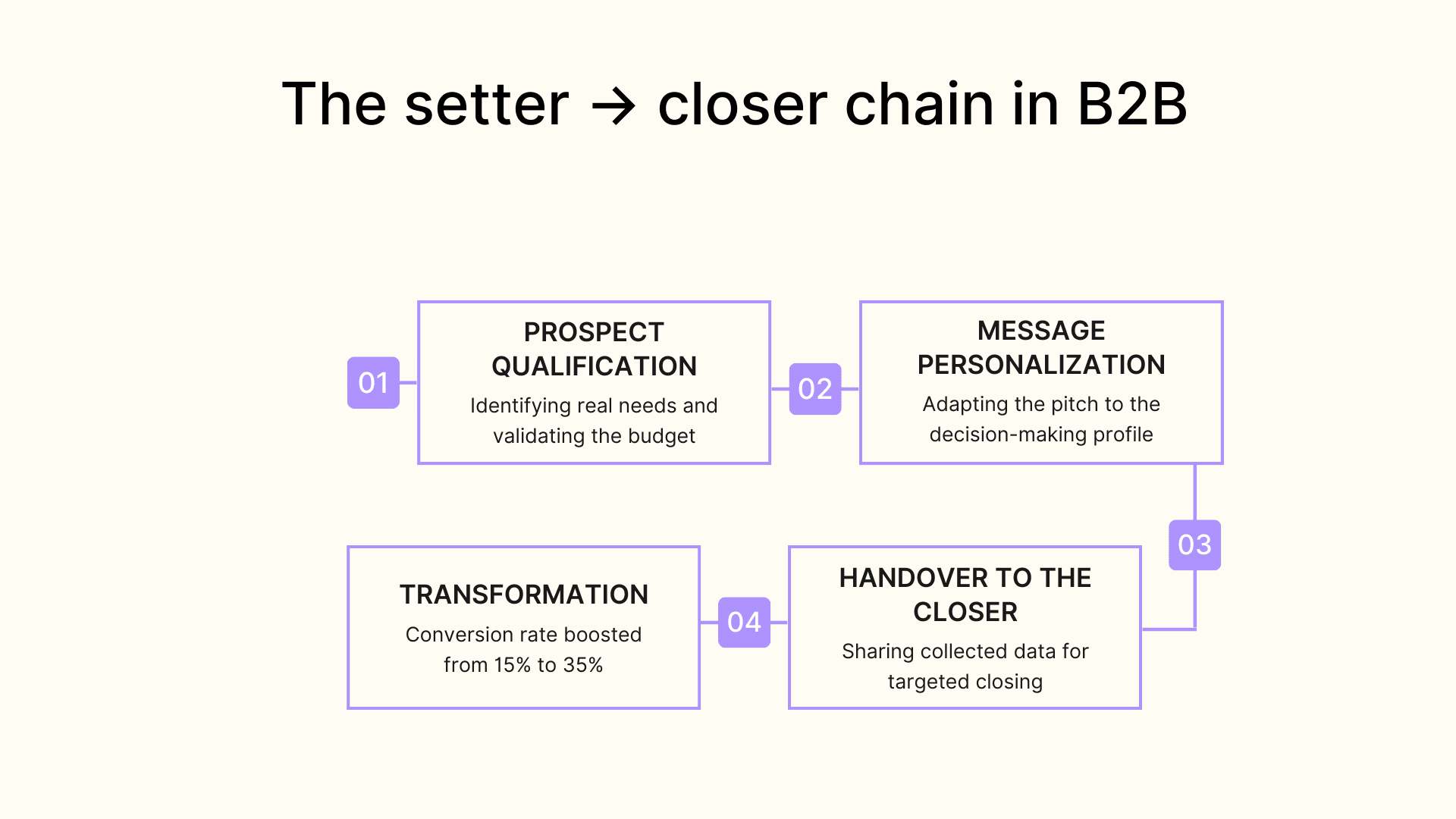
A B2B setter focuses on thorough prospect qualification and creating a favorable framework for the sale. Their main mission consists of identifying the prospect's real needs, evaluating their purchase potential, and preparing the ground for the closer.
The B2B closer takes over once the prospect is qualified. Their central objective: turn the opportunity into a signature. Using the information the setter gathered, they adapt their pitch and guide the prospect toward a purchase decision. To structure the closing conversation itself, the SIMAC method provides a five-step framework, from the client's situation to the close.
For example, in SaaS solution sales, the setter establishes first contact, understands technical challenges, and validates the budget. The closer then intervenes to present the detailed offer, negotiate conditions, and finalize the transaction.
Essential tools for the modern setter
A high-performing setter relies on a suite of digital tools to maximize their effectiveness. A sales proposal tool with read-tracking changes the nature of setting: the setter sees what the prospect actually does with the document (sections viewed, time spent, internal shares) and hands the closer facts instead of impressions.
The time saved on formatting gets reinvested where the setter actually makes a difference: the relevance of the content and the quality of the exchange. That's where behavioral tracking earns its place. Knowing which sections a prospect read, and for how long, lets you pick the right angle for a follow-up instead of waiting for silence before reacting.
Appointment management tools like Calendly optimize meeting scheduling. For structured note-taking and interaction tracking, Notion excels with its customizable templates.
Synchronization between these different solutions guarantees a smooth and measurable setting process, essential for more effectively transforming prospects into clients.
How to optimize your setting technique?
Preparation and prospect qualification
Thorough prospect qualification constitutes a determining step in B2B setting. Precise analysis of the decision-making profile, available budget, and business challenges allows identification of the most promising opportunities.
Using a structured evaluation grid reinforces scoring relevance. For example, assigning scores on criteria like need urgency, financial capacity, and contact's hierarchical level optimizes commercial action prioritization.
Methodical data collection during first exchanges accelerates the qualification phase. An experienced salesperson knows how to ask strategic questions to quickly validate the fit between their offer and prospect expectations.
The BANT method (Budget, Authority, Need, Timing) remains an effective framework for structuring this crucial step.
Commercial message personalization
A successful commercial approach relies on **thorough message personalization**. A high-performing seller adapts their communication based on data gathered during the qualification phase. For example, for a technology company, the message will emphasize innovation and ROI, while a services company will prioritize expertise and relationship quality, in a solution selling logic.
Personalization tools rely on behavioral analysis: tracking interactions (sections read, time spent, questions asked) sharpens the pitch and shapes custom proposals, in substance and in form, that answer the prospect's specific expectations.
Synchronization between CRM and personalization tools multiplies message impact. This approach allows exploitation of every client data point to build relevant and engaging communication.
Interaction tracking and analysis
In-depth analysis of prospect interactions revolutionizes B2B sales performance. An intelligent tracking system allows precise decoding of prospect engagement: time spent on each section, major interest points, and buying signals.
Giving the prospect a way to react directly inside the proposal (a button to ask a question or flag a sticking point, section by section) changes how you collect feedback: they voice the objection the moment they hit it, instead of going silent without a response.
Systematic evaluation of sales proposals, based on objective criteria like engagement rate and response speed, guides continuous optimization of your approach. For example, a low score on the pricing section may indicate a need for reformulation or more detailed value-added justification.
Digital setting: best practices
Setting strategies on social networks
Mastering professional social networks has changed the B2B setting approach. LinkedIn emerges as the preferred playing field for identifying and qualifying your prospects through targeted engagement techniques.
A hybrid content strategy mixing expert publications and storytelling amplifies your credibility. Short formats like carousels or 60-second videos maximize visibility of your messages among decision-makers.
Actively monitoring what your targets say publicly (LinkedIn posts, webinar appearances, job postings) lets you detect early buying signals. For example, a marketing director discussing their current challenges represents an opportunity for contextual and relevant contact.
When the prospect comes to you first, through content or a demo request, setting shifts into inbound sales: qualification is still essential, but it starts from interest that's already been expressed and has to move faster.
Intelligent setting automation
Adopting intelligent automation tools is changing how B2B prospects get qualified. According to the Sales Odyssey 2025 survey, 45% of professionals spend more than an hour creating a single sales proposal: that's the time automation frees up, to reinvest in qualification and in the conversation with the prospect.
Data synchronization between CRM and setting platforms generates valuable insights into potential client behavior. This data-driven approach continuously sharpens scoring: reps spend their time on the prospects who are actually moving forward.
AI assistants prepare the ground: they compile the history, draft a first version of the message, and flag the right moment to follow up. The setter keeps control of what actually makes the difference: the relevance of the question asked and the quality of the relationship. The time saved on preparation gets reinvested there, not in sending more messages.
Time management in B2B setting
Strategic planning of setting activities radically transforms sales productivity. Breaking down the day into dedicated blocks, alternating research phases and direct contact, allows maximum efficiency achievement.
A simple structure proves its worth: three 30-minute slots, the first for prospect qualification, the second for message personalization, the last for interaction follow-up. This structure reduces dispersion and accelerates case progression.
A dashboard that centralizes calls, replies, and document reads lets you quickly visualize priority actions. For example, a salesperson who identifies their optimal performance slots between 9 AM and 11 AM can concentrate their strategic calls during that window and track, week after week, the effect on their response rate.
Errors to avoid in your setting work
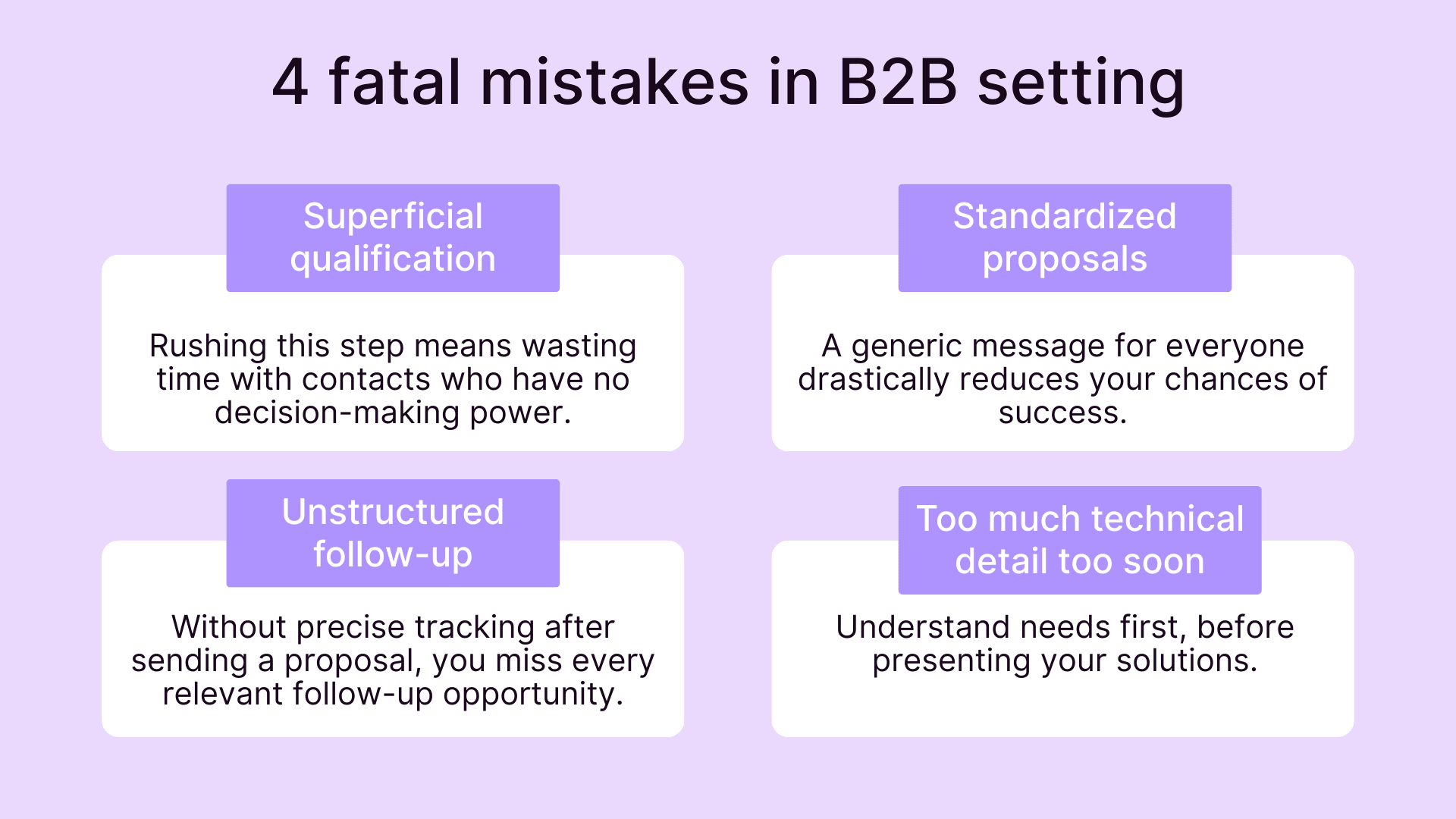
The first fatal error lies in superficial prospect qualification. A rushed salesperson who skips this step ends up wasting time with contacts without real decision-making power.
The second error consists of excessively standardizing your sales proposals. Each prospect deserves a unique approach, adapted to their specific challenges. A generic message drastically diminishes your chances of success.
This applies to substance as much as to form: a proposal where half the pages talk about the vendor tells the prospect they weren't listened to, no matter how much care went into the setting beforehand. The qualification work has to show up in the document itself: their challenges first, your answer second.
The third major error concerns lack of structured follow-up after sending a proposal. Without a precise tracking system, you navigate blindly and miss relevant follow-up opportunities.
Another common trap: technical information overload from the first exchanges. Favor a progressive approach that demonstrates your understanding of needs before presenting your solutions.
Where setting is headed: the trends taking hold
Artificial intelligence serving setting
Predictive AI redefines B2B setting rules by anticipating prospect behaviors. Behavioral analysis models decode subtle buying signals: reading time, navigation, emotional reactions.
An advanced scoring system evaluates compatibility between your proposal and the prospect's decision-making profile. This technology suggests strategic adjustments based on historical success patterns.
Algorithms can suggest a tone and an order of arguments based on the decision-maker's profile; it's still up to the setter to decide what actually rings true for this particular prospect. For example, a finance director will receive an ROI-focused approach, while a technical director will first see technical specifications.
Setting evolution in modern business
The transformation of the B2B sales world places humans at the center of setting strategies. Sales teams adopt a hybrid approach, mixing relationship expertise and digital tools.
The rise of social selling revolutionizes first contacts. Modern setters cultivate their personal branding on professional networks, creating favorable ground before the first exchange.
Organizations rethink their structures by favoring specialized teams. A setter now works a smaller number of genuinely qualified prospects, instead of chasing volume. This targeted approach allows deepening each opportunity and building lasting relationships.
Next-generation setting metrics
Setting performance indicators are being enriched by behavioral data. Average reading time per section allows identification of prospects' major interest points. A high engagement score signals a markedly higher conversion probability; the right threshold is calibrated on your own history, not a market benchmark. According to the Sales Odyssey 2025 survey, 68% of companies use no tool at all to track prospect engagement after sending a proposal: measuring it is already an edge over your competitors.
Micro-interaction analysis reveals subtle buying signals. For example, repeated consultation of pricing conditions or internal document sharing translates marked interest. That prospect is closer to a decision than one who opened the document once; it's this signal, more than a numeric threshold, that should trigger the follow-up.
A dynamic dashboard centralizes these essential metrics. Real-time visualization of the decision-making journey allows sales strategy adjustment. Automatic alerts on engagement peaks trigger targeted actions at the optimal moment.
Frequently asked questions
What exactly is setting in B2B?
Setting represents the preparatory phase of the B2B sales process that precedes closing. This strategic step consists of qualifying prospects, understanding their specific needs, and creating a favorable environment for future commercial negotiation.
How to measure setting effectiveness?
Setting performance is evaluated through the conversion rate of qualified appointments into closing opportunities. Key metrics include the number of qualified prospects, average setting interview duration, and quality of collected information.
What's the difference between setting and closing?
Setting focuses on qualification and commercial ground preparation, while closing represents transaction finalization. A setter establishes first contact, analyzes needs, and prepares the prospect for the purchase decision.