
Cross-selling: a major growth driver
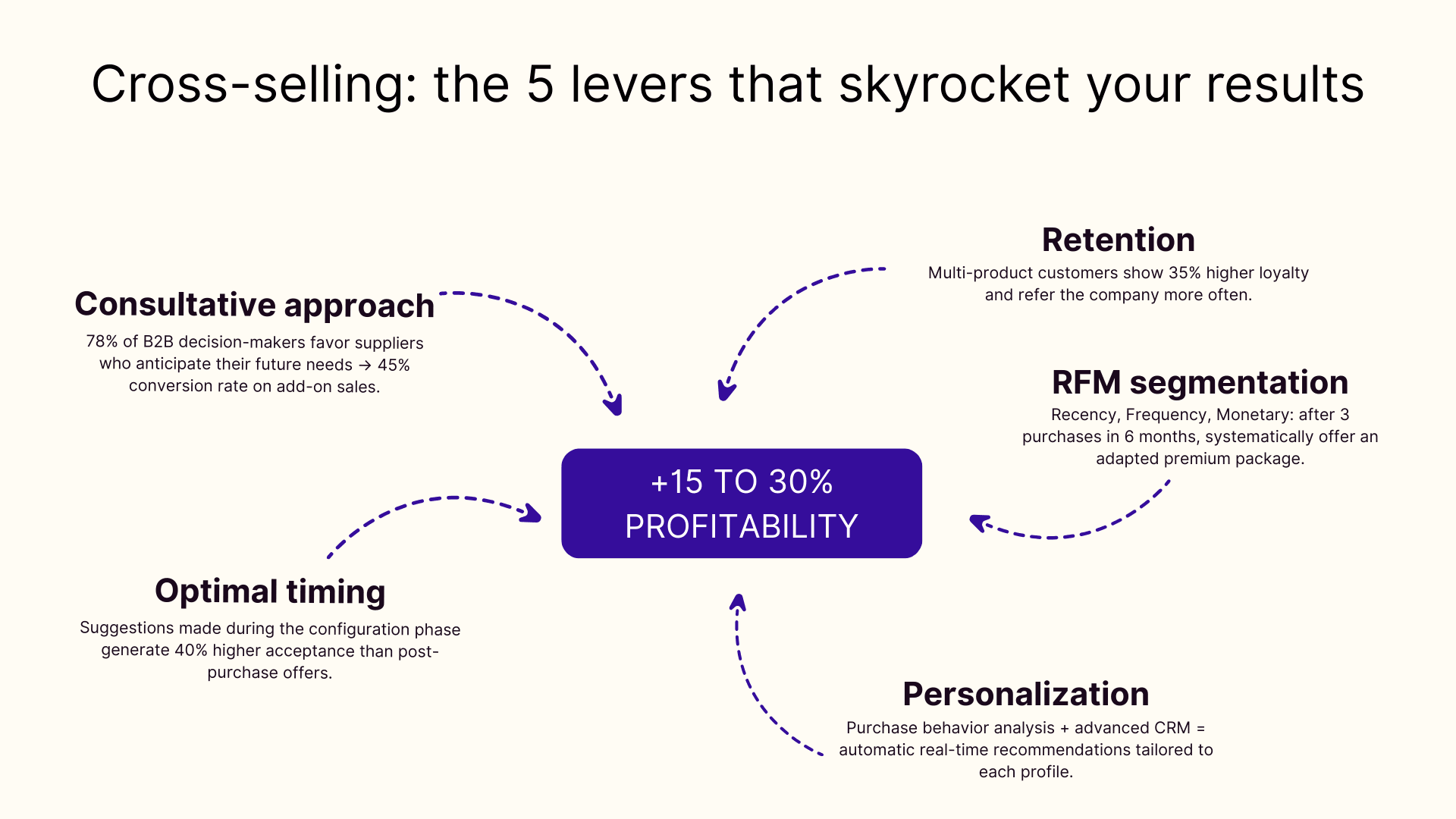
2025 data shows that companies practicing add-on sales see their profitability increase by 15 to 30% on each transaction. This approach transforms every customer interaction into a source of shared value.
A buyer satisfied with their first purchase is 3 times more receptive to suggestions for complementary products. The key lies in the relevance of recommendations and the timing chosen to present them.
Top-performing sectors like automotive or digital retail successfully convert up to 40% of their customers to additional items. The reason? Deep knowledge of their customer base's real needs combined with proper sales team training.
Cross-selling fundamentals in business
Add-on sales: definition and principles
Add-on sales represent a strategic approach consisting of suggesting additional products or services directly related to the customer's initial purchase. This method relies on thorough analysis of buyers' current and future needs.
A concrete B2B example: when acquiring management software, suggesting an adapted training module or personalized maintenance service. The goal? Create a comprehensive solution that meets the customer's specific expectations.
The fundamental principles revolve around three axes:
- Recommendation relevance based on actual usage
- Strategic timing in the buying journey
- Argumentation focused on value creation
Measurable benefits for your business
2025 data reveals that companies practicing cross-selling reduce their customer acquisition costs by 25% on average. The reason? Natural maximization of revenue per existing customer.
Another striking indicator: retention rates climb by 35% when customers adopt at least two complementary products. Multi-product buyers demonstrate increased loyalty and refer the company more often.
Implementing a cross-selling strategy also boosts customer lifetime value. Statistics show an average 40% increase in basket size over 12 months. For example, a B2B software company saw its recurring revenue grow by 45% after structuring its complementary offers around its main solutions.
Difference between cross-sell and up-sell
Cross-selling aims to offer complementary products to the initial purchase. An automotive salesperson suggesting a maintenance package with a new vehicle applies this technique. Conversely, up-selling consists of directing toward a superior version of the same product, like recommending a more powerful model from the same range.
This distinction is reflected in the sales approach. Cross-selling enriches the usage experience while up-selling focuses on upgrading. A computer equipment seller practices up-selling by suggesting a more powerful computer, but does cross-selling by recommending a carrying case.
Success with these techniques relies on fine understanding of customer needs. Detailed analysis of the buying journey helps identify the right moments for each approach.
Cross-selling techniques that work
The consultative approach in B2B
The consultative approach transforms the sales relationship into a true strategic partnership. A salesperson adopting this method takes time to explore their customer's specific challenges before suggesting complementary solutions. For example, a cloud solutions provider who identifies a need for enhanced security at their client's company can naturally recommend adapted protection services.
The key lies in creating lasting trust relationships. A 2025 study reveals that 78% of B2B decision-makers favor suppliers capable of anticipating their future needs. This approach achieves a 45% conversion rate on additional sales, compared to 15% for traditional methods.
A well-conducted discovery meeting often opens the door to natural and relevant cross-selling opportunities.
Personalizing recommendations
Personalizing product recommendations relies on analyzing users' behavioral data. An e-commerce site can leverage purchase history, pages viewed, and customer journey to create tailored suggestions.
Using an advanced CRM automates this approach in real-time. With each visit, the system identifies the most relevant complementary products based on the buyer's profile and actions.
An online fashion store boosted its revenue by 35% through contextualized recommendations. When purchasing shoes, the system automatically suggests accessories matching the customer's usual style and price range.
Optimal timing for offering complements
The precise moment of the sales suggestion largely determines its success. 2025 data reveals that proposals made during the main product configuration phase generate a 40% higher acceptance rate than post-purchase offers.
Perfect synchronization revolves around three key phases:
- During discovery: present natural extensions of the initial need
- At technical validation: integrate essential complementary elements
- At quote time: highlight high-value-added options
A savvy sales manager anticipates these opportunity windows by preparing recommendations adapted to each stage. This strategic approach transforms add-on sales into value-added service for the customer.
Sector-specific strategies: concrete examples
Cross-selling solutions for banking
Digital transformation of banking services opens new perspectives for cross-selling. Bank advisors now leverage life events as natural triggers for personalized offers. A move becomes an opportunity to suggest home insurance. A career change enables suggesting adapted retirement savings.
Predictive analysis reinforces this approach by anticipating customers' future needs. A Parisian bank increased its sales by 28% in 2025 through recommendations based on savings and investment behaviors.
The key lies in proactive customer support. A young professional subscribing to a home savings plan will naturally be offered life insurance or complementary investment solutions, creating a complete financial ecosystem around their goals.
Cross-selling applications in hospitality
The hotel sector is redefining its add-on sales methods through digitalization. Connected rooms now allow guests to directly order additional services via their smartphones. A Parisian establishment saw its ancillary revenue increase by 40% by offering personalized gastronomic experiences.
Booking represents a privileged moment to suggest complementary services. High-performing establishments systematically integrate relevant recommendations: upgrade to a family suite, spa reservation, or premium breakfast package.
Leveraging customer data enriches this approach. A Mediterranean palace anticipates its clientele's expectations by creating custom packages based on previously expressed preferences: golf access, private transfers, or local cooking classes.
B2B e-commerce cross-selling use cases
B2B platforms modernize their add-on sales strategies by drawing inspiration from consumer e-commerce best practices. An industrial supplies distributor adopted a contextual recommendation system based on sectoral buying habits.
Average order value naturally increases through relevant suggestions: when purchasing a professional laptop, the platform automatically suggests adapted accessories like a docking station or extended warranty.
B2B interfaces now integrate intelligent configurators that guide buyers toward complete solutions. A security equipment company supports its clients in creating custom packages, combining hardware, training, and preventive maintenance.
Marketing and cross-selling: winning synergy
Automation opportunities
Cross-selling automation radically transforms add-on sales processes in 2026. Modern tools now automatically identify opportune moments to suggest complementary products, based on real-time customer behavior analysis.
A marketing manager can program personalized sequences that trigger relevant suggestions at each stage of the buying journey. For example, after ordering computer equipment, the customer automatically receives targeted proposals for maintenance services or adapted training.
Intelligent automation solutions also simplify post-purchase follow-up. A service company increased its add-on sales by 35% through automated reminders offering upgrades at the optimal moment in the customer cycle.
Customer data analysis
Leveraging behavioral data reveals your customers' real purchasing habits. A high-performing company combines order histories, website interactions, and customer service feedback to create a 360° view of its clientele.
Modern visualization tools transform this raw information into actionable dashboards. An industrial equipment manufacturer identified seasonal purchasing patterns by mapping its customer base's renewal cycles.
The key lies in selecting priority metrics: repurchase rate, time between orders, or average basket value. These indicators guide your complementary product recommendations and strengthen the relevance of your sales actions.
Segmentation for effective targeting
Strategic segmentation divides your market into distinct groups sharing similar characteristics. A Parisian consulting firm doubled its conversions by creating segments based on each industry's specific challenges.
The RFM method (Recency, Frequency, Monetary) identifies your high-potential customers. A digital services company applies it to spot prospects ready for additional offers: after 3 purchases in 6 months, it systematically proposes an adapted premium package.
B2B segmentation criteria include:
- Company's digital maturity
- Purchase decision cycle
- Annual technology budget
- Growth objectives
How to measure your cross-selling performance?
Key indicators to track
Monitoring add-on sales performance relies on precise metrics. An effective dashboard measures acceptance rates for complementary offers, enabling quick adjustments to your product recommendations.
Average basket progression after implementing cross-selling reveals your strategy's real impact. High-performing companies also monitor the ratio between main products and additional items sold.
Post-purchase satisfaction rates deserve particular attention. A survey of buyers who chose complementary products evaluates the relevance of your suggestions. A score above 8/10 indicates recommendations aligned with your clientele's real needs.
Continuous results optimization
Successful cross-selling strategy relies on systematic improvement of sales actions. Weekly data analysis quickly identifies the best-performing complementary offers. A digital services company increased its conversions by 40% by adjusting its recommendations based on customer feedback.
Controlled experimentation constitutes a major optimization lever. A/B testing on different product combinations reveals the associations generating the most value. A B2B distributor discovered that offering training with its equipment doubled the transformation rate.
Dynamic personalization of suggestions relies on artificial intelligence to refine recommendations in real-time. This data-driven approach guarantees increasingly relevant and adapted proposals for each customer's specific needs.
B2B cross-selling mistakes to avoid
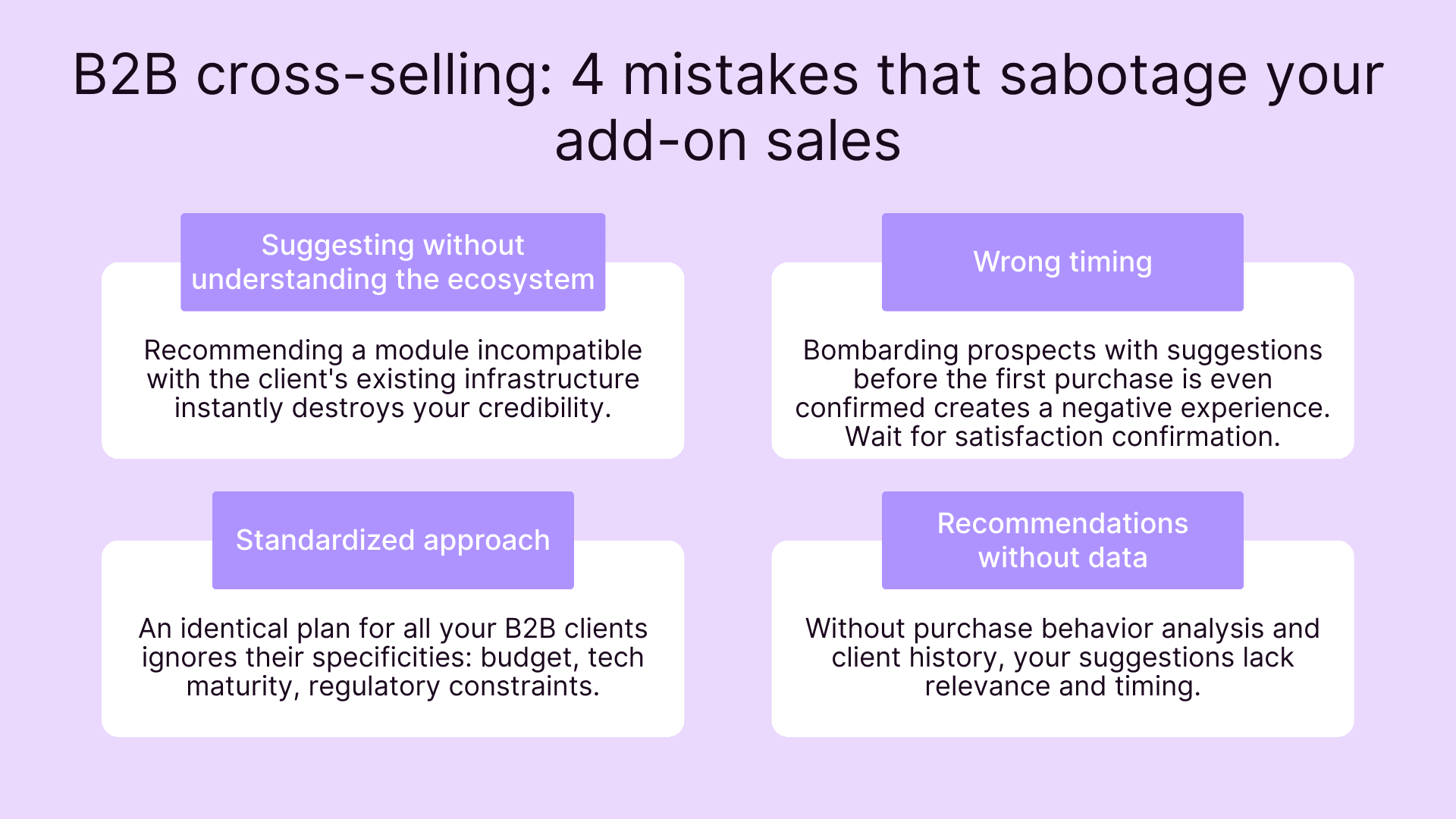
The first fatal mistake consists of offering complementary products without understanding the customer's technical ecosystem. A rushed salesperson who suggests a module incompatible with existing infrastructure instantly loses credibility.
Poor timing represents another classic trap. Bombarding a prospect with suggestions before even validating the first purchase creates a negative experience. The golden rule: wait for satisfaction confirmation on the main product.
A standardized approach for all your B2B customers sabotages your cross-selling efforts. Each company has its specificities: budget, technological maturity, regulatory constraints. A personalized plan considering these parameters will multiply your chances of success.
Trends and innovations
The cross-selling revolution accelerates with the emergence of augmented conversational interfaces. These virtual assistants analyze purchase context in real-time to formulate ultra-targeted suggestions.
Professional social networks become privileged platforms for B2B cross-selling. An industrial equipment manufacturer tripled its add-on sales by deploying contextual recommendations on LinkedIn.
Augmented reality transforms the complementary purchasing experience. Professional buyers now visualize additional product integration in their work environment before purchase. An office furniture company offers 3D simulation of complete layouts, boosting accessory sales by 40%.
Frequently asked questions
What's the main difference between cross-selling and up-selling?
Cross-selling offers complementary products to the purchase. Up-selling suggests a superior or more expensive version of the same product.
What's the best time to make an effective cross-selling proposal?
Often during main product configuration, or just after purchase if the suggestion is highly relevant and non-intrusive for the customer.
How can marketing support a cross-selling strategy?
By analyzing customer data to personalize offers and automating relevant suggestion delivery at the right moment in the buying journey.