
Strategic missions of the sales manager
Developing and driving sales strategy
The primary mission of the sales manager consists of designing an action plan aligned with market expectations. This approach begins with thorough sales data analysis and rigorous competitive intelligence.
Establishing precise quantified objectives by geographic zone and product range structures the roadmap. The sales manager then deploys dashboards to track key indicators: conversion rates, profit margins, and revenue.
A modern approach integrates customer retention and sales process optimization through digital tools. The manager adjusts their strategy according to market developments, in close coordination with the marketing department.
Managing and developing major accounts
Maximizing strategic accounts requires a tailored approach. A sales manager dedicates 40% of their time to partners generating over 60% of revenue, establishing privileged relationships based on deep understanding of mutual challenges.
Personalized support for major accounts rests on three fundamental pillars:
- Detailed mapping of decision-makers and influencers
- Deployment of targeted sales actions
- Building lasting relationships through regular touchpoints
This structured approach allows anticipating each major account's specific needs and adapting proposed solutions accordingly. The sales manager becomes a true strategic partner, creating long-term value.
Managing and energizing sales teams
A sales manager dedicates 60% of their time to energizing their teams. The key lies in personalized coaching that adapts to each salesperson's profile. A winning practice consists of organizing short, dynamic weekly meetings to maintain motivation.
Success also comes from setting individualized and realistic objectives. The manager establishes a tailored development plan for each salesperson, with targeted training and regular performance monitoring.
The best managers promote autonomy while remaining available. They create a stimulating environment where each team member can flourish and progress. A good example: some managers organize experience-sharing sessions between salespeople, strengthening team cohesion and collective learning.
Sales director vs. sales manager: what are the differences?
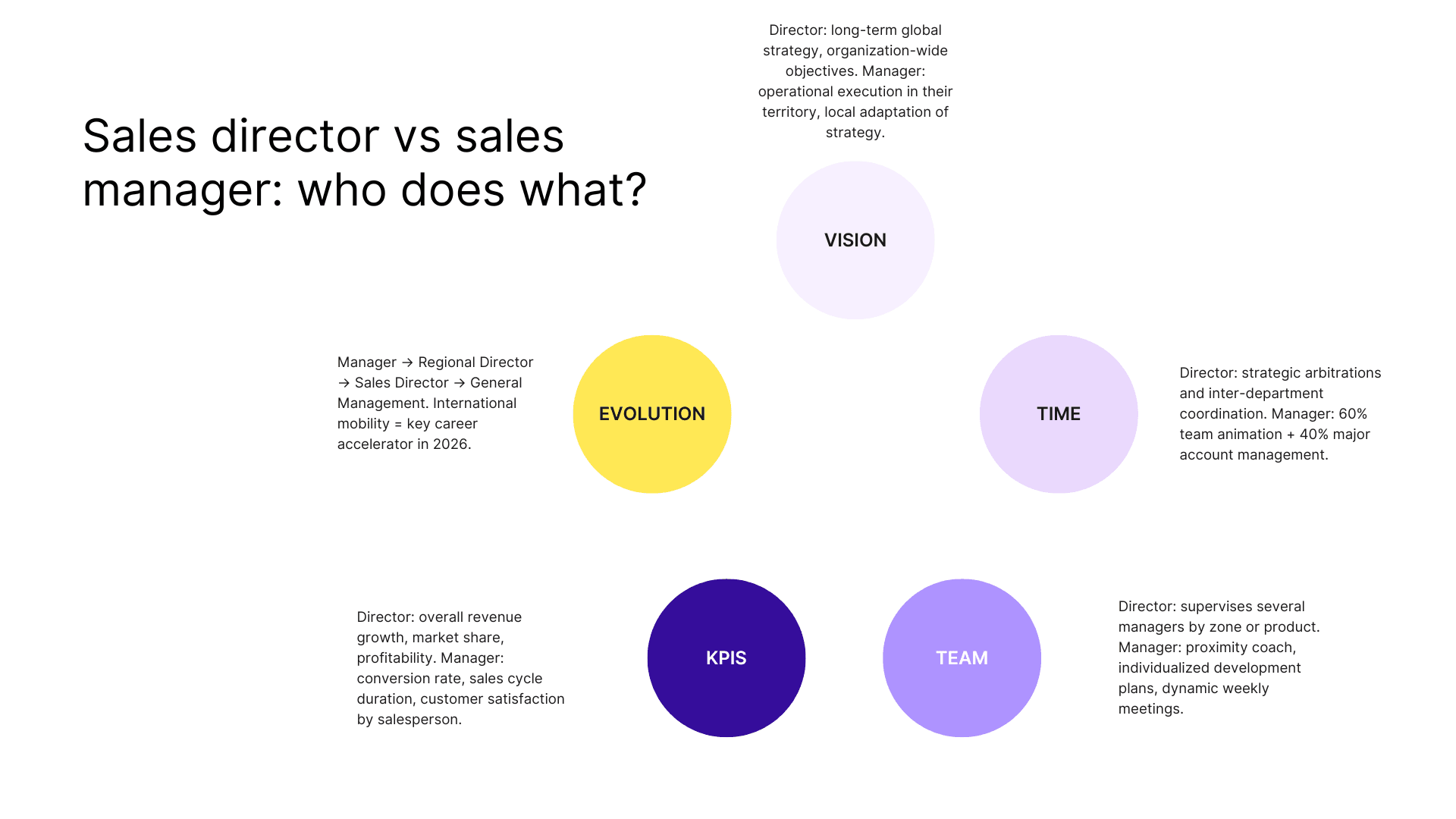
The scope of responsibility constitutes the major distinction between these two functions. A sales director defines the company's overall strategy while the sales manager ensures its application in their territory.
In large companies, the sales director supervises several sales managers distributed by zones or products. Their vision focuses on the long term with strategic decisions impacting the entire organization.
The sales manager concentrates on operational execution of action plans. Their field expertise and proximity to teams allow adapting strategy to local market realities. A concrete example: when the director sets a 20% growth objective, the manager determines specific actions to achieve it in their zone.
Essential skills to succeed as a sales manager
Leadership and managerial capabilities
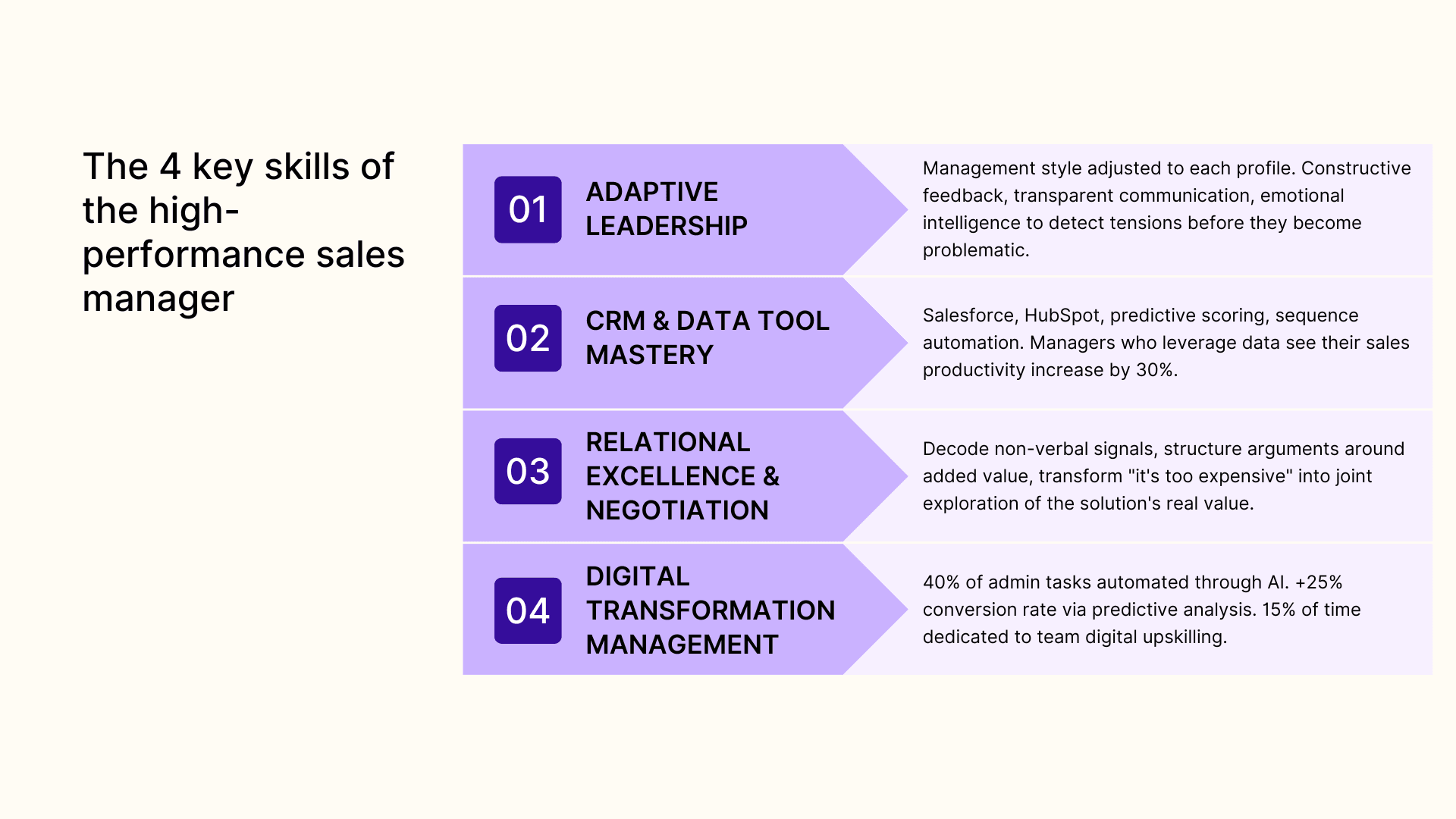
Leadership qualities constitute the foundation of a sales manager's success. Their ability to embody a clear vision of the future naturally mobilizes teams toward achieving results. An adaptive management style allows adjusting their approach according to each collaborator.
A high-performing sales manager masters the art of constructive feedback. Their transparent communication reinforces team trust. Their emotional intelligence allows detecting tensions before they become problematic.
Rapid decision-making represents another essential facet of modern sales leadership. Facing daily challenges, the manager knows how to make discerning choices while remaining receptive to their team's suggestions.
Mastering marketing and CRM tools
A modern sales manager relies on advanced technological solutions to optimize performance. Mastering CRM platforms like Salesforce or HubSpot allows fine analysis of the customer journey and automation of repetitive tasks.
Exploiting marketing data enriches commercial decision-making. Personalized dashboards offer clear visibility of key indicators: conversion rates, sales cycle duration, customer satisfaction. A performing manager knows how to leverage these metrics to adjust strategy in real-time.
Marketing automation tools multiply the impact of sales actions. Predictive scoring identifies high-potential leads while automated sequences maintain personalized contact with each prospect.
Relational excellence and negotiation
The ability to create authentic connections represents a major strategic asset. A sales manager must know how to decode non-verbal signals and adapt their approach according to their interlocutor. Practicing powerful questioning allows understanding the true stakes of each negotiation.
The art of negotiation rests on meticulous preparation. Experienced managers structure their arguments around added value rather than price. A winning technique consists of presenting several options, letting the client choose what suits them best.
Managing objections requires tact and reactivity. The secret lies in active listening and constructive reformulation. A concrete example: transforming "it's too expensive" into an opportunity to explore together the real value of the proposed solution.
Training and professional path of the sales manager
From bachelor's to master's: which studies to choose?
The bachelor's in sales development management constitutes a solid first step. This 3-year training combines theoretical learning and practical applications to master the profession's fundamentals.
To access positions with greater responsibilities, a specialized master's in sales management brings essential strategic dimension. Programs focused on digital and international prepare for new market challenges.
Business schools offer curricula adapted to company needs. A determining selection criterion: prioritize training including recognized professional certifications and partnerships with sector players.
Apprenticeship: a preferred path
Apprenticeship represents a springboard toward sales excellence. The numbers speak for themselves: 85% of apprentices land a job within 6 months following their training. This path allows total immersion in the professional world with an adapted rhythm of 3 weeks in company and 1 week in training.
Compensation constitutes a major asset: between $30,000 and $45,000 gross annually in 2025 depending on your age and education level. Beyond salary, you develop operational skills directly applicable: client portfolio management, advanced negotiation techniques, team management.
A concrete example: Sarah, 24, climbed the ranks at her employer during her apprenticeship, going from sales assistant to sector manager in 18 months.
Continuing education and professional certification
Professional organizations offer flexible and modular training adapted to working professionals. Evening courses and distance modules allow obtaining recognized certification while keeping your job.
Professional certifications like "Certified Sales Manager" validate your professional experience. These comprehensive programs address digital marketing fundamentals, customer relationship management, and advanced sales management techniques.
A major asset: the possibility to customize your path according to your needs. Short certification modules respond to specific requirements of your activity sector, such as B2B negotiation or sales performance management.
Career evolution and compensation for sales managers
Salary scale according to experience
A sales manager's compensation varies considerably according to their expertise level. A beginning professional (0-2 years) starts with an annual gross salary between $35,000 and $42,000, including a 15% variable portion.
Confirmed managers (3-5 years) see their compensation progress toward $45,000 to $55,000 gross per year, with variable portion reaching 20%.
Sector experts (6-10 years) benefit from a package between $55,000 and $65,000 gross annually. The variable portion rises to 25%, rewarding their ability to develop revenue.
Senior professionals (over 10 years) reach compensation exceeding $70,000 gross per year, with variable portion potentially representing up to 30% of total salary.
Evolution prospects toward executive positions
Progression toward executive positions is structured around two strategic axes in 2026. The first naturally leads toward sales direction, where team management mastery becomes central. A typical path begins with managing a regional team before accessing national responsibilities.
The second axis opens the way toward general management positions. This evolution requires a broader business vision and excellent understanding of financial challenges. Sales managers demonstrating strong ability to drive growth and develop innovative strategies are particularly sought after.
International mobility constitutes a valuable career accelerator. Managing cross-border projects allows acquiring a global market vision, a major asset for accessing leadership functions.
Recruiting sales managers
Profiles sought by activity sector
The 2026 market particularly values hybrid profiles combining sector expertise and digital mastery. In technology, demand concentrates on sales managers mastering SaaS solutions and artificial intelligence.
The industrial sector favors candidates with dual technical and commercial competence, capable of supporting connected factory transformation.
Agribusiness seeks talents oriented toward sustainable development and short circuits. A concrete example: a sales manager who led implementing a local organic supply chain will see their profile highly solicited.
Business services bet on experts in personalized solutions, while the banking sector values profiles mastering customer journey digitalization.
Building an impactful resume
Your resume structure must reflect your path with clarity. Adopt a two-column layout to maximize readability and highlight your quantified sales achievements.
Strategically place your keywords in the first lines: "business development," "team management," "major account negotiation." This approach optimizes your visibility with automated recruitment systems.
Your sales successes deserve a dedicated section. Example: "45% revenue increase over 12 months through deployment of new B2B prospecting strategy."
A practical tip: customize your hook according to the targeted position. A striking sentence like "Sales manager specialized in tech sector, expert in B2B startup development" will capture recruiters' attention.
New challenges in the sales manager profession
Digital transformation of sales processes
The digital revolution radically redefines sales methods in 2026. Artificial intelligence solutions now allow automating 40% of sales teams' daily administrative tasks.
Predictive customer data analysis generates personalized recommendations, increasing conversion rates by 25% on average. Electronic signatures and dynamic configuration tools accelerate the sales cycle by 60%.
Success of this digital transformation rests on team support. Training on new digital tools now represents 15% of sales managers' time. Companies investing in these digital skills see their sales productivity jump by 30%.
International business development
Conquering foreign markets requires a tailored strategy for each geographic zone. French companies now favor a progressive approach, starting with a test country before extending their presence.
The sales manager must master local cultural and regulatory specificities. A telling example: a Lyon-based SME succeeded in its Asian expansion by adapting its packaging to local color codes, tripling its sales.
Success rests on a network of reliable partners. Foreign chambers of commerce, professional trade shows, and B2B platforms facilitate identifying strategic players. Permanent commercial intelligence allows anticipating target market developments and quickly adjusting positioning.