The foundations of the DISC method
Origins and William Moulton Marston
A Harvard graduate in 1921, William Marston was a multitalented researcher. As a psychologist fascinated by human emotions, his research led him to publish his foundational work "Emotions of Normal People" in 1928.
In that book, Marston describes four typical emotional responses, based on whether a person perceives their environment as favorable or hostile, and whether they feel strong or weak facing it: Dominance, Inducement, Submission, and Compliance, the terms he originally used for what we now call Dominance, Influence, Steadiness, and Compliance. The colors attached to each profile did not come from Marston: test publishers added them much later to make the model easier to remember. The most common convention, and the one used in this article, links red to Dominance, yellow to Influence, green to Steadiness, and blue to Compliance.
A prolific creator, Marston also contributed to the invention of the polygraph through his research on blood pressure as an indicator of deception. His forward-thinking vision even pushed him to create Wonder Woman, a superheroine embodying his beliefs about gender equality.
Key principles of the behavioral model
The model rests on two fundamental axes: an orientation toward tasks or relationships, and reactivity to the environment. This analytical framework helps to identify each individual's natural preferences in how they interact and communicate.
The system's strength lies in its ability to recognize that no style is better than another. Each profile brings its unique contribution to team dynamics and collective intelligence.
For practical application, the model relies on observable indicators like speech pace, body language, or decision-making. A fast-paced, direct manager often reveals a Red Dominance, while a methodical, analytical colleague generally shows a Blue tendency.
Evolution of the DISC psychological approach
In the 1950s, psychologist Walter Clarke transformed Marston's theories into a practical assessment test. His "Activity Vector Analysis" revolutionized DISC application through an adjective list allowing people to identify their dominant traits.
In the 1970s, John Geier formalized the Personal Profile System, a self-scored questionnaire that gave DISC its current four-dimension format. Tests were not digitized until the late 1990s.
The arrival of digital technology in the 21st century propelled DISC to new dimensions. Artificial intelligence algorithms now enable more refined behavioral assessment. Personalized reports adapt to specific professional contexts, from management to sales.
What are the 4 DISC model profiles and their characteristics?
The D (Red) profile: Dominance and leadership
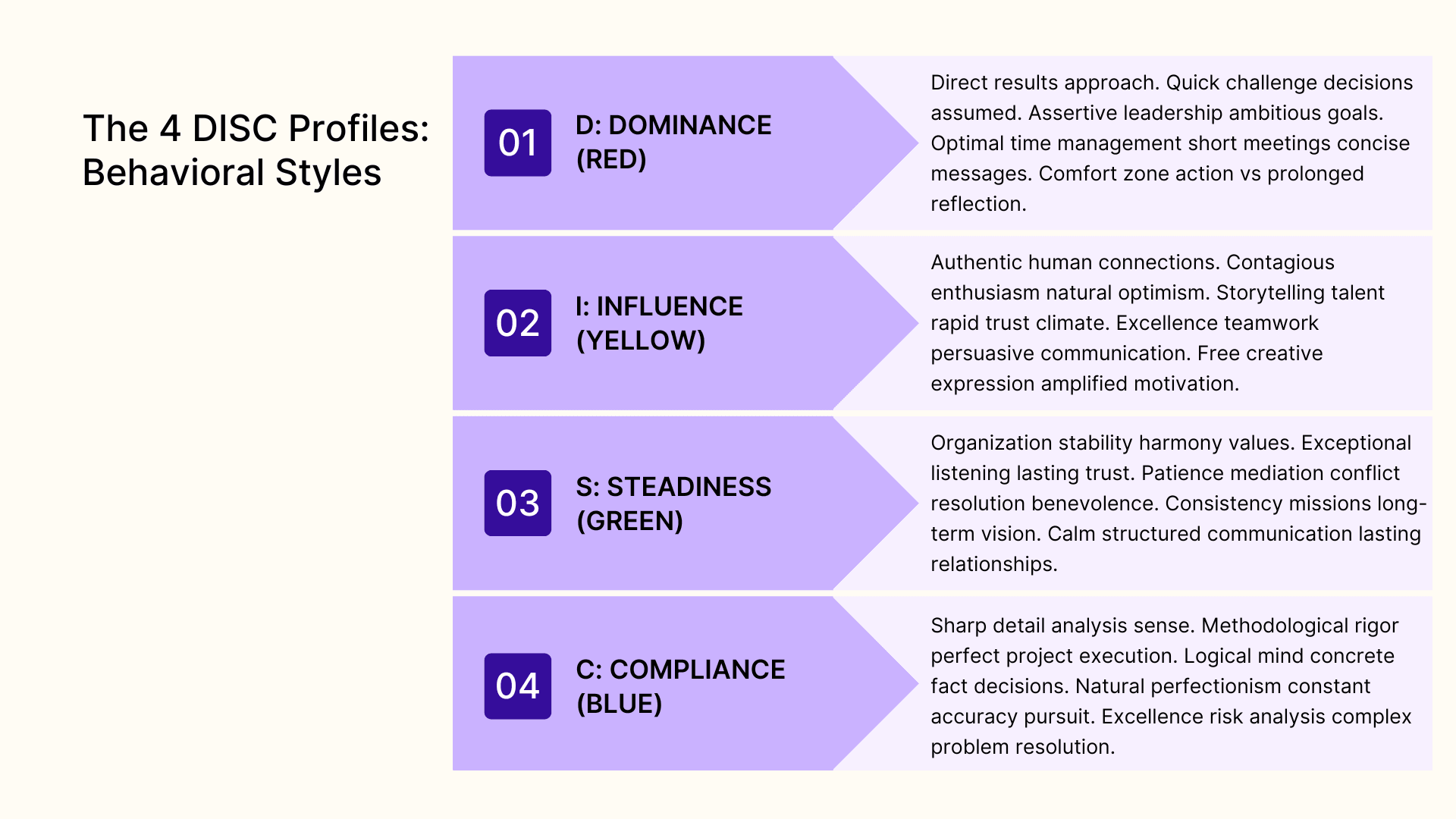
People with a D profile stand out through their direct approach and hunger for results. Naturally action-oriented, they make quick decisions and don't hesitate to take on challenges that come their way. In a professional context, these personalities prove particularly comfortable in situations requiring assertive leadership. A sales director with a D profile, for example, will set ambitious goals and motivate their team through stimulating challenges. Time management represents a real asset for this profile: short meetings, concise messages, and instant responses characterize their operating mode. Their comfort zone lies in action rather than prolonged reflection. To collaborate effectively with a D profile, favor direct exchanges focused on concrete results rather than emotional aspects.
On the phone, the CROC method (Contact, Reason, Objective, Conclusion) works particularly well with this profile, because it states the reason for the call within the first ten seconds.
The I (Yellow) profile: Influence and sociability
People with an I profile excel in the art of creating authentic human connections. Their contagious enthusiasm and natural optimism energize the team atmosphere. A marketing manager of type I transforms every meeting into a stimulating exchange moment. Their ability to unite talents and encourage collective creativity represents a real asset for innovation. This profile's positive energy particularly shines in teamwork and situations requiring persuasive communication. During client meetings, their warm attitude and talent for telling captivating stories quickly create a climate of trust. To collaborate with an I profile, favor interactive exchanges and allow space for their creative expression. Their motivation amplifies when they can share their ideas freely.
The S (Green) profile: Steadiness and cooperation
Type S people embody values of stability and harmony within organizations. Their thoughtful approach and exceptional listening ability create lasting trust within teams. An HR manager with an S profile naturally soothes tensions and facilitates conflict resolution through their benevolence. Their patience and sense of mediation allow for a serene accompaniment of organizational changes. This profile's quiet strength particularly shines in missions requiring consistency and a long-term vision. Green colleagues excel in supporting complex projects that demand methodology and perseverance. Calm and structured communication maximizes collaboration with an S profile. Their motivation grows when they can contribute to building lasting relationships.
The C (Blue) profile: Compliance and precision
Type C colleagues shine through their sharp sense of analysis and detail. Their methodological rigor guarantees perfect project execution, while their logical mind ensures decisions are based on concrete facts. A C accountant masters every technical aspect of their profession. Their meticulousness in data processing and scrupulous respect for procedures make them a reliable pillar for any organization. This profile's natural perfectionism manifests through a constant pursuit of accuracy. Blue profiles excel in risk analysis and the methodical resolution of complex problems. Structured communication, supported by objective data, optimizes exchanges with a C profile. Their professional excellence flourishes in a framework where quality takes precedence over speed.
How to identify your DISC profile?
Different available assessment tests
Certified DISC tests come in several formats adapted to business needs. The online assessment represents the most widespread solution, offering a 24 to 48-question questionnaire to complete in about 15 minutes. Paper versions remain accessible for specific situations, particularly during group training sessions. The psychometric reliability of assessments varies by publisher, with some offering detailed reports of more than 20 pages. The market offers a wide range of prices, from free tests to complete professional assessments. Premium solutions generally include a personalized debriefing with a certified practitioner, maximizing the assessment's value for personal development.
Interpreting the DISC questionnaire
The analysis of DISC questionnaire results reveals your natural behavioral style through a personalized graph. This visual representation highlights the distribution of the four behavioral dimensions in your profile. A careful reading of the scores obtained for each dimension helps to identify your dominant and secondary tendencies. A high score in Dominance combined with strong Influence suggests, for example, a charismatic leader profile. Professional interpretation also considers variations between your natural and adapted behavior. This nuance enriches the understanding of your flexibility in professional situations. A sales consultant might naturally have a pronounced Influence profile while developing analytical skills (Compliance) to meet their position's requirements.
Meaning of color combinations
DISC color associations reveal unique behavioral nuances. A Red-Yellow blend characterizes a dynamic and persuasive personality, particularly suited to sales functions. The Green-Blue fusion translates to a methodical and collaborative approach, valuable in expertise or consulting missions. The Red-Blue duality manifests as structured leadership, combining quick decision-making and thorough analysis. The Yellow-Green alliance favors harmonious relationships and collective creativity, essential in team animation. Each person possesses their own behavioral palette. A salesperson can combine their natural influence (Yellow) with acquired rigor (Blue) to optimize their sales techniques. This richness of combinations allows for adapting communication according to professional contexts.
Practical applications of the DISC method in business
DISC as a management tool
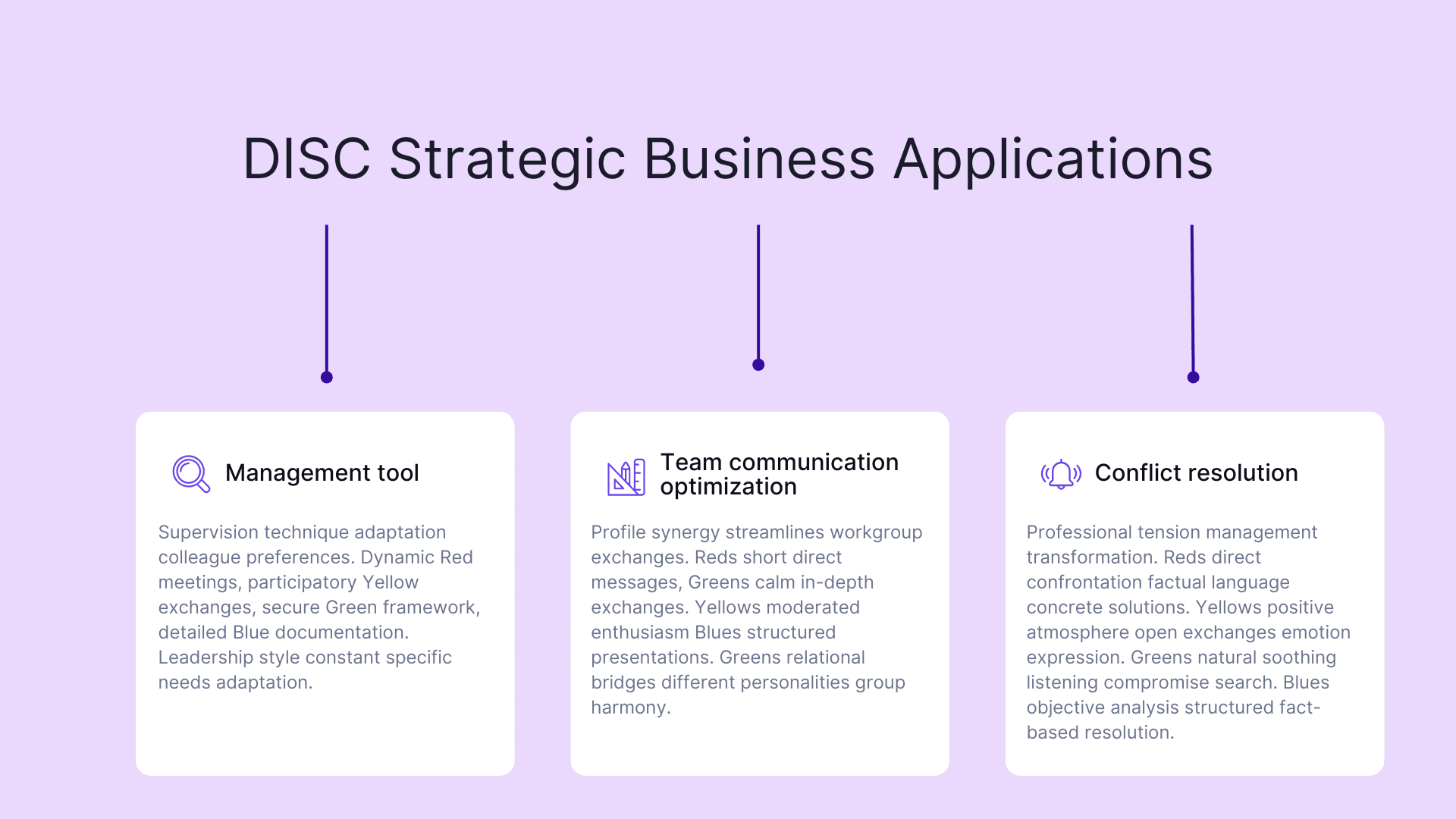
Mastering DISC changes how you manage in concrete, practical ways. An informed manager adapts their supervision techniques to each colleague's preferences: dynamic meetings for Red profiles, participative exchanges for Yellows, a secure framework for Greens, and detailed documentation for Blues. Imagine a marketing manager who assigns roles based on each person's profile: project launches go to the dominant ones, coordination to the steady ones, and results analysis to the conscientious ones. Nobody changes jobs, but everyone now works from their strength, and everyday friction fades on its own. This personalized approach strengthens team motivation. A structured briefing satisfies analytical profiles, while an interactive presentation captivates sociable profiles. The key lies in the constant adaptation of leadership style to each team member's specific needs.
Optimizing team communication
The synergy between DISC profiles represents a powerful lever for streamlining exchanges within work groups. A Red profile will naturally communicate through short, direct messages, while a Green profile prefers calmer, more in-depth exchanges. The art lies in the mutual adaptation of communication styles. Yellow profiles can moderate their enthusiasm when facing Blues, who appreciate more structured presentations. Greens excel at creating relational bridges between different personalities. Concretely, during a project meeting, each profile brings their richness: Reds synthesize decisions, Yellows stimulate exchanges, Greens maintain group harmony, while Blues verify proposal consistency.
Conflict resolution according to profiles
Understanding DISC profiles transforms professional tension management. A Red profile favors direct confrontation to quickly resolve a disagreement. When facing them, adopt factual language and propose concrete solutions. Yellow profiles seek to maintain a positive atmosphere even during tense phases. Their collaborative approach requires open exchanges where everyone can express their emotions without judgment. Greens naturally soothe tense situations through their listening ability and search for compromise. As for Blues, they prefer to objectively analyze the situation before considering a structured resolution, based on verifiable facts. Imagine a sales team strained by tension between a manager in a hurry and colleagues who feel pushed around. By letting each person voice their needs according to their profile, the manager arrives at an action plan that respects everyone's sensitivities, instead of forcing the pace set by the most dominant voices.
DISC in the sales relationship
Reading the profile from the first exchange
You'll never get a prospect's actual DISC test score. You have something better: their emails, how they answer the phone, and how they run the first meeting. Those signals are enough to form a working hypothesis about their profile from the very first contact, one you can correct later.
A D profile writes short messages, replies fast, often from their phone, and asks about price or timeline before you've even walked through the offer. In a meeting, they interrupt, cut to the point, and check the clock. An I profile answers warmly, shares context about their situation, and talks about people more than numbers. They sometimes take a while to get back to you, not out of disinterest, but because they're juggling several conversations at once.
An S profile takes time to reply and asks about onboarding, rollout, and what will change for their team. They avoid conflict and rarely say no outright: an "I need to check internally" is worth digging into. A C profile sends structured, sometimes numbered emails, asks for documentation before the meeting, and catches the inconsistencies in your pitch. They don't decide in the room; they decide after rereading everything.
Write down your hypothesis after every exchange. It will shape the format of your follow-ups as much as your proposal.
Adapting your pitch to each color
Closing a deal often comes down to how well you adjust your sales approach to the buyer's type. With a dominant buyer, lead with the key benefits and the numbers, fast. The Challenger Sales approach, which pushes the prospect with a new insight rather than simply following their lead, tends to work best here: a D respects whoever teaches them something.
To win over a sociable personality, lean on customer stories and vivid examples that show the value of your solution in action. Your own enthusiasm is your best asset.
With a steady buyer, build trust first by proving the reliability and staying power of your offer. Give them time to absorb each piece of information before moving on.
An analytical decision-maker wants a structured case, backed by precise technical data and detailed comparisons. Come prepared with thorough documentation to answer every question they raise.
DISC tells you how your buyer wants to be spoken to; the SONCASE framework tells you why they're buying in the first place. Cross the two and you avoid handing a detailed ROI breakdown to a rushed D, or an enthusiastic pitch to a C who's still waiting for proof.
Sales techniques by behavioral profile
Closing well means applying different tactics to each DISC profile. A red prospect responds to a tight, focused presentation of no more than 15 minutes, built around ROI and performance.
That reading starts as early as booking the meeting: during your setting call, a D is won over with two sentences and a date, while an S needs to understand why the conversation is worth their time before they'll agree to it.
A yellow profile thrives on a lively, interactive demo. A memorable experience, punctuated with relevant customer stories, keeps them engaged.
Green buyers prefer meetings broken into structured steps. A consultative approach built on active listening and co-building the solution with them earns their buy-in.
A blue profile expects total command of the technical details. Thorough documentation, backed by industry benchmarks and detailed comparisons, is what lets them commit with confidence.
The DISC profile should also shape the format of your proposal itself: two pages with a headline number up front for a red, a full package with technical appendices for a blue, testimonials front and center for a yellow, a step-by-step rollout plan for a green. Sending the same document to everyone means ignoring what you just learned in the room.
Real-world negotiation scenarios
Putting DISC into practice plays out in the details of each negotiation. Picture a meticulous technical director: instead of talking up overall performance, you hand him a package of comparative analysis and give him a week to read it. You lose a few days on the calendar, but you earn his trust, and the competitor who pushed him to decide on the spot just lost theirs.
Now picture a decision-maker in a hurry, a D profile: you build your case around time saved and immediate ROI, in a few numbers, no detours. A short, results-focused presentation gives them exactly what they need to decide fast. Tracking a proposal after you send it gives you clues too: a decision-maker who opens the document, skims the summary, and jumps straight to the price is behaving like a D, and deserves a short, decision-oriented follow-up rather than a recap of features.
With a buyer looking for security, take a gradual approach. Picture an S-profile manager: by multiplying touchpoints over several weeks, you build a solid relationship before addressing the contract, and every step they take becomes one more reason not to start over with another vendor.
Handling objections by profile
An objection doesn't mean the same thing depending on who raises it, and the answer that reassures one profile puts off the next. When a D says "that's too expensive," don't justify the price line by line: bring the conversation back to the expected result and the cost of doing nothing, then ask for a decision. They respect firmness, not flexibility.
An I who hesitates is rarely raising a technical objection. They're afraid of championing a project with no momentum, or losing face in front of their team. Answer with examples from comparable customers and a rollout that makes them look good, not a spreadsheet.
An S who says "let me think about it" needs security, not pressure. Walk through the support, the steps, and what happens if something goes wrong, then agree on a specific deadline. A pushy follow-up only sends them toward whichever competitor feels safest.
A C who keeps asking questions isn't trying to trip you up, they're verifying. Answer precisely, in writing if you can, and admit what you don't know rather than improvising: one spotted inaccuracy costs you more trust than an honest "I'll confirm tomorrow." In every case, answering the objection in your buyer's own register gives you a direct edge over the competitor who responds to everyone the exact same way.
Combining DISC and SONCASE
DISC doesn't tell you why your prospect is buying. It tells you how they want it presented to them. For the actual motivation, the SONCASE framework (Security, Pride, Novelty, Comfort, Money, Sympathy, Environment) remains the reference tool, and the two lenses complement each other rather than replace one another.
Take a single lever: money. For a D, it shows up as one ROI number, stated upfront, no detour. For a C, it's demonstrated through a total cost of ownership calculation over the life of the contract, assumptions spelled out, sources cited. The substance is identical, the form is opposite, and it's the form that decides whether the message lands.
The reverse is also true: the same profile can buy for very different reasons. Two D-profile executives might sign, one for the money, the other for the pride of equipping their team ahead of competitors. DISC gets you speaking their language; SONCASE tells you what to say. In the room, listen for the underlying motivation first, watch the style second, then build both your pitch and your proposal on the two together.
The limits of DISC
DISC is a quick-read tool, not a scientific instrument. Its test-retest reliability is modest, it doesn't predict sales performance, and the same buyer can shift style depending on context and pressure: an S profile pushed hard by their leadership can behave like a D for an entire buying cycle. You're observing a behavior, not a person.
There's another trap: the typology turns into a label fast. "He's a C" becomes an excuse to stop digging, when the whole point of the model is to listen better. Keep your hypothesis open and let the prospect prove it wrong.
Use DISC to adjust your pace, your format, and your follow-ups, never to decide on the prospect's behalf what they want to buy. That part only comes from asking questions, and it's what separates a proposal that speaks to the client from one that speaks about you.
Frequently asked questions
What is the DISC technique?
It's a behavioral analysis tool that classifies styles into 4 main profiles: Dominant (D), Influential (I), Steady (S), and Compliant/Conscientious (C), to better understand interactions.
What is DISC used for in business?
It helps to improve management, team communication, sales relationships, conflict resolution, and personal development by adapting your approach to different profiles.
Is there one DISC profile better than others?
No, each profile (Red, Yellow, Green, Blue) has its own strengths. The DISC method values the diversity and complementarity of behavioral styles.