
What does KAM (key account manager) mean and what are their missions?
The acronym KAM (key account manager) refers to a major accounts executive who manages strategic business relationships. Their primary mission involves analyzing the specific needs of each major client to create personalized solutions.
A KAM establishes lasting partnerships by orchestrating collaboration between different internal departments. For example, in the technology sector, they coordinate technical and marketing teams to meet the requirements of a major account client.
Cross-functional management is an integral part of their duties. They mobilize necessary resources, monitor performance indicators, and guarantee client satisfaction at every stage of the partnership.
Strategic responsibilities of the key account manager
Managing and developing the client portfolio
A KAM's success relies on their ability to structure their client portfolio according to precise strategic criteria. Effective segmentation helps identify high-potential accounts and allocate resources optimally.
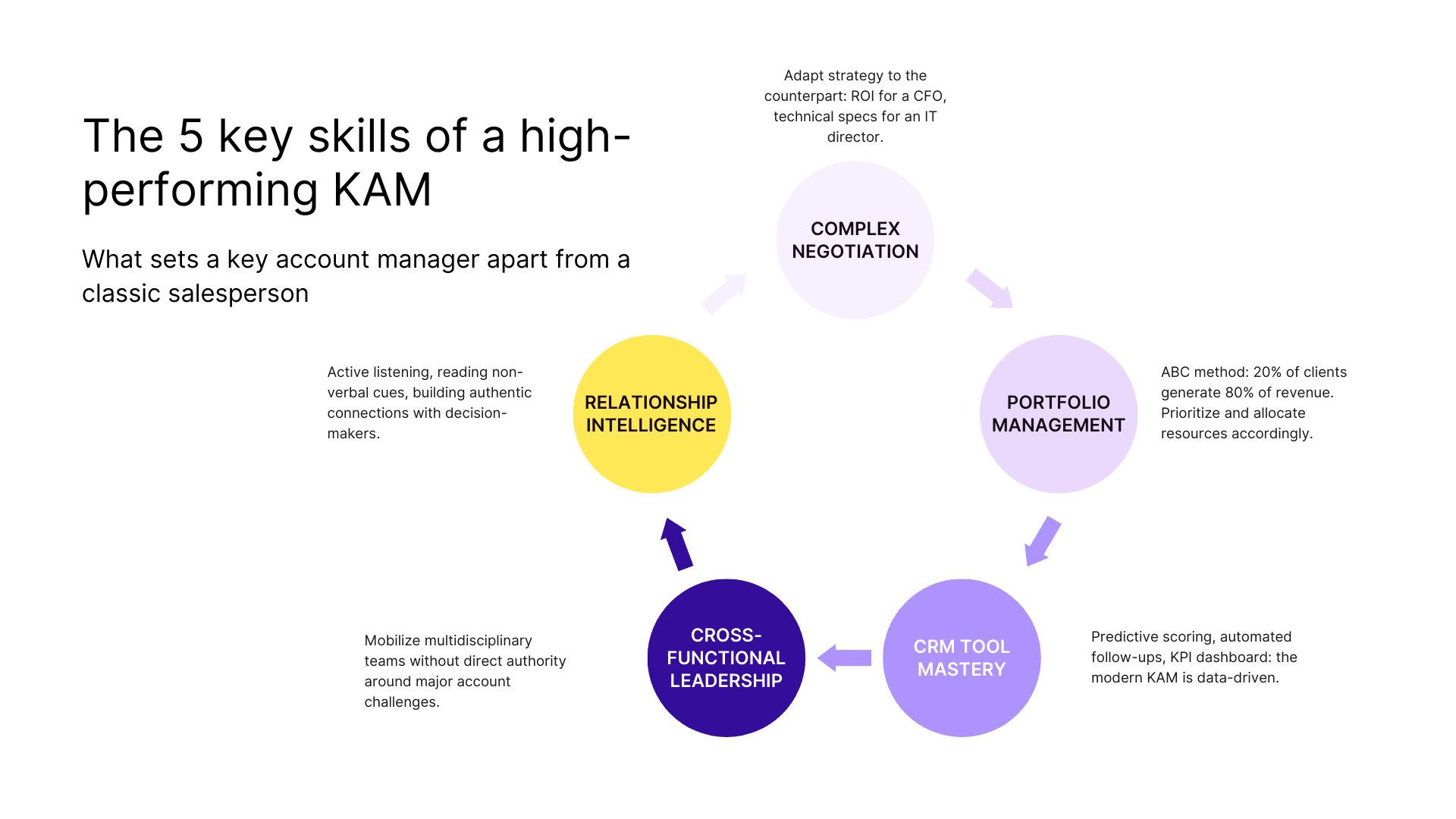
The ABC method proves particularly relevant: prioritizing 20% of clients generating 80% of revenue. This approach facilitates creating personalized action plans for each segment.
A high-performing KAM anticipates the future needs of their strategic clients. Regular analysis of sales data, combined with thorough industry monitoring, allows them to identify new growth opportunities and propose solutions adapted to market evolution.
Creating the account business plan
Creating an account business plan constitutes the fundamental step in a KAM's work. This operational document maps out the annual roadmap for each major account. An effective plan begins with precise mapping of decision-making stakeholders and their specific expectations.
The plan's success relies on defining realistic quantified objectives and planning concrete actions. For example, a KAM in the IT sector will establish a quarterly meeting calendar with different client divisions, accompanied by a detailed budget forecast.
Regular monitoring of key indicators ensures plan adaptation to market changes. Monthly updates of sales, financial, and relationship data ensure constant alignment between KAM strategies and client needs.
Managing sales teams
The KAM excels in coordinating multidisciplinary teams. Their ability to mobilize talent around major account projects determines their success. A high-performing manager knows how to identify each collaborator's skills to create effective synergies.
Team motivation comes through transparent communication of business challenges. The KAM organizes regular check-ins to share progress and highlight individual contributions. A collaborative dashboard allows everyone to visualize their participation in global objectives.
Team rituals constitute a pillar of modern management: short weekly meetings, creative brainstorming sessions, and moments celebrating successes strengthen group cohesion.
Essential skills to succeed as a KAM
Expertise in negotiation and account management
Mastering negotiation techniques represents a strategic skill for any high-performing KAM. The art of structuring complex negotiations relies on meticulous preparation: analyzing room for maneuver, identifying decision-making levers, and anticipating objections.
An experienced KAM knows how to adapt their strategy according to their counterparts' profiles. Facing a CFO, the discussion focuses on ROI and pricing conditions. For a technical director, emphasis centers on specifications and service quality.
B2B negotiation success comes through personalized arguments. For example, during a SaaS contract renewal, the KAM highlights measurable productivity gains and feature evolution to justify their commercial proposal.
Mastering lead management tools
A modern key account manager relies on high-performing digital solutions to optimize their activity. Next-generation CRM platforms facilitate real-time client interaction tracking and commercial opportunity prioritization.
Administrative task automation frees valuable time for high-value activities. Lead scoring tools allow quick evaluation of each prospect's potential through predictive algorithms based on behavioral data.
Collaborative technologies transform document management: centralized commercial proposals, version tracking, electronic signatures. A personalized dashboard offers a panoramic view of essential KPIs to effectively manage their major accounts portfolio.
Relationship skills and leadership
The human dimension constitutes the foundation of a key account manager's success. Their ability to create authentic connections with decision-makers shapes their long-term success. An experienced KAM knows how to read between the lines, decode non-verbal cues, and adapt their communication according to their counterpart.
Modern leadership requires a collaborative rather than authoritarian approach. The best KAMs excel in the art of rallying teams around common objectives. Their emotional intelligence allows them to anticipate tensions, defuse conflicts, and maintain positive momentum.
Active listening represents a fundamental skill. A KAM must know how to ask the right questions, reformulate accurately, and demonstrate deep understanding of each stakeholder's challenges. This empathetic approach strengthens trust and consolidates strategic partnerships.
Training and career path to become a key account manager
Recommended degrees and certifications
A master's in sales management or an MBA specialized in major accounts opens doors to this strategic profession. Business schools offer programs adapted to 2026 market requirements, combining theory and practice through work-study programs.
SAMA (Strategic Account Management Association) certification brings valuable international recognition. Other programs like CKAM (Certified Key Account Manager) reinforce your credibility with recruiters.
For technical profiles, an engineering degree completed by commercial specialization creates a sought-after hybrid profile. Continuing education certifications in complex negotiation or account management also allow acquiring the profession's fundamentals.
Required professional experience
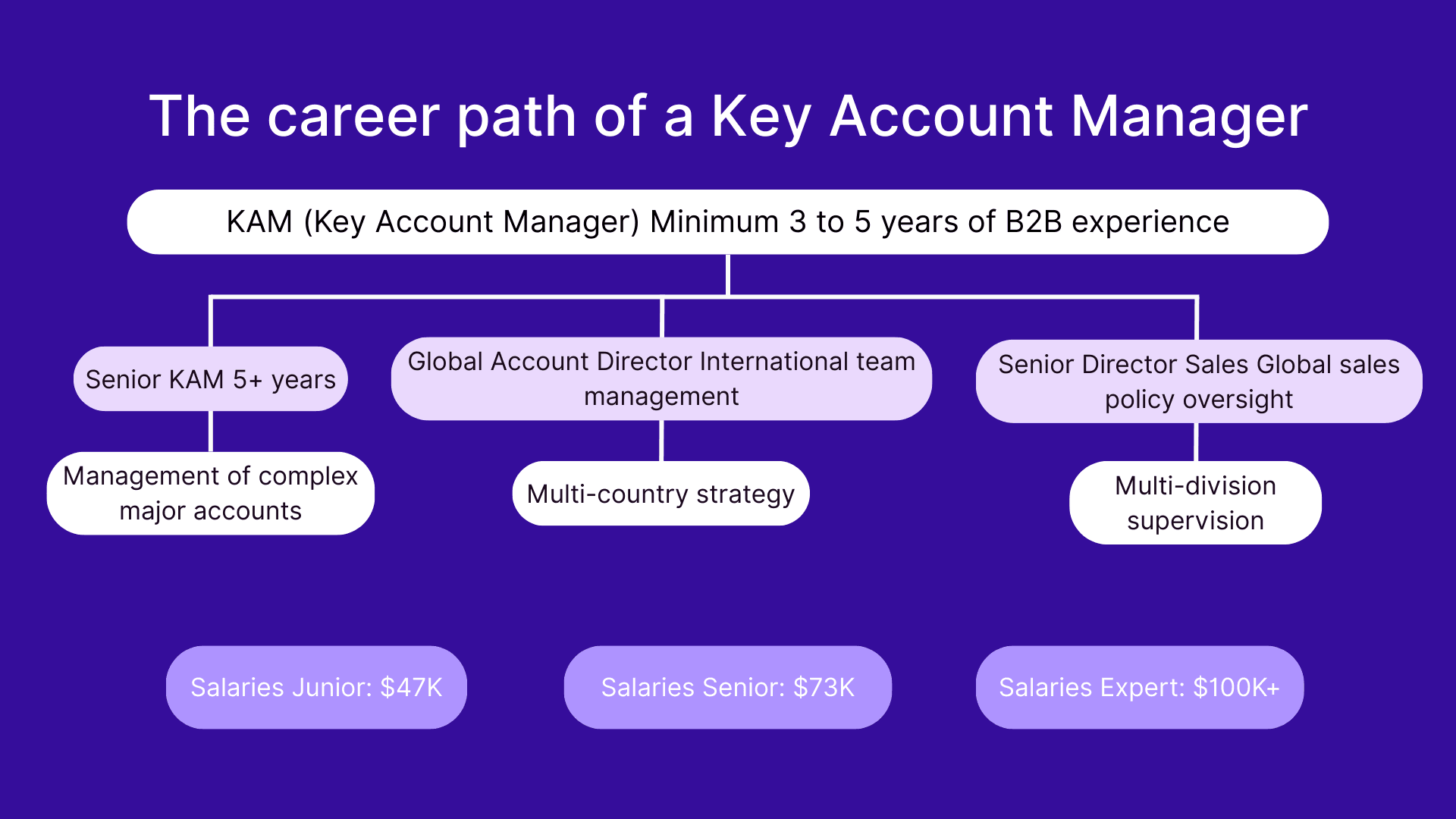
A minimum of 3 to 5 years in a B2B sales function constitutes the indispensable foundation before accessing a KAM position. Mastering complex sales cycles is acquired notably through field sales or account manager positions.
Success in this role requires dual expertise: thorough knowledge of the targeted industry sector and mastery of advanced sales techniques. For example, a KAM in the pharmaceutical industry will often have started as a medical representative before evolving toward strategic account management.
Recruiters particularly value candidates who have demonstrated their ability to manage significant client portfolios and achieve ambitious sales objectives over several consecutive years.
KAM salary and compensation in 2025
A key account manager's compensation consists of an annual base salary between $45,000 and $85,000, plus a variable portion representing 15 to 30% of total salary.
Beginners start around $47,000 gross annually. After 5 years of experience, the total package easily reaches $73,000, bonuses included.
A senior KAM with 8 years of expertise can expect a salary exceeding $100,000 per year. Technology and pharmaceutical sectors offer the most attractive compensation, particularly in major metropolitan areas where salaries are increased by 10 to 15%.
The variable compensation structure rewards performance: achieving sales objectives, portfolio development, client satisfaction.
Sectors recruiting key account managers
The KAM in the pharmaceutical industry
The pharmaceutical sector represents a privileged field of action for key account managers. The market's regulatory complexity requires dual commercial and scientific expertise. A pharma KAM manages relationships with university hospital centers, purchasing groups, and pharmacies.
The sector's digital transformation redefines the pharmaceutical KAM's missions. Managing hospital tenders now combines with health data analysis to optimize sales strategies.
Pharmaceutical laboratories seek profiles with solid scientific training, like a pharmacy doctorate or master's in biotechnology. Deep knowledge of hospital purchasing processes constitutes a major asset for succeeding in this rapidly changing sector.
Opportunities in the B2B sector
The technology and digital services market offers remarkable prospects for key account managers in 2026. The cloud solutions and cybersecurity sector experiences 15% annual growth, creating strong demand for expert sales profiles.
Renewable energies and ecological transition also generate numerous positions. A KAM in this field manages large-scale projects like solar park installation or industrial energy optimization.
The B2B banking sector seeks KAMs specialized in innovative financial services. For example, a KAM at a fintech can manage payment solution deployment across national distribution networks.
Career evolution: from KAM to senior director
A key account manager's professional advancement articulates around strategic levels. The first step leads to a senior key account manager position, generally after 5 years of successful experience managing major accounts.
The transition to global account director level marks a new dimension, with responsibility for international teams and defining sales strategies on a global scale. This position requires perfect mastery of multicultural challenges and sharp business vision.
The ultimate step toward senior director sales position demands sharp strategic management expertise. At this level, the professional orchestrates global sales policy and supervises several geographical divisions.
Frequently asked questions
What is the main daily mission of a key account manager (KAM)?
Managing and developing relationships with the company's most strategic clients (major accounts), ensuring their satisfaction and maximizing generated revenue.
What are the most important skills to succeed as a key account manager?
Excellent negotiation and long-term client relationship management abilities, sharp strategic sense, and solid communication and leadership skills.
What professional experience is generally required to access a key account manager position?
Several years of successful experience in B2B sales, often as a field salesperson or account manager, are generally necessary to evolve toward this role.