
Fundamentals of a successful government contract
The 3 main forms of government contracts
Mastering formalized procedures forms the foundation of an effective response. The open contract allows any company to apply, with a minimum 35-day deadline to submit its file.
The restricted version works in two phases: a candidate selection phase followed by an invitation to submit an offer for selected companies.
The negotiated procedure offers more flexibility. The buyer can exchange with bidders to optimize technical and financial proposals. This form particularly applies to complex markets requiring adjustments.
For amounts under $100,000, the adapted procedure gives more freedom in organization and deadlines. An interesting opportunity for small businesses starting in government contracts.
Buyers' evaluation criteria
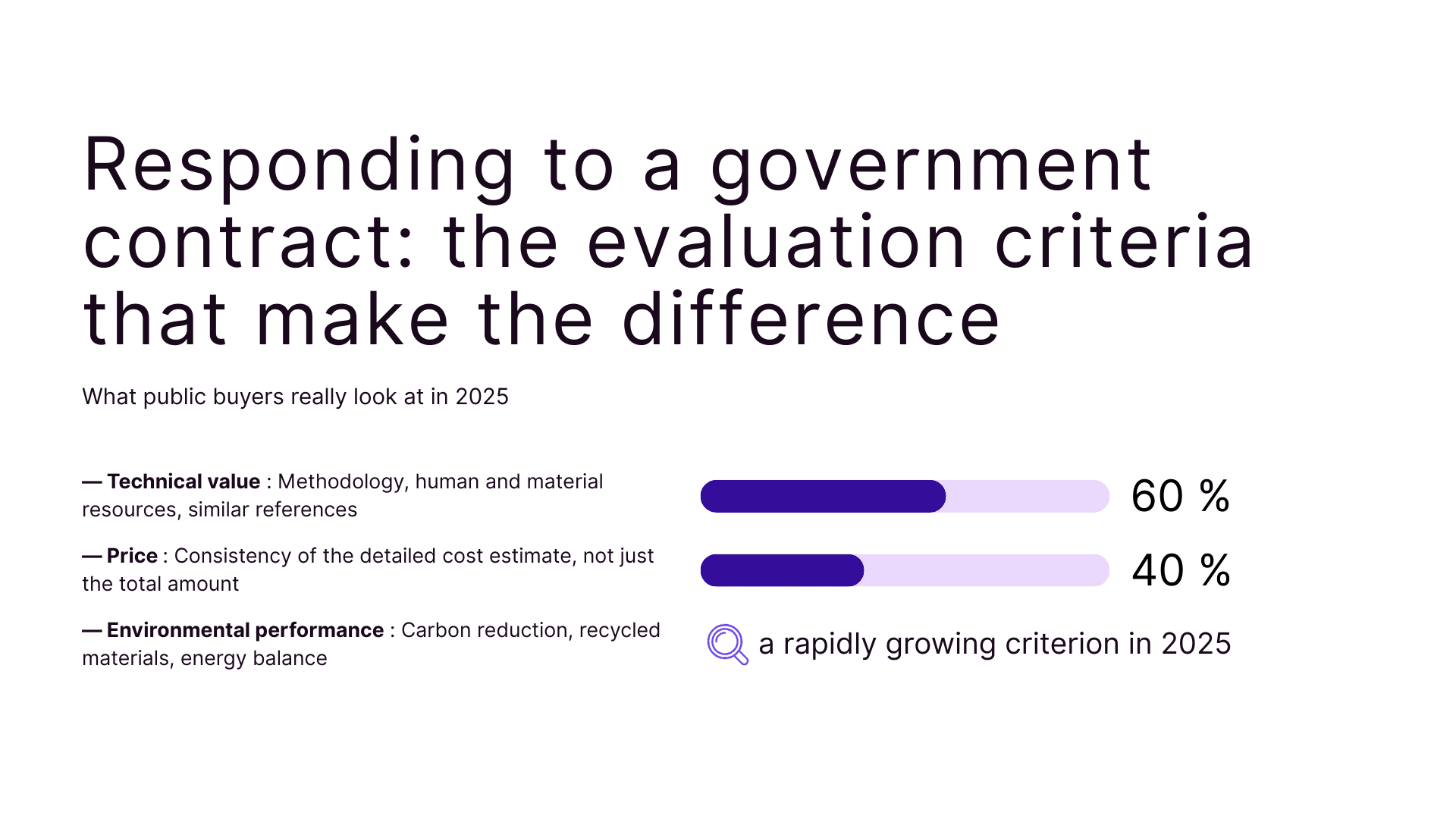
Technical value often represents 60% of the final score in proposal evaluation. It encompasses the proposed methodology, human and material resources dedicated to the project.
Price generally accounts for 40% of the scoring. The buyer examines not only the total amount but also the consistency of the detailed quantitative estimate.
Environmental performance takes on growing importance in 2026. Carbon emission reduction, use of recycled materials, or energy balance become major assets.
Each criterion breaks down into precise sub-criteria:
- Project team quality and similar references
- Implementation schedule relevance
- Risk management and proposed solutions
- CSR approach and innovation
The lifecycle of a winning response
Success in a government contract relies on perfect mastery of each phase of the process. The starting point begins with thorough analysis of the specifications, followed by precise evaluation of necessary resources.
The design phase mobilizes your teams around a relevant technical proposal. An external perspective helps refine your response and challenge your arguments before final validation.
The last step, the submission phase, requires particular attention to deadlines and requested formats. Submitting 48 hours early guarantees smooth transmission of your file.
To optimize your chances, focus on polished presentation and clear argumentation. Your technical proposal must reflect your understanding of the stakes and showcase your industry expertise.
Setting up effective monitoring
Using government portals and specialized platforms
Government procurement portals represent the essential official source for accessing national public contracts. Their personalized alert systems allow you to automatically receive announcements matching your search criteria.
Creating a free account on these portals provides access to advanced features like saving favorite searches and configuring daily email alerts. A valuable asset to not miss any opportunity in your sector.
Specialized platforms like GovWin or BidNet effectively complement this monitoring by centralizing government contracts from multiple sources. Their powerful search engines facilitate filtering by industry, geographic area, or estimated amount.
Optimizing your opportunity search
The success of a monitoring strategy relies on structured methodology. Start by defining your precise criteria: industry, geographic area, minimum and maximum amounts of targeted contracts.
Adopt a proactive approach by consulting local government investment programs. These documents reveal future projects before their official publication.
Maximize your prospecting efficiency with these proven techniques:
- Market trend analysis by quarter
- Mapping recurring buyers in your field
- Tracking renewals of existing contracts
- Monitoring territorial development projects
A weekly dashboard allows you to centralize this strategic information and anticipate future business opportunities.
Analyzing competition and market
Success in a government contract requires fine understanding of your rivals. Start by establishing detailed mapping of players by identifying their references, certifications, and strategic partnerships.
Leverage published award notices to decipher your competitors' winning strategies. These documents reveal valuable information about their strengths and added values recognized by public buyers.
Adopt a systematic approach in studying competing offers: practiced prices, proposed deadlines, highlighted technological innovations. This comparative analysis allows you to adjust your positioning and build a differentiating proposition that meets the specific objectives of the targeted market.
Preparing an unbeatable response strategy
Evaluating your capacity to respond
Objective evaluation of your resources determines your ability to win a contract. A self-diagnostic grid allows you to quickly measure your potential on precise criteria: available human resources, technical expertise, financial solidity, and logistical capacity.
Success relies on realistic estimation of time needed to build a quality file. A detailed provisional calendar helps you anticipate workload and mobilize the right skills at the right time.
Also measure your mastery of key processes: document management, electronic signature, administrative compliance. A trial run on a similar government contract reveals your strengths and improvement areas.
Building a high-performing project team
Strategic role distribution represents the key to a winning project team. The project manager must identify necessary complementary skills: technical expertise, legal mastery, and commercial vision.
A technical-commercial pair ensures a balanced response to the government contract. The technical expert guarantees relevance of proposed solutions, while the commercial adapts the message to client expectations.
Mobilizing an external proofreader brings fresh perspective to your proposal. This person, detached from the project, spots inconsistencies and validates message clarity. A proven practice: organize a kickoff meeting from the start to align the entire team on objectives and timeline.
Establishing an optimal implementation schedule
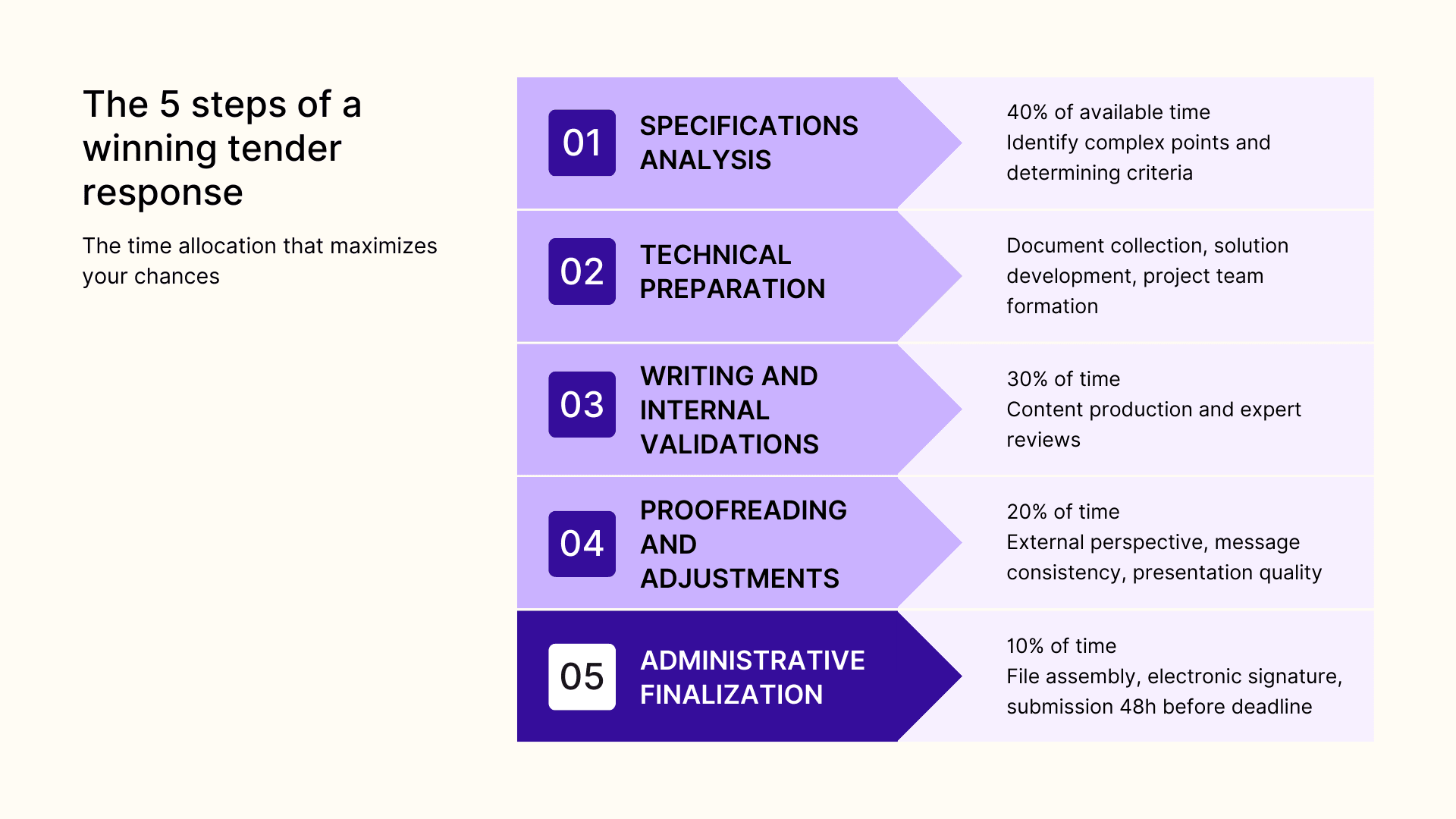
Precise chronological breakdown maximizes your chances of success. Start by reserving 40% of available time for thorough analysis of specifications and preparation of technical elements.
Then distribute remaining time according to this proven structure: 30% for writing and internal validations, 20% for proofreading and adjustments, 10% for administrative finalization. This safety margin protects against unforeseen issues.
Adopt a methodical approach with these key phases:
- Preliminary analysis: file study and identification of complex points
- Technical preparation: document collection and solution development
- Writing and validation: content production and expert verifications
- Finalization: file assembly and final quality control
Writing a convincing technical proposal
Structure and key points to develop
Clear and relevant architecture represents the foundation of a successful technical proposal. The document must be structured around specific needs expressed by the public buyer.
Start with a summary demonstrating your understanding of the contract. Follow with presentation of material and human resources adapted to project constraints. Then detail your implementation process, emphasizing quality guarantees and deadline compliance.
The technical section deserves particular attention. Highlight your certifications and similar references that prove your subject mastery. Don't forget to address potential risk management and your solutions to anticipate them.
Examples of successful technical proposals
A technical proposal model that has proven itself presents a user-centered approach. For example, a digital services company won a major contract by precisely detailing its stakeholder support process.
Success of a technical proposal also relies on concrete demonstration of skills. A construction sector SME landed a contract by presenting a detailed action plan, including photos of similar achievements and client testimonials.
Another exemplary case shows the importance of transparent trust relationships: a maintenance company convinced through a personalized dashboard, allowing the client to track service progress in real time.
Mistakes to avoid in writing
The submission deadline approaches and pressure mounts? Stay calm. A fatal error consists of recycling an old technical proposal without adapting it to the new contract's specificities.
Another formidable trap lies in overloading technical information unrelated to needs expressed in the consultation file. Instead, prioritize a targeted response that demonstrates your understanding of essential elements.
Visual presentation also deserves your attention. A poorly formatted document riddled with spelling errors instantly compromises your professional credibility. Remember to have your proposal reviewed by an outside eye before final decision.
Also avoid unrealistic promises or vague commitments. Public buyers prefer a pragmatic approach based on concrete and measurable examples.
Mastering digital response
Essential tools for submission
Success of a digital submission relies on suitable technical equipment. An electronic signature certificate compliant with eIDAS standards represents the first necessity to authenticate your documents.
Using professional PDF software guarantees your files' compliance with platform requirements. A second screen greatly facilitates navigation between different documents during the submission phase.
A stable and high-performing internet connection proves essential for downloading large files. Installing updated antivirus protects your sensitive data during exchanges with digitalization platforms.
Securing your electronic submission
Advance preparation of electronic submission minimizes failure risks. Perform a trial run 48 hours before deadline to validate your files' compatibility with the platform.
Systematically create a backup copy on physical support, clearly identified with "BACKUP COPY" mention and contract references. This precaution protects you against potential technical issues.
Keep submission proofs provided by the platform, notably the time-stamped acknowledgment of receipt. A dedicated digital archive folder will facilitate their consultation when needed.
Prioritize wired connection and close bandwidth-consuming applications during file transfer. This practice considerably reduces submission interruption risks.
Strategies for young companies
Highlighting strengths despite lack of experience
Lack of experience shouldn't hinder your response to government contracts. Highlighting your distinctive qualities can compensate for absence of track record. Your agility, mastery of new technologies, or innovation capacity constitute compelling arguments.
Showcase your degrees, certifications, and recent training. These elements prove your updated technical expertise. A telling example: a digital startup won its first public contract by demonstrating sharp mastery of latest technological advances.
Focus on transparency regarding your entrepreneurial youth. Transform it into strength by emphasizing your motivation, adaptability, and fresh perspective on sector issues. Build on individual experiences of your collaborators in their previous positions.
Opting for joint ventures or subcontracting
Strategic collaboration represents a key opportunity for young structures. Joint ventures allow equitable partnership where each company brings its specific strengths to the project. A concrete example: a digital startup partners with an experienced company to combine technological innovation and solid references.
Subcontracting offers a different approach. A new company can start by executing part of services under an established holder's responsibility. This formula facilitates progressive reference acquisition while limiting risks.
The choice between these two options depends on your current resources and objectives. Prioritize joint ventures for equal positioning, or subcontracting for progressive skill building.
Keys to post-submission follow-up
Analyzing feedback from lost contracts
Transforming failure into learning opportunity begins with methodical analysis of feedback. Systematically request detailed debriefing from the public buyer to understand your proposal's weak points.
Create a standardized evaluation grid that compares your technical score, prices, and deadlines with those of the selected candidate. This objective approach reveals your improvement margins and guides your future responses.
A telling example: an IT sector SME increased its success rate by 30% by adapting its methodology after each negative feedback. The key? An analysis matrix documenting gaps between its proposal and the winner's on determining criteria.
Building on successes to progress
Transforming victory into lasting competitive advantage requires structured approach. Minutely document determining elements of each won contract: winning argument, accepted price level, mobilized team.
Create a digital library of victorious proposals, classified by contract type and activity sector. This knowledge base will serve as reference for your future submissions. A revealing example: a digital services company reduced its response time by 40% by building on its previous successes.
Share good practices identified during your winning presentations with the entire sales team. Organize feedback sessions to spread these valuable lessons and strengthen your collective expertise.
Optimizing your success rate
Performance indicators to monitor
Regular measurement of strategic metrics guides your future decisions. Focus on preliminary qualification ratio: number of selected government contracts versus analyzed opportunities. A performing company maintains this ratio above 75%.
Average response preparation time reveals your operational efficiency. Precise monitoring allows identifying bottlenecks and optimizing your process. The sector average sits around 12 working days.
Also measure commercial return on investment: amount of won contracts divided by mobilized resources. This data, coupled with average obtained technical score, offers clear vision of your price-quality positioning in the market.
Best practices of winning companies
Companies that excel in government contracts share a culture of continuous improvement. They organize weekly collective analysis sessions of proposals, allowing them to refine their commercial and technical arguments.
Process standardization plays a determining role. Sector champions create personalized document templates and establish rigorous validation protocols at each key response step.
A differentiating factor lies in their client relationship approach. These organizations maintain regular contact with public buyers, even outside competitive periods. This proactive approach allows them to better understand emerging needs and anticipate future consultations.
Frequently asked questions
What's the most frequent mistake that makes a company lose a government contract?
Often, it's lack of customization. A standard response that doesn't correspond specifically and point by point to the specifications is quickly eliminated.
How can a young company lacking references hope to win a government contract?
By highlighting its agility, innovation, collaborators' expertise, or by partnering in joint ventures with a more experienced company.
Is price always the most important criterion to be chosen and win a government contract?
No, not always. The selected offer is the "most economically advantageous offer," which considers technical quality, deadline, and value criteria, not just price.